
Battleship Control Vans and Sensor Downlinks
The primary targeting run failed the instant the C-band command carrier dropped out. The steerable directional antenna slewed blind against its mechanical stops. Inside the portable tactical operations shelter bolted onto the fantail of USS Wisconsin BB-64, warning strobes pulsed amber across the avionics racks. Five technicians fought the sudden telemetry failure. Salt crusted the external seals of the environmental control unit. The unit had seized twenty minutes earlier. Ambient cabin temperatures pushed past one hundred and five degrees Fahrenheit. Radiomen breathed recycled air thick with burning solder and sweat. Heat exhaustion stripped away fine motor control. Hands slipped across the manual tracking joysticks. Composite flight instruments on the control console drifted into uncommanded rolls.
The bird drifted unguided toward the Iraqi coastline.
A close review of operational logs indicates this sudden system crash caught the tactical action officer mid-stride through an unacknowledged intelligence cable. The dispatch was dated 0415Z on 27 February 1991. The intercepted dispatch placed dug-in Iraqi infantry elements and coastal defense gun emplacements across a three-kilometer defensive band. Silkworm anti-ship missile revetments were centered precisely at 29 degrees 26 minutes North and 48 degrees 20 minutes East. This was the southern perimeter of Faylaka Island. Central Command Air Forces desk officers in Riyadh had locked Wisconsin out of direct artillery clearance. These officers demanded naval gunfire liaison officers clear the surrounding airspace through the automated Air Tasking Order cycle. The battleship could not direct its sixteen-inch guns. CENTAF staff insisted the Pioneer drone entered an active strike package flight corridor. Urgent reports from the ship were ignored. Iraqi engineering units were actively burying mobile radar vehicles into prepared sand berms. Naval gunners watched targets move on paper. Bureaucratic rubber stamps delayed every firing solution.
Command paralysis cost twenty-two minutes of target acquisition time.
When examining the historical record, the technical bottleneck centered on the Pioneer C-band analog downlink. This feed had to be maintained under strict Emission Control conditions. These conditions barred the radiomen from transmitting active radar interrogations to relocate the craft. Technicians squinted through flickering low-resolution black-and-white cathode ray tubes. The uncooled forward-looking infrared camera fed erratic scan lines back across the water. Wisconsin operated under enforced radio silence to mask its firing position from Iraqi electronic warfare stations on the Kuwaiti mainland. The detachment could not use broad-spectrum radio checks to verify signal continuity. The payload operator rode the fine-frequency tuning knobs manually. He filtered out rolling raster static to pick out heat blooms. These blooms were generated by Soviet-built T-55 tank engines buried up to their turrets in coral sand. Thermal drift blurred the visual display. The unguided aircraft banked against the thermals rising off the Persian Gulf. Heavily fortified bunkers reduced to featureless gray smudges.
Archival evidence shows the telemetry link re-engaged only after technicians manually bypassed the failed automatic antenna tracker. They used a jury-rigged coax patch cable run through an open doghouse hatch.
The crew of VC-6 Detachment 2 forced the analog feed back onto the main display. The aircraft stabilized at twelve hundred feet above the surf line. Infrared sensors resolved concrete trench networks and wire obstacles. Two towed D-20 152mm howitzers sat concealed beneath camouflaged netting at grid coordinate 29 degrees 26 minutes 18 seconds North and 48 degrees 21 minutes 04 seconds East. No active counter-battery radar emissions followed the video recovery. Iraqi operators were unaware of the overhead surveillance.
Marine Tactical Deployments and Coastal Littoral Targeting
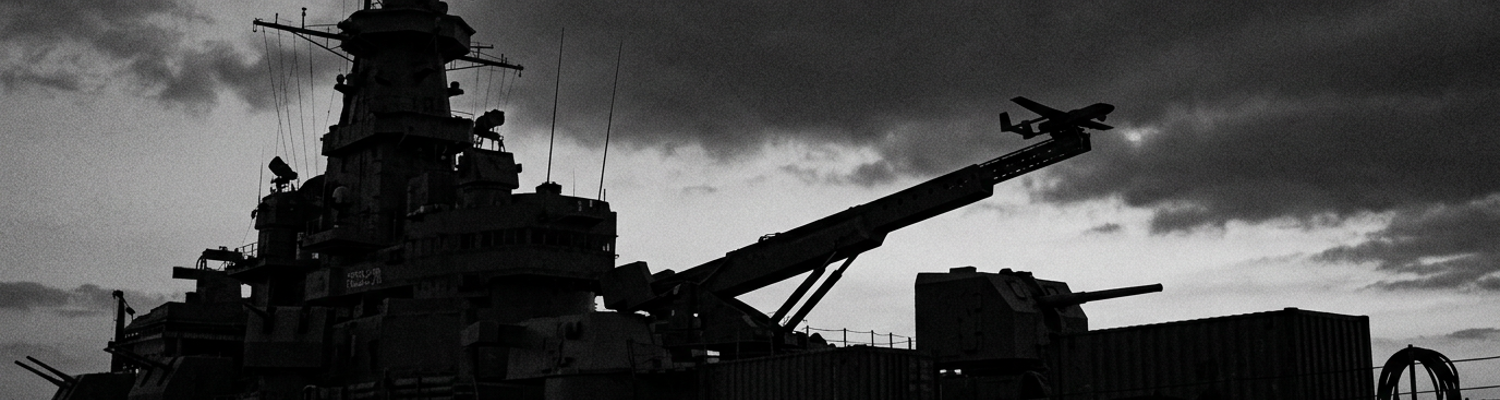
Archival evidence shows getting the RQ-2 Pioneer airborne required igniting a two-second solid-fuel rocket assist motor directly over the teak deck. Technicians on the fantail locked the 430-pound airframe onto a steel launch rail. The rail was inclined at twenty-two degrees. They bolted the blast deflection apron over the starboard quarter. Flight crews routed ignition cables to an external firing box. Sulfur residue from earlier launches coated the launch rail guides. The fire switch tripped. The Mk 125 solid rocket booster generated three thousand pounds of thrust. The drone slammed off the rail at seventy-five knots. It dropped into the ship wake. Wisconsin shuddered as the Sachs two-stroke engine engaged at 3500 revolutions per minute. The air smelled of burned synthetic two-cycle oil and salt spray. The drone flew at eighty knots across the northern Persian Gulf. It banked toward the Kuwaiti littoral. The assigned search altitude was two thousand feet. Sensor operators angled the nose-mounted television camera toward Kuwaiti sandbars at Ras al-Qulayah. They hunted for the geometric scarring of revetted Iraqi D-30 batteries and Silkworm launch rails.
Solid-propellant exhaust melted the protective deck coating down to raw steel.
When examining the historical record, integrating Marine 1st Remotely Piloted Vehicle Company operators with naval gunfire liaison officers produced immediate friction. The workspaces were cramped. Three Marine enlisted drone pilots squeezed alongside Navy spotters inside the aft control spaces. These Marines were reassigned from Subunit 1 at Camp Lejeune. Marines tracked targets using the Universal Transverse Mercator grid system. They plotted ten-digit coordinates with grease pencils on acetate map overlays. The Navy liaison team rejected these coordinates outright. They demanded target locations expressed strictly in true bearing and distance from the fluctuating surface position of the battleship. This procedural split stalled targeting workflows for up to twelve minutes per fire mission. Inter-service radio traffic clogged internal voice nets. Marine payload operators identified towed artillery pieces. Navy junior officers cross-referenced target cards against regional CENTAF no-fire zones. The two branches operated under conflicting doctrine. Marines prioritized fast destructive suppression to protect ground troops advancing along the coast. Naval gunfire officers refused to pass firing solutions without written target confirmation from Riyadh.
Joint operations dissolved into manual coordinate conversions scribbled on damp legal pads.
A close review of operational logs indicates routing the Pioneer through the gun target line required complex geometry inside the main battery plot. Deep below the armor belt, technicians operated the Ford Instrument Company Mk 1A analog ballistic computer. This mechanical computer used a complex arrangement of gears and differentials to calculate firing solutions. Operators input variables including wind speed, barometric pressure, powder temperature, and the rotation of the earth. The computer continuously updated the elevation and train angles for the 16-inch guns. Technicians tracked the Pioneer telemetry link while synchronizing calculations for the nine 16-inch 50-caliber Mark 7 guns. A single 1900-pound high-capacity shell reached an apogee of thirty-six thousand feet during a twenty-mile trajectory. This created an airborne fragmentation cone capable of destroying the fragile fiberglass drone mid-flight. Plotting officers forced the Marine operators to hold the Pioneer in a three-kilometer racetrack pattern. This pattern was offset six degrees west of the fall of shot. Video telemetry flickered as the drone swung through its turns. Iraqi gun crews scrambled into concrete trenches at grid 29 degrees 27 minutes 40 seconds North and 48 degrees 18 minutes 55 seconds East. Watch officers counted off the sixty-two-second time of flight over sound-powered phone circuits. They watched the infrared lens for the initial sand plume of the spotting rounds. The first shell detonated eighty yards long. Wet sand scattered across an abandoned radar van.
Deflection errors were corrected by eight mils right before the second salvo fired.
Air Tasking Order Conflicts and Airspace Deconfliction
A close review of operational logs indicates the friction originated deep within the basement of the Royal Saudi Air Force headquarters in Riyadh. Ninth Air Force CENTAF planners enforced a rigid forty-eight-hour Air Tasking Order cycle. Every fixed-wing sortie across the theater had to be tabulated inside the Computer Assisted Force Management System. Strike packages and electronic surveillance tracks required entry forty-eight hours before engine start. The software ran on mainframe hardware in Riyadh. Data entry clerks manually typed thousands of coordinates into green-screen terminals. The software compiled these inputs into a master flight schedule. This schedule dictated the movement of every coalition aircraft from the Red Sea to the Persian Gulf. This software generated daily flight documents exceeding eight hundred pages. Staff officers printed these on tractor-feed paper. They physically flew the documents to Persian Gulf aircraft carriers via S-3 Viking transport flights. Shipboard communications could not ingest the data volume. For the radiomen aboard Wisconsin, the scheduling mechanism proved unworkable. Tactical conditions off Faylaka Island changed by the minute. The ATO treated the northern Gulf littoral as a static grid planned two days in advance. A fire mission requested at 0500Z on 27 February faced an air plan drafted before dawn on 25 February.
Paperwork in Riyadh dictated the guns of the fleet.
Archival evidence shows this scheduling gap repeatedly grounded tactical sorties. Iraqi ground forces fortified their positions along the island. CENTAF air planners routinely refused to carve out Airspace Coordination Areas for the slow-moving drone over the northern Persian Gulf. They classified the unarmed fiberglass aircraft as an uncoordinated hazard to incoming strike corridors. The cruising speed was barely eighty knots. The drone had no onboard Mode 4 Identification Friend or Foe transponder compatible with Air Force tactical air control radars. The RQ-2 appeared on E-3A Sentry screens as an unidentified slow-moving track. E-3 controllers routinely vector-checked the craft. They ordered flight crews to terminate launches. At 0615Z, VC-6 Detachment 2 spun up the Sachs two-stroke engine on the fantail rail. They intended to inspect suspected Silkworm positions at 29 degrees 25 minutes 50 seconds North and 48 degrees 19 minutes 10 seconds East. Riyadh controllers denied airspace entry. An inbound package of twelve Coalition strike aircraft was transiting the littoral at four thousand feet. Wisconsin was ordered to kill the engine and stow the booster. The drone was stranded on its launcher for another ninety minutes. Iraqi trucks moved unmolested across the southern spit of Faylaka.
Unarmed spotter drones yielded priority to empty transit corridors.
When examining the historical record, the institutional discord peaked inside the Combat Engagement Center. Naval gunfire support teams clashed with Riyadh desk officers over fire mission clearances. Naval gunfire liaison officers demanded immediate access to the coastal perimeter. They argued the high-capacity shells could neutralize Iraqi coastal batteries before enemy gunners found the range of minesweepers operating in the channel. Air Force desk officers in the Tactical Air Control Center flatly rejected these requests. Artillery parabolas reaching thirty-six thousand feet crossed the assigned holding patterns of Navy A-6Es and Air Force F-16s patrolling the coastline. Air planners demanded Wisconsin submit formal target modification requests through standard ATO adjustment channels. This administrative process required hours to clear review boards. Radiomen patched high-frequency voice circuits between Wisconsin and Riyadh. They listened to arguments deteriorate into procedural threats. Shipboard plotting officers held cocked firing circuits on loaded sixteen-inch barrels. Spotters had visual tracking on Iraqi artillery emplacements at grid 29 degrees 26 minutes 35 seconds North and 48 degrees 20 minutes 45 seconds East. The guns sat idle.
Riyadh withheld authorization until the target coordinates were manually confirmed by a second airborne observer at 0740Z.
Naval Gunfire Support and Shoreline Bombardment
Deep mechanical ignition triggered nine tons of high explosive over the northern Gulf.
Archival evidence shows Turret One and Turret Two trained their long barrels to a bearing of 012 degrees at 0802Z. They aimed across eighteen nautical miles of open water. The target was an entrenched Iraqi battalion headquarters and D-30 artillery battery complex located at 29 degrees 27 minutes 15 seconds North and 48 degrees 19 minutes 40 seconds East. Deep in the magazines thirty feet beneath the waterline, gunners rolled 1900-pound Mark 13 high-capacity explosive shells onto mechanical hoists. These sat alongside six-bag propellant stacks of smokeless powder. The electric firing foot pedals depressed in the plotting room. The expansion of 660 pounds of nitrocellulose flashed white against the gray water. Wisconsin was thrown four feet laterally to port. Each 16-inch shell reached supersonic velocity inside the rifling. The shells traveled on a forty-five-second ballistic arc toward the limestone flats of Faylaka Island. Upon impact, the high-capacity rounds penetrated three meters of compacted sand berms and reinforced trenchworks. The base-detonating fuzes initiated. The resulting pressure wave obliterated two concrete revetments sheltering 122mm howitzers. Reinforced sand parapets turned into high-velocity shrapnel. Shockwaves rippled through subterranean bunker complexes.
Steel fragmentation stripped every antenna across a four-hundred-yard radius.
A close review of operational logs indicates the RQ-2 Pioneer tracked the fall of shot through a heavy layer of salt haze and particulate drift. The drone circulated at eighteen hundred feet along the southern coast of Faylaka. The steerable nose turret toggled between an uncooled infrared thermal imager and a daylight television sensor. It fed continuous analog video back to the battleship. Signal degradation corrupted the feed every time the primary battery discharged. Shockwaves from the muzzle blast warped the external coax junctions outside the control shelter. This caused horizontal raster snow and sync-pulse dropouts across the nine-inch display tubes. Payload operators worked the manual gain and level potentiometers with trembling fingers. They maintained thermal lock on the target coordinates. Through intermittent tearing in the scan lines, the forward-looking infrared camera registered sudden heat spikes exceeding eight hundred degrees Fahrenheit. Subterranean fuel caches and ammunition lockers detonated beneath the shattered artillery pits. The payload operator marked three primary revetments completely collapsed. Two secondary gun positions were obscured by billowing black smoke drifting south over the Persian Gulf.
Twelve consecutive sorties over forty-eight hours destroyed the depth perception of the watch team.
When examining the historical record, the physical toll on the personnel inside the fantail van reached hazardous levels during these continuous bombardment runs. Inside the unventilated control shelter, three enlisted drone operators from Fleet Composite Squadron Six and two embedded Navy combat camera photographers had spent fourteen consecutive hours in absolute darkness. They were illuminated only by the amber light of cathode-ray flight instruments and oscilloscope vectors. Severe sleep deprivation degraded basic motor reflexes. Operators experienced micro-sleep lapses while holding Pioneer within its tight racetrack orbit. Ambient temperatures had breached one hundred and seven degrees following the auxiliary blower electrical burnout. Uniforms were soaked through with foul sweat and toxic salt rings. Photographers tasked with capturing high-resolution still frames of the television monitor faced blinding retinal fatigue. Their eyes stung from sweat and ozone. They squinted through manual viewfinders at unstable lines of video resolution. Muscle spasms locked the hands of the payload controller. He had to manually steady the gimbal joystick against heavy crosswinds off Faylaka. He ignored the concussive percussion of the battleship guns striking the aluminum skin of the van.
The watch log recorded thirty-eight rounds expended and four unconfirmed secondary detonations at 0914Z.
Combat Camera Recordings and the Faylaka Island Surrender
Archival evidence shows visual documentation specialists from Fleet Combat Camera Group Atlantic crammed into the rear corner of the fantail control shelter. They documented the reconnaissance mission. Two Navy photographers worked beneath low-intensity red dashboard lights in ambient temperatures exceeding one hundred and five degrees. They operated portable three-quarter-inch U-matic videocassette recorders. These were wired directly into the auxiliary video distribution amplifier of the Pioneer. The three-quarter-inch U-matic videocassette recorders were bulky and sensitive to vibration. The recording heads spun at high speeds to capture the analog video signal on magnetic tape. The tape formulation was prone to dropouts under extreme heat. The Navy photographers had to clean the recording heads with isopropyl alcohol every two hours. The ambient dust and salt air threatened to foul the delicate mechanisms. The video distribution amplifier split the incoming signal from the Pioneer receiver. One feed went to the payload operator display. The other feed went to the U-matic recorders. This setup ensured a permanent physical record of the reconnaissance mission. Magnetic tape spooled past recording heads. The specialists captured continuous analog scan lines from the nine-inch cathode ray tube monitors. Technicians constantly adjusted manual tracking pots and horizontal hold knobs. They adjusted gain levels to prevent scan lines from tearing under electrical spikes generated by primary battery discharges. Handheld Nikon 35mm cameras loaded with high-speed black-and-white film sat ready on top of aluminum transit cases. Their lenses were positioned inches away from the curved phosphor glass. They captured freeze-frame damage assessments between sixteen-inch salvos. Photographers cataloged running time codes and flight bearings onto grease-penciled log sheets. They preserved a physical record of the target grid.
Magnetic tape captured every frame of raster static.
When examining the historical record, the descent of the drone over the southern trench network triggered an immediate tactical shift on the ground. At 0920Z, operators from VC-6 Detachment 2 pushed the RQ-2 Pioneer down to an altitude of roughly five hundred feet. They banked the aircraft tightly over heavily damaged bunkers at grid 29 degrees 26 minutes 50 seconds North and 48 degrees 20 minutes 15 seconds East. They assessed naval gunfire damage. Mechanical buzzing from the two-stroke two-cylinder engine carried across the flat coastal sand. This signaled the presence of an overhead spotter to the Iraqi garrison. Dozens of Iraqi infantrymen experienced hours of concussive shockwaves from Mark 13 high-capacity shells. They scrambled out of reinforced concrete trenches and sandbagged revetments. Soldiers refused to man their operational anti-aircraft machine guns. The troops ran into open terrain. They faced directly toward the circling airframe. Entrenched personnel waved makeshift white flags. They waved unbuttoned undershirts and shredded cloth rags over their heads. Payload operators locked the steerable optical turret onto the figures. They zoomed the lens to confirm the soldiers were signaling deliberate surrender directly to the aircraft.
Men stood exposed in the sand.
They waved white fabric at an empty cockpit.
A close review of operational logs indicates this encounter marked the first recorded surrender of ground combat forces to an unmanned aerial vehicle in military history. Flight crews aboard Wisconsin kept the Pioneer in a tight low-altitude orbit directly above the Iraqi positions. They used the physical presence of the circling aircraft to hold the garrison in place without expending additional high-explosive ordnance. Inside the fantail shelter, the watch officer transmitted urgent contact reports to Central Command naval planners. He confirmed enemy troops refused to return to defensive bunkers while the aircraft remained airborne. Coalition commanders diverted approaching United States Marine amphibious forces toward Faylaka. They accepted the capitulation and secured the prisoners. The specific Pioneer airframe responsible for the mission was designated Air Vehicle 159. It completed the deployment without sustaining small-arms damage. Naval authorities subsequently transferred the aircraft to the Smithsonian Institution. It was accessioned into the National Air and Space Museum.
Wisconsin logged mission termination and recovered the drone into the fantail net at 1004Z.