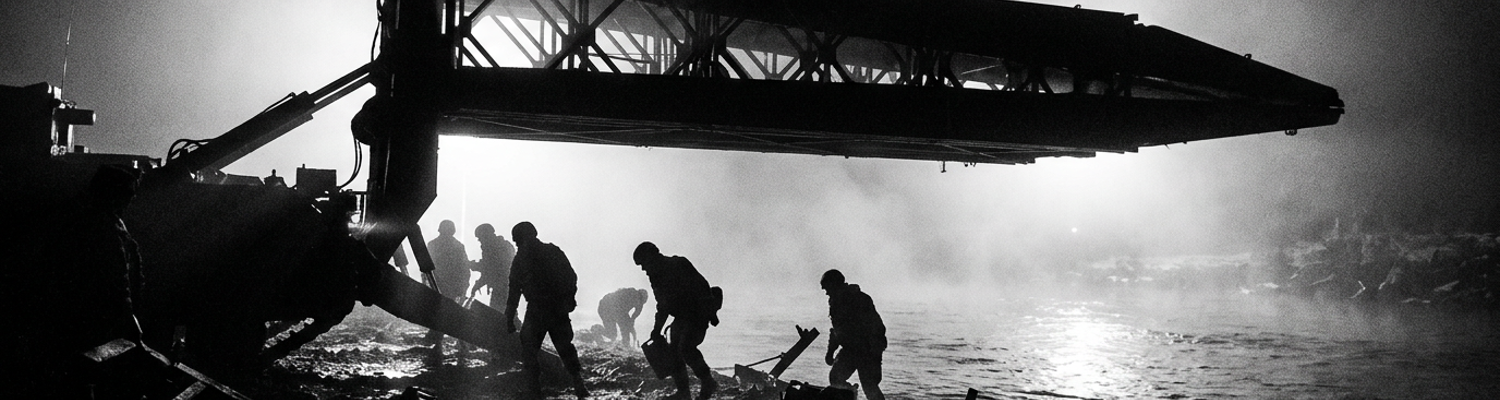

Post-Mortem Analysis of the Drinjaca River Crossing
Six hundred rounds of 120-millimeter M829A1 depleted uranium armor-piercing fin-stabilized discarding sabot ammunition. Two thousand TOW-2B wire-guided anti-tank missiles stacked in tactical transport racks. Forty-four M1A1 Abrams main battle tanks. Forty-four M2A2 Bradley fighting vehicles. Sixteen M109A6 Paladin 155-millimeter self-propelled howitzers loaded with dual-purpose improved conventional munitions.
This armored spearhead of Task Force Eagle entered northern Bosnia in late December 1995.
They crossed into the theater with full basic combat loads.
Tracked armor stops completely when the bridges fail.
Archival evidence shows the exact physical cost of the crossing attempt on the northern bank of the Drinjaca River. Salvage teams cataloged the remnants of a sheared Class 60 Medium Girder Bridge (NARA Record Group 338). Load-bearing aluminum-zinc-magnesium alloy bottom panels buckled under off-center dynamic loads. The deck trusses twisted into bent metal scrap.
Fractured T158 double-pin track shoes sat half-submerged in saturated clay-silt mud several hundred yards from the riverbank.
Sheared steel guide horns and cracked suspension torsion bars from an M88A1 medium recovery vehicle littered the approach. The recovery vehicle threw its left track assembly after violent track slippage cracked the planetary final drive housing on a twenty-two-degree reverse slope.
Severed high-pressure hydraulic hoses from an M60A1 Armored Vehicle Launched Bridge coated the freezing water with fluid. Sixty feet of aluminum scissors-bridge superstructure lay pinned against the swollen riverbank. Crumpled treadway sections sank into freezing silt alongside the vehicle hull. Dropped steel cable winch lines and discarded track-tensioning grease guns marked the abandonment point.
The Drinjaca cut through the approach corridor as a fifteen-meter channel of runoff and freezing silt.
A close review of operational logs indicates that this mechanical wreckage resulted directly from command choices driven by the Dayton Peace Agreement. Task Force Eagle faced a strict 72-hour compliance window following the formal Transfer of Authority on December 20, 1995. NATO leadership demanded immediate physical occupation of transit corridors. Maj. Gen. William L. Nash ordered elements of the 130th Engineer Brigade and the 16th Engineer Battalion to push bridging assets forward along snow-covered secondary roads.
Secondary reconnaissance was skipped.
Bank soil stabilization was ignored.
Heavy equipment operators drove directly into dense river valleys during pitch-black Balkan nights. Blinding sodium halogen searchlights illuminated thick fog and freezing rain. Ground guides could not step outside narrow tire ruts. Unmarked PROM-1 bounding antipersonnel mines and PMA-3 pressure mines lined the muddy verges.
Speed superseded soil mechanics.
When examining the historical record of the bridgehead collapse, rapid soil bearing failure triggered the structural failure. Saturated riverbank silt along the Drinjaca possessed an unconfined compressive strength below forty-five kilopascals. A sixty-ton launch sequence requires ninety kilopascals of soil bearing capacity. Heavy bank-seat beams sank unevenly into the thawing sludge under the dead weight of the launch assembly.
The eastern bank-seat beam dropped twenty-four inches as the launching nose reached the far roller.
The entire modular aluminum span twisted thirty degrees along its longitudinal axis. Bottom panel pins jammed into the frozen mud at coordinate CQ 3288 8941.
PROM-1 Minefield Breaching Operations Near Srebrenica
Archival evidence shows that Task Force Eagle combat engineers encountered unmapped tactical mine belts laid along the former confrontation line northwest of Srebrenica during the final week of December 1995.
Combat engineers from Alpha Company, 16th Engineer Battalion, attached to the 1st Brigade Combat Team, breached a 400-meter-wide lane through the Zone of Separation. They needed to secure lateral bypass routes toward the Drinjaca valley. Serbian and Bosniak forces spent forty-two months seeding the rocky ridgelines and degraded asphalt verges with hundreds of PROM-1 bounding fragmentation mines.
Defensive belts combined pressure fuzes with crisscrossed low-slung steel tripwires running parallel to the frozen drainage ditches.
Clearing crews established verified cleared lanes six meters wide. Armored convoys required these lanes to maneuver off main supply routes without detonating buried munitions.
Tripwires hung four inches above frozen mud.
When examining the historical record of these breaching operations, the physical architecture of the PROM-1 presented extreme mechanical hazards to ground teams using standard manual clearance doctrine. Each PROM-1 mine contained 425 grams of cast TNT and RDX encased within an internally grooved steel body. The body was threaded to an UPMR-3 multi-purpose tilt-and-tripwire fuze.
A pull of three kilograms on an entangling tripwire freed the internal striker mechanism.
Nine kilograms of direct downward pressure on the exposed pronged pressure cap produced the exact same result.
The initial pyrotechnic delay ignited a base propellant charge. This charge blasted the mine body sixty centimeters upward out of the frozen earth into waist-height air. A short steel retaining cable snapped the internal firing pin at peak elevation. The main explosive charge detonated. Several thousand high-velocity steel fragments dispersed across a lethal radius exceeding thirty meters.
Soil conditions along the confrontation line complicated removal. Partial freezing prevented engineers from hooking tripwires with remote grappling grapnels. Hooking frozen earth clods risked premature detonation.
Sappers worked on their stomachs across the slush.
A close review of operational logs indicates that manual mine detection along the confrontation line occurred under blinding sodium halogen illumination. Heavy winter fog routinely cut horizontal sightlines to less than three yards. Combat engineers operated in two-man clearance teams. They used handheld AN/PSS-12 pulse-induction metal detectors and non-magnetic beryllium-copper probers.
Support platoons positioned five-kilowatt diesel generators on M998 utility trucks seventy yards behind the breach points. Heavy electrical cables ran forward to elevate paired 1000-watt commercial sodium halogen floodlights on folding aluminum tripods.
The intense amber and white halogen glare bounced violently off suspended water droplets. This created high-intensity backscatter. Soldiers looking forward into the fog were blinded.
Sappers crawled forward wearing thirty-pound PASGT flak vests and clear polycarbonate blast visors. Their optics continually fogged from heavy breathing in the sub-zero air. Technicians could not visually resolve the olive-drab tripwires against the reflective glare.
They swept fingers millimeter by millimeter through icy scrub brush.
They located mechanical tripwire prongs by touch before inserting safety pins into the UPMR-3 fuze housings.
The clearance detachment cleared seventy-two yards of the breach lane by midnight on December 28. They disarmed nineteen PROM-1 mines and eight PMA-3 plastic blast mines at coordinate CQ 4185 7842.
Combat Camera Documentation of the 55th Signal Company
Archival evidence shows that two-soldier documentation teams from the 55th Signal Company moved directly behind the lead sweepers of Alpha Company during the nighttime push toward the Drinjaca River crossing.
These combat visual information specialists operated on foot in the narrow four-foot clearance corridors near coordinate CQ 3290 8935. They carried Nikon N90S 35mm film SLRs and Kodak DCS 420 digital camera systems alongside standard issue M16A2 rifles.
Documenting engineer actions in sub-zero Balkan conditions required visual recording teams to run AN/PVS-7B night-vision goggles mounted to Kevlar helmets.
They attempted to aim handheld optical systems through thick fog and driving sleet.
Ambient light levels dropped below 0.001 lux in the narrow mountain cuts. Standard passive night-vision intensifier tubes suffered from severe electronic noise and scintillation. Photographers triggered modified Vivitar 285HV strobe flash units equipped with custom infrared bandpass filtration panels to capture usable exposures of sappers probing tripwires.
Bursts of 850-nanometer light pulsed across the wet snow. This prevented visible flash signatures from alerting opposing observers dug into the surrounding hillsides.
A single stray footprint outside the white engineer tape meant instant detonation.
When examining the historical record of these clearance lanes, signal personnel faced the constant hazard of disorienting the clearing sappers with sudden electronic discharges. Combat camera documentation teams coordinated every lens position with the engineer squad leaders. They crawled on their bellies through wet slush to photograph the exact mechanical configuration of unexploded ordnance. Disposal teams attached C-4 demolition blocks only after the photographs were secured.
The photographers recorded serial numbers, striker spring tensions, and physical deterioration on Serbian PROM-1 bounding mines. They documented KB-1 dual-purpose submunitions and Soviet-era PMR-2A stake-mounted fragmentation weapons.
Visual teams held lenses three inches from exposed UPMR-3 fuzes.
They used low-power red-lens anglehead flashlights to establish manual focal planes on frost-covered metal caps.
Operating in the dirt alongside the sappers exposed camera bodies to severe environmental fouling. Freezing mud gummed focal-plane shutters. Rapid temperature shifts between heated transport vehicle cabs and frozen river valleys cracked optical elements. Proprietary lithium battery packs drained in less than twenty minutes of continuous operation.
Heavy equipment snapped aluminum trusses fifty yards down the slope.
A close review of operational logs indicates that the primary tactical requirement for the 55th Signal Company was immediate structural and hazards intelligence for the Task Force Eagle engineer staff. The Class 60 Medium Girder Bridge suffered structural failure at the northern abutment. Combat camera photographers documented the mechanical points of failure across forty high-resolution monochrome and color exposures.
Specialists photographed the sheared connecting pins and warped bottom panel chords. They captured the fractured steel bank-seat pins where the 60-ton load drove the placement pads into the collapsing forty-five-kilopascal silt.
Photographic evidence captured the specific angular deflection of the launching nose rollers. This proved to V Corps technical evaluators that the bridge collapsed due to mechanical soil shearing rather than manufacturing flaws in the Fairey Hydraulics bridge components.
Visual teams recorded the exact depth of the twenty-four-inch embankment depression. They photographed calibrated folding engineer measuring sticks set against the displaced mud at coordinate CQ 3288 8941.
Field processing units loaded these digital captures directly into tactical digital information terminals at the Brigade Tactical Operations Center in Tuzla. Technical evaluators from the 130th Engineer Brigade used the high-contrast strobe photography to draft urgent structural advisories for the incoming armored columns. Standard bank-seat soil bearing calculations failed completely in frozen Balkan silt layers.
Visual dossiers of the sheared M60A1 Armored Vehicle Launched Bridge hydraulic lines and distorted scissors trusses were radioed to headquarters within six hours of the failure. This established updated bridgehead placement rules across the entire northern sector.
Combat camera files logged eighty-four individual unexploded ordnance hazards and fourteen structural equipment failures along the Drinjaca approach route between December 25 and December 29, 1995.
Armored Vehicle-Launched Bridge Mechanical and Hydraulic Failures
Archival evidence shows that two M60A1 Armored Vehicle-Launched Bridges from Bravo Company, 16th Engineer Battalion, halted on the northern descent toward the Drinjaca River at coordinate CQ 3287 8945 at 0240 hours on December 27, 1995.
Field temperatures along the riverbed dropped to minus eighteen degrees Celsius.
Standard petro-based MIL-H-6083 hydraulic fluid inside the 110-gallon reservoirs thickened into an unpumpable gel. Internal flow velocities dropped across the high-pressure manifold circuits. Crew operators engaged the engine power take-off to power the primary hydraulic pumps. They intended to elevate the sixty-foot scissors bridge into its vertical launch staging arc.
Suction line filters starved instantly.
The viscous fluid failed to feed the dual gear pumps at operating volume. Rapid cavitation initiated across the drive shafts. Hydraulic pressure inside the primary lift cylinders plummeted from a nominal rating of 3000 pounds per square inch down to barely 1100 pounds per square inch.
This sudden loss of operating pressure froze the lift mechanism when the aluminum bridge was hoisted forty degrees into the night air.
Hydraulic pumps starved within four minutes of cold engagement.
A close review of operational logs indicates that Bravo Company commanders bypassed mandatory thirty-minute hydraulic warm-up idling cycles. They needed to beat the Dayton compliance deadline expiring at dawn. Company officers ordered vehicle crews to force the launch sequence by revving the AVLB 750-horsepower Continental AVDS-1790-2DR diesel engines up to maximum governor limits.
Severe pump cavitation tore synthetic rubber seal rings inside the four-way directional control valves. Torn neoprene fragments shot directly into the spool orifices.
Pressurized lines ruptured under internal pressure spikes.
Twenty-five gallons of pink hydraulic oil spilled across the frozen engine deck and into the slush under the tracks.
Lacking pilot pressure to hold the check valves open, the sixty-foot aluminum scissors span dropped twelve inches onto the travel locks. This bound the primary bridge-actuating cylinder rod and cracked the hydraulic fluid return reservoir along an existing weld seam.
The frozen approach angle exceeded vehicle structural tolerances.
When examining the historical record of the second launch attempt at coordinate CQ 3288 8943, steep riverbank geometry destroyed the mechanical linkage of the backup AVLB chassis. Ground crews directed the vehicle down a twenty-two-degree forward riverbank gradient. This far exceeded the operator manual limit of eight and a half degrees for longitudinal slope launches.
Positioning on this bank angle placed the entire sixty-ton vehicle weight against the front road wheels. The forward torsion bars compressed. The bridge launch frame pitched twelve degrees off its centerline.
Launch technicians initiated the deployment sequence anyway. They activated the secondary scissoring cylinder while the hull rested on unstable frozen silt.
The scissoring arms pushed the sixty-foot aluminum superstructure outward over the river current. Asymmetric lateral torque exceeding 48,000 foot-pounds sheared the cast-steel left guide-arm bracket.
Shearing stresses broke the structural guide arm cleanly across its forty-millimeter mounting pin. The bridge frame released and twisted clockwise into the river channel.
Torsional twisting forces tore open the lower deck chord rivets. The scissors hinge assembly twisted forty-five degrees out of alignment before the crew could engage emergency release levers.
Falling twenty feet out of control, the aluminum bridge treads slammed into the freezing water. The front launching tongue drove deep into the rocky river bottom. The rear guide pin remained jammed inside the vehicle frame.
Mechanics from the maintenance recovery section spent six hours under artillery illumination cutting through the sheared guide arms with oxyacetylene torches. The unusable bridge superstructure remained submerged across the northern ford.
Bravo Company logged both bridge launcher hulls non-mission-capable at 0615 hours on December 28.
Embankment Subsidence Along Unmapped Mountain Supply Routes
Archival evidence shows that the primary logistics corridor running south toward the Drinjaca River crossing buckled under the weight of the 47th Forward Support Battalion between 0300 and 0700 hours on December 28, 1995.
Convoy commanders directed ten-ton Oshkosh M977 Heavy Expanded Mobility Tactical Trucks and M1070 Heavy Equipment Transporters along Route Ruby. This unpaved logging shelf was cut into the eastern bluff at coordinate CQ 3410 8820.
Continuous winter rain mixed with melting mountain snow pack. The top three feet of alluvial clay and shale scree saturated to full liquid plasticity.
An M1070 transporter hauling forty tons of engineer timber edged onto the unsupported riverbank shelf. The outer roadway shoulder liquefied.
Soil cohesion failed instantly along an eight-meter slip plane.
The tractor-trailer combination slid sideways into the ditch. It rolled sixty degrees onto its starboard side. Hydraulic steering linkages crushed against the exposed limestone bedrock.
Thawing subsoil turned the roadbed into sliding mud.
When examining the historical record of this approach route, civil engineer survey logs confirm that ground pressures generated by loaded eighty-ton transport combinations far exceeded the bearing capacity of the uncompacted mountain paths. Single-axle loadings from the M977 supply trucks exerted over seventy-five pounds per square inch of ground pressure onto road shoulders. These shoulders possessed an allowable load-bearing capacity of less than twenty-five pounds per square inch.
Subsurface water trapped beneath a two-inch crust of frozen ground could not drain into the blocked lateral culverts.
Vibrations generated by low-range transfer cases and locking differentials liquefied the unconsolidated base course within seconds of heavy vehicle transit.
Rear tandem axles sank thirty inches into the slurry. Vehicle differentials high-centered on frozen rock cores. The drive shafts of two consecutive M923 five-ton cargo trucks loaded with 155-millimeter artillery charges sheared completely.
Tire tracks stopped four inches from blast tripwires.
A close review of operational logs indicates that logistics convoys pushed through narrow unmapped mountain defiles. Clearance between vehicle tires and sheer drop-offs shrank to less than six inches. Combat engineers from the 16th Engineer Battalion had not cleared these side routes prior to the convoy push. Transport drivers maneuvered sixty-foot vehicle combinations between jagged stone walls and unverified snowdrifts.
Heavy snowfall on the night of December 27 covered tripwires strung by Serb territorial defense units along the defile margins.
These wires connected directly to PMR-2A stake-mounted fragmentation mines and PROM-1 bounding canisters planted in the road shoulders.
Drivers in unarmored tactical cabs could not see the monofilament wires buried under three inches of fresh powder. Ground guides walking ahead with red-lens anglehead flashlights detected tripwires stretched across drainage ditches precisely where truck wheels slid off the icy crown of the road.
A lead M998 utility truck stopped at coordinate CQ 3390 8850. A spotter caught the mechanical tension wire of a PROM-1 caught on an icy branch three inches from the right front tire.
Recovery teams required seven hours with M88 winches to extract the jammed vehicles.
The entire supply column remained stationary in the defile until dawn on December 29.
Medium Girder Bridge Assembly Under Tactical Constraints
Archival evidence shows that company commanders from the 16th Engineer Battalion abandoned mechanized launchers at 0830 hours on December 29, 1995. They ordered the manual construction of a 31-meter double-storey Medium Girder Bridge at coordinate CQ 3288 8941.
Ambient air temperatures plunged to minus twenty-two degrees Celsius. The saturated mud around the abutment froze into a jagged ice shelf.
Sixty combat engineers from Charlie Company organized into four-man carrying teams. They erected the modular British-designed Fairey Hydraulics superstructure by hand.
Each aluminum-zinc-magnesium alloy top panel weighed 385 pounds. The bottom panels weighed 435 pounds.
Carrying bars slipped through frozen canvas gloves as soldiers hauled components through knee-deep silt. Sub-zero temperatures caused the alloy metal to contract unevenly. Tolerance gaps inside the panel pin lugs shrank by fractions of a millimeter.
Pins would not slide home under hand pressure.
Engineers struck the heat-treated alloy pins with twelve-pound steel sledgehammers. This risked metal spalling and stress fractures on the structural locking ears.
Bare hands froze to bare alloy within three seconds.
A close review of operational logs indicates that physical strain broke standard combat engineering work cycles within ninety minutes. Combat engineers working in heavy cold-weather parkas sweat through their base layers. Cold valley winds induced rapid hypothermia across the assembly line.
Non-commissioned officers rotated soldiers through the exhaust vents of parked M113 armored personnel carriers every twenty minutes. They thawed frostbitten extremities and restored finger dexterity.
Handling the heavy zinc components without winter gloves peeled epidermal tissue directly off palms and fingers. Medics wrapped bare flesh in petroleum gauze before sending troops back to the assembly line.
Soft clay along the riverbank prevented five-ton crane trucks from approaching the site. Every single sway brace, transom, and deck unit was carried fifty yards over broken rock by hand.
Crews aligned twenty-four transom beams across the bottom chords. They hand-torqued tension bolts to 220 foot-pounds using frozen manual socket wrenches under the harsh glare of portable halogen lamps.
Static friction multiplied as the launching nose reached open air.
When examining the historical record of the bridge launch, operational pressure from NATO Implementation Force headquarters dictated every phase of the assembly. Maj. Gen. Nash faced strict Dayton Peace Agreement deadlines. These required the physical insertion of Task Force Eagle armor across the Drinjaca into the Zone of Separation by midnight on December 30.
Charlie Company rigged a light launching nose composed of standard MGB nose cross-girders and launching rollers anchored directly into timber cribbing on the near bank.
Thirty-knot river crosswinds threatened to overturn the cantilevered structure during rollout.
Forty engineers leaned their full body weight against pushing bars. They shoved thirty-five tons of aluminum out across the fifteen-meter gap.
The guide nose engaged the far-bank landing rollers at coordinate CQ 3291 8942. Hydraulic toe jacks lowered the entire span twenty-eight inches onto prefabricated steel bank-seat beams resting on compacted crushed rock.
The 16th Engineer Battalion completed ramp installation at 2145 hours on December 30.
This was eighteen minutes before the expiration of the Dayton mandate window.
They declared the crossing site fully operational for military load class 60 traffic. An M2A2 Bradley fighting vehicle from the 1st Battalion, 67th Armor Regiment made the initial crossing at five miles per hour. Forty-four M1A1 Abrams tanks entered the southern sector.