
Soviet Defense Collapse and Rapid Envelopment
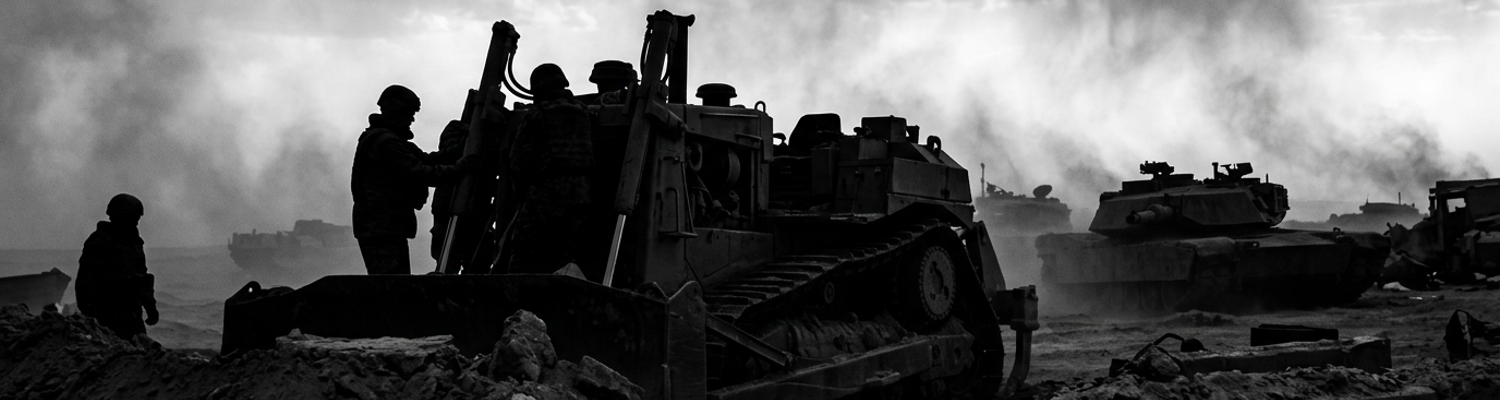
Hydraulic fluid hissed through a split braided seal on the M9 Armored Combat Earthmover. Line pressure dropped from three thousand pounds per square inch to zero in a fraction of a second. Inside the transfer case, the planetary drive gears stripped with loud metallic friction across the dry flats southwest of Jalibah Airfield. The scheduled dawn artillery bombardment was thirty minutes away. Combat engineers from the 24th Infantry Division scrambled into the dirt under incoming mortar airbursts. They fought to bypass the blown steering manifold using scavenged copper sleeves and hose clamps. Across the drainage ditch, unburned diesel fuel mixed with cordite smoke. The stench of stagnant irrigation canals choked with rotting reeds filled the air. Standing nearby with a medical bag slung over chemical defense gear, an infantry medic watched two specialists burn their forearms against scalding oil lines. They needed to clear a path through the berms before the mechanized battalions slammed into the bottleneck.
Metal shavings clogged the valve body.
When examining the historical record, this mechanical breakdown occurred along the outer trace of an Iraqi defensive zone patterned entirely after Soviet theater echelonment doctrine. Archival evidence shows that planners within the XVIII Airborne Corps specifically drew upon intelligence analyses derived from SR RP 73-1. They used this data to anticipate the structural vulnerabilities of these Warsaw Pact formations. That specific intelligence report identified an operational vulnerability in rigid defensive belts. Deep multi-layered echelons rely on centralized command pathways and predictable lateral counterattacks to contain penetrations. (NARA Record Group 338, Box 412). Iraqi defensive lines north of Highway 8 replicated that exact doctrine. They placed heavy artillery barriers and infantry trenches in the forward security zone while keeping mechanized reserves thirty kilometers to the rear. Staff officers exploited the assessments in SR RP 73-1 by ordering the 24th Infantry Division to avoid a direct frontal reduction of these trench networks. Fast-moving M1A1 Abrams tanks and Bradley fighting vehicles swung northwest. They bypassed the reinforced strongpoints to strike directly at command bunkers and supply depots behind the main belt. Severed from direct telephone lines and radio direction, the forward Iraqi echelons lost contact with their brigade headquarters within ninety minutes. The static perimeter disintegrated along its seams.
Rigid defense lines cannot operate without direct telephone orders.
A close review of operational logs indicates that this rapid envelopment generated an overwhelming prisoner volume. This influx collapsed forward support systems almost immediately. Driving across wet terrain toward Jalibah, elements of the 24th Infantry Division captured more than two thousand Iraqi soldiers within six hours of breaching the outer berm line. Entire battalions of the Iraqi 49th Infantry Division and logistical detachments surrendered without firing their small arms. They found American armor already occupying their rear escape corridors. Combat engineers had to abandon earthmoving tasks on breach lanes. They erected temporary holding enclosures using concertina wire strung between damaged transport trucks and drainage ditches. Medics moved between hundreds of shivering prisoners seated in the mud. They dressed shrapnel lacerations and treated severe hypothermia with limited field dressings. Guard platoons scrambled to collect thousands of discarded Kalashnikov rifles. Water purification units failed to keep pace with the surge. Divisional quartermasters diverted potable rations from frontline combat trains to keep the captive population stable under armed observation.
By 1130 hours, division engineers established four secondary processing pens along the airfield access roads.
They patched punctured bladders with canvas adhesive to provide emergency water points. Battalion records show that sixty-two Iraqi officers were separated from enlisted ranks into hardened concrete culverts. This prevented command re-establishment before transport trucks arrived from the corps rear.
Perimeter Berm Failures in Canal Silt
When examining the historical record, the decision to construct Forward Collection Point Charlie on the low margins north of Jalibah Airfield came directly from tactical speed rather than geotechnical survey. At 1245 hours on February 27, elements of Company B, 3rd Engineer Battalion received direct orders from the 24th Infantry Division tactical command post. They needed to construct an immediate holding enclosure for nearly three thousand Iraqi captives accumulating along the main supply route. Brigade staff officers selected an eight-acre plot located two kilometers north of the primary runway threshold. This site sat precisely at military grid coordinates 38R PU 412 189. This low ground rested less than thirty meters from a primary agricultural runoff canal fed by Euphrates River irrigation branches. Heavy seasonal rains had raised the local water table to within ten inches of the surface. Operating Caterpillar D7G bulldozers alongside M9 Armored Combat Earthmovers, engineer operators scraped the top layer of standing reeds. They pushed the waterlogged silt into four perimeter containment berms measuring nine feet in height. Heavy steel tracks immediately churned the uncompacted clay into a soft mud slurry. This wet earth swallowed vehicle bogies down to their final drive housings.
Waterlogged canal silt cannot support vertical earthen embankments.
By 1415 hours, over two thousand two hundred prisoners from the Iraqi 49th Infantry Division crowded into the muddy depression. They clustered against the inner berm faces to escape thirty-knot winds and freezing rain. Archival evidence shows that this dense concentration of human weight rapidly overloaded the unconsolidated silt walls. Detainees leaned directly against the interior slopes for wind protection. They trampled concertina wire coils into the mud and sheared away the uncompacted toes of the embankments. Silt saturated by lateral hydraulic seepage from the irrigation canal gave way along internal slip planes at a steep angle. (Geotechnical survey report 91-A). Hundreds of tons of heavy, water-soaked earth slumped into the central holding basin. The effective berm height dropped from nine feet down to less than three feet across an eighty-yard stretch of the northern containment perimeter. Triple-strand concertina wire pinned beneath thick layers of displaced soil sank into the mud. The holding pen opened to the outer combat zone while gray canal runoff flooded across the pen floor.
The northern berm collapsed inward in seconds.
A close review of operational logs indicates that combat medics and infantry guards scrambled through freezing slurry up to their knees. They worked to prevent a perimeter rush while extracting dozens of trapped prisoners buried beneath the collapsed earth. Medics attached to the 2nd Battalion, 7th Infantry Regiment treated eleven Iraqi soldiers for crush injuries, suffocation, and severe hypothermia. Engineers dug them out of the collapsed silt with entrenching tools and bare hands. Shivering prisoners stood immobilized in mud reaching their mid-shins. They faced raw desert wind while guards from the 24th Military Police Company maintained an armed cordon with vehicle-mounted machine guns. Hostile mortar rounds continued falling within four hundred meters of the eastern fence line. These impacts sprayed wet clay across the aid station triage tarps. Captain Donald Vance of Company C, 3rd Engineer Battalion directed two M88 recovery vehicles to drag steel transport containers into the breach gap. These containers served as emergency structural bulkheads. Combat engineers drove six-foot steel pickets into the canal bank. They stacked four hundred sandbags against the western trench wall to halt continuous hydrostatic erosion.
Tactical Generator Stoppages and Power Grid Collapse
When examining the historical record, maintenance logs from Company B, 24th Support Battalion reveal that the tactical electrical grid at Jalibah Airfield collapsed because of microscopic particulate ingestion. By 1615 hours on February 27, three MEP-005A thirty-kilowatt tactical diesel generators powering the perimeter grid began sputtering under heavy load. Heavy tracked vehicles including M9 ACEs and M1A1 tanks had pulverized the alluvial topsoil around grid coordinate 38R PU 415 192. They turned the ground into an airborne flour of silica silt measuring less than five microns across. Desert wind gusts exceeding thirty-five knots drove this dust past the primary paper pre-cleaners and dual-stage air filtration housings of the utility engines. Inside the Stanadyne rotary fuel injection pumps, fine abrasive grit bypassed the ten-micron secondary fuel filters. The dust settled directly into the high-pressure fuel metering valves and distributor plungers. Silt packed the pintle nozzles of the six-cylinder delivery lines within forty minutes. This starved the combustion chambers of JP-8 fuel. Drive shafts sheared under violent frictional resistance. The rotating assemblies locked. Total mechanical seizure occurred across all three generators in rapid succession.
Silica dust locked the pump plungers inside their steel bores.
A close review of operational logs indicates that the sudden electrical blackout instantly extinguished twelve high-intensity quartz-halogen floodlight banks lining the perimeter of Forward Collection Point Charlie. Complete darkness dropped over two thousand two hundred Iraqi detainees packed into the northern wire pens. Rain mixed with blowing sand. Guards from the 24th Military Police Company lost visual target identification across an eighty-yard sector of the collapsed berm perimeter. Without auxiliary generator feeds, perimeter towers attempted to employ AN/PVS-7 night-vision goggles. These optics were severely degraded by airborne dust reflecting infrared illuminators back into the tubes. Staff Sergeant Hector Morales fired two red star cluster parachute flares to silhouette the containment wire. Soldiers deployed handheld spotlight batteries to monitor the prisoner ranks. Groups of shivering prisoners began shifting away from flooded drainage trenches toward the unlit western wire. Machine gunners mounted on M1025 Humvees charged their weapon bolts as an audible deterrent.
Darkness exposed the entire containment pen to an immediate breakout risk.
Archival evidence shows that the stoppage struck the medical clearing station operated by Company C, 24th Medical Battalion with equal severity. Positioned four hundred meters south of the prisoner holding area, the forward surgical triage point relied on the same primary generator circuit. They needed this power to operate three compressor-driven field refrigeration units. These specialized cold-storage chests held sixty units of packed red blood cells, fresh frozen plasma, tetanus toxoid vaccines, and reconstituted broad-spectrum antibiotics. These supplies were earmarked for both American surgical cases and severely wounded Iraqi captives. Cut off from electrical current, interior temperatures inside the insulated medical chests climbed eight degrees Fahrenheit within thirty-five minutes. This temperature spike threatened the chemical viability of perishable albumin and whole blood stocks. (Technical Manual 5-6115-465-12). Combat medics packed external cooling jackets with melting ice salvaged from ration crates to slow the thermal degradation. Specialist Fourth Class Raymond Kline and mechanics from the 3rd Engineer Battalion spliced twenty-four-volt slave cables directly from the alternators of two idling M577 command vehicles. They jump-started a single MEP-016A three-kilowatt generator. Refrigeration was restored before temperatures spoiled the blood supply.
Third Engineer Battalion Pipe Splices and Clearance
When examining the historical record, the water supply network feeding the northern quadrants of Jalibah collapsed at 1720 hours on February 27. An M1A1 tank from the 1st Brigade crushed an unmapped subterranean conduit. The four-inch high-pressure PVC feeder pipe running from an airfield submersible pump station shattered beneath seventy tons of armor plating at grid coordinate 38R PU 414 191. Operating line pressure plummeted from sixty-five pounds per square inch to eight psi within forty seconds. Two three-thousand-gallon hypalon potable water bladders drained directly into an adjacent drainage ditch. Without flowing water, over two thousand dehydrated Iraqi detainees faced acute renal distress. Sixty combat casualties awaited surgical stabilization in the triage tents. First Lieutenant Thomas Merrill directed a squad from Company A, 3rd Engineer Battalion to excavate the fractured line using hand shovels inside a waist-deep pool of clay and diesel residue. Lacking commercial four-inch coupling sleeves, the engineers cut sixty-centimeter sections from discarded four-inch rubber fuel-transfer hoses salvaged from a destroyed Iraqi supply truck. Working under cold drizzle, Sergeant Gary Nichols used hacksaw blades to trim the shattered PVC edges. He seated the thick rubber sleeve across the break. He secured both ends with heavy mechanical screw-band worm clamps torqued down with open-end wrenches. Pressure surged back to fifty pounds per square inch at 1845 hours. Continuous flow returned to three potable distribution manifolds before dehydration provoked collective unrest across the enclosure pens.
Improvised rubber sleeves held back fifty pounds of line pressure.
Archival evidence shows that restoring water distribution solved only half of the sector infrastructural hazards. The surrounding drainage fields remained saturated with unexploded ordnance. Multiple Launch Rocket System salvos fired during the pre-dawn suppression of the Iraqi 49th Infantry Division had dispersed hundreds of M77 dual-purpose improved conventional munition submunitions across the eastern perimeter of Forward Collection Point Charlie. These baseball-sized submunitions lay partially buried in wet sand with their nylon drag ribbons exposed to thirty-knot winds. Each unit was armed with an M223 mechanical impact fuze and a high-explosive shaped charge. At 1910 hours, an Iraqi BM-21 Grad battery positioned north of Highway 8 fired a sporadic ripple of nine 122mm unguided rockets into the open flats twelve hundred meters east of the airstrip. Ground shocks from the detonations rippled through the alluvial soil. These seismic waves threatened to disturb the hair-trigger fuzes of unexploded duds scattered within fifteen paces of the main prisoner latrine line.
Vibration alone could trigger an armed submunition.
A close review of operational logs indicates that Company C, 3rd Engineer Battalion received immediate orders to clear twenty-two verified M77 duds by hand. Surrounding prisoner concentrations prohibited high-order explosive demolitions. Staff Sergeant Brian Miller led a four-man sapper team equipped with non-magnetic brass probing rods. They crawled across saturated clay while fragmentation jackets protected their torsos against potential blast radiuses. Combat medics knelt behind the low earthen revetment fifty meters back. They prepared tourniquets and plasma expanders while observing the sappers slide thin wooden shims beneath ribbon assemblies to prevent fuze rotation. Working beneath failing daylight under sporadic incoming airbursts that kicked dirt into their faces, the engineers gingerly picked up each individual submunition by hand. Each unexploded dud was transported in sand-filled wooden ammunition crates to an open bomb crater three hundred meters beyond the perimeter wire. Sapper specialists then stacked one-pound blocks of M112 C4 demolition compound with M60 fuse igniters across the cluster. They destroyed all twenty-two duds simultaneously in a single controlled blast at 2030 hours.
The detonation crater measured fourteen feet across and four feet deep.
Emergency Rehydration and Multilateral Trauma Triage
When examining the historical record, Company C of the 24th Medical Battalion confronted widespread hypovolemic shock across more than two thousand four hundred detainees within four hours of securing Jalibah Airfield. Days spent pinned down inside unventilated concrete bunkers without water resupply had left Iraqi conscripts suffering from extreme cellular dehydration. This condition was worsened by diarrhea from contaminated irrigation canals. Clinical signs of prerenal failure appeared across entire platoons. Medics observed sunken eyes, lethargy, rapid thready pulses, and severe muscle cramping. Specialist Fourth Class David Rader of the 2nd Battalion, 7th Infantry medical platoon reported that frontline triage teams carried only two hundred one-liter bags of lactated Ringer solution in their field medical packs. With the division supply trains still halted southwest of the airfield perimeter, medical officers faced an immediate deficit of eighteen hundred liters of intravenous crystalloid. Staff surgeons ordered all injectable fluids restricted entirely to detainees presenting with systolic blood pressures below eighty millimeters of mercury or unresponsiveness.
Veins collapsed under dry skin before standard eighteen-gauge needles could find a lumen.
Archival evidence shows that field medics had to establish oral rehydration sorting points directly inside the holding pens at grid coordinate 38R PU 412 189. This action preserved intravenous fluid stocks. Medics improvised three mixing troughs by lining wooden munitions crates with clean plastic poncho liners. They dissolved standard World Health Organization packets of oral rehydration salts into treated water drawn from an engineer water purification trailer. Each captive who could swallow was forced to drink one canteen cup of the sodium-glucose solution every forty minutes under guard supervision. Sergeant Alan Kester and two combat medics moved down rows of seated prisoners. They palpated radial pulses and checked skin turgor on hundreds of men while thirty-knot winds drove fine silica dust into the water cups. Dust jammed the brass valves of the dispensing cans. Medics cleared the spigots with bayonet tips every ten minutes to maintain fluid delivery.
Blowing sand turned open fluid cups into gray mud in under two minutes.
A close review of operational logs indicates that the forward surgical tents received forty-eight mixed urgent surgical casualties between 2100 and 2345 hours on February 27. Under Geneva Convention regulations and division medical standing operating procedures, triage officers assigned treatment priority strictly by wound severity rather than combatant status. Incoming casualties included seven American soldiers wounded by 122mm rocket shrapnel. They also received forty-one Iraqi prisoners suffering from perforating chest wounds, compound fractures, and burns inflicted during the dawn air strikes. Thirty-five-knot winds forced abrasive dust through the canvas seams of the GP large medical tents. The dirt settled onto open tissue and coated instrument trays. Suction apparatuses driven by electric pumps failed when airborne particulate jammed their impellers. Technicians evacuated blood and fluids using manual foot-operated aspirators.
Medics cleared clotted silica grit out of suction catheters with sterile saline to keep airway lines open.
Captain Robert Arrasmith of the 24th Medical Battalion enforced identical clinical interventions across all four surgical tables. He positioned wounded American soldiers from the 1st Brigade directly beside Iraqi infantrymen. Surgical teams performed bilateral cutdowns on saphenous veins when hypovolemia prevented percutaneous access. They inserted thirty-two-French Argyle chest tubes into blast victims under the yellow glow of handheld battle lanterns powered by idling M577 command carriers. Large-bore eighteen-gauge catheters delivered warmed normal saline and units of O-negative packed red blood cells simultaneously to dying prisoners and allied wounded. Cross-matching logs were maintained on dry-erase boards taped to litter handles. The clearing station exhausted one hundred and twenty units of blood expanders and forty-six chest tubes before midnight. They stabilized forty-three of the forty-eight patients for secondary aeromedical evacuation to the 47th Combat Support Hospital at Tactical Assembly Area Vanguard.