
Urban Warfare Conditions in Manila
A close review of operational logs indicates that lead American assault elements stepped into a highly lethal tactical environment. Over 16,000 heavily armed Japanese naval troops and army personnel waited in the concrete streets of the Philippine capital. Rear Admiral Sanji Iwabuchi ordered his Manila Naval Defence Force to fight to the last man. This directive established a sense of inescapable dread for the approaching combat engineers. The 117th Engineer Combat Battalion deployed into the dense urban environment of Manila in February 1945. They were attached directly to the 37th Infantry Division.
These combat engineers immediately encountered a high-tempo attrition zone.
Advancing down Rizal Avenue and Quezon Boulevard required clearing hundreds of roadblocks. The engineers carried heavy M2 flamethrowers, satchel charges, and bangalore torpedoes through streets choked with burning debris. Sustained operations required the men to dismantle barricades made from overturned trolley cars and iron rails welded together. They did this while taking plunging fire from multi-story buildings.
Combat fatigue set in rapidly.
Sleep deprivation compounded the physical exhaustion of carrying sixty pounds of explosives through the tropical heat. Japanese defenders utilized heavy artillery and fortified civilian structures to resist American advances. Iwabuchi forces stripped 120mm dual-purpose naval guns and 20mm anti-aircraft cannons from sunken warships in Manila Bay. They bolted these weapons directly to the reinforced concrete floors of government buildings.
The Manila Post Office became a heavy defensive position.
Defenders barricaded the ground-floor windows of civilian structures with sandbags and poured concrete. They left only narrow slits for their heavy weapons. Artillery crews positioned 150mm howitzers to fire point-blank down the long avenues. The physical mechanics of this urban warfare become clear when examining the historical record. Concussive blasts from these heavy artillery pieces firing indoors ruptured the eardrums of the defenders. The localized shockwaves battered the assaulting engineers.
Medical officers recorded a sharp spike in psychiatric casualties among the demolition teams by the second week of February.
The psychological toll of continuous breaching operations pushed the 117th Engineer Combat Battalion to its breaking point. Men developed uncontrollable hand tremors. This made the delicate task of crimping blasting caps onto fuse cords highly dangerous. Archival evidence shows that the constant threat of hidden explosives induced severe hyper-vigilance. The cognitive function of veteran engineers eroded rapidly. Men began collapsing behind ruined walls. They were unable to process basic verbal commands from their squad leaders.
Mechanical parts failed just as frequently as the men wielding them.
The humid air of the urban environment clogged the pressure valves on the M2 flamethrowers. This caused misfires during direct assaults on fortified civilian structures like the University of the Philippines campus. Detonators degraded in the damp conditions. Engineers had to manually re-wire demolition charges while exposed to 20mm cannon fire from adjacent legislative buildings.
Squad leaders physically dragged catatonic engineers out of the line of fire at the Taft Avenue intersection.
Command decisions by Major General Robert S. Beightler forced the exhausted engineers to maintain the assault pace. They had to blow holes through the interior walls of interconnected civilian structures to avoid the artillery-swept streets. This tactic meant the 117th engineers spent hours in dark corridors packed with civilian corpses and booby traps. Japanese troops rigged 155mm artillery shells to the doorknobs of office buildings. They wired stairwells with tripwires connected to high-explosive depth charges. Disarming these improvised devices in the dark with trembling hands accelerated the combat fatigue across the battalion. Company B suffered heavy casualties when a rigged heavy artillery shell detonated inside the basement of the Manila Hotel. The blast collapsed the first floor onto the breaching team. Combat engineers documented 140 separate booby traps cleared within a single three-block radius near the Intramuros district.
M2 Treadway Bridging Across the Pasig River
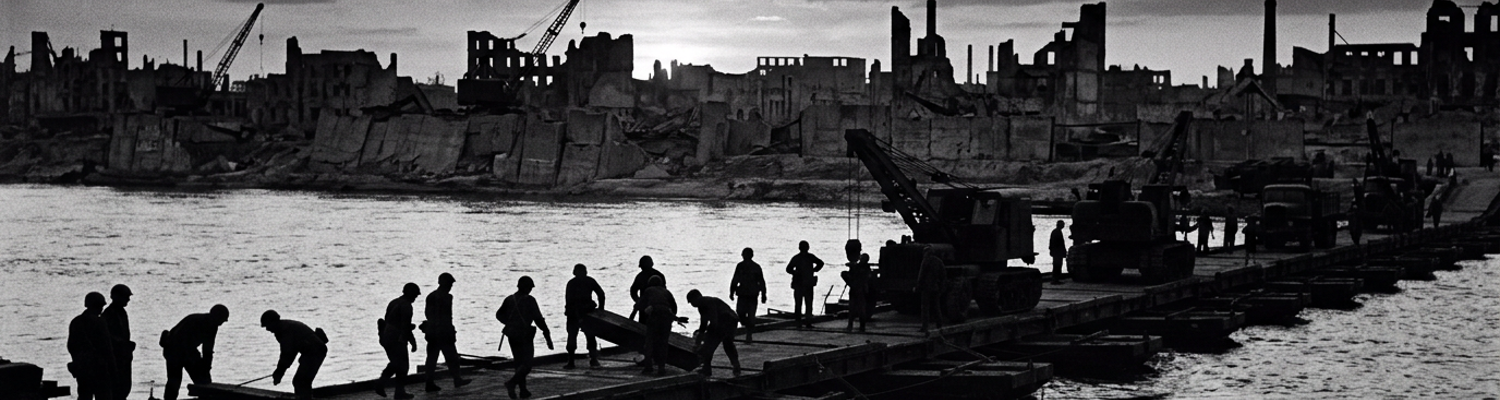
Archival evidence shows that by February 15, the 117th Engineer Combat Battalion received orders to span the 400-foot width of the Pasig River. The crossing site was located near the coordinates 14 35 34 N 120 58 38 E. Major General Robert S. Beightler directed the bridging operation just east of the demolished Jones Bridge. This crossing was required to facilitate the advance of the 37th Infantry Division.
Engineers attempted to construct M2 treadway pontoon bridges across the Pasig River under direct observation.
The M2 treadway system required the assembly of heavy steel tracks laid over 18-ton pneumatic rubber floats. Each treadway segment measured twelve feet in length. The segments required four men to lift them using specialized carrying tongs. Men wrestled with 1,000-pound steel sections in the waist-deep muck of the north bank. The manual labor demanded extreme physical exertion from troops already suffering from severe sleep deprivation.
Specialized air compressors used to inflate the canvas-covered rubber pontoons frequently overheated in the 95-degree tropical heat.
Engine belts snapped. Mechanics cannibalized parts from destroyed trucks to keep the compressors running. The engineers pushed the assembled pontoon sections into the deep current of the river. This exposed waterborne construction systematically destroyed the psychological endurance of the bridging companies. Japanese forces holding the massive neoclassical Post Office building on the south bank possessed an unobstructed line of sight down onto the crossing site.
Spotters on the reinforced roof of the structure tracked every movement of the American engineers working in the open water.
The total lack of concealment created a high-tension environment. Men fumbled with the heavy steel connecting pins required to lock the treadways together. Dropping a single locking pin into the murky river meant a squad had to halt construction. They waited until a replacement was carried forward from the supply dumps. The psychological erosion manifested in physical symptoms. Veterans of the New Georgia campaign began hyperventilating while standing on the exposed rubber floats.
Squad leaders reported engineers freezing in place.
They stood motionless while holding the heavy sledgehammers needed to drive the alignment stakes into the riverbed. Relentless Japanese artillery fire targeted bridging sites to prevent Allied armor from crossing. Iwabuchi gunners inside the walled city of Intramuros registered their 150mm howitzers and 75mm mountain guns directly on the M2 treadway coordinates. Gun crews utilized delayed-fuse armor-piercing shells. These projectiles penetrated the river surface before detonating.
The blasts created deadly underwater shockwaves.
The pressure crushed the internal organs of engineers swimming nearby. Shells struck the water at regular intervals. The resulting geysers of river mud and shrapnel tore through the inflated rubber pontoons of the bridge. Deflated floats caused the heavy steel treadways to buckle and sink below the waterline. The physical mechanics of repairing the damaged bridge required engineers to wade out into the artillery-beaten zone. They had to detach the sunken steel plates.
The men manually hauled new rubber floats into the impact area.
Artillery barrages struck the crossing site in fifteen-minute intervals. Concussive shockwaves from the 150mm detonations ruptured the eardrums of the men working in the water. The blast pressure threw engineers off the steel tracks into the debris-filled river. Commanders recorded dozens of psychiatric casualties collapsing on the north bank. The specific details of the technical repairs expose the breaking point of the human element.
The 117th Engineer Combat Battalion deployed replacement bridging sections under continuous 20mm anti-aircraft fire.
This fire originated from the Legislative Building. Armor-piercing tracers ignited the auxiliary fuel tanks of a bridging truck reversing to the water edge. The explosion killed three engineers and scattered burning gasoline across the partially completed M2 treadway. Medical personnel evacuated thirty-two men exhibiting severe catatonia in a single afternoon. The continuous blast exposure caused men to lose all spatial awareness.
Blank-eyed engineers sat in the mud.
They were unable to recognize their own squad members. Medics applied tourniquets to shrapnel wounds while taking plunging machine-gun fire from the south bank. Officers physically pushed trembling replacements into the river to secure the final steel locking pins. The 44th Tank Battalion finally pushed its lead M4 Sherman tanks across the completed span at 1600 hours. The 30-ton armored vehicles crushed the patched rubber pontoons down to the muddy riverbed as they drove over the steel tracks.
Equipment Failures From Submerged Urban Debris
A close review of operational logs indicates that the physical environment of the Pasig River actively dismantled the heavy bridging equipment. The fast-flowing tidal current exerted thousands of pounds of lateral force against the partially constructed M2 treadway. Securing the floating bridge required heavy stabilization against the flow of water. Standard procedure dictated the deployment of high-tensile hydraulic anchors to lock the pontoon lines into the riverbed.
The river bottom near the ruined Jones Bridge contained thousands of tons of submerged concrete debris.
This material came from the demolished span. Winch operators engaged the hydraulic systems to drive the anchors into the mud. The high-tensile steel flukes slammed directly into these massive reinforced concrete slabs. The mechanical force of the hydraulic rams bent the steel anchor points backward upon impact. Hydraulic fluid lines ruptured under the extreme pressure spikes. Pressurized oil sprayed across the steel treadways.
High-tensile hydraulic anchors failed to secure pontoon lines.
Submerged concrete debris blocked the penetration depth. Without functioning anchors, the fast current violently twisted the heavy rubber pontoons out of alignment. The heavy steel connecting pins holding the treadway plates together sheared off under the unanchored torque. The river current immediately tore the unsecured pontoons downstream toward Japanese defensive positions. Squad leaders from Company C had to abandon standard mechanical procedures.
They ordered exhausted engineers directly into the contaminated water.
Men dove beneath the surface to manually wrap thick steel mooring cables around the jagged submerged concrete blocks. The zero-visibility underwater environment forced the engineers to feel for stable anchor points with their bare hands. They did this while holding their breath. Jagged rebar protruding from the sunken masonry sliced through their canvas uniforms and deep into their skin. The extreme physical exertion of fighting the strong current while dragging fifty-pound steel cables underwater accelerated the severe combat fatigue spreading through the ranks.
Engineers surfaced hyperventilating and vomiting river water.
The mechanical failure extended directly to the heavy equipment required to keep the bridge afloat on the surface. To maintain the buoyancy of the 18-ton pneumatic rubber floats, the engineers relied on gasoline-powered units positioned in the mud on the north bank. The concussive blasts from continuous Japanese artillery strikes pulverized the surrounding urban structures. This covered the river in a thick layer of shattered building materials.
Mechanical air compressors jammed repeatedly.
They ingested floating masonry and sheared rebar directly into their intake manifolds. The internal impellers designed to suck in ambient air instead pulled in the highly abrasive concrete dust. This grit bypassed the standard mesh filters and coated the internal cylinders. The friction stripped the lubrication from the moving parts within minutes. Small fragments of sheared steel rebar suspended in the viscous river sludge splashed against the machines.
This debris jammed the high-speed cooling fans.
Engine blocks cracked open under the resulting thermal stress. The breakdown of these compressors created a severe tactical crisis for the bridging companies. The 117th mechanics had to tear down the seized engine blocks right on the exposed riverbank. They took continuous 20mm anti-aircraft fire from the Japanese positions inside the Post Office. The men used standard wrenches to strip the damaged intake valves.
They attempted to scrape the fused masonry dust off the pistons with their combat knives.
As the compressors failed one by one, the rubber pontoons out in the river began to lose air pressure from shrapnel punctures. Without the mechanical pumps, squad leaders forced the catatonic engineers to manually inflate the massive rubber floats using small hand pumps. This required hundreds of repetitive physical thrusts per float in the 95-degree tropical heat. The psychological erosion peaked as men collapsed over the hand pumps. They were completely unresponsive to the incoming mortar fire detonating in the water just feet away. A direct artillery strike on the primary compressor staging area destroyed the remaining repairable units. The blast scattered the cannibalized engine parts across the muddy bank.
Continuous Operations Under Sustained Sniper Fire
The 117th Engineer Combat Battalion stepped into a kill zone occupied by over 16,000 heavily armed Japanese naval and army personnel. Rear Admiral Sanji Iwabuchi ordered his forces to hold the concrete ruins of Manila to the last man. The adversary possessed overwhelming numerical superiority at every major intersection along the Pasig River. Major General Robert S. Beightler issued direct orders requiring the engineers to maintain the assault pace regardless of casualty rates.
The command decision forced the bridging units to endure 72-hour continuous operational shifts.
They received no relief in active combat zones. Men operated D7 armored bulldozers and carried 600-pound steel Bailey bridge panels across the debris-choked streets near the intersection of Taft Avenue and Padre Faura Street. They did this without a single hour of sleep. The physical demands of wrestling heavy steel components into place destroyed the muscles of the combat engineers. Drive sprockets on the bulldozers snapped under the strain of pushing aside overturned trolley cars.
The operators lacked the cognitive awareness to disengage the clutches in time.
By the forty-eighth hour of continuous deployment, the complete lack of rapid eye movement sleep induced severe auditory hallucinations across the demolition squads. Medical officers distributed standard-issue Benzedrine sulfate tablets to keep the men conscious. The amphetamines masked the immediate physical exhaustion but rapidly accelerated the psychological decay of the battalion. Men dropped heavy steel treadway pins into the deep river mud.
Their hands shook too violently to grip the metal.
Mechanics servicing the pneumatic air compressors passed out while holding their wrenches against the vibrating engine blocks. Rubber drive belts snapped and whipped across the staging area. Engines overheated and seized right on the riverbank because the maintenance crews were too delirious to check the oil reservoirs. The continuous 72-hour exposure to high-explosive concussions caused the engineers to lose basic motor functions.
Men forgot how to unbuckle their own webbing.
Squad leaders physically dragged unconscious men back to their feet to keep the bridging lines moving forward. Concealed Japanese snipers in ruined infrastructure deliberately targeted these exhausted bridge construction crews. The skeletal remains of the Manila Central Post Office and the completely gutted Legislative Building provided hundreds of elevated firing positions overlooking the crossing sites. Japanese naval infantrymen equipped with Type 99 Arisaka rifles utilized flashless powder.
This masked their exact locations within the shadowed masonry.
They did not shoot randomly into the mass of American troops. Marksmen specifically aimed at the engineers holding the heavy steel sledgehammers required to drive alignment stakes into the riverbed. Killing the man with the hammer halted the entire assembly line. A 7.7x58mm armor-piercing round striking a steel pontoon section created a deafening metallic crack. The bullet then ricocheted through the packed ranks of the bridging company.
Splinters of sheared steel acted as secondary shrapnel.
Men working in the waist-deep water of the Pasig River had zero hard cover to deflect the plunging fire. The psychological toll of this precise sniper fire pushed the battalion past its breaking point. An engineer falling into the fast-flowing current with a gunshot wound to the chest forced the rest of his squad to immediately drop their steel treadway plates. They had to do this to avoid being pulled under the water.
The snipers waited for the unarmed medical personnel to crawl out onto the exposed rubber floats before firing their next shots.
Combat fatigue mutated into absolute catatonia among the survivors. Veterans of the Bougainville campaign wedged themselves between shattered concrete pylons on the north bank. They completely ignored direct orders to step back out onto the pontoon bridge. Officers from Company B had to physically pry the fingers of their own men off the ruined bridge abutments. The concealed riflemen systematically dismantled the American command structure.
They prioritized anyone wearing a lieutenant insignia or carrying a heavy SCR-300 radio handset.
The casualty rate forced corporals to take command of entire bridging platoons while standing in pools of their own squadmates blood. The 117th engineers left thirty-eight dead men floating in the river debris by nightfall.
Psychological Erosion and Physical Collapse
The 117th Engineer Combat Battalion advanced into a heavily fortified urban kill zone. Over 16,000 deeply entrenched Japanese naval and army personnel held the sector. Rear Admiral Sanji Iwabuchi ordered his Manila Naval Defence Force to hold the concrete ruins to the last man. The adversary possessed overwhelming numerical superiority at every major intersection along the Pasig River. This heavy concentration of armed defenders established a sense of inescapable dread for the outnumbered American combat engineers.
They were tasked with clearing the advance routes.
Major General Robert S. Beightler issued direct orders mandating an unrelenting assault pace to break the defensive lines. His command decision forced the bridging units to endure continuous operational shifts extending past seventy-two hours. They received no relief in active combat zones. Sustained sleep deprivation rapidly compounded the effects of high-tempo combat. This led directly to acute psychological breakdown among the personnel.
Medical officers distributed standard-issue Benzedrine sulfate tablets to keep the men conscious.
The amphetamines masked the immediate physical exhaustion but rapidly accelerated the psychological decay of the battalion. The complete lack of rapid eye movement sleep induced severe auditory hallucinations across the demolition squads operating near the ruined General Post Office. Men developed uncontrollable hand tremors while trying to crimp blasting caps onto fuse cords. Veterans of previous Pacific campaigns began collapsing behind shattered concrete walls.
They were entirely unable to process basic verbal commands from their platoon leaders.
Squad leaders physically dragged catatonic engineers through the rubble by their canvas webbing. Archival evidence shows that this extreme physical fatigue directly compromised technical precision during critical bridging operations across the Pasig River. The engineers attempted to construct M2 treadway pontoon bridges to facilitate the crossing of the 37th Infantry Division armor. The system required the precise assembly of 1,000-pound steel tracks laid over large pneumatic rubber floats.
Exhausted men wrestled with the twelve-foot treadway segments in the waist-deep muck of the north bank.
Their depleted muscles failed under the extreme physical exertion of carrying sixty-pound steel plates through the tropical heat. Engineers froze in place while holding the heavy sledgehammers needed to drive the alignment stakes into the riverbed. The physical mechanics of assembling the bridge required absolute coordination. To lock the floating bridge sections together, the engineers had to insert heavy steel connecting pins through aligned metal brackets.
Men suffering from severe combat fatigue fumbled blindly with these heavy pins.
Their hands shook too violently to maintain a grip on the slick metal. Dropping a single locking pin into the murky river meant a squad had to halt construction until a replacement was carried forward from the supply dumps. The heavy steel tracks frequently misaligned because the troops lacked the physical strength to push the sections against the fast-flowing tidal current. The specific details of the equipment maintenance expose the exact breaking point of the human element.
Specialized gasoline-powered air compressors used to inflate the canvas-covered rubber pontoons required constant mechanical adjustment in the 95-degree heat.
The mechanics servicing these units suffered from the same severe sleep deprivation as the frontline squads. Concrete dust from shattered buildings clogged the intake valves. This required precise manual cleaning that the exhausted men could no longer perform. Mechanics passed out while holding their wrenches against the vibrating engine blocks. Delirious maintenance crews failed to check the oil reservoirs or monitor the pressure gauges on the manifolds.
Engine belts snapped and whipped across the staging area.
The mechanical air compressors overheated and seized directly on the exposed riverbank. Without functioning pumps, officers forced the unresponsive engineers to manually inflate the 18-ton rubber floats using small hand pumps. This technical failure demanded hundreds of repetitive physical thrusts per float from men already suffering from severe muscle depletion. The psychological erosion peaked as engineers collapsed entirely over the hand pumps.
Medics applied tourniquets to men who sat blank-eyed in the mud.
They completely ignored the Japanese 75mm mountain gun shells detonating in the water twenty yards away. The battalion ceased to function as a cohesive tactical unit under the sustained pressure of the crossing. Medical personnel evacuated forty-two completely unresponsive men from the bridging site before noon.