
Task Force 64 Deployment into Ironbottom Sound
Steam pipes ruptured inside the forward fireroom of the destroyer USS Walke after an enemy torpedo detonated against the starboard hull. The blast fractured the primary boiler lines and buckled the main deck plates. Engineers inside the flooded machinery spaces choked on blinding white vapor and scrambled across slick floor plates to turn the manual boiler shutoff valves. Water tenders struggled to vent the remaining high-pressure steam before the boilers exploded, but incoming seawater quickly drowned the auxiliary feed pumps and killed all internal electrical power. Repair parties rushed down the buckled companionways with wooden shoring timbers to isolate the flooded magazine. Topside gunners hand-cranked the manual training gears on their five-inch mounts to keep firing into the dark.
Admiral Willis A. Lee navigated battleships USS Washington and USS South Dakota into Ironbottom Sound on November 14, 1942, alongside four screening destroyers to intercept an approaching enemy bombardment fleet. The sudden disaster aboard Walke instantly shattered the forward screen, exposing the trailing battleships to an ambush planned by the Japanese command. Vice Admiral Nobutake Kondo led a bombardment force centered on battleship Kirishima and heavy cruisers Atago and Takao to shell Henderson Field. Kondo had sent his vanguard warships ahead into the strait to eliminate any Allied vessels that blocked their path. Lookouts aboard Kondo's cruisers and destroyers spotted the silhouettes of the approaching American column against the dark mountain backdrop of Savo Island.
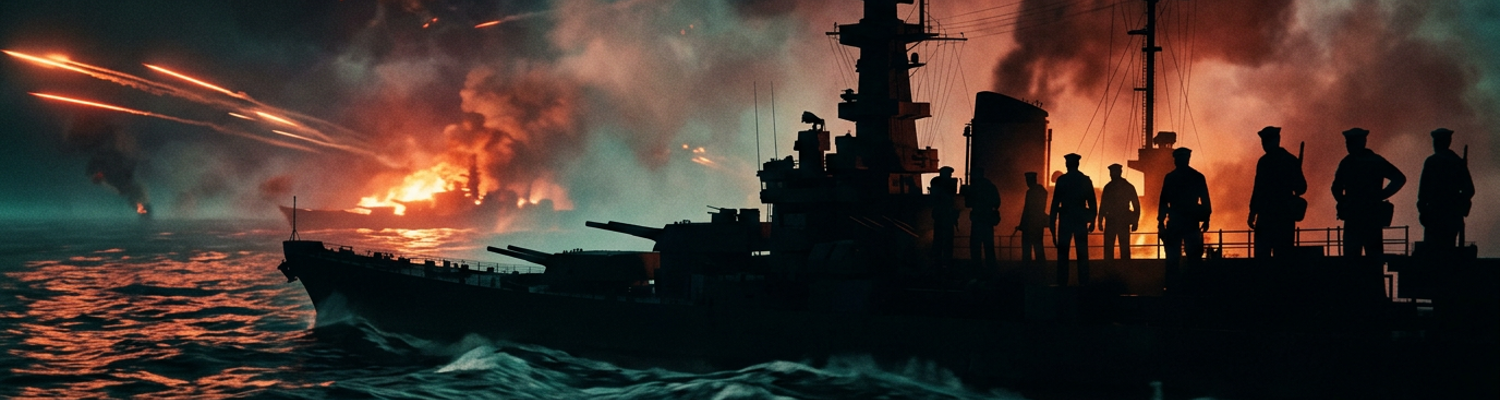
Torpedo officers aboard the Japanese cruisers swung their deck-mounted launchers toward the American destroyers, unleashing salvos of oxygen-fueled Type 93 torpedoes across the calm water. Heavy gunfire from Japanese eight-inch and five-inch guns flashed across the channel seconds later, hammering the lead American ships with concentrated high-explosive shells. Spotters on the Japanese warships adjusted their optical rangefinders to track every secondary target, overwhelming the thin American defensive perimeter with rapid coordinated salvos. Shell fragments and burning debris rained across the water as the Japanese strike pulverized the American vanguard. Japanese gunfire and torpedo spreads rapidly sank or crippled screening destroyers USS Walke, USS Benham, USS Preston, and USS Gwin.
Walke rolled over and sank within minutes after an internal magazine blast ripped her hull apart, while Preston caught fire, lost all steam pressure, and quickly followed her to the bottom. Benham took a torpedo hit that completely severed her bow, yet her damage-control crews managed to keep the shattered hull afloat through sheer effort. Gwin sustained heavy shell damage to her engine room safety valves and after deckhouse, forcing her crew to fight spreading fires while limping out of the firing line. Surviving sailors jumped into the churning fuel-slicked sea, leaving the two American battleships to navigate the channel without any escort. Battleships USS Washington and USS South Dakota pressed forward into the smoke-choked sound, maneuvering around the burning hulks of their own destroyers.
Navigators aboard Washington plotted radical helm adjustments to avoid running down swimming American sailors and drifting wreckage scattered across the dark channel. Radar operators inside Washington's plotting room swept their fire-control antennas toward Savo Island, tracking the heavy Japanese warships that were closing in from the north. South Dakota followed close behind the flagship, swinging her massive triple turrets to starboard to acquire the approaching enemy cruisers on optical directors. Captains on both sides increased engine revolutions to maximum battle speed, committing the capital ships to a close-range duel in the confined waters of Ironbottom Sound.
USS South Dakota Cascading Electrical Failure
Throttlemen aboard USS South Dakota spun heavy brass handwheels to answer that call for maximum revolutions, sending high-pressure steam into the propulsion turbines to keep pace with the flagship Washington ahead. Turbine casings vibrated as the ship surged forward through the narrow channel, placing immense mechanical stress on the auxiliary machinery and shipboard electrical systems. Generators deep within the armored hull shuddered as gun blast shockwaves and sudden electrical line surges overloaded the primary distribution network. An electrical switchboard blowout aboard USS South Dakota at 2333 hours tripped critical circuit breakers and severed bus-tie feeders. Electricians in the forward distribution spaces shielded their eyes from violent electrical arcs as switch contacts melted and safety relays slammed open across the panels. Dead distribution buses instantly starved vital command and control compartments of electricity, plunging the interior decks into total darkness.
Radar screens and bridge instrument clusters went dark across the upper superstructure as line voltages collapsed throughout the ship. The sudden blackout disabled South Dakota's gyrocompasses, search radars, and Mark 38 fire-control directors. Navigators lost their true heading references when the master gyro rotors drifted offline, leaving the bridge team unable to plot course corrections amidst burning destroyer wreckage and shallow reefs. Plotting officers in the darkened tracking stations stared at blank indicator dials and lifeless cathode-ray tubes, completely stripped of electronic data regarding the enemy battle line. Fire-control operators in the optical director towers lost their power-assisted slewing motors, preventing them from transmitting target ranges down to the mechanical computers below deck.
Lookouts on the open bridge wings strained their eyes through the heavy gun smoke to locate enemy silhouettes, shouting warning reports through dead interior sound-powered phone circuits. Gun crews inside the forward sixteen-inch turrets watched their motorized training drives shut down without any warning from the plotting rooms. Loss of auxiliary power forced main gun turrets out of remote director alignment while operating in close proximity to Japanese surface combatants. Turret captains ordered their men onto the manual training gears, demanding every ounce of muscle to rotate thousands of tons of steel and armor plate by hand. Machinists turned heavy mechanical hand cranks against stiff hydraulic resistance, but manual operation proved far too slow to keep the massive rifle barrels aligned with fast-moving surface targets across the water.
Gunners in the secondary five-inch mounts faced the same crisis as their electric hoists stalled, forcing ammunition handlers to lift heavy powder casings and projectiles up narrow access trunks by hand. Japanese searchlight batteries illuminated the channel from several miles away, pinpointing South Dakota in overlapping beams of bright white light. Searchlight beams locked onto South Dakota across the narrow channel, exposing the darkened warship to direct visual targeting from the enemy battle line. Captain Thomas Gatch found himself commanding a blind and largely defenseless capital ship while Japanese spotters easily tracked her tall superstructure against the dark mountains of Savo Island.
Electricians deep in the forward distribution spaces worked by handheld flashlights in suffocating heat to isolate damaged switchboard panels and reset tripped circuit breakers. Damage-control teams threw manual bus-tie switches to route reserve power from surviving aft generators, working against time to re-energize basic steering control before enemy salvos arrived. Japanese heavy cruisers Atago and Takao opened fire alongside battleship Kirishima, unleashing heavy high-explosive and armor-piercing shells at the illuminated target. South Dakota absorbed multiple direct hits along her superstructure and radar antennas, taking shell damage while her engineers fought in the dark to restore main battery power.
Searchlight Illumination and Japanese Gunfire Concentration
Cruisers Atago and Takao illuminated the blinded South Dakota with searchlights and opened heavy caliber fire, exploiting the American battleship's dead electrical circuits and stalled gun directors. Searchlight crews aboard the Japanese cruisers locked carbon-arc beams directly onto the bridge structure, blinding the American spotters and creating brilliant optical aiming points across the calm water. USS South Dakota took twenty-seven direct hits to her superstructure while silhouetted against the burning wrecks of American destroyers. Heavy eight-inch and fourteen-inch projectiles punched through the unarmored fire-control towers, severing internal telephone trunk lines, smashing radar antennas, and igniting fires in radio transmitter compartments. High-velocity shell fragments swept across the open bridge wings and machine-gun tubs, disabling secondary director stations, and cutting down exposed sailors, while muzzle blast from South Dakota's own stern turret had earlier set her Kingfisher floatplanes ablaze on the fantail catapults.
Repairmen scrambled across scorched deck plates with hand-cranked extinguishers and canvas hoses to smother the raging aviation fuel fires on the fantail. Damage-control teams inside the darkened interior compartments hauled wounded comrades down smoke-filled companionways, using battle lanterns to navigate buckled steel bulkheads and severed electrical cabling. Quartermasters on the navigation bridge wrestled with emergency sound-powered telephone handsets to relay rudder angles directly to the after steering compartment after main helm power collapsed entirely. Captain Thomas Gatch directed his helmsman to sheer away from the flaming destroyer hulks, using manual engine telegraphs to increase speed in an attempt to throw off the enemy gunners. Dense clouds of black smoke poured from the pierced deckhouses, hiding South Dakota's waterline from Japanese spotters while her towering radar masts remained clearly visible in the relentless white glare.
Gunners aboard the Japanese warships concentrated exclusively on South Dakota, failing to detect USS Washington tracking them in the darkness. Admiral Nobutake Kondo and his staff aboard cruiser Atago fixed their attention entirely on the battered American battleship, believing that their coordinated salvos had trapped the only surviving Allied capital ship. Lookouts aboard Kirishima, Takao, and the surrounding Japanese destroyers never turned their night-vision binoculars toward the open water to the west, where Washington moved silently through the dark channel fewer than nine thousand yards away. Radar operators inside Washington's darkened plotting room tracked every maneuver of the Japanese bombardment line on their SG surface-search screens, marking the exact bearing and speed of battleship Kirishima.
Computers in Washington's central plotting station processed the steady radar returns and transmitted continuous optical and mechanical firing solutions directly to the main battery turrets. Gunners inside Washington's three sixteen-inch triple turrets loaded forty-five-caliber armor-piercing shells onto mechanical hoist trays in absolute silence, waiting for the order to commence firing. Rammers shoved the 2,700-pound projectiles and silk powder bags into the open breeches of Washington's main battery rifles with heavy metallic thuds. Turret captains spun their locking wheels to seal the heavy steel plugs as target dials hummed, indicating that all nine barrels were trained onto Kirishima's center of mass.
Admiral Willis A. Lee observed the illuminated combat zone from Washington's flag bridge, confirming by radar that South Dakota had pulled clear of his forward line of fire. Cruisers Atago and Takao continued hurling eight-inch salvos at South Dakota's smoking upper works, entirely unaware of the modern American dreadnought closing in on their starboard beam. Captain Glenn Davis stood beside the main battery salvo switches on Washington's navigation bridge, holding his fire until the range narrowed to point-blank visual distance. Captain Davis tripped the firing keys seconds later, sending the first salvo of nine sixteen-inch shells roaring across the water directly into Kirishima.
USS Washington Unjammed SG Radar Approach
Projectiles from Washington's forward turrets crossed the dark water in less than fifteen seconds, striking the Japanese dreadnought while her own guns remained trained on South Dakota. Admiral Lee utilized USS Washington's unjammed SG surface-search radar plot to track Japanese capital ships with exact spatial resolution. Technicians inside the central plotting room monitored the microwave emissions as the antenna swept through heavy gun smoke and tropical squalls without suffering any electronic interference from Japanese counter-measures. Radar plotters translated those steady electronic pulses into razor-sharp spatial coordinates, separating the looming landmass of Savo Island from the moving silhouettes of Kondo's bombardment group. Plotting officers used grease pencils to mark the heading and speed of each enemy vessel onto the edge-lit glass board, giving the bridge team continuous updates on Kirishima's movements. Lee tracked the continuous data stream beside the plotting table, recognizing that the electronic picture gave his flagship complete spatial dominance over the confused waters of the sound.
Battleship USS Washington closed undetected to a point-blank range of 8,400 yards off the port beam of battleship Kirishima. Lookouts aboard the Japanese warships never turned their night optics toward the open water to port, remaining completely fixated on the burning crippled silhouette of South Dakota. Kirishima's fourteen-inch guns continued blasting heavy shells across the channel, producing blinding muzzle flashes that ruined the night vision of her own bridge crew and masked the American dreadnought's approach. Deck officers aboard Washington watched the Japanese battleship maneuver in plain view, tracking its towering pagoda mast against the dark sky with optical directors.
Navigators on Washington kept the warship steady on its intercept course, slipping past burning American destroyers without altering engine revolutions. Helmsmen held the ship on a steady parallel heading, bringing all nine sixteen-inch rifles into an ideal broadside orientation without drawing a single enemy spotter's attention. Lee withheld fire until optical and radar signatures verified Kirishima as the hostile target pounding South Dakota. Identifying combatants in the confined channel presented severe hazards because South Dakota was drifting without electrical power, her position uncertain and her recognition lamps dead.
Spotters stationed in the forward director tower peered through high-magnification rangefinders, comparing the superstructure profile and gun flashes against silhouettes in the ship's recognition manuals. Radar operators cross-checked every visual flash against the largest blip on their scopes, ensuring that the target was indeed the fourteen-inch dreadnought leading the Japanese assault. Combat officers needed total certainty that they were not aiming at their own sister ship amidst the swirling clouds of cordite smoke and burning oil. Confirmation came when Kirishima energized carbon-arc searchlights to illuminate South Dakota's ruined upper works, exposing the Japanese battleship's exact position, heading, and hostile identity.
Motors inside Washington's armored barbettes slewed all nine sixteen-inch gun barrels onto those confirmed coordinates to finalize the firing solution. Computers in the plotting room transmitted instantaneous deflection corrections into the hydraulic training gears as the battleship forged ahead at battle speed. Shell handlers deep in the handling rooms hoisted heavy armor-piercing caps into the loading trays, preparing an uninterrupted flow of ammunition for rapid follow-up salvos. Lee issued the order to open rapid fire over the primary command circuit, unleashing an unstoppable fusillade directly into Kirishima's unarmored hull. Five-inch secondary guns joined the onslaught with continuous high-explosive fire, raking Kirishima's superstructure to destroy searchlights, optical directors, and bridge personnel before the Japanese battle line could react.
Five-Minute Midnight Engagement Against Kirishima
Steel fragments ripped through Kirishima's upper works as those secondary shells detonated, shattering optical rangefinders, cutting down exposed gunners, and instantly extinguishing the searchlights that had illuminated South Dakota. Commencing fire at midnight on November 15, 1942, USS Washington expended seventy-five 16-inch shells and 107 5-inch shells in five minutes. Gun crews inside Washington's three main turrets rammed massive 2,700-pound armor-piercing projectiles into hot breeches every twenty-five seconds, maintaining a relentless mechanical rhythm while secondary gunners hand-loaded hundreds of brass powder casings into their twin mounts. Hydraulic hoists clattered in a continuous cycle between the deep handling rooms and the gun houses, feeding propellant bags and heavy shells to keep all nine big rifles firing without interruption.
Sailors in the plotting room tracked each outgoing salvo on radar scopes, calling out corrections to the bridge as the fire-control computer adjusted the elevation gears for every successive discharge. Shockwaves from the simultaneous salvos flattened the surface of Ironbottom Sound and blew out canvas awnings across the American flagship, yet the gunners ignored the violent concussions to sustain their rapid firing pace. Projectiles from those rapid salvos slammed directly into Kirishima at water level, tearing massive breaches through her outer hull plating and splintering interior bulkheads. Washington scored at least nine 16-inch and forty 5-inch hits, wrecking Kirishima's steering gear and setting uncontrollable fires belowdecks.
Cables and hydraulic steering lines severed beneath the waterline as two sixteen-inch shells pierced the unarmored stern compartments, jamming the massive rudder twenty degrees to port. Japanese mechanics inside the steering compartments were killed instantly by blast shockwaves or drowned under the sudden rush of incoming seawater, preventing repair teams from connecting the manual emergency linkages. Damage-control parties fought through choking cordite fumes to rig emergency portable pumps, but fractured electrical cables left the auxiliary power panels completely dead. Raging fires fed by ruptured fuel lines spread through the lower decks, cutting electrical power to water pumps, filling the boiler spaces with suffocating smoke, and driving engine-room crews away from their stations.
Boilers inside those evacuated machinery spaces lost feedwater pressure as extreme heat warped the piping, robbing Kirishima of propulsion while her jammed rudder locked the ship in a helpless turning circle. Captain Sanji Iwabuchi and his bridge officers struggled to regain control from their shattered pagoda mast, but the loss of electrical communications left them completely isolated from the flooded compartments below. The fatal damage inflicted on Kirishima forced her scuttling, compelling Kondo to retreat and saving USS South Dakota from destruction. Japanese destroyers swept in to pull hundreds of burned and wounded survivors off the listing battleship before opening Kingston flood valves to sink the shattered warship into the deep waters off Savo Island.
Admiral Nobutake Kondo watched his flagship burning uncontrollably from the bridge of heavy cruiser Atago and ordered his remaining surface ships to cancel the planned bombardment of Henderson Field. Japanese navigators plotted a new course north, steering the surviving cruisers and destroyers away from the deadly American radar-guided gunfire to retreat toward Truk. Crewmen aboard the battered South Dakota used the sudden lull in gunfire to extinguish their deck fires, clear tangled communication lines, and patch ruptured hull plating. Engineers deep inside the American dreadnought finally restored stable electrical power to the main distribution boards, allowing the ship to steam southward out of the combat zone alongside Washington.