
Task Force 61 Operational Deployment and Command Isolation
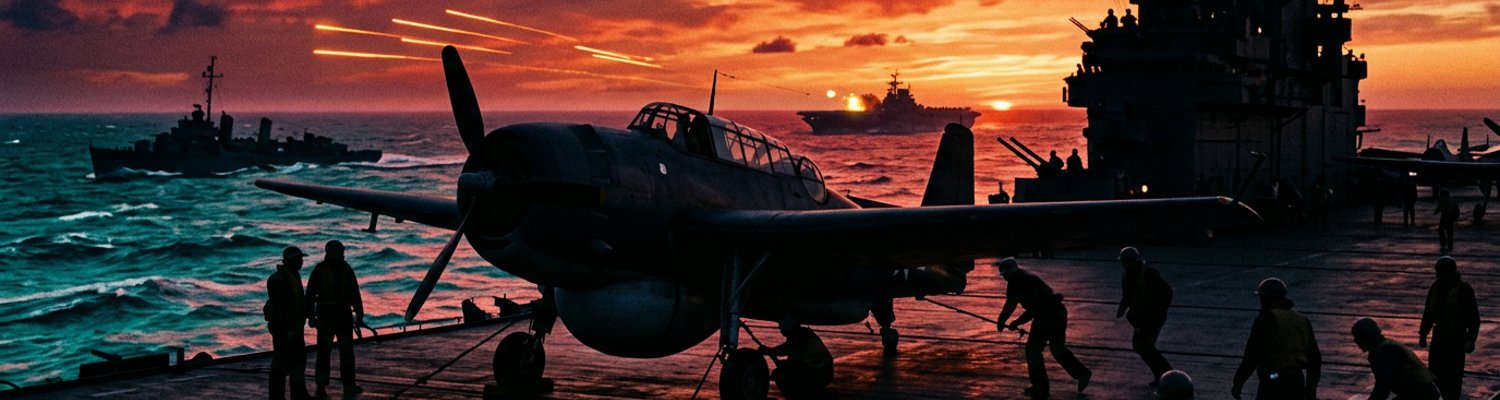
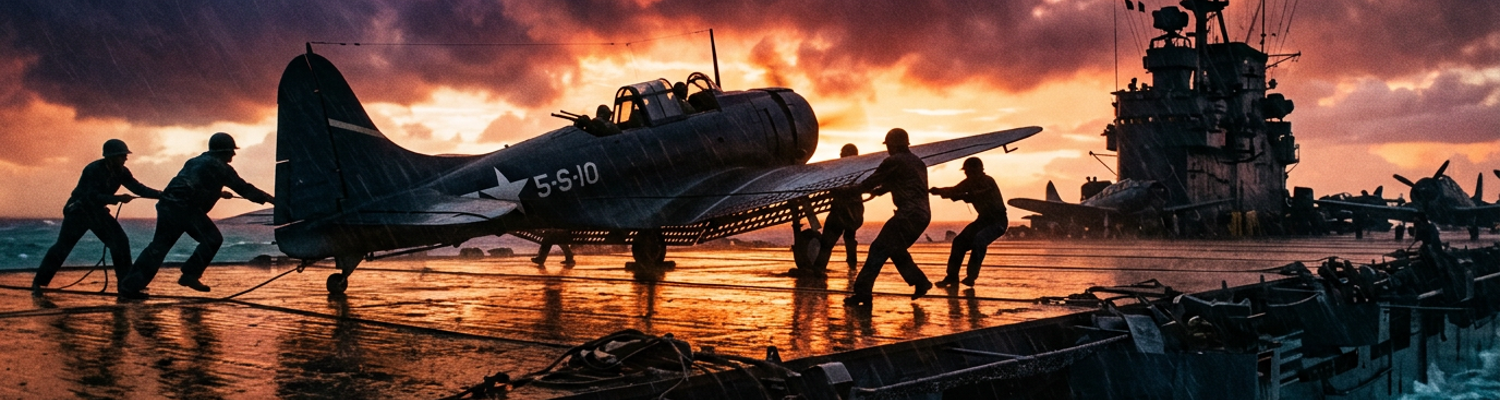
Rain squalls rolled across the open ocean southeast of the Solomon Islands, masking the horizon in thick gray mist and churning the sea into heavy swells that slammed against the steel hulls of the warships. Tropical humidity soaked the carrier flight decks, while boiler rooms deep below the waterline trapped suffocating air that regularly exceeded one hundred and ten degrees. Crew members worked in drenched dungarees under constant threat of heat exhaustion, manning damage control stations and wrestling heavy aircraft across slick steel plates as the ships pitched violently in the surf. Unpredictable wind shifts and sudden torrential downpours repeatedly blinded lookouts and complicated basic flight operations, forcing navigation officers to alter course repeatedly just to launch and recover scout planes. These punishing weather conditions battered every vessel in the fleet, grinding down the physical stamina of thousands of sailors as mechanical equipment steadily degraded under the relentless exposure to salt and moisture.
Vice Admiral Frank Jack Fletcher commanded Task Force 61 from his flagship USS Saratoga, coordinating operations alongside USS Enterprise and USS Wasp while monitoring these erratic maneuvers across the choppy sea. Fletcher worked inside a stifling, poorly ventilated compartment illuminated by dim battle lamps, where staff officers pinned paper markers onto plotting boards to track the scattered positions of the fleet. Each carrier group maintained its own defensive screen of cruisers and destroyers, positioned miles beyond visual range over broad stretches of ocean to prevent a single Japanese air strike from targeting multiple flattops at once. Dispersed task groups forced Fletcher to rely on written dispatches and signal flags rather than direct personal contact, leaving him physically cut off from the subordinate commanders aboard Enterprise and Wasp. Messengers hurried between the bridge and the communication offices carrying carbon copies of delayed contact reports, leaving the admiral to plot fleet movements using scraps of delayed intelligence.
Task Force 61 operated southeast of the Solomon Islands under strict fuel rationing and radio silence protocols that worsened these intelligence delays. Radio transmitters stayed locked down to prevent Japanese direction finders from pinpointing the American carrier positions, depriving Fletcher of immediate voice communication with his subordinate task forces. Signal officers relied on blinker lights, flag hoists, and scout planes dropping message bags onto flight decks, methods that introduced hours of delay into every tactical order. Fuel consumption added another layer of operational friction, as high speed carrier turns in heavy seas drained the fuel oil tanks of the screening destroyers at alarming rates. Fletcher ordered destroyers to shut down auxiliary boilers and cruise at economical speeds, constantly calculating remaining fuel reserves against the distance to rear area replenishment tankers.
USS Wasp turned south alongside its escorting cruisers and destroyers to rendezvous with these replenishment tankers, pulling an entire carrier group away from the patrol zone. Fuel gauges on the screening destroyers had dropped toward critical margins, convincing Fletcher that logistics took priority after scout planes reported no enemy carriers within immediate striking range. Saratoga and Enterprise remained alone in the patrol area, separated by twenty miles of water while maintaining strict communication silence. Staff officers inside the flag plot of Saratoga continued shifting wooden markers across their charts, unaware that three Japanese aircraft carriers were steaming southward toward their position. Fletcher committed his remaining two carriers to launch expanded search patrols at dawn, pushing scout planes into the overcast sky to locate the approaching Japanese fleet.
Radio Intelligence Flaws and Detachment of Task Force 18
Pilots flying SBD Dauntless dive bombers swept across hundreds of nautical miles of gray water without spotting a single wake or mast, returning to their carrier decks with empty contact logs. Their negative sightings seemed to confirm the high level communications arriving through the cryptographic center from Pearl Harbor. Misleading radio intelligence summaries from Pacific Fleet headquarters indicated Japanese fleet carriers were anchored well north of Truk Lagoon. Radio traffic analysts in Hawaii had misinterpreted call sign distributions and Japanese message routing, concluding that the main enemy striking force remained docked at its central anchorage over one thousand miles from the Solomons. Communications runners carried these printed radio bulletins directly into the flag plot of Saratoga, where Fletcher and his staff adjusted their defensive perimeters based on the assumption that no immediate carrier engagement threatened their ships.
Fletcher weighed these reassuring intelligence summaries against the worsening logistical crisis across his destroyer screens, where fuel gauges hovered near empty after days of high speed maneuvering. Acting on the erroneous reports, Fletcher detached Rear Admiral Leigh Noyes and Task Force 18 with USS Wasp south toward Efate for refueling. Signal lamps flickered across the water from Saratoga, transmitting the release orders to Noyes so his escorting destroyers could replenish their dry bunkers before their boilers sputtered out. Noyes turned his task force away from the combat patrol line, gathering two heavy cruisers and seven destroyers into formation for the long transit toward the New Hebrides. Engineers deep in the boiler rooms of Wasp throttled up their turbines to standard cruising speed, steadily widening the physical distance between Noyes and the rest of Task Force 61.
Sailors aboard Saratoga and Enterprise watched the silhouette of Wasp vanish over the southern horizon, leaving the American task force critically exposed. The departure of USS Wasp stripped the American force of roughly one third of its carrier aviation assets immediately prior to contact with Chuichi Nagumo fleet. Noyes took eighty three operational fighters, dive bombers, and torpedo planes away with him, reducing Fletcher from a potent three carrier armada down to just one hundred and fifty three aircraft. Vice Admiral Chuichi Nagumo was already driving south toward Guadalcanal with three carriers, deploying Shokaku, Zuikaku, and Ryujo with nearly one hundred and eighty strike planes ready for launch. Fletcher remained trapped in his information vacuum, leaving Fletcher to study empty charts while Nagumo drove his carriers within air striking range under cover of scattered rain squalls.
Officers inside Saratoga flag compartment adjusted their tactical charts to reflect Wasp absence, completely unaware of the enemy strike groups converging on their coordinates. Fletcher stared down at the remaining two carrier positions, knowing that any unexpected contact would now force Enterprise and Saratoga to fight without reserve squadrons or defensive fighter reinforcements. Messengers continued to deliver routine radio intercept updates from rear bases that still insisted the Japanese carriers were idle at Truk. Fletcher approved the night patrol orders for his remaining air groups, sending fresh search coordinates down to the ready rooms as darkness settled over the Solomon Sea.
Headquarters Isolation and Sighting Report Latency
Pilots in the ready rooms plotted those assigned search sectors onto grease pencil flight boards before climbing into their cockpits for the morning search sweeps. Deck crews unlashed tie down ropes and pulled wheel chocks from the tires of scout planes, guiding the aircraft forward into the damp headwind across Saratoga pitching flight deck. Dozens of search planes climbed through the morning clouds alongside long range Consolidated PBY Catalina flying boats operating from primitive island anchorages at Ndeni. A scouting Catalina spotted the Japanese light carrier Ryujo and its escorting cruisers shortly after nine in the morning, but the discovery failed to reach the fleet commanders when it mattered most. Intense tropical humidity and solar atmospheric turbulence disrupted high frequency radio waves across hundreds of miles of ocean, scattering Morse code transmissions into chaotic bursts of static that ground stations and shipboard antennas could not decipher. Radio operators inside Saratoga suffocating communication spaces pressed heavy earphones against their heads, adjusting tuning dials repeatedly as fragmented letters and broken coordinates dissolved into electrical noise.
Messengers carried those broken transmission transcripts up iron companionways into the flag plot, delivering scraps of scribbled paper that provided only vague information on enemy movements. Isolated aboard USS Saratoga, Fletcher operated without definitive confirmation of whether Ryujo was an isolated decoy or part of a concentrated fleet carrier sortie. Memories of the Battle of the Coral Sea four months earlier weighed heavily on the admiral, reminding his staff how Japanese naval commanders had sacrificed the light carrier Shoho to divert American striking power away from the fleet carriers Shokaku and Zuikaku. Fletcher knew that if Ryujo served as a diversion, committing Saratoga dive bombers and torpedo planes against it would empty his flight decks and leave Task Force 61 vulnerable to a counterstrike from concealed Japanese flattops. Cryptographic reports from Pearl Harbor continued to claim that the primary Japanese carrier fleet remained at Truk, yet the absence of positive sightings in the northern waters gave Fletcher no reassurance. Staff officers leaned over the wide navigational chart table under flickering incandescent bulbs, pinning markers on incomplete positions while Fletcher paced the deck plates in complete isolation from the tactical reality.
Enterprise dive bombers swept north through overcast skies to resolve the missing intelligence, searching miles of ocean for the Japanese fleet carriers. Two scout bombers from Enterprise eventually spotted the main carrier striking force containing Shokaku and Zuikaku through breaks in the clouds, but equipment interference and shared frequencies with fighter direction radios blocked their transmissions from reaching Fletcher plotting room. Hours passed without fresh intelligence, while radar screens and coastwatchers warned that Ryujo had launched an air strike of its own against the Marine airfield at Guadalcanal. Fletcher concluded that he could no longer hold his aircraft in reserve while an enemy flight deck operated within striking range of American ground forces. Flight deck officers on Saratoga launched thirty Douglas SBD Dauntless dive bombers and eight Grumman TBF Avenger torpedo bombers at 1340, sending the strike group down the flight deck toward Ryujo. Commander Harry Felt rallied his thirty eight strike planes into tight formation and set a northward course, committing the majority of Fletcher offensive aviation against a secondary target just as Nagumo fleet carriers launched waves of dive bombers directly at Task Force 61.
USS Enterprise Fighter Direction and Radar Bottlenecks
Enterprise radar operators tracked the outbound strike on their display scopes until sharp signal pulses bounced back from the northwest, revealing an incoming formation of unidentified aircraft. USS Enterprise CXAM 1 radar detected incoming Japanese strike groups at a distance of eighty eight miles, but manual plotting backlogs stalled threat tracking inside the stifling compartment. Sailors crowded around a vertical edge lit Plexiglas board, frantically writing down bearings, distances, and estimated altitudes with yellow grease pencils as reports flooded in over sound powered phone circuits. Radar technicians struggled to distinguish the enemy bombers from scattered flights of returning American scout planes that lacked functional identification friend or foe transponders. Plotting runners tripped over cables in the dim red lighting, while grease pencil marks accumulated in confusing layers that smeared under sweaty hands before officers could calculate accurate intercept angles. Communications supervisors watched the backlog multiply by the minute, realizing that the raw tracking data on their boards lagged five to ten minutes behind the actual position of the enemy planes.
Plotters handed these delayed coordinates directly to the fighter direction team, but radio channel congestion and fighter director officer communication delays prevented Combat Information Center personnel from vectoring VF 6 F4F 4 Wildcats to adequate intercept altitudes. Fighter director officers pressed their microphone switches into a single overcrowded very high frequency radio channel that was already filled with rapid chatter between carrier air groups and screening cruisers. Pilots from VF 6 circled tens of miles away at barely ten thousand feet, burning valuable aviation fuel while waiting for clear vectoring instructions that dissolved into harsh squeals of static. Radio operators on Enterprise shouted into their headsets to clear the frequency, yet overlapping transmissions from Saratoga and distant scout bombers repeatedly cut off the fighter director officers mid sentence. Wildcat division leaders rocked their wings in frustration as broken numbers and scrambled compass bearings crackled uselessly through their cockpit headphones. Carrier direction teams lost precious minutes repeating instructions to unresponsive cockpits, leaving their fighter patrols idling in low cruising orbits while the sky above them remained completely unguarded.
Aichi D3A2 Val dive bombers from Shokaku and Zuikaku initiated their high altitude attack runs before American combat air patrol interceptors could reposition, exploiting the empty sky eighteen thousand feet above the task force. Lieutenant Commander Mamoru Seki led the twenty seven dive bombers into a steep echelon formation as the wake of Enterprise stretched across the dark ocean water below. American fighter pilots caught sight of the Japanese formation through breaks in the clouds, banking their Wildcats into steep climbs and pushing their throttles forward in an attempt to reach intercept height. Heavy Grumman Wildcats labored under slow climb rates, gaining less than two thousand feet per minute while the Japanese Vals peeled off into steep seventy degree dives. Japanese aircrews dropped toward the fleet completely unopposed by American fighters, aligning their telescopic bomb sights with the flight deck of Enterprise as the diving planes accelerated past two hundred and forty knots.
Lookouts on the carrier bridge spotted the diving planes plunging through the broken cloud deck and shouted alarms into the shipboard announcement system. Captain Arthur Davis ordered emergency hard rudder, swinging the carrier into sharp evasive turns that threw sailors against steel bulkhead walls and tilted the flight deck into the rolling sea. Gun crews across the catwalks opened fire with five inch guns, one point one inch quad mounts, and twenty millimeter cannons, throwing dense patterns of tracer fire and black flak bursts into the path of the diving Vals. Japanese dive bombers held their diving angles through the flak bursts, releasing heavy armor piercing bombs at fifteen hundred feet before pulling up sharply across the carrier mastheads. Explosions shook the hull plates of Enterprise as three direct bomb hits tore through the flight deck, igniting aviation fuel lines and shattering the isolated command spaces below.
Aichi D3A2 Bomb Strikes on USS Enterprise
Steel fragments tore through catwalks and repair lockers as Enterprise absorbed three direct hits from 250 kilogram semi armor piercing bombs and multiple near misses within a four minute span. Massive geysers from the near misses collapsed exterior walkways, drenched anti aircraft gun tubs with thousands of tons of seawater, and threw the carrier into an unnatural shudder that knocked helmsmen off their feet. Concussion waves rippled through the outer hull plating below the waterline, loosening rivets and flooding outboard fuel tanks while the wooden flight deck buckled under scorching blasts. Flying metal severed communication cables running along the catwalks, instantly isolating gun mounts from central director control and forcing anti aircraft crews to aim manually through thick smoke. Damage control parties charged their fire hoses and dragged heavy rescue gear across blistered deck planks toward the smoking blast holes.
Flames erupted through the forward blast hole where a separate strike punched through the flight deck aft of the island, detonating near officer quarters and threatening adjacent five inch 38 caliber powder magazines. Shrapnel from this blast severed electrical cables and pierced thin stateroom partitions, turning living spaces into a roaring fire that directly bordered the handling rooms. Gun crews and ammunition passers felt the steel bulkheads grow burning hot against their bare hands as dense fumes seeped through the ventilation dampers into the lower handling rooms. Repair personnel immediately opened sprinkler valves and directed high pressure saltwater lines into the threatened spaces, dousing ready service ammunition racks before rising temperatures could ignite the stored charges. Sailors passed unexploded five inch shells and smoldering mattress bedding by hand from man to man to clear the compartment corridors of combustible material.
Smoke billowed upward from deeper inside the ship where one bomb penetrated five decks deep near the starboard No 2 gun gallery, killing thirty five men and destroying primary ventilation blowers. Detonation forces crushed the starboard machinery spaces and obliterated damage control stations, throwing men against machinery, severing electrical conduits, and rupturing high pressure steam pipes. Poisonous gases and scorched air backed up through collapsed intake ducts because the shattered blowers could no longer draw fresh air into the lower engineering compartments. Firemen and machinists strapped on oxygen rescue breathing apparatus to crawl through pitch black, suffocating boiler rooms while searching for survivors among the mangled steel framework. Exhausted sailors pulled wounded shipmates up vertical escape ladders with braided hemp lines, fighting intense heat that peeled paint from the bulkheads and blistered bare skin.
Stretcher bearers carried those burn casualties toward emergency dressing stations while Captain Arthur Davis struggled to assess the full extent of the destruction from the navigation bridge. Sound powered telephone circuits hung dead along the bulkheads, cutting off the bridge from the flooded lower decks and forcing junior officers to sprint through smoke filled passageways with handwritten casualty tallies. Radio transmitters onboard Enterprise suffered intermittent power losses that prevented Davis from sending an immediate damage assessment to Fletcher aboard Saratoga twenty miles away. Flag plot officers on Saratoga watched a thick black column of smoke climb over the southern horizon, completely unaware whether Enterprise remained capable of steering, launching aircraft, or surviving another coordinated air strike. Fletcher waited by the plotting table in agonizing silence for status reports that did not arrive, while Enterprise listed to starboard and fought her own fires in total tactical isolation.
Steering Engine Room Flooding and Improvised Triage
Saltwater and chemical foam from the firefighting efforts on the flight deck drained directly into shattered exhaust trunks, cascading deep into the stern of the carrier. Ruptured fire mains and firefighting foam flooded the steering engine compartment, short circuiting electrical control motors and locking the rudder at twenty degrees right. Steering cables sparked violently under water as electrical shorts tripped circuit breakers and filled the enclosed lower compartment with acrid smoke. Helmsmen on the navigation bridge rotated the wooden steering wheel without response as thirty four thousand tons of armored steel heeled sharply to starboard at twenty seven knots. Watchstanders inside the steering room collapsed unconscious onto the steel deck plates from toxic gases before anyone could throw the transfer switches to backup control units. Bridge officers watched the magnetic compass card spin continuously through three hundred and sixty degrees while the carrier carved an unending circle across the waves.
Destroyer escorts struggled to maintain protective screening positions around Enterprise as the carrier carved through its own wake in continuous circles across submarine infested waters. Lookouts swept their binoculars across the surrounding ocean for torpedo wakes, well aware that an unmaneuverable fleet carrier presented an ideal target for lurking Imperial Navy submarines. Captain Arthur Davis could neither steer toward the safety of Fletcher task group nor send a clear radio signal through his damaged transmission lines to explain why Enterprise was steaming erratically. Chief Machinist Mate William A Smith led an emergency repair team into the flooded steering space under temperatures exceeding one hundred and thirty degrees Fahrenheit and toxic gas conditions. Smith strapped on a modified oxygen breathing apparatus and clipped a hemp lifeline around his waist before dropping through the escape hatch into the stifling darkness below. Blistering heat from broken steam lines and trapped combustion fumes seared through dungarees, forcing team members to crawl on hands and knees across scorching steel ladders.
Steam and poisonous fumes immediately attacked the breathing equipment as Smith reached the waterlogged deck of the steering compartment. Smith waded through waist deep water thick with chemical foam, dragging heavy flashlights to locate the dead motor casings and jammed rudder linkages. Suffocating heat overwhelmed Smith twice during his initial inspections, knocking him unconscious and forcing support sailors at the hatchway to haul him to the surface with the safety rope. Corpsmen revived Smith with fresh oxygen and cool water on the deck above, but the chief machinist refused evacuation and descended back into the furnace like space for a third attempt. Smith located the auxiliary steering motor panel submerged in oily bilge water and used insulated hand tools to clear scorched wiring from the terminals.
Electricians ran temporary jumper cables through shattered bulkheads from an intact power bus to establish a secondary circuit. Damage control teams bypassed electrical systems to rig improvised steering control while Enterprise circled uncontrollably in submarine infested waters. Machinists turned heavy iron bypass valves by hand against intense hydraulic backpressure, forcing trapped hydraulic fluid through emergency lines to the steering rams. Hydraulic pressure slowly built across the dual cylinders until the locked rudder finally broke free from its twenty degree starboard stops. Rudder indicators on the bridge jerked back to amidships after thirty eight minutes of uncontrolled turns, allowing helmsmen to steady Enterprise on a southern course toward Task Force 61.
Combat Divergence and Emergency Henderson Field Landings
Enterprise flight deck crews stared at the shattered teak planking, buckled steel beams, and smoldering blast holes that spanned the length of the ship. Severe flight deck damage aboard Enterprise prevented the recovery of returning SBD 3 Dauntless dive bombers and TBF 1 Avenger torpedo planes as the sun dipped toward the western horizon. Radio operators in the carrier island tried to transmit divert vectors through burned antenna wires, but damaged transmitters and strict radio silence protocols garbled the outbound signals before the circling aviators could decode them. Vice Admiral Fletcher remained aboard Saratoga miles away in total administrative isolation, tracking the strike groups with grease pencil estimations while unaware that Enterprise had turned away without clearing her deck for flight operations. Pilots in the darkening sky checked dwindling fuel needles against their flight logs, reading only a few gallons of aviation gasoline left in their reserve tanks as they searched the blank sea for their carrier. Flight leaders realized that landing aboard the burning flagship was impossible and made the split second decision to break formation and steer south toward the British Solomon Islands.
Aviation fuel drained past the reserve markers as the scattered flights flew across the dark waters of Ironbottom Sound toward the silhouette of Guadalcanal. Marine lookouts stationed around the jungle perimeter heard the unannounced drone of radial engines overhead and scrambled to their defensive gun pits, suspecting an incoming night attack by Imperial Japanese bombers. Marine officers inside the ground command post quickly identified the sound of American Wright and Twin Wasp engines and switched on truck headlights and kerosene smudge pots along the edge of the ground. Surviving aircrews from Scouting Squadron 5 and Bombing Squadron 6 executed emergency night landings on the unfinished dirt runway at Henderson Field on Guadalcanal. Navy pilots dropped their landing gear through low hanging jungle mist and touched down blind on the uneven surface, bouncing hard over deep bomb craters, loose gravel, and thick tropical mud. Ground crewmen sprinted out into the dark to pull exhausted pilots and radiomen from the cockpits before their sputtering engines died from fuel starvation.
Marine mechanics immediately pushed the surviving SBD Dauntless dive bombers into revetments carved out of the tree line and began siphoning fuel from drums by hand to prepare the planes for combat. The unexpected carrier aircraft contingent reinforced the Cactus Air Force at a decisive juncture in the land campaign for Guadalcanal. Marine ground commanders under Major General Alexander Vandegrift lacked adequate strike aircraft to defend their defensive lines against incoming Japanese reinforcement convoys known as the Tokyo Express. Navy pilots from Enterprise and Saratoga integrated directly into Marine flight operations within hours of their arrival, sharing scarce rations, cot space, and hand cranked fueling pumps with the exhausted Marine squadrons. Fleet headquarters in Hawaii and task force commanders in the Coral Sea still logged these dive bombers as missing in action, remaining trapped in their communication blackout while the marooned carrier aviators armed five hundred pound bombs to strike Japanese troop transports approaching the beachhead at dawn. First Marine Division armorers cranked mechanical bomb hoists through the predawn darkness, locking heavy ordnance under the wings of the newly arrived naval aircraft to defend the perimeter.
Command Failures and Strategic Repercussions in the Eastern Solomons
Dauntless dive bombers rolled down the muddy runway at first light, carrying those heavy bombs into immediate strikes against the approaching Japanese transport convoy. Navy and Marine pilots caught the enemy reinforcement force northwest of Guadalcanal, sinking the transport Kinryu Maru and damaging the light cruiser Jintsu until the Japanese turned their surviving ships around. Vice Admiral Fletcher chose not to pursue the retreating enemy warships, ordering Task Force 61 to withdraw southward to conserve dwindling fuel reserves among his screening destroyers. Enterprise limped out of the combat area under its own jury rigged steering, heading toward the repair anchorage at Tongatapu with three bomb holes in its flight deck and seventy-four dead sailors. Fletcher sent encrypted operational summaries back to Hawaii reporting that the immediate threat to the island had been repelled, prompting senior leaders in Pearl Harbor to demand immediate operational reviews of the carrier withdrawal.
Fletcher faced intense post action scrutiny from Admiral Chester W Nimitz regarding the decision to detach USS Wasp based on unverified negative intelligence. Staff officers at Pacific Fleet headquarters reviewed the message logs and demanded to know why Fletcher had trusted general radio estimates from Pearl Harbor when his own scout planes had not yet confirmed the location of the main Japanese carrier force. The premature departure of Wasp had stripped Task Force 61 of nearly one hundred frontline aircraft hours before Nagumo attacked, throwing the entire burden of fleet defense onto Enterprise and Saratoga. Fletcher maintained that his screening destroyers were dangerously low on fuel, but Nimitz pointed out that sending away a full third of American carrier striking power during an active offensive operation risked total disaster in the Solomons. The strategic argument ruined Fletcher standing among fleet planners, and when a Japanese submarine torpedoed Saratoga near Espiritu Santo a week later, Nimitz quietly transferred the wounded commander to a shore post in the Aleutian Islands.
Officers at Pacific Fleet headquarters discovered that the damage to Enterprise had stemmed from administrative and communication failures far worse than Fletcher fuel calculations. The battle exposed systemic deficiencies in shipboard radar reporting, prompting the US Navy to overhaul carrier Combat Information Center organization and fighter direction doctrine. Radar technicians on Enterprise had tracked the incoming Japanese strike groups more than eighty miles out, but sound powered telephone operators could not relay the coordinates fast enough to prevent a massive paperwork backlog. Grease pencil plotters smeared raw bearings across overcrowded Plexiglas boards, leaving the carrier fighter director officer unable to judge the true speed, heading, or altitude of the diving Vals. American Wildcat fighters had circled in clear sky thousands of feet below the incoming bombers because the carrier lacked a centralized plotting room capable of sorting radar clutter into immediate radio orders for pilots.
Shipyard workers at Pearl Harbor began tearing out old plotting rooms aboard American carriers to install newly standardized Combat Information Centers with independent radar repeaters and multi channel radios. Naval commanders replaced the single overloaded fighter director officer with specialized teams of radar plotters, status board keepers, and air controllers working in unified spaces. The revised doctrine gave these specialized watch officers direct authority to order fighter squadrons into specific altitude tiers without waiting for clearance from the carrier navigation bridge. Electronics technicians installed dedicated very high frequency radio circuits on every carrier flight deck, ensuring that fighter intercept channels remained separate from general fleet warning networks. Naval planners issued these standardized plotting tables and radio procedures to every carrier group departing for the South Pacific, locking the new operational structure into fleet regulations before the next carrier battle off the Santa Cruz Islands.