
Field Manual 4-02 and Golden Hour Mandates
At 0338 hours, a severed coaxial lead disconnected the high-frequency antenna link between the Spera Ridge tactical operations outpost and the battalion tactical operations center at Forward Operating Base Salerno. This hardware failure plunged the high-altitude ridgeline into complete isolation. The outpost radio operator watched the signal indicator on the AN/PRC-117F display drop to zero bars. Eighty-two-millimeter mortar fragments continued to strike the perimeter stone wall.
Static swallowed the tactical net.
A close review of operational logs indicates that this sudden signal blackout collided directly with the strict operational requirements of the Department of Defense sixty-minute medical evacuation mandate. Enacted across the Afghan theater under defense directives dating back to 2009, this policy enforced an uncompromising operational standard. Critically wounded combatants classified as Urgent or Urgent-Surgical required transfer from the point of injury into advanced surgical care within sixty minutes of a nine-line transmission. Aviation units maintained strip alerts designed to launch twin-engine UH-60A and UH-60L Black Hawk DUSTOFF airframes within fifteen minutes of an authenticated emergency call. Aircrews calculated tight weight-and-balance manifests to accommodate twin General Electric T700-GE-701D turboshaft engines. These powerplants labored heavily in the thin air of eastern Afghanistan. Field elevations routinely exceeded two thousand meters. Defense department protocols demanded complete medical suites aboard these airframes. Required equipment included mechanical ventilators, active suction units, and specialized en-route critical care nurses capable of administering packed red blood cells mid-flight. Operating within contested valleys like Spera also triggered mandatory armed escorts. Flight dispatchers withheld unarmed medevac launches until AH-64D Apache gunships spun their rotors and cleared departure checks. This sequence consumed precious fractions of the sixty-minute window before the evacuation birds ever left the runway.
The countdown did not pause for mechanical delays.
Archival evidence shows that frontline personnel were simultaneously adjusting to the August 2013 release of Field Manual 4-02. This manual redefined Army Health System doctrine across all operational echelons. It established rigid structural standards for Role 1 tactical casualty collection points. Point-of-injury triage had to transition immediately into structured physiological stabilization before any air movement request. Under the August 2013 doctrine, a single battalion combat medic working out of an exposed casualty collection point carried heavy clinical burdens. Medics secured compromised airways with surgical cricothyroidotomy kits. They applied windlass-based Combat Application Tourniquets to arterial bleeds. They initiated intravenous infusions of tranexamic acid within three hours of catastrophic tissue damage. Field Manual 4-02 instructed frontline elements to segregate incoming wounded into strict triage tiers using Talon II collapsible litters. Personnel cataloged each soldier on standard field medical cards (Department of the Army Form 2173). Medics managed tension pneumothoraces through needle chest decompressions at the second intercostal space. Implementing these hospital-grade stabilization procedures within a remote outpost proved exceptionally difficult. The manual presupposed an uninterrupted chain of voice communications to transmit nine-line medical evacuation requests and coordinate blood product resupply with Role 2 forward surgical teams located at regional hubs.
Doctrinal requirements failed against physical geography.
When examining the historical record of the 0340 ridge triage, the collision between the doctrinal stabilization mandate of Field Manual 4-02 and the ticking sixty-minute evacuation clock exposed deep systemic friction. Medics at Spera Ridge faced severe blast injuries and traumatic amputations caused by an ammonium nitrate pressure-plate explosion along the southern perimeter footpath. Without the AN/PRC-117F connection, the medic could not transmit the nine-line message to summon the outbound air ambulance from Task Force Knighthawk. Outpost personnel attempted to push the casualty data through an alternate VHF tactical net. Operators dialed manual frequencies into an AN/PRC-148 handheld radio. The battery voltage fell rapidly below ten volts.
No confirmation beep returned across the handset.
Afghan Auxiliary Signaling and Khost Province Patrols
Night patrols in the border valleys of Khost operated without standard visual markers.
Archival evidence shows that throughout the autumn and winter of 2013, Combined Joint Task Force-10 shifted its collection footprint across Spera District. Military intelligence detachments deployed four-man U.S. Army HUMINT Collection Teams directly onto joint foot patrols alongside irregular Afghan auxiliary units. These formations traversed elevations exceeding twenty-two hundred meters along ridgelines overlooking the Kaitu River basin. American collectors carried sixty-five-pound mission loads. They balanced Handheld Interagency Identity Detection Equipment alongside standard body armor plates, target dossiers, and multi-band AN/PRC-152 handheld radios. Tactical command dictated that these joint teams conduct tactical site exploitation and field interrogations inside isolated compounds near villages like Mandozayi and the Spera bazaar. Movement through these narrow mountain trails occurred exclusively during zero-illumination windows. This scheduling evaded insurgent early-warning observers positioned on dominating peaks. Patrol leaders deliberately avoided valley roads due to heavy concentrations of pressure-plate improvised explosive devices embedded in the unpaved dry wadi washes. Every kilometer traversed on foot required constant coordination between the trailing American security detachment and forward Afghan screening elements.
Terrain channelized every step into fatal engagement zones.
When examining the historical record of these combined operations, the technical divide between conventional American infantry and the Afghan Local Police exposed severe friction points during casualty handoffs. Auxiliaries assigned to rural checkpoints lacked the baseline logistical support distributed to regular Afghan National Army brigades. Afghan Local Police personnel guarded mountain positions wearing civilian shalwar kameez garments under non-ballistic load-bearing vests. They carried legacy Romanian AKM rifles and stamped Chinese Type 56 carbines. Magazines contained mismatched, corroded 7.62x39mm ammunition. Night operations amplified these physical deficits. Coalition troops observed sectors through high-performance AN/PVS-14 monocular night-vision devices. Auxiliary fighters lacked thermal or electro-optical observation gear entirely. Visual signaling across forward lines relied on handheld civilian flashlights or cheap green laser pointers purchased in local bazaars. Units occasionally deployed disposable infrared chemical lights with expired shelf lives. Batteries failed without warning in sub-zero ridge temperatures. Signaling tools extinguished at critical junctions.
Auxiliary forces possessed zero cryptographic communication capability.
A close review of operational logs indicates that the Afghan Ministry of Interior never provisioned the Spera auxiliary network with Type 1 National Security Agency encryption hardware. Tactical voice traffic among Afghan Local Police posts ran across unkeyed, commercial-off-the-shelf Icom IC-V8 and Baofeng UV-5R VHF transceivers. These radios operated on open civilian frequencies. Auxiliary commanders carried no Automated Communication Security Equipment. They possessed zero AN/PYQ-10 Simple Key Loaders. They held no access to secure Single Channel Ground and Airborne Radio System frequency-hopping electronic keys. Transmissions traveled over plain text in localized Pashto dialects across the high-frequency spectrum. Any insurgent monitoring station equipped with basic radio scanners could intercept the traffic. When casualty evacuations forced these rural auxiliaries to link up with coalition tactical perimeters after midnight, cross-net radio authentication was mechanically impossible. American perimeter sentries tuned their AN/PRC-117F receivers to proprietary SINCGARS hopping nets. Auxiliary units attempted voice contact on unencrypted 144-megahertz civilian channels. Approaching Afghan litter teams were forced to announce their presence using improvised physical gestures in dead darkness.
Severe Mountain Weather and DUSTOFF Platform Grounding
Rotor blades sat chained to the tarmac at Forward Operating Base Salerno.
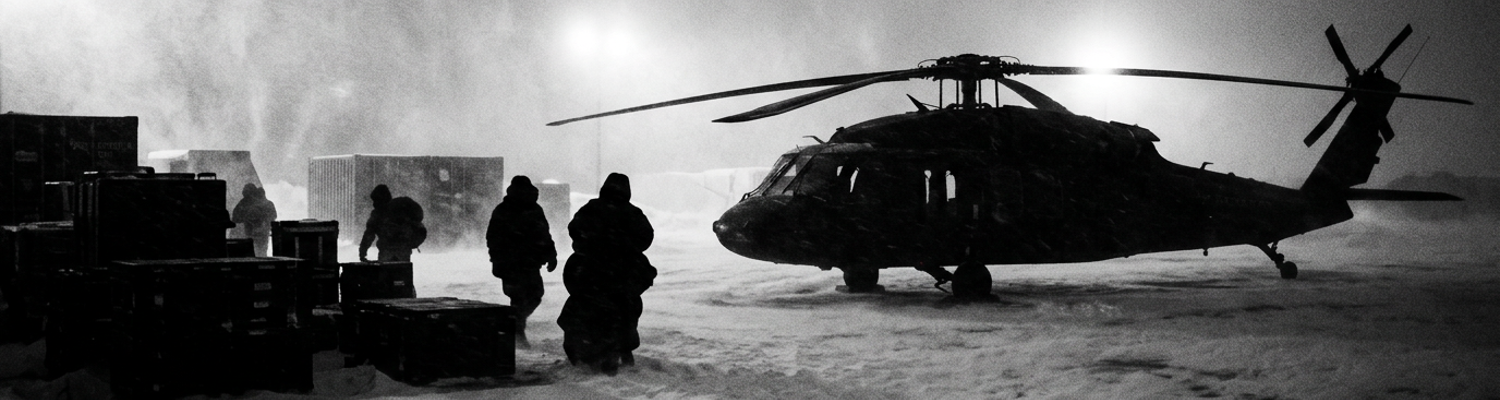
Archival evidence shows that by 0342 hours, an aggressive winter cold front pushed across the Spin Ghar range. Gale-force blizzards swept directly through the mountain passes separating Spera District from the flight line. Meteorological sensors logged sustained winds of forty-two knots. Localized gusts exceeded fifty-five knots across high-altitude gaps at twenty-four hundred meters elevation. Sub-zero temperatures caused supercooled water droplets to form instantaneous rime ice along the leading edges of main rotor blades. Company C, 6th Battalion, 101st Combat Aviation Brigade operated twin-engine UH-60L Black Hawk utility helicopters configured for aeromedical evacuation under callsign DUSTOFF. Onboard electrothermal de-icing blankets lacked the thermal capacity to shed rapid rime accumulation at minus fifteen degrees Celsius. Ice accretion altered airfoil camber. This increased blade drag and degraded aerodynamic lift until engine torque margins dropped past safe operational limits. Pitot-static heat elements failed to prevent ice from plugging dynamic pressure probes. Airspeed indicators on cockpit instrument panels disabled completely. Flight operations duty officers at Salerno recorded local cloud ceilings dropping below two hundred feet. Horizontal visibility collapsed to zero meters. Aviation commanders enacted an immediate weather stop. All rotary-wing assets transitioned to mandatory ground-hold status.
The sky was closed.
When examining the historical record of rotary-wing flight routes in Khost Province, zero-visibility mountain flying stripped aircrews of survivable flight profiles. Aviation doctrine required DUSTOFF pilots to maintain continuous visual contact with ridgelines when traversing narrow, serpentine ingress corridors along the Kaitu River drainage basin. Standard military instrument flight rules provided no verified low-altitude approach corridors through unmapped mountain defiles. Jagged granite walls rose three thousand meters above sea level along these routes. Operating with AN/AVS-6 night vision goggles proved impossible under active blizzard conditions. Cockpit searchlights reflected directly off airborne snow crystals. This produced severe optical backscatter that blinded aviators and destroyed depth perception. Forward-looking infrared sensors mounted on escort AH-64D Apache gunships experienced thermal crossover. Snow-covered mountain slopes and sheer rock walls became indistinguishable on multifunction displays. Controlled flight into terrain emerged as an absolute certainty rather than an acceptable flight risk. Low-altitude flight through restricted mountain corridors also forced helicopters into predictable geographic choke points. Insurgent gunners positioned heavy twelve-point-seven-millimeter DShK machine guns at these exact coordinates. Without the ability to detect terrain contours or hostile firing positions, Task Force Destiny could not clear an ingress heading toward the Spera perimeter.
No aircraft departed.
A close review of operational logs indicates that the physical grounding of Task Force Destiny completely shattered the sixty-minute evacuation timeline for casualties at the ridge. Spera outpost personnel received the aborted flight status over the battalion satellite net. Hypothermia accelerated traumatic shock among blast-injured patients simultaneously. Combat medics were forced to convert outdoor triage tarps into subterranean warming stations inside sandbagged fighting bunkers. Medical personnel depleted tactical supplies of plasma and freeze-dried blood products without any prospect of aerial replenishment from Salerno. Evacuation options narrowed to manual casualty carries across twelve kilometers of snow-drifted goat paths controlled by local insurgent cells. Frontline elements were completely severed from surgical intervention assets for the remainder of the night. At 0344 hours, ground sentries prepared defensive fires while listening to footsteps approaching the outer wire.
Convoy Communication Failures and Medical Resupply Halts
Archival evidence shows that at 0339 hours, four up-armored vehicles belonging to Forward Support Company, 1st Battalion, 26th Infantry Regiment advanced along the switchbacks of Route Copper. The column pushed toward Spera Ridge under blackout driving conditions. The formation comprised three M1151A1 High Mobility Multipurpose Wheeled Vehicles and a trailing RG-31 Mine-Protected vehicle. Cargo included eight cases of Hextend plasma expanders, freeze-dried blood plasma units, thirty-two junctional tourniquets, and ten replacement oxygen cylinders. Movement across the unpaved surface churned through eight inches of fresh powder at fifteen kilometers per hour. Lead vehicle drivers operated using AN/PVS-14 monocular night vision devices wired to amber dashboard illumination. Drivers scanned the ascending cutbanks for command wires and pressure-plate indicators. Inside the command Humvee, the convoy commander monitored an AN/VRC-90 vehicle-mounted vehicular radio amplifier tray connected to an OE-254 whip antenna.
Static crackled steadily through the dynamic speaker.
No voice reply returned from the mountain ridgeline.
When examining the historical record of 3rd Brigade Combat Team operations that night, technical misconfigurations within the Single Channel Ground and Airborne Radio System architecture severed coordination before the wheels turned out of Forward Operating Base Salerno. Communications technicians responsible for loading the tactical radios programmed the outpost RT-1523E receiver with automated combat net radio hopset uniform four-one-zero. Technicians used transmission security key variables valid through midnight. The vehicle convoy operated under separate movement orders issued by Task Force Duke logisticians. The convoy departed the wire carrying frequency-hopping net ID uniform four-zero-one. This data loaded from an AN/PYQ-10 Simple Key Loader running an outdated communications security electronic variable (COMSEC file 88-A). The SINCGARS algorithms relied on microsecond-accurate time-sync intervals across thirty to eighty-seven megahertz frequencies. A mismatch in hopset data caused each radio to jump to conflicting frequencies every few milliseconds without establishing contact. Operators on the ridge keyed handsets across secure voice channel zero-four. Convoy radiomen toggled through preset channels without realizing their equipment was broadcasting across unoccupied spectrum. Repeated manual attempts to drop out of frequency-hopping mode and acquire the outpost on a fixed single-channel recovery frequency of forty-six point seven-five megahertz failed. Radio operators misdialed decimal settings under heavy vehicle vibration.
Neither element received an electronic handshake.
A close review of operational logs indicates that this communication collapse triggered an immediate command stop two thousand four hundred meters short of the Spera casualty collection point extraction line. Convoy vehicles reached Phase Line Amber at grid coordinate WB 2341 8912. Route Copper narrowed into an eighty-meter granite defile flanking the dry riverbed below the outpost at this location. Operating procedures strictly prohibited uncoordinated entry into the primary tactical casualty collection point extraction corridor without authenticated challenge-and-reply radio verification from the ridge perimeter guard force. The convoy commander avoided moving into pre-registered final protective fire zones or triggering tripwire ambushes established by defending infantry platoons. Snowdrifts against the eastern shoulder of the cutbank masked potential fifty-pound ammonium nitrate blast points. This denied the heavy RG-31 clearance to maneuver. At 0341 hours, the lead vehicle brought its bumper within five yards of a rockfall blocking the left track. The driver set the brakes and cut the headlights completely. Medics inside the convoy could see thermal flares igniting across the upper peak. Doctrine prevented advancing unarmed litters without security escorts across open, snow-covered gravel.
Exhaust plumes drifted across frozen rock faces while ambient temperatures dropped to minus eighteen degrees Celsius.
Improvised Hypothermia Management Protocols at Role 1
Blood loses its ability to clot once core body temperature falls below thirty-four degrees Celsius.
Archival evidence shows that by 0345 hours, the aid post inside Bunker Three had exhausted every factory-sealed Hypothermia Prevention and Management Kit in its inventory. Distributed across standard combat medic aid bags, each kit unit contained a single multi-cell Ready-Heat chemical blanket and a vacuum-packed Heat Reflective Shell designed to trap radiant warmth. Two catastrophic blast trauma casualties arriving from the perimeter breach required immediate active thermal intervention. Combat medics tore open the four available kit sleeves within twelve minutes of the initial triage cycle. Oxygen-activated chemical cells embedded within the Ready-Heat liners began their reaction on schedule. Ambient temperatures hovering at minus sixteen degrees Celsius curtailed their peak thermal output. Chemical packets designed to sustain a temperature of forty degrees Celsius for eight hours degraded rapidly in the freezing air draft circulating through the bunker entrance. Sharp granite gravel on the dugout floor repeatedly perforated the thin vapor-barrier linings of the reflective shells. Accumulated heat vented directly into the sub-zero atmosphere. Replacement supply panniers carried in the bunker held additional tourniquets, chest seals, and hemcon dressings.
Supply inventories contained no spare heat blankets.
A close review of operational logs indicates that this supply void placed treating personnel in direct conflict with the stabilization doctrine established in Field Manual 4-02. Army Health System doctrine identified hypothermia as the initial trigger of the lethal triad of trauma. Thermal collapse directly induces metabolic acidosis and systemic coagulopathy in hemorrhagic shock patients. Field Manual 4-02 mandated active thermal regulation at the point of injury to prevent core body temperatures from dropping during resuscitation. Blast victims lose thermal mass through rapid blood loss and massive peripheral vasodilation caused by exposure. Spera Ridge sat twenty-four hundred meters above sea level. High-altitude air density accelerated evaporative heat loss across sweat-drenched, exposed skin. Room-temperature intravenous fluids administered to replace intravascular volume acted as internal thermal sinks. These fluids drove patient core temperatures down by several tenths of a degree with each five-hundred-milliliter bag of unheated saline or Hextend infused through eighteen-gauge catheters. DUSTOFF helicopters remained grounded at Salerno. Mechanical warming systems did not exist at the outpost. The single on-duty medic faced physiological collapse in three blast patients whose clotting factors were failing in the freezing mountain air.
Doctrine dictated thermal protection without providing the means to maintain it.
When examining the historical record of the 1st Battalion, 26th Infantry Regiment, field medical personnel responded by cobbling together non-standard thermal systems from general combat equipment. Medics gathered olive-drab modular sleeping bag systems from unoccupied infantry cots. They slipped casualties inside water-resistant bivy covers lined with synthetic patrol bags. Standard litters rested directly on frozen dirt. Troops layered empty wooden ammunition crates and discarded MRE cardboard boxes beneath the canvas beds to interrupt conductive heat transfer into the stone floor. To generate active external heat, team members collected forty-eight chemical Flameless Ration Heaters from discarded Meal, Ready-to-Eat ration cases. Soldiers activated the magnesium-iron alloy pads using small squirts of non-potable water. They sealed them inside plastic ration sleeves to prevent chemical caustic burns. Medics positioned these improvised heaters along major vascular pathways at the femoral triangles and axillary vaults. Personnel warmed unheated intravenous fluid bags under their own wet-weather parkas. They used core body heat to bring cold crystalloid solutions closer to physiological baseline before line injection.
At 0349 hours, the temperature sensor on the aid station monitor registered a patient core temperature of thirty-two point eight degrees Celsius.
Garbled Nine-Line Transmissions and Perimeter Mistargeting
Archival evidence shows that at precisely 0340 hours, the tactical operations post inside Spera Ridge attempted to broadcast an emergency nine-line medical evacuation request. The operator used an AN/PRC-148 Multiband Inter/Intra Team Radio set to thirty-six point two zero megahertz. The primary antenna link had collapsed. The radio operated entirely on internal lithium-ion battery reserves. The transmitter pushed barely one watt of output power. Severe VHF frequency static and atmospheric thermal inversion over the mountain pass degraded the frequency modulation carrier wave. Squelch circuits at the receiving end clicked open and shut erratically. This interference cut through entire phonetic strings. The outpost radio operator read through the standard lines. Line One designated the grid coordinates of the southern ridgeline. Line Two provided call sign Iron Three. Line Three identified two Urgent-Surgical blast amputations. Transmission fidelity collapsed entirely on Line Six. The sender attempted to state that no enemy personnel occupied the pickup zone. Atmospheric white noise clipped the voice transmission into an isolated fragment that listeners interpreted as enemy troops in area.
Static turned an emergency casualty dispatch into an active ambush warning.
When examining the historical record of 1st Battalion, 26th Infantry Regiment watch logs, this acoustic distortion traveled straight into the tactical headset of an assistant gunner stationed at Bunker Four. Defensive positions forty meters above the southern trail maintained total light discipline during zero illumination. Ground controllers monitoring the thirty-megahertz band registered broken syllables indicating armed movement along the wire. They missed Line Eight entirely. Line Eight designated the casualties as Afghan Local Police auxiliaries. The receiver on the parapet emitted a continuous high-pitched hum. High-voltage squelch circuits failed to suppress ground-wave attenuation against the granite rock face. Sentries lacked two-way voice confirmation from Forward Operating Base Salerno. The guards concluded that the severed transmission signaled a hostile assault on the extraction corridor.
The mountain perimeter locked down under the assumption of immediate ground contact.
A close review of operational logs indicates that precisely eighty meters down the southern defile, four Afghan Local Police auxiliaries ascended toward the defensive wire. They carried an improvised canvas litter. These men transported a fellow auxiliary whose lower right leg had been severed by an ammonium nitrate blast twenty minutes earlier. Under freezing fog, the irregular fighters moved in civilian shalwar kameez trousers covered by wool patu blankets. They wore non-standard chest rigs loaded with curved Kalashnikov magazines. None of the four men carried ballistic helmets, thermal identification markers, or infrared glint tape. Sub-zero temperatures had drained the unbranded AA alkaline batteries inside their civilian green laser pointer. This failure stripped them of their only signaling device. Moving through knee-deep snow across broken granite scree, the litter bearers crouched low to balance the shifting weight of the bleeding casualty. They advanced in staggered bounds between jagged boulder outcroppings.
Inside Bunker Four, two American infantry sentries scanned the approach through AN/PVS-14 monocular night vision devices. They observed four armed silhouettes maneuvering up the low-visibility draw. Green phosphor optics displayed the outline of civilian clothing and slung AKM carbines against the snow. This visual signature matched Haqqani Network fighters known to infiltrate perimeter breaches after explosive detonations. The garbled radio net deprived the sentries of friendly position updates. The sentries could not detect infrared markings. They classified the litter party as an enemy infiltration element closing in on the inner defensive wire. The gunner seated behind an M240B machine gun pushed the weapon safety forward. He gripped the spade handle with both hands. He centered his iron sights on the lead bearer at a range of sixty-two meters.
Finger pressure took up the initial trigger slack.
Communication Interoperability Reforms in Austere Environments
When examining the historical record of the Spera Ridge near-miss, after-action reviews conducted by the 3rd Brigade Combat Team, 1st Infantry Division exposed systemic technical failures across the tactical net. Coalition investigators arriving at Forward Operating Base Salerno documented a complete lack of shared radio architecture. Zero integration existed between American perimeter defense elements and the Afghan Local Police detachments guarding surrounding ridgelines. Outpost sentries operated exclusively within secure frequency-hopping nets governed by Single Channel Ground and Airborne Radio System protocols. Auxiliary fighters relied on commercial, unencrypted transceivers broadcasting between one hundred thirty-six and one hundred seventy-four megahertz. Radio technicians discovered that the auxiliary unit civilian Baofeng and Icom handsets lacked transmission power. They could not override severe VHF ground-wave attenuation. They lacked the cryptographic chipsets required to interface with automated tactical operations centers. Partner units possessed neither standardized visual signaling kits nor functional infrared markers. They relied entirely on commercial green lasers powered by depleted AA alkaline batteries that went dark below freezing.
Investigating officers recovered five frozen transceivers from the southern approach trail that morning.
A close review of operational logs indicates that the formal command inquiry focused heavily on the complete absence of integrated recognition signals during casualty movements. Investigators found that neither Task Force Duke nor the Afghan Ministry of Interior had issued standardized recognition protocols for night casualty transfers into fortified coalition collection points. The litter party had moved within sixty-two meters of Bunker Four carrying an amputee on a canvas stretcher. They dressed in local wool patu wraps that concealed their weapons while masking their friendly status under AN/PVS-14 green phosphor optics. American sentries faced an approaching team devoid of infrared glint tape, Phoenix infrared strobes, or prearranged optical flash sequences. A clipped nine-line transmission stating enemy troops in area primed the guards for combat. Review boards noted that frontline infantry units in Khost Province were regularly exposed to irregular auxiliaries operating under ad-hoc visual arrangements. These arrangements collapsed under stress, cold weather, and radio static.
The division command staff classified the communication gap as an immediate tactical vulnerability across all remote outposts in Regional Command-East.
Archival evidence shows that by late November 2013, Combined Joint Task Force-10 issued tactical directives establishing binding communications and identification standards for all joint casualty collection points. Regional headquarters mandated that forward outposts and auxiliary liaison teams maintain dedicated, cross-band tactical bridge radios. Technicians configured these radios to monitor civilian VHF guard frequency one hundred forty-three point nine zero zero megahertz in plain text. This frequency ran concurrently with secure combat nets. S-6 signal sections received orders to field AN/PRC-152 handheld radios directly to partnered Afghan command cells. Technicians loaded them with unified frequency-hopping hopsets and short-duration transmission security keys distributed via AN/PYQ-10 Simple Key Loaders. Directives instituted strict fail-safe recognition procedures at perimeter approach corridors. Commands established designated optical verification lines at one hundred meters and fifty meters from the wire. Every forward collection point received supplies of high-intensity infrared VIP strobes, eighty-mil optical filters, and adhesive 850-nanometer glint squares to attach directly to casualty litters.
Commanders barred irregular auxiliaries from approaching perimeter wire without flashing a confirmed three-pulse infrared authentication signal.
Implementation logs from December 2013 show that battalion commanders across eastern Khost established recurring mechanical validation checks for all forward-deployed signaling gear. Inspection teams tested auxiliary battery stockpiles. They replaced civilian consumer alkaline packs with military-grade lithium BA-5590 and BB-2590 cells. These military batteries sustained power outputs down to minus twenty-five degrees Celsius. Radio operators assigned to outpost operations centers completed mandatory retraining on AN/VRC-90 vehicle trays and RT-1523E receiver transceivers. Instructors standardized the manual entry of single-channel recovery frequencies to prevent hopset mismatches during tactical emergencies. Outposts along the border received two hundred additional Talon II litters retrofitted with reflective identification bands.