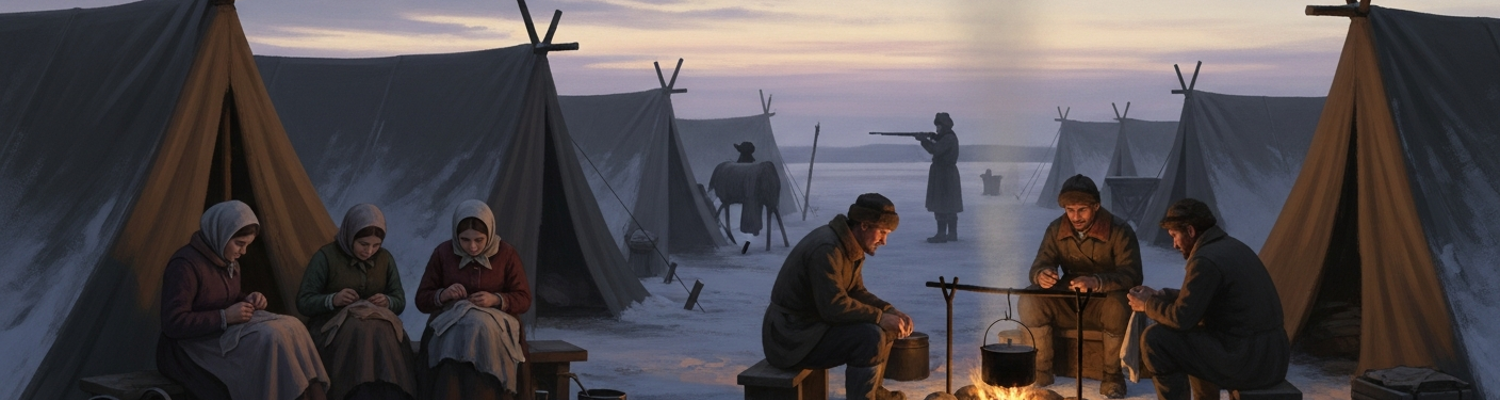

The Continental Army did not march alone. Trailing the columns of infantry and artillery was a second army, a sprawling, unofficial logistical corps essential to the war effort. This civilian tail, known to contemporaries as “retainers to a camp” or “persons whatsoever serving with the armies,” consisted of thousands of women, children, tradesmen, and enslaved persons. Lacking uniforms and formal enlistment, these camp followers formed the functional backbone of the Continental Army, providing services the fledgling military institution could not supply for itself. They were a constant source of logistical strain and disciplinary problems, yet their labor proved indispensable to the army’s survival through the brutal eight-year struggle for independence.
The Unofficial Muster Roll
The population of camp followers was a microcosm of colonial society, driven by a mix of necessity, loyalty, and the pursuit of freedom. The most numerous group was women, primarily the wives, daughters, and mothers of enlisted soldiers. For many, following the army was a matter of survival. With their husbands and fathers gone, many women faced destitution and had no other means of support. Others were displaced from their homes by the fighting, especially in areas occupied by enemy forces, and saw the army as their only refuge. This was particularly true for women from places like New York City or for the wives of soldiers from Quebec, who faced hostility from their Loyalist neighbors.
Beyond soldiers’ families, the camps attracted a variety of other civilians. Licensed traders known as sutlers set up shop to sell goods like soap, liquor, and other provisions not regularly supplied by the army. Their presence was a tolerated necessity, though they were often accused of price gouging and required regulation by the army command.
Skilled artisans, or artificers, also traveled with the troops, serving as blacksmiths, carpenters, wheelwrights, and coopers. They repaired wagons, shod horses, and maintained the army’s equipment. These men were sometimes organized into their own companies under the Quartermaster General’s Department, forming a distinct, quasi-military element within the camp.
The camps also held the promise of liberty for enslaved persons. Both free and enslaved African Americans were present. Some were brought by officers as personal servants. Others, like Sarah of the 1st Maryland Regiment, were enslaved people who saw the Continental Army as a potential path to freedom. Virginia’s Royal Governor, Lord Dunmore, issued a proclamation in 1775 promising freedom to enslaved people who fled Patriot enslavers to serve the British, a policy that drew thousands to the British lines. In response, the Continental Army also became a destination for freedom-seekers, though their status remained precarious. Hannah Till, for example, purchased her own freedom and found employment as a cook for General Washington himself, serving for six and a half years at his headquarters.
Consuming and Creating Logistics
The presence of thousands of extra civilians created immense logistical challenges for the Continental Army’s chronically undersupplied Quartermaster Department. These followers needed to be fed, sheltered, and guarded, adding a significant burden to a supply chain that could barely sustain the fighting men. At its peak, the ratio of women to men in the army could be as high as one for every fifteen soldiers in some units. During the winter encampment at Valley Forge in 1777-1778, an estimated 400 women were present. Each of these individuals drew rations, consuming precious food and supplies. A soldier's daily ration, when available, might consist of a pound of beef and a pound of bread; a follower's half or quarter ration, multiplied by hundreds, represented a substantial drain on the commissary.
Despite the strain they placed on formal logistics, camp followers critically filled the gaps in the army’s support structure. The Quartermaster Corps, responsible for supply and transport, and the Medical Department were rudimentary and understaffed. Camp followers provided a range of essential, if informal, services. Women were the army’s laundresses, a vital role in an era when hygiene was a primary defense against disease. Clean clothes helped curb the spread of typhus, known as “camp fever,” which frequently ravaged armies. They also cooked for individual soldiers or groups of men, mended torn uniforms, and scavenged the countryside for extra food. They nursed the sick and wounded, a task the understaffed Medical Department could not handle alone. When his generals complained that the sick “suffered much for Want of good female nurses,” Washington authorized advertisements seeking “humane and industrious women” for the job. In 1777, Congress authorized a monthly pay of eight dollars for nurses, though the work was unpleasant and dangerous due to constant exposure to disease like smallpox and dysentery. Women like Jane Norton were recognized by officers for their persistence in “attending and relieving the sick and wounded at all times.”
From Nuisance to Necessity
General George Washington’s view of camp followers was complex and evolved throughout the war. Initially, he saw the “multitude of women” as a nuisance and a “clog upon every movement.” He worried they slowed the army on the march, drained scarce resources, and created disciplinary problems. In August 1777, he issued orders for officers to “get rid of all such as are not absolutely necessary,” particularly those who were pregnant or had children. Before marching his army through Philadelphia that same year, he ordered that “not a woman belonging to the army is to be seen with the troops on their march.”
Washington, however, came to recognize their indispensability. He understood that many women had no other means of subsistence and that attempting to expel them would have disastrous effects on morale and discipline. He acknowledged that if he did not provide for soldiers’ families, he risked losing “by Desertion, perhaps to the Enemy, some of the oldest and best Soldiers in the Service.” This realization forced a shift in policy from attempted exclusion to regulated inclusion. Washington eventually conferred the title “Women of the Army” upon these followers and issued numerous orders to formalize their rations and regulate their conduct. Baron von Steuben’s “Regulations for the Order and Discipline of the Troops of the United States,” the army’s drill manual adopted in 1779, further codified their position. Steuben’s regulations assigned laundresses a specific place in the column of march, behind the baggage of their respective regiments, and stipulated that only a certain number per company were entitled to draw rations. This represented a formal, if limited, integration into the army’s operational structure, acknowledging their function while attempting to control their impact.
A Force of Its Own
The followers themselves were not passive recipients of army policy. On several occasions, they organized to protect their interests in what amounted to informal labor negotiations. When Congress ordered a reduction in rations for women, a group from a New York artillery regiment resisted. They argued they earned their food by washing clothes for soldiers who often failed to pay them. Their husbands threatened to desert, forcing Washington to relent and restore the rations. In another instance, washerwomen for General Anthony Wayne’s regiment went on strike to protest non-payment. Wayne, while admonishing the women for their insubordination, also ordered his captains to deduct laundry fees from the pay of soldiers who were not punctual in their payments.
Their status was ambiguous. They were civilians, yet they were subject to military law and could be flogged or drummed out of camp for theft, disorderly conduct, or other infractions. They lived in a precarious space, not quite soldiers but essential components of the military machine, their presence a constant negotiation between the army's needs and its commander's desire for order.
The View from Opposing Lines
The large, sprawling nature of the Continental Army's baggage train, swelled by thousands of followers, did not go unnoticed by its opponents or allies. British commanders often viewed the American army's slow-moving civilian tail as a tactical vulnerability, a weakness to be exploited on the march. The contrast was particularly stark when compared to the professional European armies of the day. The French expeditionary force under the Comte de Rochambeau, which arrived in 1780, was operated with a highly organized, state-funded logistical corps. French officers were often taken aback by the American army's apparent disorganization, its reliance on a civilian appendage that seemed to blur the lines between army and society.
This very distinction, however, highlighted the fundamental nature of the American war effort. Lacking the robust state institutions of a European power, the Continental Army had to rely on this informal, resilient, and deeply personal support system. The camp followers were not just a logistical solution; they were a reflection of a revolutionary society mobilizing for war in the only way it could. They were the living, breathing, and laboring connection between the home front and the battlefront, ensuring the army could continue its fight.