
SHAEF G-5 Financial Branch Deployment to Paris
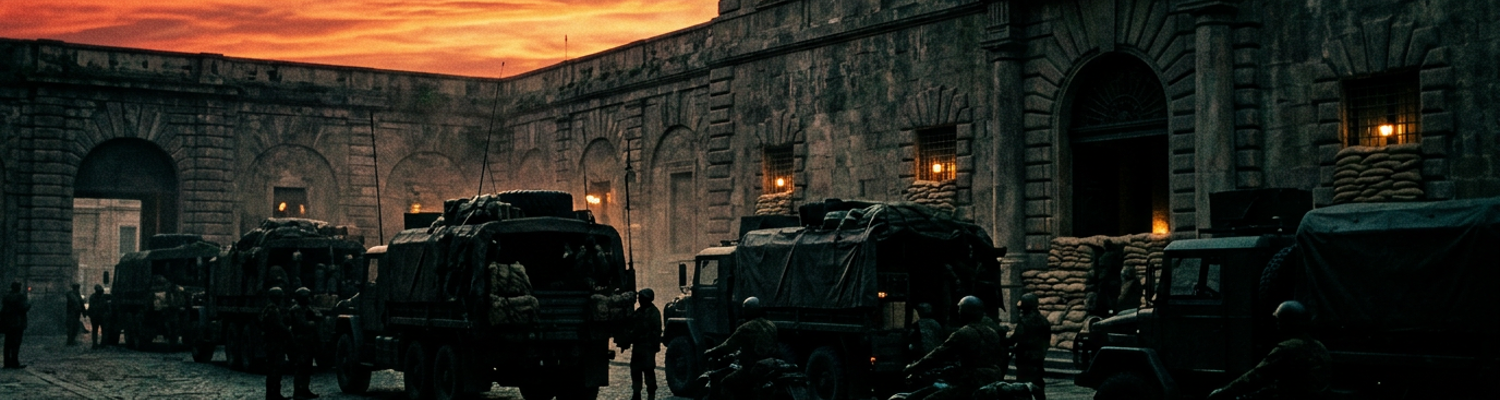
Soldiers loaded wooden footlockers, field desks, and heavy canvas map cases into Dodge weapons carriers under an urgent twelve-hour deadline to reach Paris before retreating German forces could sabotage the national monetary reserves. Intelligence specialists assigned to the SHAEF G-5 Financial Branch rushed between supply depots to gather currency conversion handbooks, carbon paper, and security seals alongside soldiers of the 1st European Civil Affairs Regiment. Mechanics tightened loose fan belts, stacked spare tires, and strapped extra five-gallon fuel cans to truck bumpers to ensure the convoy could make the push without stopping for fuel. Orders dictated that the teams move out immediately to catch the advancing French 2nd Armored Division, forcing clerks to pack crated typewriters and weapons in darkness during the final hours of late August 1944. Drivers gunned their engines and steered the heavy trucks out of staging fields, weaving past burnt-out armored vehicles and rubble-strewn intersections toward the barricaded outskirts of central Paris. Scattered rifle fire and isolated pockets of German snipers cracked from upper-story apartment windows along the boulevards as the lead vehicles turned toward the central banking district.
Riflemen from the 1st European Civil Affairs Regiment dismounted at the iron gates of the Banque de France headquarters, aiming their carbines at neighboring rooftops while securing the outer courtyard under total blackout conditions. Officers ordered perimeter guards to sandbag the ground-level windows along the rue de la Vrilliere and set up machine-gun positions to block armed looters or counterattacking German patrols. Financial specialists took heavy brass ring keys from elderly French bank guardians and hurried through the pitch-black administrative halls toward the subterranean bullion vaults. Flashlight beams cut across cold limestone walls as the search teams walked down reinforced spiral staircases, inspecting the massive steel security doors and ventilation shafts for hidden tripwires or demolition explosives. Bank employees explained that retreating occupation officials had disabled the electric vault elevators, leaving the intelligence detachment to carry heavy ammunition boxes, field radios, and emergency battery banks down the narrow service shafts by hand.
Technicians unloaded the heavy equipment onto concrete floors to establish an improvised forward technical post in the damp cellar vaults directly adjacent to the subterranean currency chambers. Portable diesel generators set up near basement exhaust flues shook the stone foundations, blowing hot oily exhaust back into the unventilated corridors and coating the walls in greasy black soot. Intelligence personnel worked under intense sensory strain as the generator roar echoed off wet masonry walls, mingling with the sickening smell of stagnant bilge water and damp air. Mold and moisture seeped from the vaulted ceilings onto wooden tables, forcing clerks to wipe condensation from ledger paper with their uniform sleeves while checking occupation transaction records. Specialists coughed in the chemical haze and rubbed burning eyes as they picked scorched ledger paper out of basement incinerators where fleeing German administrators had attempted to destroy currency shipment slips.
Clerks smoothed the scorched fragments under battery lanterns and matched the charred balance figures against intact central bank account books to halt unauthorized bank transfers. Captains and warrant officers conferred directly with French bank directors, issuing immediate written orders to freeze all foreign-denominated accounts and impound remaining currency reserves before black-market traders could exploit the transition. Signal corps runners laid telephone wire along the subterranean stairwells, linking the damp basement command post to the main Allied communications hub at the Hotel Scribe. Armed guards sealed the heavy vault doors with steel padlocks and stamped lead seals, logging every serial number into master registers. Officers placed an armed security watch over the vaults and carried the first batch of verified financial ledgers up to waiting courier trucks for transport to headquarters.
Securing Damaged Ledgers and Banking Records
Trucks rolled away into the damp Parisian night, leaving behind secondary basement chambers overflowing with thousands of soaked and partially incinerated account folios. Specialists assigned to the G-5 salvage team carried wire mesh drying racks and lengths of hemp cord into the lower boiler rooms to begin emergency recovery operations on records abandoned by retreating German administrators. German clerks had dumped transaction ledgers into furnace fireboxes and blocked drainage pipes to flood storage vaults, turning critical banking files into heavy masses of sodden pulp and scorched vellum. Technicians set up portable kerosene blowers and electric floor fans to circulate dry air through the cold masonry corridors, carefully laying individual waterlogged pages across sheets of dry blotting paper to draw out moisture without smudging the fountain-pen figures. Clerks used blunt wooden spatulas and brass tweezers to separate charred, sticking leaves, salvaging daily cash balances, gold transfer slips, and requisition warrants before mold could rot the paper fibers. Workers cataloged each recovered fragment in numbered ledger envelopes, noting the basement room where the material was found and marking damaged lines with red wax pencils to establish clear chain-of-custody tracking.
Envelopes of dried documents were brought immediately to makeshift examination tables where intelligence officers began the forensic reconstruction of accounts held by the Bank der Deutschen Luftfahrt and German clearing offices across metropolitan Paris. Specialized banking teams laid out fragmented transaction books from the German aviation bank, which had handled payments for French manufacturing plants producing aircraft engines, landing gear, and airframe parts under occupation contracts. Analysts pieced together burned check stubs and carbon invoices from the German clearing office, matching individual debit vouchers with recorded deliveries of aluminum sheet metal, machine tools, and industrial lubricants. Flashlights and handheld magnifying lenses allowed officers to read faint imprint lines left on scorched duplicate sheets, tracing millions of francs that occupation authorities had systematically extracted from Parisian commercial institutions. Accountants cross-referenced transaction numbers against requisition orders issued by the German military administration, mapping the exact bank channels used to move stolen French capital across the border into Reich accounts. Missing account volumes and burned ledger leaves created substantial gaps in the records, leaving analysts with broken mathematical chains that could not be reconciled through German paperwork alone.
Accountants from major French commercial banks entered the basement post to help Allied officers decode the fragmented double-entry bookkeeping systems before emergency banking deadlines expired. Civil affairs officers conducted detailed interrogations of French head bookkeepers, chief cashiers, and file clerks who had worked in the occupied institutions, seeking immediate explanations for contradictory debit entries and unfamiliar German clearing symbols. French staff members identified the specific accounting procedures the German clearing office had enforced, explaining how clerks had split single transactions across multiple hidden ledger columns to disguise unauthorized currency withdrawals. Allied and French specialists worked side by side through the night under strict operational deadlines, recalculating daily balances on hand-cranked mechanical adding machines and matching German clearing house vouchers with corresponding French credit journals. Bookkeepers spotted hidden holding accounts that disguised military requisitions as ordinary commercial transactions, enabling the team to isolate genuine civilian deposits from German state assets that required immediate seizure. Captains signed formal freezing certificates for every identified account, locked the reconstructed ledgers into steel shipping chests, and handed the finalized balance registers to armed guards waiting to deliver the evidence to supreme headquarters.
Reconstruction of Vichy Occupation Indemnity Levies
Couriers hauled the heavy steel chests past the vault perimeter guards, leaving the remaining G-5 financial intelligence specialists surrounded by wooden crates of unprocessed Vichy government ledgers. Analysts turned their portable electric lamps toward the primary records of the Banque de France to begin a systematic financial audit of the 400-million-franc daily occupation assessment extracted under Article 18 of the 1940 Franco-German Armistice. That armistice clause had bound the defeated French state to fund the entire maintenance of the German military presence, establishing an artificial exchange rate of twenty francs to one Reichsmark that grossly overvalued German purchasing power. Officers fed scorched, brittle folio leaves into ledger frames, fighting severe eye strain and mental exhaustion as they totaled daily credit entries that had drained more than thirty billion francs every three months from the national reserve. Generator fumes hung heavy in the stagnant damp cellar vaults, settling onto ink-stained fingers while clerks used mechanical adding machines to verify the staggering cumulative figures against original wartime deposit receipts. Mathematical cross-checks revealed that the occupation levy had deliberately exceeded actual troop garrison costs by more than double, generating vast surplus sums that the German military administration had redirected into special operational credit accounts across the capital.
Auditors tracked those surplus credit balances through French Treasury accounts to reconstruct how the Wehrmacht had converted French monetary funds into industrial war production. Ledger columns showed that German procurement offices in Paris had systematically drawn millions of francs daily from these Treasury reserves to purchase French-manufactured munitions, tank components, and aircraft engines directly from domestic factories. Investigators pulled transport invoices from damp filing boxes to confirm that occupation authorities had similarly charged the French state for the complete operational maintenance of the SNCF rail transport network, forcing the domestic rail system to haul German freight trains eastward at French expense. French Treasury transfer logs also confirmed extensive procurement payments for raw materials, including bulk shipments of aluminum, industrial steel, refined copper, and construction timber seized for the Todt Organization. Civil affairs officers worked through persistent sleep deprivation and physical fatigue, using red wax crayons to mark every ledger line where French national tax revenues had paid for war supplies delivered to frontline German divisions. The verified disbursement totals showed that Wehrmacht agencies had spent nearly half of the entire armistice levy on direct procurement, leaving the French economy stripped of essential commodities while piling astronomical debts onto the national balance sheet.
Analysts tackled the final and most complex phase of the audit by dissecting the Berlin clearing balances that German occupation authorities had used to strip French industrial and commercial capital. German banking officials had routed all Franco-German commercial trade through the central clearing office in Berlin, creating an artificial accounting system where French exporters shipped factory goods to Germany without receiving real currency or reciprocal commercial imports in return. Bookkeepers inspected the Banque de France debit logs, demonstrating that the French central bank had been forced to advance hundreds of billions of francs to local manufacturers to cover unpaid German clearing balances. The accumulating paper credits held against Berlin had functioned as an enforced, interest-free loan that generated uncontrolled domestic currency inflation while transferring real French manufacturing machinery, consumer products, and commercial holdings into German hands. Officers cross-checked the final clearing balances against recovered German bank manifests, finding an uncollectible deficit of more than one hundred and sixty billion francs registered in favor of France on the books. Major John Richardson of the G-5 Financial Branch stamped the compiled audit findings with official verification seals, bound the three master calculation folders with green cloth tape, and carried the completed indemnity audit up the cellar stairs for immediate submission to the Supreme Allied Commander.
Commercial Banking Channels and Capital Flight Networks
Investigators squeezed past Richardson on the damp basement staircase, carrying heavy wooden crates filled with impounded files from private commercial banks along the Boulevard Haussmann. Specialists from the G-5 Financial Branch emptied file folders across the damp wooden tables and began auditing private balance sheets from institutions including the Banque Nationale pour le Commerce et l Industrie and Credit Lyonnais to uncover illicit transfers. Exhausted clerks scraped dried mud and soot off the canvas ledger covers, lighting additional kerosene hurricane lamps to inspect hastily altered debit ledgers. Accountants tracked urgent wire transfers and courier receipts that retreating German officers had dispatched in early August, searching for systematic leaks of French capital routed into neutral havens in Switzerland and Spain. Pervasive fumes from the nearby diesel generator drifted into the room as clerks cross-referenced balance amounts, discovering that German corporate syndicates had liquidated substantial French industrial profits into Swiss franc holdings and Madrid bank credits during the final weeks before the liberation. Officers marked each suspicious transaction path with blue wax pencils, documenting how German financial agents had used falsified commercial invoices to funnel hundreds of millions of francs beyond the reach of Allied armies.
Analysts followed the blue pencil marks directly into the secret business files of collaborationist firms that had created elaborate dummy corporate entities to disguise illegal holdings. Search teams pried open locked steel deposit boxes found hidden behind false basement masonry in commercial bank branches, pulling out bundles of untraceable bearer bonds and stacks of illicit foreign exchange reserves. Officers used heavy pry bars and cold chisels to crack rusted safe-deposit doors, working in stagnant air that smelled of moldering paper and stale grease. Warrant officers sorted through thick envelopes of Swiss francs, American dollars, and British pounds sterling that collaborationist industrialists had stashed away to protect their personal wealth from wartime seizure. Technicians dismantled the paper networks of shadow import-export companies, identifying French factory directors who had fronted German shell corporations to shift chemical patents, shipping shares, and foreign currencies across the Pyrenees and the Swiss border. Clerks filled out formal interdiction warrants for every discovered dummy company, confiscating the concealed negotiable bearer bonds and cataloging the foreign currency bills into serialized canvas evidence sacks.
Canvas evidence sacks and ironbound trunks packed with impounded banking manifests were carried up to the ground-floor courtyard, where forward dispatch riders waited with Harley-Davidson motorcycles and Dodge weapons carriers. Captains coordinated directly with courier detachments to chart secure convoy routes through the southwestern suburbs, where isolated German stragglers and snipers still threatened the primary supply roads. Mechanics replaced frayed fan belts and topped off radiator fluid under dim blackout lights, making sure each vehicle could withstand the rough roads without breaking down in hostile territory. Drivers checked their carbines, secured extra petrol drums to their tailgates, and signed double-entry custody manifests before pulling out into the congested military corridors linking Paris to SHAEF rear echelons in Normandy. Logistics crews steered the trucks through artillery-pitted secondary roads and around blown bridges, delivering the commercial audit evidence under armed guard to rear-echelon financial intelligence sections for immediate inter-Allied enforcement. Guards pushed the final shipment of manifests through the rear depot gates at Valognes, handing the certified transfer receipts back to the Paris couriers for the return run.
Currency Stabilization and Allied Military Franc Control
Motorcycle couriers pocketed the transfer receipts and sped back toward central Paris, where anxious civilian crowds were already massing outside commercial bank branches along the Boulevard des Italiens. Intelligence officers from the SHAEF G-5 Financial Branch met immediately with administrators from the French Provisional Treasury inside the drafty central banking halls to stop the threat of mass bank runs. French officials drafted emergency decrees that enforced strict cash withdrawal caps, limiting each account holder to a maximum of five hundred francs per week to keep local cash reserves from collapsing overnight. Bank clerks behind steel teller cages stamped civilian ration cards and inked personal identification booklets under the watchful eyes of armed Allied soldiers, carefully checking ledger names against verified customer balance logs. Stagnant cellar air mixed with diesel exhaust from idling staff cars drifted through the open stone doorways while clerks stacked paper banknotes into rationed bundles on the wooden counters. French Treasury inspectors locked the surplus vault grates and turned their attention to street markets where unregulated cash transactions were threatening the official price schedules.
Vendors and black-market merchants in the Les Halles market district began circulating suspicious paper currency, prompting Allied field agents to confiscate large batches of forged Supplemental Allied Military Francs from produce stalls and cafe registers. Intelligence specialists carried the suspect paper bills into an improvised testing room in the bank basement, setting up glass droppers, magnifying lenses, and chemical reagents across a scrubbed pine workbench. Technicians applied iodine solutions and diluted nitric acid droplets directly to the paper surfaces to test the fiber composition and color-fastness of the printing inks. Genuine Allied military currency produced on durable cotton-linen bond stock resisted the chemical solutions, while the crude counterfeit bills turned dark blue and smeared as cheap wood pulp dissolved under the acid wash. Investigators used brass calipers and handheld magnifying glasses to examine the engraved French flag emblems and serial number alignments, identifying distinct mechanical flaws in the printing plates that pointed to clandestine printing shops operating in the city. Specialists swept the contaminated currency bundles into sealed tin canisters and filed formal seizure reports with Allied command to establish emergency monetary boundaries across the liberated zone.
Officers from the G-5 Financial Branch used those seizure reports to coordinate with French central bank directors and enforce fixed cross-currency exchange rates across every Allied paymaster desk and commercial window in the capital. Allied headquarters pegged the conversion rate at exactly fifty French francs to one American dollar and two hundred francs to one British pound sterling, giving civil affairs units an unbending monetary baseline to suppress rampant currency speculation. Civil affairs officers worked alongside French postal and telegraph administrators to impose rigid postal and commercial wire remittance restrictions throughout metropolitan Paris. French telegraphers and postal workers halted all outgoing private money orders and foreign telegraph transfers, refusing to process any commercial wire request that lacked an official clearance stamp signed by the Provisional Treasury. Armed sentries took up security posts beside the central telegraph switchboards to ensure that no unauthorized financial messages left the capital, while bank tellers locked their foreign exchange drawers and logged every conversion into triplicate ledgers under battery lanterns. Allied paymasters shut their transaction grates at dusk, locking the remaining franc packets inside ironbound field safes to keep local circulation firmly under military control.
Asset Interception and the Foreign Exchange Depository
Field safes clanged shut across Paris as the supreme headquarters activated the SHAEF Currency Section in September 1944 to build a unified Foreign Exchange Depository mechanism for impounding enemy monetary assets. Civil affairs specialists carried portable steel deposit trunks down into the fortified sub-basements of the Banque de France, where armed sentries guarded thousands of seized bullion bars and confiscated enemy foreign reserves. Lieutenant Colonel Bernard Bernstein and his financial intelligence teams converted the damp subterranean chambers into a centralized processing depot, working through the night to inventory truckloads of enemy assets brought in from branch banks across the Seine basin. Stagnant air thick with the smell of diesel exhaust from idling surface generators and wet masonry clung to the damp uniforms of technicians who unpacked wooden crates filled with confiscated Reichsmarks, Swiss francs, and British pounds sterling. Specialists weighed each lot on mechanical balance scales and recorded the serial groups into duplicate master registers to prevent looting, black-market leakage, or unauthorized commercial movement across military boundaries.
Balance scales clattered on heavy wooden worktables as clerks instituted standardized evidentiary chain-of-custody protocols for all gold bars, foreign paper currencies, and negotiable instruments seized in bank vaults throughout the capital. Technicians stamped each gold ingot with individual inventory numbers, measured its purity with touchstones and acid testing kits, and verified its weight against German clearing logs recovered from commercial vaults. Clerks stacked foreign paper currency into banded packets of one hundred notes, sealing every bundle inside heavy waterproof canvas envelopes that were stamped with indelible purple ink and initialed by two witnessing officers. Warrant officers logged negotiable securities, bearer bonds, and foreign exchange certificates into triplicate deposit manifests, writing down the exact bank vault compartment where each parcel was found alongside the names of the German and French officials who held the keys. Armed guards loaded the sealed canvas sacks into padlocked iron chests, signed the outward delivery vouchers, and stacked the crates against the vault walls under round-the-clock military police surveillance.
Padlocked iron chests stayed under armed guard while intelligence analysts carried the corresponding asset registers upstairs to cross-reference the paper trails against broader international German holdings. Specialists matched the recovered Parisian asset ledgers directly against intelligence files gathered under Operation Safehaven, a coordinated Allied economic campaign designed to identify and block German capital transfers into neutral countries. Analysts pored over scorched transaction folios under dim electric lamps, using brass rulers and red pencils to connect collaborationist shell corporations in Paris to hidden accounts in Zurich, Lisbon, Madrid, and Buenos Aires. Bookkeepers traced how retreating German industrial syndicates had transferred French manufacturing patents, mineral concessions, and foreign exchange reserves through dummy brokerage firms in Switzerland before Allied divisions closed the ring around the capital. Technical teams transcribed every corporate name, bank routing code, and hidden escrow balance onto standardized Safehaven index cards, compiling evidence that Allied diplomats and intelligence agencies used to pressure neutral banking authorities into freezing German flight capital.
Safehaven index cards were bound into thick operational dossiers and packed into steel dispatch boxes alongside photographic copies of the original French deposit sheets. Couriers carried the finished intelligence packets up the stone cellar stairs into the courtyard, where logistics drivers warmed up their Dodge weapons carriers in the autumn drizzle. Sergeants inspected the vehicle fuel tanks, tightened the canvas cargo tarpaulins over the dispatch cases, and handed signed receipt certificates to the depot duty officer. Drivers shifted into gear and steered the supply trucks out of the bank gates onto the cobblestones, heading toward the communications airfields at Orly to deliver the financial evidence to forward operational commands and Allied economic intelligence centers across Europe.
Evidentiary Architecture for Postwar Economic Prosecutions
Mechanics at the Orly airfield guided the Paris supply trucks directly across the tarmac, where transport planes waited with open cargo doors to receive the crated banking evidence. Flight crews secured the heavy wooden boxes with tie-down ropes and flew the material to rear staging depots, where Allied war crimes prosecutors began assembling the legal foundation for the International Military Tribunal at Nuremberg. Allied legal specialists took direct custody of the reconstructed French bank ledgers, uncrating the bound volumes in secure document rooms to establish the exact chain of financial exploitation. Lawyers worked alongside civil affairs accountants to examine the dried, charred folios, matching confiscated payment vouchers to Wehrmacht requisition slips that documented the systematic economic pillage of occupied France. Staff attorneys cataloged each recovered ledger leaf under formal evidence control logs, proving that German occupation authorities had intentionally exceeded legitimate administrative costs to bankrupt the French state. Legal teams packed certified photographic duplicates and index sheets into shipping lockers, sending the files to Nuremberg to serve as primary documentary evidence against the leaders of the German war economy.
Prosecutors at Nuremberg used these French bank records to expose the direct role of the German Reichsbank in laundering confiscated civilian and state funds through Western European financial systems. Audit sheets reconstructed in the damp Paris cellars showed that the Reichsbank, operating under the direction of Walther Funk and Emil Puhl, had systematically converted plundered gold, stolen foreign currency, and expropriated civilian deposits through French commercial channels. German banking officials had routed the proceeds of forced confiscations through the Banque de France and private Parisian institutions to conceal the illicit origin of the funds before transferring the balances to Berlin or neutral markets. Financial investigators tracked debit entries showing how the Reichsbank had commingled the assets seized from private businesses and persecuted populations with ordinary state funds to purchase critical war materials abroad. Allied attorneys presented the reconstructed accounting books directly to the tribunal to counter claims that central bank directors were unaware of the economic plunder carried out across the occupied territories. The entered ledgers provided indisputable physical evidence that the German central banking network had operated as an active partner in international theft and state-sponsored spoliation.
Officers in civil affairs divisions analyzed the operational lessons of the Paris mission, turning the improvised vault recovery methods into a structured blueprint for future campaigns. Senior commanders recognized that the rapid seizure and forensic reconstruction of enemy financial records had neutralized black-market networks and preserved irreplaceable legal evidence under combat conditions. Army planners compiled formal training circulars that mandated the early integration of specialized banking officers, forensic accountants, and vault security teams into forward combat echelons. New field manuals instructed civil affairs units to target enemy clearing houses, secure domestic ledger archives, and seal foreign exchange channels before retreating forces could destroy the paper trail or transfer assets into neutral territory. Staff officers packed the final procedural handbooks and Paris after-action reports into heavy canvas transit bags, loaded the sealed documents onto courier flights, and dispatched the new operational doctrines to frontline civil affairs regiments advancing toward the German border.