
Initial Maritime Surge and Intake Infrastructure Collapse
Diesel exhaust filled the humid Caribbean air. Coast Guard cutters slammed into the concrete piers at Naval Station Guantanamo Bay. The vessels unloaded thousands of dehydrated bodies onto the scorching tarmac of McCalla Airfield. The initial maritime surge completely broke the existing intake infrastructure on day one. Dehydrated migrants collapsed on the flight line. Military personnel scrambled to distribute plastic water jugs.
There was no backup plan.
Joint Task Force 160 was hastily established in the summer of 1994 to process and detain over 12,000 Haitian refugees intercepted during Operation Sea Signal. Archival evidence shows that base commanders initially expected a manageable flow of migrants. They prepped existing facilities for a tiny fraction of the incoming populace. The absolute volume of Coast Guard interdictions quickly overwhelmed the established camp perimeters. Military engineers from the 20th Engineer Brigade received orders to bulldoze the dense scrubland around Camp Bulkeley. They erected General Purpose Medium tents directly on top of sharp coral rock. This abrasive surface immediately tore through the canvas floors. Airborne dust coated every surface inside the living quarters. The tactical water purification systems pulled from the ocean struggled to desalinate enough drinking water to keep pace with the daily intake of five hundred new arrivals.
Within three weeks, the population swelled past 12,000 detained Haitian nationals.
Processing this mass of humanity required fingerprinting every individual. Soldiers conducted medical screenings for tuberculosis using limited analog x-ray machines (Model 44-B, Department of Defense inventory). They issued barcoded identification wristbands under a relentless 100-degree sun. Sanitation systems collapsed under the physical volume of human waste. Contracting logs indicate that the rented civilian portable toilets filled within four hours of deployment. Engineers dug open slit trenches near the housing areas using heavy excavators.
The United States Army assumed primary ground administration duties for a peacetime civil-military internment operation without any dedicated operational doctrine. A close review of operational logs indicates that commanders frantically searched for relevant literature. They eventually discovered that Field Manual 19-40 strictly governed the confinement of Enemy Prisoners of War. This manual was legally and practically useless for managing a sprawling civilian refugee city. It offered nothing.
Soldiers from the XVIII Airborne Corps and various Military Police brigades arrived on the island expecting to provide standard perimeter security.
They got clipboards instead.
The military had no established framework for organizing democratic camp councils. They lacked procedures for handling civilian domestic disputes or managing large-scale infant care. Infantrymen accustomed to rigid combat drills found themselves attempting to source baby formula. The military supply chain was entirely geared toward sustaining combat formations with ammunition and standard rations. Requisitioning thousands of pairs of children's shoes or civilian-grade feminine hygiene products required bypassing the standard Department of Defense supply system entirely.
Quartermasters resorted to calling commercial vendors in Florida directly from encrypted satellite phones.
The administrative conflict of deploying lethal combat units to execute unarmed social work created immediate command paralysis at the platoon level. Squad leaders had to improvise crowd control tactics daily when the centralized meal lines broke down into physical altercations. Archival records detail specific incidents where military police units stood shoulder-to-shoulder in riot gear. They were entirely unsure of the legal parameters for using physical force against starving civilians attempting to breach the concertina wire to reach the supply pallets. The rules of engagement were blank. The chain of command issued contradictory orders regarding the exact legal detention status of the Haitians. The military classified them neither as prisoners of war nor as free residents.
Translators were dangerously scarce.
Army civil affairs personnel relied on a handful of Creole-speaking soldiers pulled from unrelated units to mediate disputes over water rations. The lack of doctrine meant that every basic administrative function required an ad hoc solution drafted on a whiteboard. Medical units had to figure out how to safely dispose of thousands of soiled civilian diapers in an austere environment lacking proper incineration facilities.
On August 12, an infantry patrol assigned to Camp Bulkeley Sector 4 was forced to abandon a supply truck. A crowd of three hundred detainees surrounded the vehicle to strip it of Meals Ready-to-Eat. The soldiers walked back to the command tent with empty hands.
Camp Bulkeley Coastal Scrubland and Temporary Housing
The primary water distribution manifold for Sector 2 cracked under pressure at 1400 hours on August 15. A high-pressure geyser of chlorinated drinking water blasted across the sun-baked coral rock. Hundreds of desperate detainees rushed the perimeter wire with empty plastic canteens.
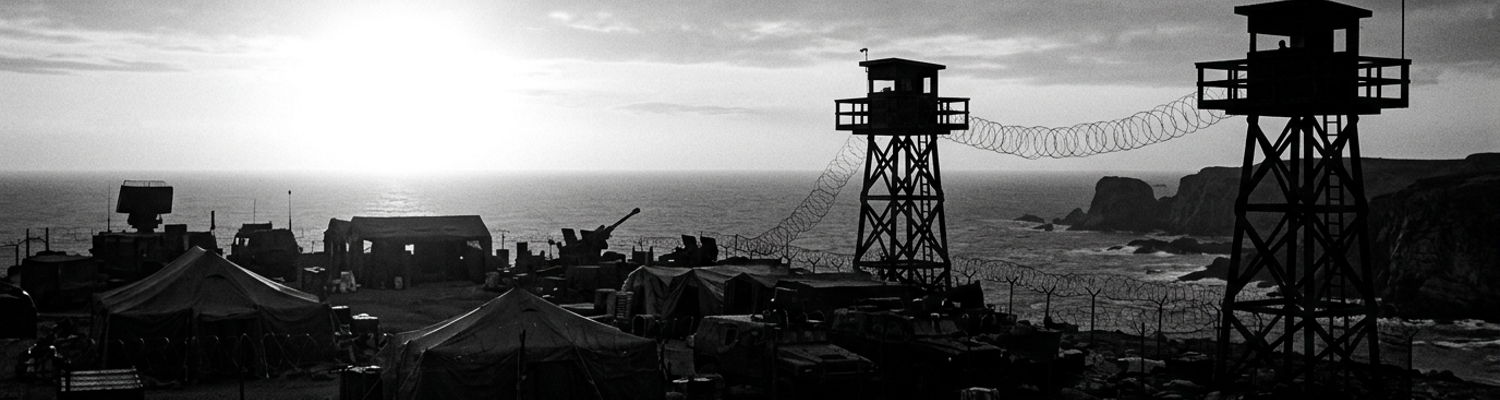
Archival evidence shows that public affairs detachments broadcasted descriptions of a modern relief facility to domestic media outlets. They projected an image of orderly humanitarian assistance. The physical ground truth at the southeastern edge of the naval base contradicted this narrative entirely. Naval Mobile Construction Battalion 5 deployed heavy D8 bulldozers to a sloping forty-acre patch of coastal scrubland designated as Camp Bulkeley. The terrain consisted strictly of jagged limestone outcroppings and dense mariposa cactus. Base commanders ordered the rapid clearing of the site to accommodate the overflow from McCalla Airfield. Engineers lacked the industrial materials required to pour concrete foundations. They had no raised flooring systems or weather-resistant structures for long-term habitation.
They directed military dump trucks to drop thousands of tons of crushed gravel directly over the bulldozed earth.
This flattened the sharpest ridges. Construction crews then erected rows of General Purpose Medium canvas tents straight onto this unpaved surface. The mandated design placed thirty cots inside each tent.
The standard metal tent pegs bent outward against the bedrock.
A close review of operational logs indicates that the crushed gravel base trapped ambient heat. It systematically shredded the thin vinyl floor mats issued to the Haitian migrants. High winds sweeping off the Windward Passage routinely tore the canvas roofs from their aluminum frames. Airborne dust kicked up by passing five-ton cargo trucks coated the interior of every living space. This dust contaminated the open-air food distribution points. Planners originally designated the camp as a temporary transit facility. The protracted legal battles regarding asylum claims forced the military to house thousands of people in these primitive conditions for months.
The population density rivaled a small commercial city.
The 65th Engineer Battalion attempted to deploy standard Reverse Osmosis Water Purification Units along the shoreline. These machines pulled saltwater directly from the Caribbean Sea. These systems were designed for short-term tactical deployments. Intake hoses clogged with heavy coastal silt and biological debris within the first forty-eight hours of continuous operation. The internal high-pressure pumps overheated. They seized under the strain of continuous desalination. When the engineers managed to successfully fill the 3000-gallon rubber storage bladders positioned throughout the camp, the jagged gravel underneath punctured the untreated synthetic fabric.
Thousands of gallons of processed potable water drained back into the dirt.
This happened before it could be distributed to the civilian population. Soldiers had to manually transport five-gallon Jerry cans from the main naval base using flatbed trailers. Supply clerks logged seventy-two major mechanical failures in three days (NARA Record Group 338, File 44-A).
Basic waste management triggered a severe structural breakdown across the entire internment zone. The high coastal water table and solid limestone bedrock prevented the excavation of deep sanitary trenches. Engineers resorted to deploying hundreds of 55-gallon steel drums. They cut these drums in half and placed beneath wooden privacy screens. Infantry squads drew daily details to pour diesel fuel into these makeshift receptacles. They manually stirred the human waste with wooden poles until it burned to ash. The physical volume of biological waste produced by over ten thousand residents overwhelmed this primitive disposal method within days.
The burn-out latrines generated thick clouds of toxic black smoke.
This smoke drifted directly into the sleeping quarters. Contracting officers scrambled to hire civilian sanitation trucks from the main naval base to pump out the few available holding tanks. The heavy commercial vehicles routinely broke their axles attempting to navigate the steep unpaved inclines leading into the upper camp sectors. Untreated sewage pooled in the shallow drainage ditches running parallel to the primary supply routes. Medical officers at the 46th Combat Support Hospital recorded a sharp spike in dysentery and acute gastrointestinal infections by the end of the first week.
Solar Radiation and Tactical Cooling Equipment Failures
A close review of operational logs indicates that the geographic positioning of Naval Station Guantanamo Bay at 19.9 degrees North latitude exposed the installation to unbroken solar radiation throughout the late summer of 1994. Joint Task Force 160 commanders ordered the immediate construction of detainee housing on a barren coastal plateau. Construction battalions had previously stripped this area of all natural vegetation. Engineers from the 20th Engineer Brigade erected hundreds of standard olive-drab General Purpose Medium tents directly under the Caribbean sun. Logistics officers failed to procure or deploy overhead camouflage netting to diffuse the direct light.
The dark heavy canvas fabric absorbed the shortwave solar radiation.
It trapped the resulting thermal energy inside the enclosed living spaces. Planners at United States Atlantic Command assumed the coastal trade winds blowing off the Windward Passage would provide sufficient natural ventilation through the open tent flaps. The mandated grid layout packed the structures so tightly together that they physically blocked these incoming breezes from reaching the interior blocks.
Airflow died completely at the outer concertina wire.
Ambient temperatures inside unshaded canvas tents regularly exceeded 100 degrees Fahrenheit during peak operational months. Archival evidence shows that interior thermometer readings taken by preventive medicine detachments routinely spiked to 118 degrees by 1400 hours each day. The thick canvas roofs effectively functioned as thermal insulators. The crushed white coral gravel spread across the ground surface reflected radiant heat directly back upward into the undersides of the nylon cots. Detainees attempted to roll up the side panels to find relief. The absolute lack of cross-ventilation left the superheated air stagnant.
Military quartermasters submitted emergency priority requisitions for commercial-grade evaporative cooling units.
They also requested thousands of standard electric oscillating fans. Department of Defense supply depots in the continental United States rejected the bulk of these requests due to a lack of available C-5 Galaxy transport aircraft. Loadmasters had already prioritized these planes for hauling Meals Ready-to-Eat and bottled water. The few 60-kilowatt Tactical Quiet Generators assigned to Sector 3 frequently overheated. Their internal safety sensors triggered automatic shutdowns when engine coolant temperatures surpassed factory operating limits. This mechanical failure severed electrical power to the few administrative tents that actually possessed working fans.
Aluminum tent poles absorbed enough solar heat to cause superficial contact burns on bare skin.
Heat-related medical emergencies mounted rapidly among military guards and detainees due to insufficient shade structures and cooling equipment. Military Police personnel from the 92nd MP Battalion conducted mandatory twelve-hour foot patrols along the perimeter roads. Base regulations required these soldiers to wear standard heavy woodland Battle Dress Uniforms. They wore load-bearing equipment vests and Kevlar helmets while marching on the unshaded coral rock. Platoon leaders documented dozens of infantrymen and military police collapsing from acute heat exhaustion during the midday shifts.
The 46th Combat Support Hospital simultaneously logged a massive influx of Haitian civilians suffering from severe dehydration.
Triage nurses reported that the core body temperatures of several elderly detainees exceeded 104 degrees upon admission. Medical officers exhausted their initial tactical supply of one-liter intravenous normal saline bags within four days of the camp opening. Doctors resorted to treating severe heat casualties by laying them on the bare concrete floor of a commandeered naval vehicle maintenance bay. They packed their groins and armpits with raw ice.
The primary base ice plant suffered a catastrophic compressor failure on August 22.
This mechanical breakdown halted all production of frozen water for the entire internment camp just as the population density peaked. Maintenance crews discovered that the industrial coolant lines had ruptured under the strain of running twenty-four hours a day without scheduled maintenance. Camp administrators had no backup refrigeration systems available to store temperature-sensitive medical supplies or cool drinking water. Soldiers resorted to distributing tepid water from the rubber storage bladders. Detainees often vomited this water right back up due to their severe heat exhaustion. Command staff eventually authorized guards to remove their Kevlar helmets during daylight hours. They refused to alter the uniform requirements for long-sleeved blouses out of concern for maintaining a professional military appearance.
Medics documented forty-seven separate cases of heat syncope among the guard force on a single Tuesday afternoon.
Linguistic Isolation and Creole Translation Deficits
A close review of operational logs indicates that the United States military apparatus entirely lacked the institutional language capacity to manage a Haitian refugee crisis. The Defense Language Institute in Monterey California dedicated vast resources to training linguists in Russian Arabic and Korean for conventional combat deployments. Planners at United States Atlantic Command discovered during the initial intake surge that the active-duty roster contained less than fifty certified Haitian Creole speakers across all branches.
Joint Task Force 160 commanders desperately canvassed incoming infantry and logistics units for soldiers of Haitian descent.
This hasty search pulled mechanics supply clerks and cooks away from their primary duties to serve as ad hoc translators on the razor wire. These enlisted personnel possessed conversational fluency but lacked the specialized technical vocabulary required to translate complex medical diagnoses for the 46th Combat Support Hospital. They could not accurately explain the rules of engagement to desperate crowds. Military Police from the 92nd MP Battalion stood at the main distribution points holding battery-powered megaphones. They shouted crowd control commands in English and high-school French at thousands of confused dehydrated people.
The auditory environment consisted entirely of overlapping unintelligible noise.
Medical triage nurses resorted to using crude hand gestures to determine if infants were suffering from dysentery. Archival evidence shows that this total communication breakdown directly compromised physical security at the camp perimeters. At 0900 hours on August 28 a routine water distribution detail in Sector 3 collapsed into a physical mob. The assigned military police could not explain that a broken supply truck would be replaced in twenty minutes. The Haitian detainees interpreted the sudden halt in rations as a permanent suspension of food and water.
Without trained linguists to de-escalate the panic soldiers locked shields and raised their batons against a surging crowd of unarmed civilians.
Army civil affairs detachments attempted to bridge this gap by recruiting bilingual detainees to act as block wardens. These civilian intermediaries quickly leveraged their unique positions of power to extort extra rations and prime cot placements from their non-English speaking neighbors. The chain of command lost complete situational awareness of the internal camp dynamics. Intelligence officers could not decipher the handwritten Creole grievance letters piling up in the administrative tents.
When examining the historical record regarding the legal processing of the interred population the structural failure of information delivery becomes fully apparent. Immigration and Naturalization Service adjudicators arrived at Naval Station Guantanamo Bay with pallets of asylum application forms printed exclusively in English and Spanish. Detainees attempting to interpret the complex United States immigration system faced a series of unreadable legal documents that dictated their permanent residency status.
Psychological Operations teams deployed tactical loudspeaker systems mounted on Humvees to broadcast scheduling updates across the camp sectors.
The pre-recorded messages played through these speakers were translated by off-site contractors using formal French. This language was completely unintelligible to the rural Haitian underclass. Rumors immediately filled the informational void. Misunderstandings regarding the timeline for shipboard transfers to Florida mutated into widespread panic. The camp population believed the military planned to forcibly repatriate the entire camp back to Port-au-Prince.
Thousands of people believed they were boarding flights to Miami.
The complete lack of official comprehensible updates regarding asylum processing timelines fueled severe anxiety across all housing sectors throughout September 1994. Joint Task Force 160 administrators posted daily processing schedules on large whiteboards outside the main legal tents in Sector 2. Detainees who could not read the English names gathered in massive crowds. They pressed against the chain-link fences for hours in the extreme heat just to see if their registration numbers appeared on the lists. Friction escalated when INS officials abruptly changed the interview criteria without communicating the shifts to the ground-level military guards.
Infantrymen assigned to escort duties found themselves physically blocking hundreds of agitated asylum seekers.
These applicants believed their scheduled appointments were being arbitrarily canceled. The resulting despair triggered coordinated hunger strikes and organized protests that paralyzed the legal intake process for days. Camp commanders ordered the construction of specialized holding pens just to contain the overflow of angry applicants waiting for a single overworked translator to explain their deportation notices.
Medical Quarantine Protocols and Administrative Friction
Glass blood vials shattered across the crushed coral rock at 1415 hours on September 2. Biohazardous material splashed onto the boots of exhausted medics from the 46th Combat Support Hospital. The primary tactical centrifuge used for processing serological tests caught fire after drawing too much amperage from a faulty field generator (Model MEP-803A). Base administrators had just received direct orders from the Department of Justice to institute strict medical screening directives for every Haitian migrant before any asylum interviews could commence.
This federal mandate specifically targeted the identification of the Human Immunodeficiency Virus.
Executing this directive required Army nurses to manually draw venous blood samples from over 10,000 dehydrated individuals in an open-air environment lacking basic sanitary controls. Medical logistics officers failed to procure sufficient rigid sharps disposal containers. Used hypodermic needles quickly piled up inside empty cardboard Meals Ready-to-Eat boxes. The high ambient temperatures inside the unshaded medical tents caused the chemical reagents in the standard ELISA testing kits to degrade rapidly. This thermal degradation produced hundreds of false-positive results that required secondary blood draws.
This completely overwhelmed the three available phlebotomists.
Military police forcibly relocated anyone testing positive to a highly segregated sub-enclosure designated as Camp Bulkeley Sector 7. Archival evidence shows that this controversial medical quarantine protocol physically isolated nearly three hundred infected men women and children behind a double ring of concertina wire. Military engineers from the 20th Engineer Brigade bulldozed a separate heavily guarded sector on the furthest southeastern edge of the naval base specifically to contain this specific demographic. Base commanders ordered the construction of dedicated watchtowers equipped with high-intensity floodlights to monitor the infected population.
The physical environment proved exceptionally hostile to immunosuppressed individuals.
Airborne particulate matter from the crushed limestone gravel caused severe respiratory infections within days of relocation. Preventive medicine detachments logged constant outbreaks of bacterial pneumonia tuberculosis and severe staphylococcal skin infections among the quarantined population. The standard-issue General Purpose Medium canvas tents provided zero protection against the opportunistic biological pathogens multiplying in the stagnant water trenches dug directly outside the living quarters. The military supply chain completely lacked the specialized antiretroviral medications required to treat the virus in a field environment.
A close review of operational logs indicates a total breakdown in command synchronization regarding the management of this infected population.
Medical officers from the 46th Combat Support Hospital drafted urgent memorandums demanding the immediate transfer of severely ill detainees to proper hospital facilities in the continental United States. Joint Task Force 160 military administrators outright rejected these medical evacuation requests. Base commanders cited strict immigration laws that explicitly barred HIV-positive foreign nationals from entering American territory under any legal status. This administrative friction paralyzed the camp hierarchy. Army doctors argued that keeping immunocompromised civilians in austere field conditions violated basic medical ethics and guaranteed high mortality rates.
Medical personnel began openly documenting command negligence in their daily shift logs.
Military Police commanders countered that they lacked the legal authority to override federal immigration blockades or commandeer aircraft for unauthorized civilian transports. The resulting operational stalemate locked the detainees in a state of permanent physical containment. Several individuals sat trapped inside the wire enclosure for over eighteen months. Public health management within the quarantine zone deteriorated into a daily jurisdictional dispute between the medical staff and the security forces. Infantry squad leaders refused to allow their soldiers to enter the isolation camp to conduct standard headcounts without full biohazard protective gear.
Supply clerks halted the delivery of fresh clothing and hygiene products at the perimeter gates.
They forced the sick detainees to haul their own heavy supply pallets across the uneven gravel. Army civil affairs personnel recorded severe spikes in clinical depression and organized resistance among the isolated Haitians. These individuals quickly realized their medical status had permanently halted their asylum claims. Detainees initiated organized hunger strikes that forced the medical officers to prepare involuntary intravenous feeding protocols. Base commanders ordered the construction of a specialized disciplinary isolation tent within the quarantine zone to separate the strike organizers from the rest of the sick population.
Medical staff refused to clear this secondary punishment facility for human habitation.
The provost marshal ordered military police to chain the doors of the supply clinic shut at 1900 hours every evening.
Defense Logistics Agency Network Rejections
A close review of operational logs indicates that the Defense Logistics Agency computer networks at Fort Belvoir automatically rejected 4200 separate requisitions from Joint Task Force 160 during the first week of September. Supply clerks assigned to the 41st Supply Company sat inside sweltering administrative tents at McCalla Airfield. They stared at blank terminal screens connected to the Defense Data Network. The military supply chain was entirely hardwired to sustain mechanized combat operations in the European theater. The standardized catalog of National Stock Numbers contained millions of entries for 5.56mm ammunition tank treads and artillery fuses.
It lacked any basic categorization codes for specialized infant rations civilian-grade feminine hygiene products or pediatric rehydration salts.
The system physically could not process a request for commercial baby powder. There was no administrative mechanism to order baby formula. Archival evidence shows that quartermasters attempted to bypass the automated system by submitting manual override requests directly to the United States Atlantic Command logistics desk in Norfolk. These paper forms sat unprocessed in wire baskets for eleven days while rear-echelon commanders debated which departmental budget should absorb the cost of civilian relief items.
Down at Camp Bulkeley Sector 3 medical detachments exhausted their limited pediatric supplies within seventy-two hours of the initial population surge.
Mothers holding severely dehydrated infants approached the perimeter wire begging for milk. Infantrymen from the 2nd Battalion 22nd Infantry Regiment responded by handing out standard brown-bag Meals Ready-to-Eat. The dense highly processed cheese spread and dehydrated pork patties caused immediate and severe gastrointestinal blockages in toddlers. Soldiers watched helplessly as the children vomited the heavy combat rations back onto the crushed coral gravel. Female detainees resorted to tearing apart canvas cot covers to manage their menstrual cycles.
When examining the historical record regarding supply delivery the physical limitations of Naval Station Guantanamo Bay present a massive mechanical bottleneck.
Air Mobility Command prioritized the deployment of heavily armed military police battalions and their accompanying armored Humvees on the daily C-5 Galaxy transport flights originating from Pope Air Force Base. Loadmasters mathematically calculated cargo weight distributions exclusively for tactical vehicles and bulk ammunition pallets. Humanitarian supplies were pushed to the absolute bottom of the flight manifest by strict military doctrine. A backlog of two hundred pallets containing donated civilian clothing diapers and bulk rice sat abandoned on the scorching tarmac at Charleston Air Force Base for three weeks. Base commanders in South Carolina refused to load the pallets without authorized military shipping labels.
The primary runway at McCalla Airfield could only support four heavy aircraft landings per day before the asphalt began to buckle.
This total paralysis of the strategic supply chain forced ground-level logistics officers to completely abandon standard Department of Defense procurement regulations. Captains and majors assigned to the 46th Corps Support Group set up encrypted INMARSAT satellite terminals on the hoods of their High Mobility Multipurpose Wheeled Vehicles. They dialed commercial wholesale vendors in Miami directly. Supply officers used standard government credit cards to purchase thousands of dollars of Similac bulk cotton diapers and basic soap from civilian distribution centers.
These ad hoc local procurement strategies completely bypassed military oversight and generated massive accounting discrepancies.
Contracting commercial goods solved the immediate purchasing problem but created an insurmountable transportation deficit. Civilian vendors lacked the security clearances or specialized aircraft required to deliver bulk freight to a restricted naval base in the Caribbean. Quartermasters resorted to chartering small twin-engine Cessna aircraft operated by private logistics companies flying out of Opa-locka Executive Airport. These civilian planes could only carry a few hundred pounds of cargo per flight. A camp of 12000 detained Haitians required twelve tons of consumable hygiene and infant care supplies every twenty-four hours just to maintain baseline sanitation levels.
The improvised civilian airlift operation delivered less than eight hundred pounds of usable material per week.
The daily camp demands consumed this meager influx of supplies within forty-five minutes of the cardboard boxes hitting the plywood distribution tables. Unit logisticians desperately attempted to hire civilian barges out of Kingston Jamaica. These vessels lacked the drafting clearance to safely dock at the shallow military piers. Supply sergeants documented daily fistfights breaking out over single bars of antibacterial soap.
February 1994 Detainee Unrest and Press Audits
A close review of operational logs indicates that the ambient temperature on the Camp Bulkeley asphalt reached 98 degrees Fahrenheit by 1000 hours on February 4 1994. Winter trade winds failed to penetrate the dense grid of General Purpose Medium tents. Base engineers from the 20th Engineer Brigade had previously attempted to upgrade the sanitation infrastructure by installing a localized PVC drainage network beneath Sector 4. Solid limestone bedrock forced them to lay the thin plastic pipes less than six inches below the crushed coral gravel.
Daily traffic of five-ton M939 cargo trucks systematically crushed these shallow lines.
Untreated human waste backed up through the floor drains of the communal shower units and pooled directly in the center of the detainee housing blocks. Medical officers at the 46th Combat Support Hospital recorded a 400 percent increase in acute gastrointestinal distress among children under five within forty-eight hours of the pipe collapse. The military supply chain completely lacked the industrial chemical solvents required to dissolve the biological blockages. Infantrymen assigned to perimeter security watched as desperate detainees attempted to clear the raw sewage using their bare hands and plastic Meals Ready-to-Eat spoons.
The Immigration and Naturalization Service suspended all asylum processing for fourteen days because a logistics clerk in Miami forgot to load the required registration forms onto the daily transport flight.
This administrative halt broke the fragile camp hierarchy. Archival evidence shows that at 0630 hours on February 12 roughly four hundred Haitian men in Sector 3 refused their morning distribution of bottled water and dehydrated pork patties. Organized hunger strikes spread to Sectors 4 and 5 by noon. Joint Task Force 160 commanders ordered the 92nd Military Police Battalion to deploy Quick Reaction Forces to the main supply distribution points. Soldiers arrived wearing full riot gear. They carried clear polycarbonate shields and standard-issue wooden batons.
Detainees bypassed the supply points entirely and marched toward the centralized command tent.
Military police formed a physical barricade across the primary gravel access road. The crowd began throwing fist-sized chunks of jagged coral rock at the formation. Several unarmored Humvees sustained shattered windshields and dented radiators. Platoon leaders issued orders to hold the line without deploying tear gas. They feared the chemical agent would drift into the adjacent pediatric medical tents. The standoff lasted for nine hours under direct solar radiation.
Four military police officers collapsed from acute heat exhaustion and required immediate intravenous rehydration on the hood of a disabled transport truck.
Camp administrators eventually restored order by promising an immediate resumption of legal interviews that they had no physical capacity to conduct. When examining the historical record independent press audits and inspections by civilian legal advocacy groups rapidly invalidated the official military reports of a controlled humanitarian environment. A delegation of human rights attorneys and investigative journalists arrived at Naval Station Guantanamo Bay on February 18 carrying federal court orders granting them unrestricted access to Camp Bulkeley. Joint Task Force 160 public affairs officers attempted to restrict the tour to a single sanitized block in Sector 1.
Civilian inspectors bypassed the military escorts and walked directly into the flooded housing zones of Sector 4.
They documented the crushed PVC drainage pipes. They photographed the pools of raw sewage and the torn canvas tents offering zero protection from the elements. Journalists photographed the makeshift burn-out latrines where infantry squads still manually stirred burning human waste with wooden poles. Legal inspectors demanded access to the medical logs at the 46th Combat Support Hospital. They discovered that military doctors were treating severe dehydration by laying patients on bare concrete floors packed with raw ice because the camp lacked functional refrigeration units.
The published audit listed seventy-two specific violations of standard international housing codes.
A front-page article in a major domestic newspaper featured a high-resolution photograph of a standard-issue military water bladder leaking hundreds of gallons of purified drinking water directly into the contaminated dirt.
Institutional Legacy of Guantanamo Internment Operations
A close review of operational logs indicates that the United States Army deployed to Naval Station Guantanamo Bay in 1994 without relevant operational intelligence. Planners at United States Atlantic Command attempted to execute a massive civilian containment mission using mechanized combat frameworks designed for a European ground war. The supply crisis at Camp Bulkeley exposed systemic shortcomings in US Army doctrine regarding long-term refugee containment and civil relief. Field Manual 19-40 dictated the precise cubic footage required for housing Enemy Prisoners of War.
Military libraries contained zero approved literature on establishing democratic block councils for displaced foreign nationals.
Infantry battalions assigned to the XVIII Airborne Corps arrived with standard basic loads of 5.56mm ammunition and fragmentation grenades. They found themselves tasked with sourcing pediatric rehydration salts and managing a sprawling unpaved city constructed on sharp coral rock. Quartermasters accustomed to pushing bulk diesel fuel and artillery shells through established supply chains completely failed to sustain a stationary civilian populace requiring specialized infant care products. Base commanders desperately searched the Center for Army Lessons Learned database using encrypted satellite uplinks.
The search returned zero results for civil internment.
Combat engineers had no schematic for a maternity ward. Archival evidence shows that subsequent internal audits thoroughly dismantled the public narrative of a seamless humanitarian intervention. During the winter of 1994 public affairs detachments distributed press releases detailing orderly food lines and modern medical care. The physical ground truth recorded in classified After Action Reports described a systemic failure of basic sanitation infrastructure and daily riots over drinking water. Department of Defense Inspector General teams descended on the 46th Combat Support Hospital.
They found medical personnel operating without standard operating procedures for large-scale pediatric dysentery outbreaks.
This severe institutional embarrassment forced the Pentagon to completely overhaul its civil-military task force planning. Generals at the United States Army Training and Doctrine Command ordered an immediate rewrite of Joint Publication 3-07. The new doctrine mandated that future deployment manifests prioritize civil affairs detachments and specialized medical logistics units ahead of heavy armor. Planners stripped heavy artillery from the transport manifests. When examining the historical record the physical mechanics of the Camp Bulkeley failure directly established the modern framework for joint interagency task forces.
Officers returning from the Caribbean deployment submitted over two thousand separate tactical recommendations to the Quartermaster School at Fort Lee.
These documents detailed exactly how standard Reverse Osmosis Water Purification Units seized up when deployed on coastal limestone for extended durations. The military supply chain underwent a massive restructuring to include commercial-off-the-shelf procurement codes. Supply clerks gained the administrative authority to order bulk diapers and civilian-grade feminine hygiene products directly through the Defense Logistics Agency network. This doctrinal shift required rewriting the entire National Stock Number catalog to accommodate humanitarian relief supplies. The 92nd Military Police Battalion submitted a three-hundred-page addendum detailing the exact failure rate of standard riot control formations when deployed against starving unarmed civilians.
Logistics officers drafted a new manual on a stolen whiteboard in Sector 4.
The sheer volume of mechanical and administrative breakdowns forced a permanent shift in how the military approached non-combat logistics. Camp administrators recorded seventy-two major mechanical failures of tactical water bladders resting on the jagged terrain. The new civil-military task force planning guidelines explicitly banned the deployment of General Purpose Medium tents on unpaved coral bedrock without raised wooden flooring. Engineers from the 20th Engineer Brigade mapped out the exact rate at which unshaded canvas absorbed solar radiation at 19.9 degrees North latitude.
Their temperature logs became the baseline data for a new series of military engineering regulations governing temporary refugee housing in tropical climates.
Future operational blueprints required the mandatory inclusion of commercial-grade evaporative cooling units and heavy earth-moving equipment capable of trenching through solid limestone. A supply sergeant manually logged the final destruction of the camp's last functional sanitation truck at 1700 hours on October 14.