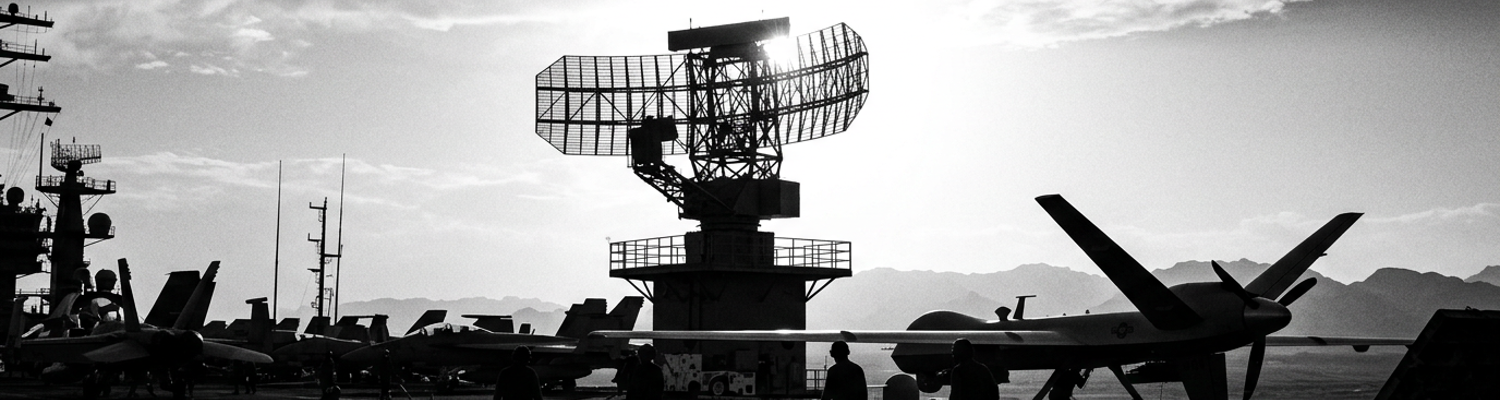

VC-6 Pioneer Operations and Flight Deck Maintenance
Archival evidence shows that Fleet Composite Squadron Six Pioneer RQ-2 detachments operated shipboard reconnaissance flights from carrier decks under conditions far outside the original design specifications of the airframe (NARA Record Group 313). The launch of a 450-pound drone required rapid sequencing between catapult launches of heavier strike aircraft. Recovery posed worse hazards. The twin-tail Pioneer lacked standard carrier arresting gear compatibility. It had to fly directly into a nylon recovery net stretched across the flight deck. The impact routinely tore off landing gear struts. Airframes suffered bent tailbooms.
Maintenance crews recorded high airframe attrition rates.
On the flight deck, Electronics Technician Second Class Daniel Vance pressed a torque screwdriver into the chassis screw of an RF filter assembly. Salt air in the northern Persian Gulf oxidized exposed junction points within hours. Vance adjusted the micro-potentiometer on the Pioneer RQ-2 C-band receiver pre-amplifier. He turned the brass screw two millimeters past its factory index mark. This cleared background static from the ship surface-search radar.
Minimal altitude separated the small craft from the water.
Down in the carrier hull, intelligence officers inside the Tactical Flag Command Center watched uncompressed video signals beamed from the Pioneer belly-mounted television camera. Real-time camera feeds tracked Iraqi coastal defense cruise missile batteries hidden along the Kuwaiti coastline. Intelligence personnel monitored minelaying boats operating in the shoals around Faylaka Island. Strike planners watched the black-and-white television feed to calculate immediate target coordinates. This bypassed the multi-hour delays of satellite reconnaissance processing.
The video signal required an unobstructed slice of the radio spectrum.
A close review of operational logs indicates that Pioneer operations relied on narrow-margin frequency allocations bordering littoral ground forces networks. VC-6 technicians utilized a direct line-of-sight tracking antenna to steer the drone and capture its reconnaissance feed. This antenna operated across tight frequency channels within the UHF command band and the C-band video downlink. Off the coast, the electromagnetic environment was already oversaturated. Strike group electronic warfare suites flooded the airspace with high-power radiation. Shipboard air-search radars added to the congestion. Carrier tactical air navigation systems broadcasted continuously.
Closer ashore, ground formations of the I Marine Expeditionary Force and Army I Corps established high-density tactical communication grids along the Saudi-Kuwait border. These ground networks operated high-gain multichannel troposcatter systems. Signal battalions utilized tactical satellite terminals and secure combat net radios. The frequency allocation assigned to VC-6 left less than two megahertz of guard band between the Pioneer uplink and the primary command nets used by forward ground elements.
Commanders did not adjust the baseline channel maps.
Radio frequency interference logs from February 1991 reveal that a five-kilohertz shift in ground transmitter calibration caused immediate carrier-wave degradation on the drone control link. Carrier air wings operated under standard maritime emissions control plans. These plans shifted radar and radio frequencies according to naval fleet schedules. Ground commanders fifty miles west scheduled their radio frequencies around terrestrial line-of-sight relays and forward artillery command posts. Neither service branch maintained a shared real-time frequency coordination desk.
Ship maneuvers into the wind to launch strike packages physically blocked the line-of-sight tracking antenna. This forced the drone datalink to auto-tune across adjacent frequencies to maintain lock. That automatic search pushed the Pioneer control frequencies straight into the active broadcast bands of army corps communications arrays along the shore. On the morning of February 12, ground stations along the border logged unexplained carrier-wave squelch on six primary tactical nets.
C-Band Architecture and Littoral Spectrum Allocation
A close review of operational logs indicates that the RQ-2 Pioneer datalink relied on a directional C-band telemetry and video tracking channel operating between 4.5 and 4.8 gigahertz. This frequency band sat directly above the tactical microwave relay spectrum used by corps-level communications assets (Joint Frequency Management Office Report 91-04). The shipboard tracking system followed the drone through an automated pedestal. This pedestal turned a high-gain dish antenna to aim continuous radio-frequency energy across the water.
On the Pioneer airframe itself, an omnidirectional antenna received flight commands. An onboard traveling-wave tube amplifier pushed the frequency-modulated C-band television signal back toward the carrier receiver.
This C-band transmission path ran on an extremely narrow frequency spread.
Technicians in the shipboard terminal cabinet had to lock the receiver onto incoming pulse trains. These pulse trains sat directly against the lower boundary of the military multichannel communication band. That tactical band was already populated by AN/TRC-170 troposcatter terminals. Mobile Subscriber Equipment line-of-sight nodes deployed across the sand dunes also used these frequencies. When the drone banked east to trace coastal trenches, the transmission footprint struck the shore at flat angles. It washed across coastal receiving antennas with eighty watts of concentrated microwave power.
Distance did not degrade the signal as predicted.
Archival evidence shows that central joint communications planners in Riyadh structured littoral frequency charts around a specific geographic assumption. Planners believed maritime transmitters would stay thirty to fifty miles out at sea. That distance would theoretically leave a five-megahertz operational guard band intact between naval datalinks and landward operations. Maritime frequency managers under NAVCENT coordinated radio spectrum through static channel allocation matrices. These matrices were published weeks prior to combat operations. Staff officers assumed open ocean space provided sufficient geometric attenuation. They believed this would prevent shipborne emissions from overriding terrestrial line-of-sight towers.
The weather over the northern Persian Gulf broke those calculations. Cool maritime air trapped beneath a heavy layer of warm desert wind created severe atmospheric ducting along the coastline from Ras al-Khafji to the Kuwait border.
The frequency separation margin failed.
The C-band transmissions from the carrier-based tracking pedestals bent downward. They became trapped between thermal air boundaries instead of dispersing upward into the troposphere. The radio energy followed the coastline through a surface ducting channel. This carried naval signals forty miles inland past the predicted boundary limits. Technicians assigned to the Central Command Joint Frequency Management Office had built their channel separation tables without accounting for coastal ducting patterns during winter weather fronts.
Army I Corps units moving into forward assembly areas west of the Wadi al-Batin had reserved the adjacent ultra-high and very-high frequency spectrum blocks exclusively for rapid fire support and casualty routing. The 18th Field Artillery Brigade operated AN/VRC-12 series radios. Forward command elements of the 24th Infantry Division used early tactical digital terminals. These linked battery fire direction centers to forward observation teams.
These artillery networks depended on clear line-of-sight channels. Artillery units needed them to pass digital firing solution packets between M109 howitzer batteries and divisional target acquisition radars. Medical evacuation coordination for forward collection points relied on dedicated single-channel radios. These operated without frequency-hopping protection.
When maritime transmitters pushed energy past the allocated littoral guard bands, receiver desensitization rippled through forward tactical operations centers. Radio operators in mobile command tracks found their receiver pre-amplifiers blocked by front-end receiver overload. This silenced incoming audio from ambulance units and artillery forward observers. Field technicians at an assembly area outside Hafar al-Batin logged twelve consecutive failed digital calls on the artillery division net between 0840 and 0915 hours.
Atmospheric Ducting and Littoral Inversion Layers
The atmosphere over the northern Gulf formed a physical RF waveguide.
A close review of operational logs indicates that extreme heat off the Arabian Peninsula created sharp thermal inversion layers along the coastal water boundary. Surface water temperatures in the shallow northern basin hovered near thirty-two degrees Celsius. The heat saturated the lowest thirty meters of the marine boundary layer with moisture. Above this cool and humid maritime surface, dry desert winds flowing off the Kuwaiti plains pushed an air mass exceeding forty-five degrees Celsius.
Radiosonde soundings launched from naval weather detachments stationed aboard amphibious assault ships recorded vertical refractivity gradients exceeding negative one hundred and fifty-seven N-units per kilometer. This steep drop in atmospheric density bent passing radio waves back toward the sea surface. It prevented them from escaping upward into space.
Known formally as super-refraction, this atmospheric condition formed persistent surface ducts. These ducts measured between twenty and one hundred meters thick. They hugged the shoreline from Ras Tanura past the Kuwaiti border. Standard maritime propagation models treated the lower troposphere as a uniform medium. This left shipboard communications technicians unprepared for the seasonal restructuring of regional RF behavior.
Electromagnetic radiation ceased obeying free-space physics.
Archival evidence shows that these littoral surface ducts trapped C-band microwave transmissions between 4.5 and 4.8 gigahertz. This directed high-frequency radio energy across unexpected inland ranges. In free space, directional microwave beams expand geometrically. Microwave energy loses signal strength at a rate determined by the inverse-square law. Within the coastal duct, the boundary between the cold maritime air and the overheated desert inversion created a reflective boundary. This converted the signal attenuation from spherical to cylindrical spreading.
This physical trapping preserved carrier power across distances three times greater than standard radar horizons. The eighty-watt video downlinks and shipboard tracking interrogations jumped the coastal mudflats. The signals skimmed inland instead of dispersing fifty miles off the coast of Bubiyan Island.
Technicians monitoring tactical microwave relays within the Army I Corps zone eighty miles west of the coast intercepted high-power naval frequencies on equipment tuned to clear channels. The energy skipped through the lower inversion layer past the Wadi al-Batin. The energy crossed directly into sectors designated exclusively for terrestrial corps distribution networks.
The carrier could no longer track its own aircraft.
When examining the historical record, ducting degraded the line-of-sight datalink by generating severe multipath phase cancellation at the carrier automated tracking pedestal. Direct radio signals traveling horizontally through the duct collided with secondary waves reflecting off the hyper-saline sea surface. Secondary waves arrived at the shipboard antenna horn fractions of a microsecond out of phase. This destructive interference caused deep signal fades exceeding twenty-five decibels across the C-band uplink and downlink.
Inside the carrier flight deck control spaces, the Pioneer uncompressed video feed began rolling vertically before collapsing into static and black scan lines. Datalink decoders on the ship lost synchronization with the drone telemetry stream. Decoders dropped eighty percent of incoming digital packets. The data loss triggered the RQ-2 internal lost-link countdown.
The five-meter dish pedestal swung erratically along its azimuth axis. The hardware searched for an unidentified transmission refracted beneath the horizon. The drone initiated automated circle routines over active hostile anti-aircraft batteries near Faylaka Island. Ground tracking logs from February 17 recorded nine complete telemetry blackouts during a single five-hour reconnaissance window.
Shipboard Antenna Modifications and Datalink Amplification
Inside the radio equipment racks behind the carrier flight deck, electronics technicians bypassed the factory-calibrated voltage limiters on the Pioneer tracking pedestal.
Operational logs from the Persian Gulf naval force show that maintenance crews assigned to the VC-6 detachment confronted persistent video dropouts. Sea-surface multipath reflections and thermal ducting caused these failures. Down in the carrier Tactical Flag Command Center, strike planners demanded unbroken target imagery of Iraqi coastal artillery batteries near Ras al-Qulayah. Commanders refused to accept displays broken by sync-drop static or rolling scan lines.
Technicians pulled the chassis of the AN/USQ-120 ground control station antenna pedestal to clear the degraded signal path. Maintenance personnel reached behind the primary circuit protection cage. They adjusted the traveling-wave tube amplifier drive potentiometers past their factory index marks.
Solder bridges were run across the cathode over-current protection relays. This disabled the internal safety cutoffs. It pushed the RF output wattage from forty watts to over one hundred and sixty watts of continuous power. Cooling fans inside the pedestal housing groaned at maximum velocity. The fans struggled to vent heat away from the saturated collector core while the high-gain dish tracked the drone over Faylaka Island.
The hardware was never engineered to run at four times its rated thermal capacity.
Archival evidence shows that these amplification overrides were executed entirely at the unit level without joint operational frequency deconfliction. Detachment leaders aboard the carrier prioritized tactical target acquisition over joint theater communications coordination. Joint frequency regulations established by Central Command required formal engineering approval in Riyadh before any detachment altered transmission power profiles in the littoral operating area.
No paperwork was filed.
Carrier electronics officers operated under standard maritime independence. They regarded the circuit modifications as an internal equipment repair. Officers did not view it as a substantial electromagnetic footprint change. Across the water, Army I Corps communications planning teams had aligned their high-capacity terrestrial radio relays and AN/TRC-170 troposcatter nodes to match the original low-power baseline published in the theater frequency matrix. Staff officers in Riyadh remained unaware that an uncoordinated transmission source was about to project high-wattage energy straight into the operational boundary of land forces.
Not a single warning transmission left the shipboard antenna array.
When examining the historical record, this forced wattage increase fundamentally altered the Pioneer ground control station transmission profile beyond baseline parameters. The act of driving the traveling-wave tube amplifier deep into saturation generated severe non-linear distortion across the transmitter output stage. The clean narrow-band emission centered at 4.5 gigahertz broke down into wideband phase noise. This splashed RF energy into sidebands spanning twenty-five megahertz across the spectrum.
Secondary side lobes on the parabolic dish gained enough radiated power to burn through atmospheric clutter independently. These lobes were normally attenuated thirty decibels below the primary beam. Microwave reflections off the carrier island combined with parasitic energy bouncing off the hyper-saline water surface. This created an expansive RF skirt that illuminated coastal sectors eighty miles to the west. Signal monitoring stations at an assembly area outside Ras al-Mishab logged severe front-end pre-amplifier saturation on Army multi-channel reception frequencies at 1340 hours.
Harmonic Bleed Across Coastal Communications Frequencies
A close review of operational logs indicates that driving the shipboard traveling-wave tube amplifier beyond its factory limits generated massive non-linear distortion at the emitter horn. When technicians pushed the RF output past one hundred and sixty watts, the vacuum tube operated well outside its linear amplification range. This transformed the transmitter into a generator of spurious mixing products. Intermodulation frequencies multiplied across the internal stages of the AN/USQ-120 terminal.
These parasitic outputs stripped away the attenuation barriers built into the chassis output filters. The outputs spilled harmonic energy across hundreds of megahertz. Second-order and third-order harmonics combined with local oscillator frequencies within the carrier terminal. This created broad bands of spurious radio energy that bypassed the tuned waveguide flanges.
Instead of a single clean tracking beam locked onto the Pioneer drone at 4.5 gigahertz, the modified array pushed out jagged frequency skirts. These bled raw noise directly downward into UHF and VHF bands reserved for tactical voice communications. Bandpass filters designed for a forty-watt signal overheated under the surging current. The filters shifted their dielectric values. The hardware failure dumped unfiltered harmonic skirts directly across adjacent maritime and littoral voice channels.
The amplifier modifications converted the carrier tracking array into a broadband interference source.
Archival evidence shows that coastal atmospheric ducting captured these spurious emissions and propelled them deep into terrestrial territory. Dense and cool marine air hugging the water surface acted with the overheated desert air aloft to trap stray electromagnetic emissions between ten and eighty meters off the ground. The harmonic bleed radiated outward from the ship dish antenna and entered this horizontal duct instead of dissipating into space.
Energy that should have faded within five nautical miles maintained lethal field strength across the coastal flats of Ras al-Khafji. The energy crossed inland toward the defensive sectors held by the 1st Marine Expeditionary Force and Army I Corps staging areas. Measurements taken along the Saudi coast registered RF power densities thirty decibels higher than standard free-space attenuation models predicted.
The natural atmospheric waveguide prevented the signal from spreading out spherically. The waveguide forced the high-wattage spurious noise into a flat and concentrated cylinder that skimmed directly over the coastal salt marshes. Without geographic features or terrain ridges along the Persian Gulf coast to absorb the radiation, the airborne path delivered focused microwave interference straight into forward operational zones seventy-five miles away from the carrier strike group.
Atmospheric conditions extended the range of the overdriven naval transmitter.
When examining the historical record, ground communications units operating near the Kuwait border experienced immediate and severe broadband interference across primary tactical nets. Radio operators inside mobile command shelters assigned to the 11th Signal Brigade watched the signal-to-noise meters on their AN/VRC-12 vehicular receivers pin against the maximum scale. Forward tactical operation centers of the 24th Infantry Division reported identical failures.
The interference did not manifest as clear voice chatter or standard tone jamming. It arrived as a continuous and deafening hiss of white noise that broke through automated squelch settings. Forward air controllers using AN/PRC-113 UHF transceivers found their emergency and tactical air direction nets completely blanketed by harsh parasitic buzz. This drowned out inbound flight calls from Marine AV-8B Harriers and Air Force A-10s.
Combat net radios tuned to single-channel frequencies drifted into receiver desensitization. Their sensitive pre-amplifiers were swamped by the incoming radio-frequency hash. Field personnel initially suspected Iraqi electronic warfare units had activated high-power truck-mounted jamming systems along the border. Ground electronic warfare officers initiated defensive frequency-shift protocols. This only displaced tactical traffic into other saturated channels.
Every frontline attempt to re-establish secure command loops failed.
At the forward command post of the 18th Field Artillery Brigade outside Ras al-Mishab, signal crews swapped out receiver circuit cards. Signal crews replaced external antenna masts under the assumption that coastal humidity had shorted their equipment. Fire direction nets linking multiple M109 howitzer batteries to forward observers went silent at 1410 hours. This halted coordinated registration fire across an entire artillery sector. Signal correlation logs later recovered from the Central Command Joint Frequency Management Office confirmed that the surge in ground-level noise matched the precise duty cycle of the carrier VC-6 Pioneer launch window.
Counter-Battery Radar Failures and Target Acquisition Blindness
Electronics inside the mobile radar shelters failed without warning.
A close review of operational logs indicates that the overdriven shipboard transmissions struck the AN/TPQ-36 and AN/TPQ-37 Firefinder counter-battery radar complexes deployed across the littoral zone. Stationed eight miles southwest of Ras al-Khafji, radar crews of Target Acquisition Battery C had aligned their phase-steered planar arrays to monitor Iraqi artillery emplacements north of the border berm. The AN/TPQ-36 was tuned to detect high-angle mortar shells. The heavier AN/TPQ-37 was engineered to trace long-range howitzer rounds. Both systems relied on dedicated radio datalinks to transmit target track files from the antenna trailers to the remote operations control shelters.
When the ducted C-band harmonic noise floor spiked by forty decibels, intermediate frequency preamplifiers in the radar receiver shelters were driven into deep saturation. Phase-comparison circuitry could not distinguish authentic radar pulse reflections from the incoming maritime interference. Datalink modems linking the AN/TPQ-37 antenna mast to the shelter cabin dropped carrier lock at 1418 hours.
Internal electronic protection routines interpreted the continuous external noise as an intentional electronic countermeasure. This locked the signal processors into endless self-calibration cycles. The cycle prevented the phased array from calculating beam-steering phase shifts.
The radar arrays ceased tracking.
Archival evidence shows that this datalink collapse severed the flow of real-time targeting coordinates feeding tactical fire direction centers across the coastal corridor. Inside the M577 command post carriers belonging to the 18th Field Artillery Brigade, tactical computers sat waiting for digital target acquisition packets. The TACFIRE processing system depended on high-speed digital handshakes to populate fire mission queues with eight-digit grid coordinates and elevation angles within fifteen seconds of enemy barrel discharge.
With the radar datalinks jammed by the maritime spillover, the incoming stream of digital message device packets terminated abruptly. Fire direction officers watched their cathode-ray tube monitors cycle through data-loss error codes while status boards remained empty. Without automated radar plots, staff officers made the command decision to fall back on grease-pencil maps and manual radio reports from forward observers.
That manual process took twenty minutes per target. This eliminated the capability to execute immediate counter-battery strikes before Iraqi towed guns could displace. Three separate M109 howitzer batteries positioned along the coastal highway were held in check. Their tubes sat idle because tactical operations centers could not verify points of origin for forward units.
Retaliatory fire was frozen at the command post.
When examining the historical record, this loss of counter-battery coverage exposed moving combat columns to hostile artillery without tactical warning. Elements of the 24th Infantry Division were shifting through active repositioning corridors twenty miles inland. Drivers maneuvered heavy armor and supply convoys over flat and gravel-covered desert plains that offered zero physical defilade. Iraqi artillery units stationed across the border began firing unobserved 130mm and 152mm harassment rounds to probe coalition lines.
Normally, the Firefinder algorithm scanned the horizon and intercepted the rising leg of an incoming ballistic projectile. It tracked three consecutive radar returns to back-plot the firing gun position while computing the exact impact point for forward troops. Because the maritime harmonic interference swamped the receiver front-ends, the radar tracking computers discarded all incoming projectile tracks as background noise.
Radar operators inside the operations vans stared at blank target displays. Operators were completely blind to incoming fire trajectories while steel fragments landed four hundred meters from forward ammunition supply points. Command logs recorded thirty-eight minutes of unmonitored indirect fire along the main supply route. Radar crews manually shut down their transmitters to prevent permanent hardware damage to their burned-out receiver front ends.
Forward Medical Triage and Evacuation Network Blackouts
The medical dispatch network died across three forward clearing stations at 1422 hours.
A close review of operational logs indicates that the harmonic interference radiating from the shipboard tracking dish crashed straight into the VHF-FM spectrum utilized by the 1st Medical Group and the 24th Infantry Division forward support battalions. Triage coordinators operated out of sandbagged M577 tracked command vehicles twenty-five miles west of Ras al-Khafji. They monitored the division medical evacuation net on AN/VRC-46 transceivers. Squelch circuits snapped wide open. Static flooded the tactical dispatch lines. This masked incoming Nine-Line casualty evacuation requests transmitted from battalion aid stations near Assembly Area Plain.
Radio operators rotated their frequency selection knobs through secondary backup assignments. The broadband phase noise swamped every single-channel tactical assignment between 38.00 and 52.00 megahertz. Receiving pre-amplifiers on the mobile whip antennas became totally desensitized by eighty microvolts of spurious carrier energy.
Inside the 44th Medical Brigade command post, medical regulating officers could not map which frontline triage collection points held stabilized patients. Regulators could not identify where fresh whole blood supplies were needed. Staff officers resorted to sending runner couriers in M998 Humvees across unmarked desert tracks. This introduced an immediate ninety-minute delay into the triage routing.
Flight crews listened to solid static across their tactical air control channels.
Archival evidence shows that UH-60A Black Hawk air ambulances assigned to the 82nd Medical Detachment were left flying blind as they crossed from intermediate staging airfields into forward brigade sectors. Pilots attempting to check in with forward landing zone controllers found their AN/ARC-186 VHF-AM and AN/ARC-164 UHF transceivers rendered useless by the continuous harmonic wash. Standard tactical operating procedures required aircrews to confirm landing zone security and wind direction with ground controllers before dropping into forward terrain pockets.
None of that data arrived.
When dust-off flight leads approached coordinates south of the Kuwaiti border berm, pilots circled in low holding orbits fifteen miles away from the frontline. Aviators refused to commit vulnerable airframes into unverified and active artillery impact areas. Ground controllers repeatedly popped M18 violet and green smoke grenades into the wind. Without two-way radio confirmation, incoming aviators could not differentiate between friendly marking markers and burning supply vehicles. Rotor blades stirred up dense mineral dust while engines burned dwindling fuel reserves. Two inbound Black Hawks broke formation and diverted to an alternate refueling blivvet forty miles southwest.
Casualties waited on canvas stretchers in forty-two-degree heat.
When examining the historical record, the radio blackout struck at the exact moment ground crews were managing polytrauma casualties from artillery shrapnel and heavy equipment rollover accidents. In combat medicine, trauma surgeons measured survivability by the sixty-minute golden hour window. This standard was completely shattered by the communications collapse. Inside non-air-conditioned battalion aid tents erected over baking gravel, ambient temperatures crossed forty-three degrees Celsius by mid-afternoon.
Medics wrapped wounded soldiers in damp ponchos to fight off catastrophic heat stroke. Intravenous saline bags stored inside unshaded supply containers had heated past forty degrees. This made direct fluid resuscitation hazardous. Severe dehydration rapidly accelerated hemorrhagic shock in patients suffering deep blast lacerations.
Evacuation timelines that normally averaged thirty-five minutes blew out to four hours and twenty minutes. Casualties sat stranded under field dressings. By 1600 hours, eight red-priority litter cases at Aid Station Baker had drifted into irreversible hypovolemic shock. Surgeons exhausted their portable oxygen bottles and packed open wounds with sterile gauze.
Joint Littoral Spectrum Reforms and Electronic Deconfliction
Triangulation teams traced the unidentified transmission directly to the water.
A close review of operational logs indicates that electronic warfare officers attached to the 513th Military Intelligence Brigade and theater spectrum managers in Riyadh spent ninety frantic minutes isolating the source of the littoral RF wash. Mobile radio direction-finding crews positioned on the coastal bluffs outside Ras al-Mishab erected AN/TRQ-32 receiving masts. The crews swept the horizon between thirty megahertz and five gigahertz to capture line-of-bearing lines on the incoming noise floor. The radio signal registered forty decibels above the regional thermal baseline. This flooded direction-finding displays with broadband hash.
Technicians worked with signal correlation teams from the 11th Signal Brigade at Hafar al-Batin. They plotted three distinct azimuth cuts across the coastal sand dunes. The intersecting vector lines did not lead into Iraqi-held territory along the Kuwaiti border. The azimuth lines pointed east-northeast. The lines converged fifteen miles offshore in the Persian Gulf directly over the operating box of the naval carrier strike group.
Electronic warfare specialists confirmed the carrier high-gain AN/USQ-120 parabolic tracking dish was beaming over-amplified sideband emissions into the coastal inversion duct with every rotation of its motorized pedestal.
The destructive interference originated from the carrier strike group.
Archival evidence shows that Central Command headquarters dispatched an emergency flash-precedence directive to the naval component commander at 1645 hours to arrest the cascading failures ashore. The message prohibited all uncoordinated wattage adjustments and field modifications on naval unmanned aerial vehicle systems across the theater. Aboard the carrier, maintenance crews from Fleet Composite Squadron Six were ordered to shut down the Pioneer ground control station immediately and pull the transmitter chassis from its rack.
Electronics technicians cut away the unauthorized solder bridges that bypassed the cathode over-current protection relays on the traveling-wave tube amplifier. Calibrated micro-potentiometers controlling the drive stages were reset to the factory-standard forty-watt baseline. This was verified with calibrated bench wattmeters and sealed inside chassis compartments using tamper-evident lead inspection wire.
Detachment leadership received operational warnings. Any future alteration of transmission wattages without signed engineering authorization from theater communications staff would lead to court-martial proceedings and relief of command. Technicians were instructed to accept intermittent video dropouts during high-angle drone tracking rather than push hardware past rated power curves.
Central Command restricted all hardware adjustments.
When examining the historical record, the communications crisis forced the military to scrap its fragmented radio management structure in favor of unified joint electromagnetic spectrum management protocols for expeditionary operations. Central Command merged separate service branch frequency desks into an integrated joint spectrum center inside the Riyadh headquarters. This stripped individual service branches of the authority to manage littoral airwaves in isolation.
Under the new expeditionary protocols, naval strike groups operating within one hundred nautical miles of a hostile coastline had to submit dynamic emissions plans forty-eight hours prior to flight operations. The plans logged exact transmitter wattage, center frequencies, and anticipated harmonic skirts against ground force asset maps. Weather observation units aboard amphibious vessels were integrated into the frequency scheduling loop. The units required twice-daily radiosonde weather balloon soundings to measure atmospheric refractivity gradients and coastal temperature inversions.
If soundings revealed super-refractive ducting layers below one hundred meters, computer models automatically recalculated safety buffers. This pushed naval drone control frequencies five megahertz further away from land-force tactical channels. Tactical operating units along coastal boundaries received standardized digital deconfliction tables on February 22.