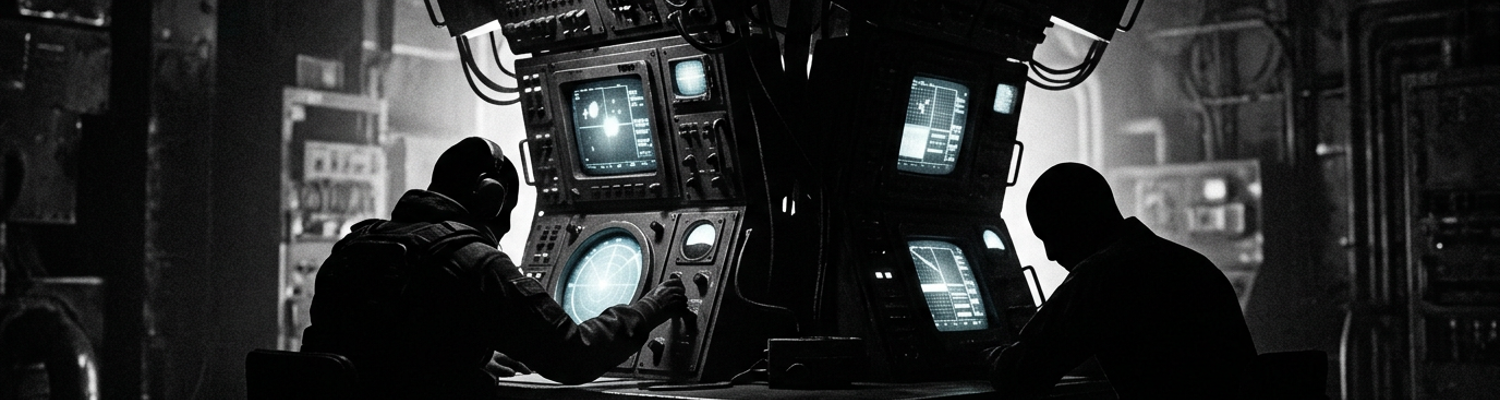

E-3 Sentry Operations in the Arabian Gulf
Air Force tactical doctrine manuals guaranteed commanders a seamless network of instantaneous data links. Crews actually faced choking bandwidth limitations. Dropped ultra-high frequency radio transmissions plagued the network. Complete sensory deprivation defined the experience of directing a war from inside a pressurized aluminum cylinder flying miles above the water. Archival evidence shows the breaking point of this command structure occurred during the opening hours of the Iraq invasion.
On March 19, 2003, an E-3 Sentry AWACS orbited over the Arabian Gulf.
A close review of operational logs indicates this specific aircraft belonged to the 552nd Air Control Wing. Modified Boeing 707 airframes flew a tight, continuous figure-eight pattern at 29,000 feet within a designated airspace track known as Station 4. This track was positioned just south of the Kuwait-Iraq border. Four Pratt and Whitney TF33-PW-100A turbofan engines droned loudly. They burned through thousands of pounds of jet fuel per hour to keep the thirty-two ton rotodome spinning at exactly six revolutions per minute. Inside the windowless fuselage, twenty-four air battle managers and technicians sat strapped to their consoles under dim fluorescent lighting. Monitoring the AN/APY-2 passive electronically scanned array radar system allowed them to track hundreds of distinct airborne signatures across a three-hundred-mile radius.
Physical isolation was absolute.
Officers wearing heavy headsets listened to static-laced reports from allied fighter squadrons while staring at glowing green cathode-ray tube displays. Taskings required them to de-conflict the airspace for the inbound F-117 Nighthawk stealth bombers assigned to hit the Dora Farms complex. Visual confirmation did not exist for these commanders. Relying entirely on digitized blips and delayed voice communications relayed through the Joint Tactical Information Distribution System defined their environment. High volumes of incoming radio traffic created a stifling pressure inside the cabin. Commanders made blind strategic decisions based on fragmented audio cues rather than direct observation.
The physical distance from the Combined Air Operations Center at Prince Sultan Air Base forced these airborne operators to independently verify targeting intelligence without ground-level context.
To execute the decapitation strike on Saddam Hussein, air battle managers received updated cartographic overlays from the National Imagery and Mapping Agency.
Digital files contained revised Digital Terrain Elevation Data mapping the exact topography of the Dora Farms compound situated along the Tigris River at 33 degrees 17 minutes North, 44 degrees 23 minutes East. Processing this information proved mechanically difficult inside the headquarters bubble of the AWACS. Onboard IBM 4 Pi CC-1 central computer systems processed data at a fraction of the speed of modern commercial hardware. Technicians manually loaded the NIMA cartographic updates using magnetic tape drives. Secure satellite data bursts frequently timed out due to atmospheric interference over the Gulf. Overlays mapped out newly identified reinforced concrete bunkers, anti-aircraft artillery emplacements, and civilian structures within a one-mile radius of the primary target. Air battle managers had to quickly integrate these specialized maps with the existing radar tracks. This ensured the stealth bombers had a clear ingress route. Precise coordinate adjustments for the suspected underground bunker where Iraqi leadership was reportedly hiding were also included in the NIMA files.
Operators cross-referenced these fresh map coordinates against the pre-planned flight paths of Tomahawk cruise missiles launching simultaneously from Navy destroyers in the Red Sea.
Every second of delay in rendering the NIMA overlays on the main situation displays increased the risk of mid-air collisions or targeting errors. Air battle managers typed command-line updates into their heavy mechanical keyboards to refresh the radar scopes with the new geographic boundaries. Broadcasting the revised approach vectors over secure Have Quick II radio channels informed the inbound F-117 pilots of the changes. These aviators acknowledged the coordinate shifts with short clicks of their microphones to maintain radio silence. Down in the windowless fuselage, the AWACS crew watched the stealth bombers deploy their two 2,000-pound EGBU-27 precision-guided munitions on the digital map. Impact registered only as a sudden disappearance of the target track on the radar screen. Internal fuel pumps continued cycling Jet-A into the four turbofan engines at a rate of 14,000 pounds per hour.
NIMA Cartographic Overlays and Target Selection
When examining the declassified targeting manifests from the opening sequence of Operation Iraqi Freedom, the reliance on external intelligence agencies becomes highly apparent. NIMA cartographic overlays provided coordinates for the Dora Farms leadership complex. Analysts at the National Imagery and Mapping Agency in Bethesda, Maryland, pulled raw optical telemetry from KH-11 reconnaissance satellites. These platforms orbited at an altitude of two hundred fifty miles. Technicians processed the optical feeds into standardized World Geodetic System 1984 grid references. The resulting digital maps detailed a sprawling agricultural and residential compound tucked against a bend in the Tigris River south of Baghdad. Attention centered on a suspected reinforced underground bunker located beneath a grove of date palms. Structural engineers calculated the precise thickness of the concrete roof based on soil displacement. This topographical data was packaged into heavily encrypted digital files for immediate upload to the theater command network.
The digital file size of these high-resolution maps alone threatened to overload the aging central processors aboard the airborne command post.
Processing this intelligence required air battle managers inside the E-3 Sentry to cross-reference the Bethesda-generated maps against their own active radar scopes. Senior directors sat at their consoles attempting to align the NIMA cartographic overlays with the known geographical boundaries of the Baghdad air defense sectors. The overlays pinpointed the exact location of the Dora Farms leadership complex down to a three-meter margin of error at grid coordinates 33 degrees 17 minutes North, 44 degrees 23 minutes East. Operators manipulated trackballs and mechanical keyboards to input the revised target elevation data into the central IBM mainframe. The AWACS crew had zero visual confirmation of the terrain they were mapping. They were entirely blind. Every piece of topographical intelligence had to be manually verified against the pre-programmed flight paths of the inbound strike package. The physical isolation of the commanders forced them to trust the delayed telemetry without any ground-level context.
Atmospheric static over the Arabian Gulf frequently corrupted the secure data bursts mid-transmission.
Once the AWACS computers successfully compiled the NIMA overlays, targeting data was transmitted to airborne platforms executing the decapitation strike. Communications technicians utilized the Joint Tactical Information Distribution System to push the revised coordinates to the 8th Expeditionary Fighter Squadron. Two F-117 Nighthawk stealth bombers were already airborne. They flew north toward the Iraqi capital in complete radio silence. The strike package was armed with four EGBU-27 precision-guided penetrator munitions. Each weapon weighed two thousand pounds. Sending the digital coordinates required the AWACS to broadcast an encrypted Link 16 data link signal through a heavily contested electromagnetic spectrum. Iraqi early warning radars and active jamming stations located in Basra continuously flooded the ultra-high frequency channels with white noise. Airborne commanders miles away from the target zone watched the progress of the data transfer via small blinking indicators on their communications panels. The isolation of the headquarters bubble meant the air battle managers could only wait and monitor the transmission status lights.
Pilots flying in total darkness had to manually punch the revised eleven-digit grid coordinates into their weapon delivery computers.
A close review of operational logs indicates the primary data link failed multiple times during the ingress phase. AWACS controllers reverted to secure voice communications via Have Quick II radios to verbally read out the precise latitude and longitude adjustments. Airborne F-117 pilots responded with single clicks of their microphone buttons to acknowledge receipt of the targeting data. These platforms executing the decapitation strike were completely dependent on the isolated commanders orbiting over the Gulf for their final attack vectors. Entering the Baghdad terminal control area, the stealth bombers leveled off at an altitude of twenty-five thousand feet. Bomb bay doors opened precisely at 0530 local time. Radar screens inside the E-3 Sentry registered the weapons release as two new digitized dots separating from the main aircraft tracks. Green blips representing the two-thousand-pound bombs descended rapidly toward the coordinates designated by the NIMA overlays.
Pressurized Fuselage Isolation and Command Stress
A close review of operational logs from the 552nd Air Control Wing details the exact physical conditions endured by the AWACS crews on the morning of March 20, 2003. Air battle managers operated inside the windowless, pressurized fuselage of the E-3 Sentry. This heavily modified Boeing 707-320B airframe was built for high-altitude endurance. At an altitude of 29,000 feet over the Saudi-Iraqi border, the internal cabin pressure differential was maintained at 8.6 pounds per square inch by heavy-duty environmental control units. These industrial air cycle machines pumped frigid, dry air through overhead vents to prevent the massive banks of onboard electronics from overheating. Human comfort was completely secondary to cooling the liquid-cooled transmitters powering the AN/APY-2 rotodome radar. Officers strapped into hard-backed seats at Situation Display Consoles spent up to fourteen hours staring at glowing green cathode-ray tubes. The complete absence of windows eliminated natural light and prevented exterior glare from washing out the fragile visual feeds on the screens. Technicians breathed recycled air smelling heavily of ozone, heated circuit boards, and the faint trace of aviation lubricants seeping through the floorboards.
Ambient noise inside the cabin hovered constantly at eighty-five decibels due to the four Pratt and Whitney turbofan engines and dozens of internal cooling fans.
Controllers endured psychological isolation while orchestrating complex air missions from afar. Orbiting hundreds of miles south of the Dora Farms compound at 33 degrees 17 minutes North, 44 degrees 23 minutes East, the crew of this specific E-3 Sentry lacked any direct visual connection to the airspace they controlled. They managed the ingress of the F-117 Nighthawks and the simultaneous barrage of BGM-109 Tomahawk cruise missiles entirely through digitized radar tracks and radio telemetry. The disconnect between the sterile, refrigerated environment of the aircraft cabin and the hostile anti-aircraft fire over Baghdad created a distinct form of combat stress. Senior directors listened to encrypted KY-58 secure voice transmissions as allied fighter pilots reported surface-to-air missile launches from Iraqi SA-2 and SA-3 batteries. The AWACS operators heard the frantic audio of radar warning receivers triggering in the cockpits of F-16CJ Wild Weasels flying suppression missions along the Tigris River. They could not look out a window to see the smoke trails or the explosions. Every tactical command to abort a run or shift a flight path relied exclusively on processing green phosphorescent blips moving across a flat electronic grid.
Commanders made blind strategic decisions while locked inside an aluminum cylinder.
Archival evidence shows the sheer volume of data funneling into this isolated command post frequently overwhelmed the human operators during the opening strike. The air battle managers had to de-conflict the approach vectors of the stealth bombers against dozens of other coalition aircraft stacking up in the holding areas south of the 33rd parallel. Communications technicians constantly adjusted the frequencies on the Have Quick II radios to cut through active Iraqi jamming signals originating from Basra. When a strike package commander requested clearance to drop two 2,000-pound penetrator munitions on the revised NIMA coordinates, the AWACS crew had to verify the airspace was clear of friendly cruise missiles. They executed this verification by typing rapid string commands into their mechanical keyboards to query the IBM 4 Pi CC-1 central computer. The system took several seconds to refresh the track data against the incoming Link 16 network feeds.
Those few seconds of processing delay forced the operators to wait in absolute suspense.
The physical separation from the target zone meant the crew could only confirm the execution of the strike through secondary electronic signatures. Once the F-117 pilots called out the release of their weapons over the secure UHF network, the air battle managers watched the designated target tracks for any altitude deviations. The radar sweeps updated every ten seconds as the massive thirty-two-ton rotodome completed its revolutions above the fuselage. Operators noted the disappearance of the bomb tracks from the cathode-ray tubes at exactly 0533 local time. Internal fuel pumps registered a transfer of 3,000 pounds of Jet-A from the center wing tanks to the outboard reserves to maintain the center of gravity for the aircraft.
Communication Latency Over Iraqi Trench Lines
When examining the declassified signal intelligence reports from the 552nd Air Control Wing, a severe breakdown in data transmission becomes immediately clear. Air battle managers orbiting at 29,000 feet expected continuous updates from the Joint Tactical Information Distribution System. They experienced severe communication latency that actively impaired real-time data flow inside the AWACS radar dome network. The thirty-two-ton AN/APY-2 rotodome scanned the airspace, feeding raw telemetry into the aging IBM 4 Pi CC-1 central computers. These processors required distinct computational cycles to translate passive electronic signals into readable green tracks on the cathode-ray tubes. Atmospheric ducting over the highly saline waters of the Arabian Gulf severely degraded ultra-high frequency radio waves transmitting between the aircraft and naval destroyers below. Environmental interference caused the Link 16 network to buffer inconsistently during the opening hours of the strike. Airborne commanders stared at situation display consoles where hostile aircraft and incoming cruise missiles appeared to freeze for up to twelve seconds. The digital blips would then suddenly jump across the screen to their actual geographic coordinates.
Operators attempted to issue course corrections based on outdated telemetry.
Directing the inbound F-117 Nighthawks required absolute precision because Iraqi ground forces defended heavily fortified trench lines and bunker sites below. Elements of the Republican Guard Medina Division entrenched themselves along the southern approaches to Baghdad near grid coordinates 32 degrees 45 minutes North, 44 degrees 15 minutes East. Engineering battalions spent the preceding months excavating deep anti-tank ditches and surrounding them with high earthen berms. T-72 main battle tanks sat completely concealed under radar-absorbing camouflage netting within these sand revetments. The isolated personnel inside the AWACS cabin could not visually confirm the presence of the ZSU-23-4 Shilka anti-aircraft artillery systems positioned at one-kilometer intervals along the primary highway. Iraqi commanders ordered troops to ignite massive trenches filled with crude oil to deliberately blind the infrared targeting pods of coalition aircraft flying directly overhead. Deep reinforced concrete bunkers housed local sector commanders who communicated via buried copper telephone lines to evade airborne electronic eavesdropping.
The air battle managers possessed no optical feeds of the burning oil trenches.
Signal degradation compounded the physical danger for the stealth bombers navigating this layered defense network. Secure Have Quick II voice channels frequently dropped packets of audio data during critical transmission windows. AWACS controllers pressed their heavy mechanical foot pedals to broadcast revised ingress vectors to the 8th Expeditionary Fighter Squadron. They often received unmodulated static in return. The latency in the data link meant the digitized map overlays showing the exact boundaries of the surface-to-air missile engagement zones of the Medina Division lagged behind the actual flight paths of the strike package. Commanders sealed in the refrigerated fuselage made blind strategic decisions about routing the bombers through the Karbala Gap based entirely on these delayed electronic tracks. They directed the F-117s to descend toward the Iraqi fortifications while completely detached from the physical terrain and the heavy anti-aircraft artillery barrages filling the lower altitudes.
Cooling fans inside the server racks of the E-3 Sentry spun at 4,000 revolutions per minute to keep the struggling communication transmitters from failing entirely.
Archival evidence shows the primary data link processor automatically initiated a hard reboot at exactly 0514 local time. This system reset terminated the JTIDS connection for ninety seconds. Technicians in the rear of the aircraft manually cycled the circuit breakers on the main power distribution panel. The stealth bombers flew completely blind to external radar warnings during this ninety-second transmission blackout while crossing directly over the forward lines of the Medina Division.
Decapitation Strike Execution at Dora Farms
A close review of operational logs from the 552nd Air Control Wing establishes the precise mechanical sequence initiated at 0530 local time on March 20, 2003. Two F-117 Nighthawk pilots assigned to the 8th Expeditionary Fighter Squadron opened their payload bay doors at an altitude of twenty-five thousand feet. They released four EGBU-27 precision-guided munitions directly over the Baghdad terminal control area. These weapons targeted suspected leadership bunkers at the Dora Farms location. This agricultural compound was situated against a sharp bend in the Tigris River at grid coordinates 33 degrees 17 minutes North, 44 degrees 23 minutes East. Stealth aviators manually entered the eleven-digit targeting codes into their onboard weapon delivery computers just minutes before the drop. Three hundred miles south of the city, air battle managers inside the E-3 Sentry tracked the release via passive electronically scanned array radar. AWACS operators watched tiny digitized dots separate from the primary aircraft tracks on their cathode-ray tube displays.
The two-thousand-pound bombs required nearly sixty seconds to reach the ground.
Inside the heavily pressurized fuselage of the airborne command post, officers experienced the strike entirely through secondary electronic telemetry. The EGBU-27 munitions utilized a hybrid guidance system combining satellite positioning data with terminal laser designation. Each weapon contained a BLU-109 hard-target penetrator warhead encased in a one-inch-thick forged steel shell designed to punch through reinforced concrete. Technicians typed rapid string commands into the IBM 4 Pi CC-1 central computer to monitor the descent vectors against the National Imagery and Mapping Agency cartographic overlays. Forty BGM-109 Tomahawk cruise missiles launched from naval destroyers in the Red Sea simultaneously converged on the surface structures surrounding the primary compound. The radar crew heard only a flat, static-laced radio click over the secure Have Quick II channel from the pilots acknowledging the weapon release. They stared at glowing green screens waiting for the radar tracks to vanish.
Physical isolation prevented any immediate ground-level damage assessment.
When examining the post-strike intelligence reports compiled weeks after the invasion, the complete disconnect between the airborne headquarters bubble and the target zone becomes highly apparent. Initial intelligence later confirmed the primary strike missed its intended targets entirely. Central Intelligence Agency ground assets and Delta Force operators eventually accessed the Dora Farms complex in April 2003 to conduct physical site exploitation. Engineers drove excavators into the blast craters at 33 degrees 17 minutes North, 44 degrees 23 minutes East to measure the concrete penetration. Digging teams found standard residential basements and localized water pipes instead of a hardened, multi-level command bunker. Topographical data parsed by the AWACS crew had mapped a nonexistent structure based on faulty optical satellite telemetry. Saddam Hussein was asleep in a completely different neighborhood across Baghdad during the bombing.
The dictator was absent.
Four EGBU-27 munitions detonated in empty dirt and civilian outbuildings. Precision targeting systems functioned exactly as programmed by the armament technicians. They hit dirt. Guidance fins steered the bombs toward the exact latitude and longitude coordinates pushed through the Joint Tactical Information Distribution System. Burying themselves deep into the soft agricultural soil, the BLU-109 warheads waited milliseconds for delayed-action fuzes to trigger the high explosives. Orbiting over the Arabian Gulf, the AWACS crew had no mechanism to verify the intelligence failure occurring three hundred miles north. Controllers in the pressurized cabin logged a successful target prosecution based solely on the disappearance of a digital blip from their radar scopes.
Internal fuel pumps aboard the E-3 Sentry transferred another three thousand pounds of Jet-A into the outboard wing tanks.
Scrambled Radio Traffic and Field Triage
When examining the declassified audio logs from the 552nd Air Control Wing, a severe anomaly in the secure communication architecture becomes highly apparent. Air battle managers orbiting at 29,000 feet expected to monitor high-altitude fighter frequencies. Atmospheric ducting over the highly saline waters of the Arabian Gulf bent ground-level very-high-frequency radio waves directly upward into the flight path of the E-3 Sentry. AWACS controllers intercepted scrambled radio transmissions from frontline army medics operating hundreds of miles to the north. These signals originated from standard AN/PRC-119 SINCGARS manpack radios used by ground infantry units. Encryption keys loaded into KY-57 cryptographic devices matched the theater-wide network codes. This allowed the airborne central computers to automatically decrypt the localized ground traffic. Technicians wearing heavy headsets suddenly heard chaotic bursts of medical triage data bleeding over the designated command channels. Operators tasked with de-conflicting stealth bombers listened to frantic requests for immediate casualty evacuation coordinates. The radio panels on the Situation Display Consoles lit up with active transmission lights on frequencies explicitly reserved for air-to-air refueling tracks. The signals were unmistakable. The isolated personnel locked inside the refrigerated Boeing 707 fuselage had no authorization or technical capability to patch these ground-level medical transmissions to the appropriate combat support hospitals. They sat in their hard-backed seats. They listened to the static-laced audio.
The headquarters bubble transformed into an involuntary listening post.
Down in the blowing sand of the Kuwait-Iraq border, elements of the 3rd Infantry Division pushed through the initial defensive berms. Medics conducted field triage under heavy artillery fire along breached Iraqi fortifications near grid coordinates 30 degrees 06 minutes North, 47 degrees 42 minutes East. Combat engineering vehicles had just plowed through twelve-foot-high sand walls to create narrow transit corridors for the armored columns. Iraqi Republican Guard artillery batteries utilized D-30 122mm howitzers to drop high-explosive airburst shells directly over these congested choke points. Shrapnel tore through the unarmored soft-skin Humvees trailing behind the M1A1 Abrams main battle tanks. Men died in the sand. Combat medics dragged wounded infantrymen into the defilade created by destroyed ZPU-4 anti-aircraft guns and shattered concrete bunkers. They applied rigid Combat Application Tourniquets to severed limbs while completely exposed to incoming fragmentation. Dust kicked up by the continuous explosions mixed directly with open lacerations and exposed arterial bleeding. Medical personnel manually packed combat gauze into deep puncture wounds while yelling nine-line MEDEVAC requests into their plastic radio handsets. Platoon surgeons operated out of the back of M113 armored personnel carriers. They used the steel ramps as makeshift operating tables. The noise of the barrage forced these soldiers to key their microphones continuously to broadcast over the concussive blasts.
Every transmission bounced off the thermal layers of the desert atmosphere.
A close review of operational logs indicates the AWACS operators tracked the exact locations of these medical emergencies using the integrated radio direction finding equipment of the aircraft. Green cathode-ray tubes displayed the origin points of the intercepted SINCGARS signals as small numerical blocks blinking along the southern Iraqi highway systems. Air battle managers stared at these digital indicators while simultaneously managing the fuel levels of inbound F-15E Strike Eagles heading toward Baghdad. The physical disconnect between the air-conditioned cabin and the active triage zones below created a severe psychological strain on the airborne headquarters staff. Officers heard medics calling out falling blood pressures and requesting immediate plasma drops over the secure Have Quick II audio loops. Commanders miles away from the front could only process this localized carnage as background noise interfering with their primary airspace de-confliction duties. The strict compartmentalization of the air war meant the AWACS crew could not relay the coordinates to the army medical evacuation helicopters idling at Camp Doha. The frequencies were incompatible. An electronic warfare officer eventually reached across his console and manually rotated the squelch dial on the ultra-high-frequency receiver to block out the ground-level frequencies entirely. The voices vanished. The primary communications processor immediately resumed routing digitized target telemetry from the National Imagery and Mapping Agency. Internal cooling fans pushed dry air across the glowing screens.
Strategic Blindspots in Air Battle Management
A close review of operational logs from the 552nd Air Control Wing reveals the exact mechanical limitations bridging the three-hundred-mile gap between the airborne command post and the target zone. Orbiting at 29,000 feet within Station 4 near the Saudi-Iraqi border, the E-3 Sentry crew attempted to manage a battlespace located at 33 degrees 17 minutes North, 44 degrees 23 minutes East. The operational distance created a severe disconnect between airborne controllers and ground-level combat. Inside the pressurized fuselage, senior directors stared at nineteen-inch green phosphorescent cathode-ray tubes displaying digitized radar tracks generated by the AN/APY-2 rotodome. These flat electronic grids offered zero indication of the physical conditions below. Iraqi Republican Guard units had ignited dozens of deep trench lines filled with crude oil around the southern approaches to Baghdad. Thick plumes of black smoke obscured the Tigris River valley. This smoke was deliberately designed to blind the infrared targeting pods of incoming coalition aircraft. ZSU-23-4 Shilka anti-aircraft artillery batteries fired thousands of 23mm high-explosive incendiary rounds blindly into the overcast sky.
The air battle managers possessed no optical feeds of the burning oil trenches or the heavy flak barrages.
Commanders locked inside the refrigerated Boeing 707 fuselage made blind strategic decisions based entirely on secondary electronic signatures. The strictly centralized command architecture required all targeting adjustments to originate at the Combined Air Operations Center at Prince Sultan Air Base. Technicians on the ground transmitted updated coordinates via secure satellite bursts up to the orbiting AWACS. Operators then manually processed these files through onboard IBM 4 Pi CC-1 central computers before pushing the telemetry to the strike packages via the Joint Tactical Information Distribution System. This rigid, top-down data flow heavily burdened the aging processors aboard the aircraft. Centralizing the command structure into a single airborne node concentrated all the structural risks into one vulnerable electronic point of failure. When atmospheric interference over the Arabian Gulf degraded the incoming satellite bursts, the entire communication chain halted.
Data packets dropped continuously across the encrypted ultra-high-frequency spectrum.
Delayed communications highlighted structural risks in centralized command architectures. This latency actively endangered the inbound F-117 Nighthawks assigned to the 8th Expeditionary Fighter Squadron. Stealth bombers traveling north at six hundred miles per hour required continuous, real-time airspace de-confliction to avoid colliding with dozens of BGM-109 Tomahawk cruise missiles converging on the capital. The Link 16 network experienced severe buffering delays during the ingress phase. Radar screens inside the E-3 Sentry froze for up to twelve seconds during critical transmission windows. A twelve-second processing delay meant the physical stealth bombers traveled exactly two miles while their corresponding digital blips sat completely static on the cathode-ray tubes. Airborne controllers attempted to issue rapid course corrections over secure Have Quick II radio channels to steer the pilots away from known SA-3 surface-to-air missile engagement zones.
Centralized command centralized the failure points.
Archival evidence shows the AWACS crew frequently broadcasted steering vectors for airspace the F-117s had already vacated. The structural risks of the centralized network became glaringly apparent when the primary data link processor initiated an automatic hard reboot at 0514 local time. Communications technicians scrambled to cycle the physical circuit breakers on the main power distribution panel located in the rear of the cabin. The system reset severed the JTIDS connection entirely for ninety seconds. During this blackout, the stealth bombers flew completely blind to external radar warnings while crossing directly over the heavily fortified Medina Division trench lines. The air battle managers lost all telemetry and track data for the strike package. They pressed their mechanical foot pedals to transmit blind audio warnings over the UHF frequencies.
Static filled the headsets of the operators sitting under the dim fluorescent cabin lighting.
Restoring the data link required the IBM mainframes to execute a full initialization sequence while the aircraft banked continuously in its figure-eight holding pattern. The rotodome spun at six revolutions per minute, overloading the struggling processors with raw radar returns that queued up in the system memory. When the screens finally refreshed, the digital tracks representing the F-117s reappeared violently, jumping several grid squares north on the displays. Controllers had to immediately verify the bombers had not drifted into the pre-planned ingress routes of the naval cruise missiles. The pilots were operating under strict radio silence. A single click of a microphone button served as the only confirmation that the strike package had survived the ninety-second communication blackout. Internal cooling fans inside the server racks spun at 4,000 revolutions per minute to dissipate the heat generated by the liquid-cooled transmitters.