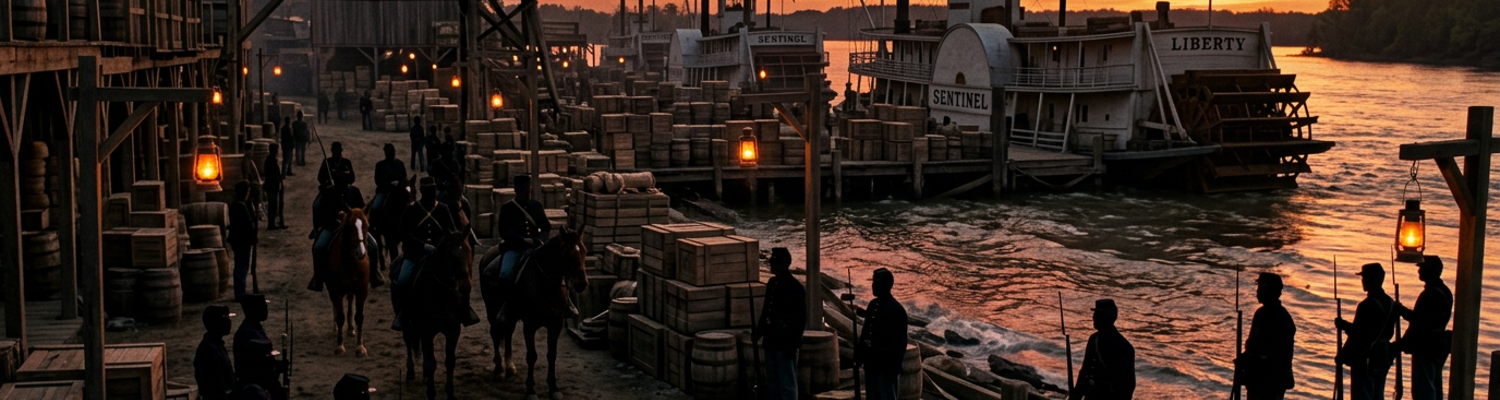
Banner for Court Martial Dockets and Provost Operations at City Point

Court Martial Dockets and Provost Operations at City Point

USMilitaryArchive
USMilitaryArchive

Published on

6 Views
0 Likes
Text Size

Dockets for Capital Court Martials Before the Crater Iron shackles and chain links ran out across the supply depots at City Point during the scorching third week of July 1864, leaving Provost Marshal General Marsena Patrick without the basic mechanical restraints needed to secure a surging flood of Union prisoners. Quartermaster steamboats arriving from Washington carried hardtack and artillery shells rather than replacement irons, forcing provost guards to improvise wire ties and rope bindings that prisoners repeatedly cut or untied in the dark. This equipment failure collided directly with an operational disaster at the front lines, where relentless Confederate sharpshooting, continuous artillery bombardments, and temperatures reaching well over one hundred degrees broke the endurance of veteran regiments. Thousands of infantrymen collapsed from sunstroke in the dry trenches outside Petersburg, while hundreds more slipped into the scrub pine woods each night to abandon their units entirely. Armed pickets along the rear rail corridors caught fleeing soldiers by the wagonload, creating an unprecedented administrative and physical bottleneck that the existing base stockades could not contain. Carpenters from the military railroad service rapidly built new provost detention pens across the Petersburg rear echelons to contain the overflow of arrested men. Work crews felled acres of Virginia forest to throw up ten foot stockade fences at Meade Station, Birney Station, and the City Point supply bluffs, creating massive outdoor corrals exposed to the blinding summer sun. Conditions inside these raw dirt compounds deteriorated almost immediately as provost detachments crowded thousands of conscripts, bounty jumpers, and battle fatigued infantrymen together without canvas fly tents or wooden shade shelters. Foul latrine trenches overflowed into the packed soil, while water carts hauled from the Appomattox River delivered cloudy drinking water that fueled rapid outbreaks of dysentery and camp fevers. Guards armed with loaded muskets patrolled the perimeter catwalks day and night, repeatedly firing into the crowded yards whenever prisoner fights broke out or mutinous groups attempted to dig beneath the boundary logs. Provost marshals processed these unruly captives through temporary intake desks, compiling extensive rosters of defiant soldiers that they forwarded directly to the army trial advocates. Judge Advocate General staff officers recorded an unprecedented spike in capital desertion and mutiny dockets as these rosters flooded their desks during the final two weeks of July 1864. Formal court martial boards sat continuously inside stifling hospital wall tents pitched along the military railroad line, working through hundreds of case files under orders to expedite every hearing. Trial records documented a severe collapse of combat cohesion across the Ninth and Fifth Corps, filling ledger after ledger with accounts of entire picket details refusing to advance, enlisted men assaulting their company officers, and bounty substitutes deserting within hours of reaching the front. Military judges dispensed with ordinary procedural delays, issuing guilty verdicts within minutes and handing down mandatory death sentences for any soldier convicted of desertion in the presence of the enemy. Major General George Meade reviewed these mounting stacks of capital convictions each night at his headquarters tent, signing death warrants in heavy ink to prepare the army for its upcoming attempt to breach the Petersburg defenses. Provost guards carried out strict summary execution directives across the army camps to halt this systemic breakdown of discipline prior to the July 30 assault. Corps commanders halted nonessential trench duties and ordered full brigades to assemble at dawn in hollow squares around open fields, forcing thousands of wavering troops to witness the physical cost of disobedience. Wagons rolled into the center of each square carrying condemned soldiers seated on top of raw wood coffins, escorted by provost firing squads carrying rifled muskets loaded with single lead balls. Staff officers read the court martial orders aloud over the quiet formations before firing details stepped forward, aimed at white cloth targets pinned over the hearts of the prisoners, and discharged their volleys. Provost officers checked the bodies alongside field surgeons, supervised the burial of the corpses in pits dug directly behind the firing posts, and immediately marched the silent regiments back into the assault trenches facing the Crater. ## Casualties at Cold Harbor and Morale Collapse Burial pits dug across the Petersburg front line mirrored the catastrophic ground left behind at Cold Harbor, where the loss of over twelve thousand Union casualties in early June 1864 triggered widespread straggling across the Army of the Potomac. Frontline veterans who survived the frontal assaults against fortified Confederate earthworks refused to advance during subsequent attacks, pinning themselves flat in the sand and underbrush whenever buglers sounded the charge. Exhausted soldiers abandoned their haversacks, dropped their Springfield rifled muskets into roadside ditches, and drifted miles behind the active lines to escape continuous artillery and sniper fire. Baggage trains, ambulance corrals, and rear hospital sites filled with thousands of uninjured men who claimed they had lost their companies or were seeking water. Brigade commanders sent desperate dispatches to headquarters warning that their combat strength had melted away, as entire company rosters ceased to exist on morning roll calls. Provost marshals deployed cavalry patrols across every secondary road and cow path leading away from the Chickahominy River to intercept this uncontrolled outflow of armed combatants. Cavalrymen dragged wagonloads of apprehended deserters out of roadside thickets and swamp margins, yet these roundups barely checked the severe fracture of frontline infantry cohesion that resulted in thousands of combatants abandoning their regiments. Veteran units that had fought since the Wilderness lost their collective will to assault fortified positions, leaving junior officers completely unable to enforce basic march discipline or maintain line integrity. Inexperienced conscripts and high priced substitutes sent to replace the staggering losses took advantage of the tactical confusion, slipping past company sergeants during night movements and vanishing into the Virginia woods. Regimental colonels reported that hundreds of soldiers intentionally lagged behind the marching columns, discarded their ammunition cartridges in the mud, and gathered in lawless bands near the river crossings. Base depots at White House Landing and later City Point struggled to process the sheer volume of runaway infantrymen who swarmed supply wharves in desperate attempts to stow away aboard northbound transport steamers. Provost guards cordoned off the river docks with fixed bayonets, turning back hordes of disorganized soldiers and herding them into temporary detention stockades for immediate screening. Surgeons working directly alongside provost guards inside the screening compounds instituted rigorous surgical inspection protocols to identify and detain soldiers with self inflicted gunshot wounds. Desperate infantrymen seeking an escape from the bloody trenches had taken to discharging their own muskets through their left hands or feet, often firing through loaves of bread, thick wool blankets, or wet paper to muffle the flash and avoid telltale gunpowder residue. Examining doctors swabbed skin around entry holes with chemical sponges to detect black powder scorches, measured barrel burn radii, and checked whether bullet trajectories entered at impossible downward angles while rifles were supposedly leveled at enemy lines. Army medical directors stamped suspect health passes with red ink markings, stripped the wounded men of their weapons, and handed them over directly to armed provost escorts as criminal prisoners. Guards forced these bleeding captives into separate holding pens where staff officers recorded their names, regiments, and precise wound characteristics for trial evidence. Provost marshals marched these maimed suspects under heavy armed guard into central stockades to await trial by general court martial for cowardice and deliberate self mutilation. ## Cavalry Cordons and Screening Operations Along the James River Marsena Patrick recognized that locking mutilated suspects inside central stockades did nothing to stem the wider tide of soldiers slipping quietly away through the army rear sectors. The Provost Marshal General deployed mounted pickets across all major James River crossing points to seal off every water route leading away from the active campaign lines. Cavalry troopers from veteran provost squadrons rode constant day and night patrols along the riverbanks between Bermuda Hundred, City Point, and Fort Powhatan, covering every creek mouth, sandbar, and hidden marsh trail. Sentries on horseback watched the shoreline with carbines across their saddles, scanning the water for abandoned skiffs, makeshift rafts, or drifting timber that fleeing men could use to cross over to the northern shore. Troopers searched through every riverfront plantation outbuilding, dragging out hidden rowboats and destroying unauthorized canoes with broadaxes so that no straggler could find transportation across the water. Picket posts established at half mile intervals maintained visual contact across the open flats, firing warning shots across the river bends whenever unidentified figures emerged from the tree lines. Barricades of felled timber and sharpened rails sprang up along primary transit axes near Wilcox Landing as provost units turned their focus toward the overland escape corridors. Provost officers established fixed filtration checkpoints at these road junctions to halt and inspect every individual moving toward the James River docks. Guards constructed log cabins and wooden turnstiles across the roadways, forcing entire columns of quartermaster wagons, ambulance trains, and mounted couriers into single file lanes. Armed sentries carrying loaded Spencer repeating carbines manned each gate, ordering riders off their horses and demanding travel credentials from every soldier before letting the turnstiles turn. Clerks worked continuously under open canvas awnings beside the road barriers, checking personal identification against updated army rosters of missing men and noting down the physical descriptions of anyone lacking proper paperwork. Provost details searched inside hay wagons, under canvas wagon covers, and among stacks of empty barrels, using fixed bayonets to prod through cargo piles where desperate infantrymen frequently hid to get past the outer lines. Inspectors at the Wilcox Landing checkpoints apprehended vast numbers of unassigned convalescents and detached personnel traveling without official corps level transit passes. Thousands of recovering wounded men discharged from base hospitals wandered the rear roads under vague verbal orders, claiming they were searching for their regiments while deliberately walking toward the rear. Quartermaster teamsters, mess attendants, and detached artillery wagoners also roamed between depots without written orders, exploiting the administrative confusion of the siege lines to escape trench duty. Provost officers seized these wandering soldiers immediately, rejecting any company level travel passes or handwritten doctor notes that did not carry the formal red ink stamp of a corps commander. Clerks logged each seized man into intake ledgers, confiscated his weapons, and directed him into heavy timber holding pens built directly beside the road barricades. Armed cavalry details roped the apprehended men into marching columns of four, stepped them onto the dusty road under a heavy guard of loaded carbines, and drove them back toward City Point for processing and reassignment to front line earthworks. ## Wharf Checkpoints and Maritime Interdiction at City Point Sentries swung open the heavy timber gates along the river bluff as the marching columns arrived at City Point, where army engineers and provost marshals converted the vast deep water logistical depot into a sealed rear security perimeter. High board fences and wire barricades cut off the entire waterfront from the army camps inland, funneling all wagon traffic and foot travelers through narrow, guarded checkpoints. Provost Marshal General Marsena Patrick stationed veteran provost battalions along this barrier to ensure that no retreating infantrymen could blend in with the thousands of civilian stevedores, teamsters, and hospital attendants working near the water. Sentry posts spaced every fifty yards gave armed guards clear sightlines across the warehouses, railroad sidings, and open cargo flats. Guards turned back any individual who lacked a blue tinted headquarters badge or an official quartermaster travel voucher signed by the base commandant. This containment cordon funneled all foot traffic directly into designated inspection pens, cutting off unauthorized access to the riverbank and leaving the crowded commercial docks completely isolated from the army rear. Dock barricades divided the wooden piers into controlled loading zones, forcing every dockworker, sailor, and arriving soldier through fixed filtration posts. Provost sergeants stood at the base of each wooden pier with loaded carbines, examining movement papers and checking official travel authorizations against master depot registries. Thousands of wounded convalescents and detached infantrymen drifted toward the waterfront each day, attempting to blend in with civilian freight handlers and coal shovelers loading cargo barges. Sentries pulled suspect soldiers out of work details, stripped off unauthorized civilian coats or teamster shirts they had stolen to disguise their military uniforms, and checked their hands for weapon calluses. Guards escorted verified workers onto the piers with colored cloth armbands, while turning away unauthorized personnel and locking unassigned stragglers into holding pens along the river wall. These strict dockside barriers ensured that only authorized personnel and cargo reached the waterfront, leaving departing supply vessels as the final target for soldiers desperate to escape the Virginia campaign. Guards boarded every chartered steamship, schooner, and empty coal transport tied along the James River piers before harbor pilots received clearance to cast off for northern ports. Armed provost guards conducted rigorous inspections of each vessel, carrying fixed bayonets and brass lanterns down iron ladders into the dark holds. Search parties crawled across coal heaps, opened boiler access panels, and checked narrow crawlspaces beside the steam engines to flush out hidden combatants. Desperate soldiers smeared their skin with black soot, wedged themselves into paddlewheel housings, or climbed inside empty water barrels to avoid detection. Troopers thrust long iron sounding rods into soft freight piles and tapped along wooden bulkheads, dragging dozens of coughing, soot covered stowaways out of the bilges each morning. Provost officers placed armed sentries at every gangway and ladder to prevent any crewman or laborer from helping captured men slip back into the river. Officers stood at every vessel gangplank beside the civilian ship masters to enforce passenger manifest verifications on all soldiers attempting to travel north. Boarding details scrutinized every pass, discharge certificate, and travel order to detect soldiers using forged furlough paperwork. Swindlers and desertion brokers operating in the rear camps sold counterfeit documents that featured carved wooden stamps, faked signatures of corps commanders, and chemically aged paper. Clerks checked each uniform against the vessel certified passenger manifest, matching written physical descriptions against the actual soldiers and rejecting any man whose name did not appear on the original harbor clearance list. Inspectors tested ink consistency, checked regimental rosters against base telegraph records of front line units, and seized anyone holding fraudulent credentials. Guards stripped the fake documents from the apprehended men, fastened their wrists behind their backs with iron handcuffs, and marched them down the timber pier directly into the wharf detention pen. ## Contraband Rings and Black Market Sutler Networks Detention pens along the riverbank quickly filled with civilian prisoners as provost search details uncovered an illicit trade network operating across the City Point wharves. Inspectors halted cargo unloading across every barge and schooner to search for unapproved whiskey shipments entering the army supply base. Civilian riverboat crews and corrupt merchants concealed liquor inside hollowed out machinery crates, lard tubs, and barrels marked as vinegar or pickled pork to evade dockside sentries. Provost guards drove long iron augers through crates of dry goods and tapped cask staves with wooden mallets, smashing dozens of hidden glass bottles whenever smelling alcohol on the wood. Search details rolled the confiscated barrels to the end of the piers, broke the heads open with axes, and emptied hundreds of gallons of black market whiskey directly into the James River. Crates broken open on the piers yielded thick packets of counterfeit military currency that civilian dealers used to buy stolen army property from corrupt teamsters. Black market rings passed thousands of dollars in bogus treasury greenbacks to frontline soldiers while purchasing diverted uniform coats, cavalry saddles, and rifled muskets from depot warehouses. Clerks working inside harbor intake sheds rubbed suspect notes with chemical testing solutions and examined paper fibers under brass magnifying lenses to expose forged signatures and blurry serial numbers. Provost marshals confiscated stacks of these fraudulent bills from civilian satchels, sea chests, and coat linings during mandatory dockside searches. Guards hauled the seized currency ledgers and apprehended swindlers into base headquarters to build formal prosecution files for military trials. Brigadier General Marsena Patrick convened military commissions at City Point to try these civilian operators for evading quartermaster regulations. Depot officers assembled these special tribunals inside wooden administrative buildings to bypass the slow procedures and jurisdictional disputes of northern civil courts. Judge advocates introduced confiscated account books, counterfeit greenbacks, and smuggled whiskey jugs as proof against civilian blockade runners, corrupt ship masters, and unregistered freight forwarders. Accused operators stood before panels of Union officers to face charges of defying depot travel restrictions, bribing dock guards, and trafficking in stolen military rations. Commission members sentenced convicted operators to harsh monetary penalties, forced labor on base road building crews, or confinement in the federal prison at Fort Norfolk. Quartermaster officers reinforced these court rulings through the summary revocation of sutler permits to strip black market vendors of their commercial privileges. Unauthorized merchants and licensed sutlers had erected hundreds of canvas shanties and plank counters directly against the quartermaster supply storehouses, blocking wagon access and hawking bootleg liquor to off duty soldiers. Inspectors examined trade licenses at every commercial stall, revoking permits on the spot whenever vendors gouged enlisted men on staple prices or harbored contraband goods. Infantry details tore down illegal wooden shanties, loaded seized commercial freight into army transport wagons, and carried out the physical expulsion of unauthorized merchants operating near the bread storehouses and forage yards. Guards marched the dispossessed traders to the outer depot gates under fixed bayonets, loaded them onto outbound northern steamers, and posted sentries along the perimeter fences to prevent them from reentering the lines. ## Bounty Jumper Apprehensions Along James River Shipping Lanes Steamers carrying deported civilians down the James River quickly attracted organized syndicates of professional bounty jumpers seeking maritime escape back to northern recruitment districts. These criminal networks specialized in repeatedly enlisting recruits under forged identities to pocket municipal, state, and federal cash bounties that frequently totaled over a thousand dollars per man. Brokers coordinated with corrupt riverboat personnel, purchasing counterfeit civilian travel certificates and bribing deckhands to conceal fraudulent recruits inside chain lockers, steam pipe galleries, and auxiliary lifeboats before vessels cleared the docks. Provost Marshal General Marsena Patrick organized extensive surveillance operations targeting these syndicates, directing intelligence staff to map out broker networks, waterfront boarding houses, and money couriers operating between City Point and northern transit centers. Armed picket boats and shore lookouts monitored all commercial river traffic moving between Bermuda Hundred, City Point, and Newport News, recording vessel movements and intercepting unauthorized skiffs that met passing ships in the dark. Sentries patrolled the river channels day and night to dismantle this organized maritime pipeline that stripped frontline units of hundreds of replacements each week. Detectives dressed in civilian work coats boarded commercial transport vessels operating on the lower James River to expose these escape networks from the inside. Provost officers deployed plainclothes detectives among the deck passengers and freight handlers, giving them instructions to observe shipboard routines without revealing their military status. Undercover investigators spent hours mingling with coal shovelers, listening for syndicate recognition phrases, and monitoring dark passages near the boiler rooms where fraudulent recruits waited to discard their army uniforms. Detectives located false bulkheads and hollowed out cargo crates where ship engineers stashed fugitive recruits in exchange for fifty dollar cash payouts. Investigators waited until the vessels navigated the deep channels near Fort Powhatan, far beyond swimming range of the shoreline, before pulling concealed Colt revolvers and blowing copper whistles to signal waiting provost boarding parties. Armed soldiers poured out of forward cabins to secure the steering gear, arrest corrupted riverboat officers, and pull dozens of soot covered jumpers from the engine holds. Investigators marched the handcuffed syndicate members off the boats at armed river docks for field interrogation. Guards marched these intercepted draft evaders and fraudulent recruits from the docks directly into designated secure stockades built along the bluffs behind City Point. Base engineers constructed these specialized containment pens with double walled oak palisades, deep boundary ditches, and elevated guard platforms to defeat experienced escape artists who had broken out of civilian jails across the North. Turnkeys stripped incoming prisoners of their boots, civilian disguises, and concealed money belts, logging stacks of seized treasury greenbacks into general court martial dockets as physical evidence of bounty fraud. Provost staff separated organized brokers and repeat deserters from inexperienced draft evaders, breaking up syndicate command structures inside the stockades and preventing gang leaders from silencing cooperative witnesses. Armed sentries walked the high catwalks at all hours with loaded Springfield rifles, keeping large tin reflectors and oil lanterns focused across the dirt yards below. Provost marshals processed these captive syndicates for military commissions that sentenced convicted bounty jumpers to long terms of hard labor on government fortifications under heavy iron leg irons and ball and chain restraints. ## Clerks and Administrative Exhaustion in the Provost System Clerks stacked heavy transcripts from these commission trials into sagging canvas wall tents as escalating War Department mandates from Washington flooded field provost headquarters. Bureau officials in the capital issued strict orders requiring exhaustive paperwork for every detained soldier, demanding triplicate copies of descriptive rolls, sworn witness depositions, and physical inventories of confiscated property before any sentence could be confirmed. Scribes detailed from veteran infantry regiments worked twelve hour shifts inside stifling administrative tents, dipping steel pens into iron gall ink that smeared across sweat soaked ledger pages. Every case file required clerks to cross reference enlistment dates, state recruitment quotas, and financial bounty vouchers against distant regimental records to expose aliases and fraudulent substitution contracts. The Judge Advocate General office repeatedly returned entire dockets across the telegraph lines for minor procedural errors, demanding corrected affidavits and formal officer endorsements that field clerks had no time to gather. This clerical avalanche quickly outstripped Marsena Patrick and his small administrative staff, burying active court files beneath mountains of unverified paperwork that halted the formal transfer of convicted prisoners to labor gangs. Stockades along the Petersburg siege lines swelled far past safe capacity as thousands of unsentenced men sat trapped behind rotting pine palisades. Rations for these crowded compounds dwindled to critical levels because quartermaster supply trains prioritized active combat brigades in the trenches, leaving provost officers with meager supplies of worm eaten hardtack and spoiled salt pork. Severe food shortages and fouled surface wells triggered crippling outbreaks of dysentery and scurvy that incapacitated both the prisoners and the exhausted provost guards stationed over them. Stockade security deteriorated as corps commanders stripped experienced infantry details from rear echelon guard duty to reinforce rifle pits, replacing them with convalescent soldiers and untrained recruits who could not maintain order. Judicial personnel along the siege lines vanished just as rapidly, as line captains and majors qualified to sit on court martial panels were pinned down by Confederate sharpshooter fire, wounded in trench skirmishes, or killed outright. Provost marshals found themselves completely unable to assemble the mandatory panels of five to thirteen commissioned officers required by military law to convene general courts martial, leaving capital cases entirely suspended. Dockets accumulated by the hundreds across corps headquarters desks as this procedural backlog crippled disciplinary enforcement immediately prior to the Crater offensive. Mutiny charges, desertion warrants, and theft complaints sat untouched in leather courier satchels while administrative officers fruitlessly petitioned Washington for emergency judicial relief. Brigade commanders attempting to enforce discipline in the trenches faced an impossible dilemma, as sending insubordinate soldiers to City Point only removed able bodied riflemen from the line without resulting in swift punishment. Regimental officers preparing for the massive assault against Elliott Salient discovered that repeat offenders were routinely returned to company ranks after days of unrecorded detention because rear provost stations had run out of space to hold them. This breakdown of procedural accountability destroyed the deterrent value of the Articles of War, convincing frontline troops that field commanders lacked the authority or administrative capacity to execute formal sentences. Guards along the reserve trenches stopped arresting combat shirkers during the final forty eight hours before the mine detonation, recognizing that the paralyzed judicial system could not process a single new docket. Infantry details tasked with clearing rear rail corridors abandoned their filtration checkpoints to assist quartermaster teams in hauling heavy artillery ammunition toward the siege works. Disciplinary pens outside City Point degenerated into chaotic holding yards where untried suspects bargained with demoralized sentries or slipped away into the Virginia pine woods without challenge. Company captains marching their battalions into the covered assault trenches on July 29 found themselves leading hundreds of men who had witnessed the total collapse of army law, forced to rely on drawn revolvers and physical threats rather than the provost system to hold their assault lines in place.

Preserve the Legacy of Service

History isn't just written in textbooks—it is preserved by family members, researchers, and veterans who ensure the details are never lost. Join our community to bookmark records, build custom reading collections, and share stories.
CONTINUE EXPLORING
More from Civil War Era

Community Discussion

Login to Comment