
The Strategic Imperative for Forward Airfields
The air war in the South Pacific was a contest against distance. Planners understood that airpower was the key to isolating Japanese garrisons, but its application was governed by the unforgiving mathematics of fuel consumption. For the Thirteenth Air Force, operating B-24 Liberators from rear bases like Henderson Field on Guadalcanal, strikes against the northern Solomons or New Britain were extreme range missions. A close review of operational logs (Record Group 38, NARA) confirms that a significant portion of an aircraft's lift capacity on these flights was dedicated to gasoline for the return journey, not its bomb load. This handicapped the offensive power of the campaign.
The solution was a network of forward-operating bases. These were to be carved out of jungle and coral by the U.S. Navy’s construction battalions, the Seabees.
The proposed airstrip designated 6-Fish, part of the broader Operation Fish logistical network, was conceived for a remote, unnamed atoll. Its location was chosen to solve this specific problem, acting as a force multiplier. Seabees, often skilled construction workers in civilian life, were tasked with transforming inhospitable terrain into functional military installations using bulldozers, graders, and explosives. Constructing an airstrip on a coral atoll involved blasting and pulverizing the rock, grading it into a flat surface, and compacting it to bear the weight of heavy bombers.
An airfield like 6-Fish would extend the effective combat radius of heavy bombers by hundreds of miles. For a B-24 crew, the existence of a forward field meant they could carry a heavier bomb load. The B-24 had a maximum range around 2,850 miles, a figure reduced drastically when carrying its maximum 8,000-pound bomb load. An intermediate strip allowed bombers to strike Rabaul with a full complement of ordnance and then refuel before the safer flight back to their primary base. This increased the destructive power of each raid and improved survival odds for aircrews. The field would also serve as an emergency landing site for damaged aircraft that could not complete the return journey, saving experienced crews and high-value machines from being lost to the sea.
Beyond its role for bombers, the imperative for 6-Fish was connected to the strategic airlift sustaining the island-hopping campaign. The Douglas C-47 Skytrain was the unglamorous workhorse of the Pacific, a link carrying everything from ammunition and engine parts to medical supplies. These transport aircraft were essential for countering the mobility of Japanese forces. Like the bombers, the C-47s were constrained by range. A forward strip like 6-Fish would serve as a refueling hub, allowing a constant stream of supplies to reach the front lines and enabling the rapid evacuation of wounded personnel. A C-47 could be configured to carry up to 18 stretcher cases, and the ability to move the wounded quickly was a significant factor in combat effectiveness. The presence of 6-Fish would transform the airlift from a series of precarious, long-distance flights into a more robust logistics network.
A Single Point of Mechanical Failure
The operational capacity of Fishhook Airstrip depended on one machine. Deployed with the 6th Naval Construction Battalion, a Cedarapids Model A portable rock crusher was the sole piece of heavy equipment on the atoll capable of pulverizing coral. This assembly of diesel engines, conveyors, and hardened steel grinding plates was designed to ingest large chunks of coral and reduce them to a graded aggregate suitable for a runway surface. A review of the initial equipment manifest for the 6-Fish project (File 6-NCB-E-44) shows a request for two such pulverizers, a standard redundancy. Shipping allocations in the South Pacific theater were brutally constrained. The second crusher was offloaded at Espiritu Santo to make room for a priority shipment of 155mm artillery shells. This decision, made by a logistics officer far from the front, created a single point of failure. Every B-24 that landed and every C-47 that took off did so from a surface dependent on one overworked engine.
It was a vulnerability known to every Seabee on the island.
From the moment construction began, the Cedarapids crusher was run twenty-four hours a day. The demand was relentless. The initial 5,000-foot runway needed to be built and then constantly maintained. Tropical deluges would wash away the finer binding particles of the coral surface, leaving a treacherous field of loose, sharp-edged aggregate. The battalion’s after-action reports detail a constant cycle of repair. As soon as a section of the runway was graded, another would begin to degrade. The pulverizer was tasked with producing a constant supply of fresh coral mix to patch these wounds. Maintenance crews fought a losing battle against metal fatigue. The crusher’s primary drive belt was replaced twice in the first month. The engine’s injectors were constantly clogged by contaminated fuel. A formal request for a new set of manganese steel jaw plates, the primary crushing components, was submitted on three separate occasions. The parts remained a low-priority item in the theater’s supply chain. The machine was being pushed far beyond its specified operational limits.
The pulverizer’s function was a direct component of Allied airpower. The surface of a coral airstrip was a constant hazard. Unlike asphalt, pulverized coral could be sharp and abrasive, placing extreme stress on aircraft tires during high-speed, high-weight takeoffs. A B-24 Liberator, weighing over 55,000 pounds when fully loaded, required a stable surface. A pothole or a soft patch could lead to a blown tire or a collapsed landing gear strut. The four large propellers of a Liberator spun perilously close to the ground. Loose coral chunks kicked up by the tires could be thrown into the blades, causing immediate engine damage. For the C-47 Skytrains, a disabled aircraft on the single runway would halt all traffic. The operational readiness of the Cedarapids crusher was therefore directly proportional to the number of sorties that could be flown.
Japanese Naval and Air Reconnaissance
The waters surrounding Fishhook Airstrip were a hunting ground. Operational logs from the Solomon Islands campaign reveal a persistent and systematic Japanese naval presence. This was not a passive blockade but an active, aggressive effort. Fast destroyers, many of them veterans of the nocturnal supply missions Allied forces called the Tokyo Express, patrolled the narrow sea channels nightly. These ships, built for speed and night combat, would race down from bases in Rabaul or the Shortland Islands after dusk. The threat was compounded by the unseen presence of Imperial Japanese Navy submarines. Records show that RO-class coastal submarines were actively deployed throughout the Solomons with the specific mission of interdicting supply lines. One of these boats, lurking submerged on a key approach route, could sever the atoll’s lifeline without warning.
The ocean belonged to the Imperial Japanese Navy at night.
This naval pressure posed a direct threat to the C-47 Skytrain. The unarmed, slow-moving transports were exceptionally vulnerable. A typical supply run to 6-Fish involved a long, exposed flight over water. The greater danger came from the air. Japanese naval patrols could radio the position of incoming C-47 formations to airbases on Bougainville, vectoring fighters to intercept. A formation of lumbering Skytrains, laden with 6,000 pounds of cargo, stood little chance against a flight of A6M Zero fighters. The flight path to Fishhook was a perilous gauntlet.
The isolation of the airstrip made it a subject of intense enemy scrutiny. Japanese intelligence efforts employed a combination of aerial and naval reconnaissance to build a complete picture of the base’s activities. High-altitude photographic missions were flown by twin-engine Mitsubishi G4M bombers, documenting the progress of runway construction. More troubling were the low-level flights by single-engine floatplanes. An auxiliary seaplane carrier like the Kiyokawa Maru could launch its reconnaissance aircraft from a hidden cove, allowing them to approach the atoll from unexpected directions. Intelligence reports from the period confirm that Japanese reconnaissance was active and effective. From the sea, a destroyer or submarine could use its periscope and rangefinders from just over the horizon to observe flight operations without being detected. They noted takeoff schedules, aircraft types, and patterns of life, feeding a steady stream of intelligence back to Rabaul.
14:22 Hours: Hydraulic Line Rupture
Catastrophic failure arrived at 14:22 local time. The Cedarapids Model A pulverizer had been running for seventy-six consecutive hours, its diesel engine laboring to reduce dense coral heads quarried from the atoll’s western reef. The Seabees were in a race against a weather front forecast to bring torrential rains by nightfall. Completing the last uncompacted 800-foot section of the primary runway was operationally mandated to accommodate a B-24 strike scheduled to depart in less than twelve hours. The machine, positioned at the northern threshold of the strip, was the only tool capable of producing the precise grade of aggregate needed to bear the 65,000-pound maximum takeoff weight of a fully-laden bomber. The maintenance crew had jury-rigged a supplemental cooling system using a salvaged pump and seawater, a modification noted in the day’s engineering report (Log Entry 1400-6NCB-18OCT43) as a temporary fix. It was not enough.
The failure began with a deafening pop that echoed across the airfield. It was the sound of a high-pressure hydraulic line, rated for 3,000 pounds per square inch, surrendering to metal fatigue. The three-quarter-inch line, which fed the main actuator for the crusher’s jaw mechanism, had split along a weld point. After-action analysis determined the weld had been weakened by corrosion from constant salt spray. A jet of hot hydraulic fluid erupted from the rupture, instantly atomizing into a fine, flammable mist that enveloped the engine housing. The five-man crew, who had been clearing a jam on the input conveyor, was immediately soaked. For a critical window of time, chaos reigned. The first instinct was to kill the diesel engine to prevent the atomized fluid from igniting. Two men, temporarily blinded by the spray, scrambled for the master fuel cutoff valve while another grabbed a fire extinguisher, his hands slipping on the oil-slicked canister. The air filled with the acrid smell of hot hydraulic oil and the panicked shouts of the crew.
The timing could not have been worse. The rupture occurred as the pulverizer was processing the last batches of finish-grade aggregate. With the machine silent, the airstrip was frozen at 85 percent completion. An inspection by the battalion’s engineering officer thirty minutes later confirmed the assessment: the runway could not support bomber operations. The uncompleted northern section was a soft patch of loose, oversized coral, a deadly trap for the landing gear of a B-24. The operational plan for twenty-four Liberators was now impossible. C-47 transport flights were also suspended. Fishhook Airstrip was cut off.
The initial damage assessment revealed the ruptured hose was not a component that could be easily patched. Its specific pressure rating and fittings were unique to the Cedarapids crusher. The 6th NCB had no dedicated spare parts. A frantic search of the battalion’s motor pool yielded no replacement. The engineering officer sent a priority dispatch to Espiritu Santo requesting an emergency air-drop of a replacement part. He knew it would be days, if not a week, before it arrived.
Vagrant 2-5: An Inbound Emergency
At 14:27 local time, the drone of Pratt & Whitney R-1830 Twin Wasp engines announced an arrival. The C-47 Skytrain, call sign Vagrant 2-5, was on final approach. Inside the cockpit, the pilot began his landing checklist. Gear down. Flaps set. Airspeed bleeding off to a stable 90 knots. Below, the narrow slash of white that was 6-Fish grew in his windscreen. The flight had been dispatched from Henderson Field as a priority medical sortie. Its cargo was not ammunition. Aboard the aircraft was a three-man Navy surgical support team and fifty wooden crates containing powdered blood plasma. As the Skytrain descended through 500 feet, a frantic voice crackled over the radio from the makeshift control tower. The transmission was a single, repeated phrase: wave off, the runway is fouled.
The runway was closed.
The pilot of Vagrant 2-5 pushed the throttles forward and climbed away. A go-around was a fuel-intensive action. A glance at his gauges confirmed the developing crisis. The flight from Guadalcanal had been planned with a minimal fuel reserve, standard procedure for maximizing cargo loads. The nearest divert airfield was back on the Russell Islands, hundreds of miles away, well beyond his remaining fuel range. The radio operator on the ground relayed the situation: the island's only coral pulverizer had failed. The pilot was trapped in the sky, circling a disabled airfield with a non-negotiable cargo and rapidly dwindling fuel. Archival evidence of similar incidents shows that such a situation often had only one outcome: ditching the aircraft at sea.
On Fishhook, men were dying.
Hours earlier, a reconnaissance patrol from the 1st Marine Raider Battalion had been ambushed on a neighboring islet. The survivors overwhelmed the atoll’s small aid station. A lone battalion surgeon and his corpsmen were fighting a losing battle against hemorrhagic shock. The primary injuries were from Japanese Type 97 hand grenades, causing devastating shrapnel wounds. The surgeon’s supply of morphine was nearly exhausted. The last unit of blood plasma had been administered over an hour ago. The wounded Raiders were fading. Without an immediate infusion of plasma to restore blood volume, at least six of them would not survive until nightfall. The surgeon had personally coded the request for the emergency plasma flight. The sound of the C-47’s engines had been a signal of relief. As the aircraft climbed away, that hope turned to dread. The men in the aid station could hear the plane circling overhead.
An Improvised Runway Under Fire
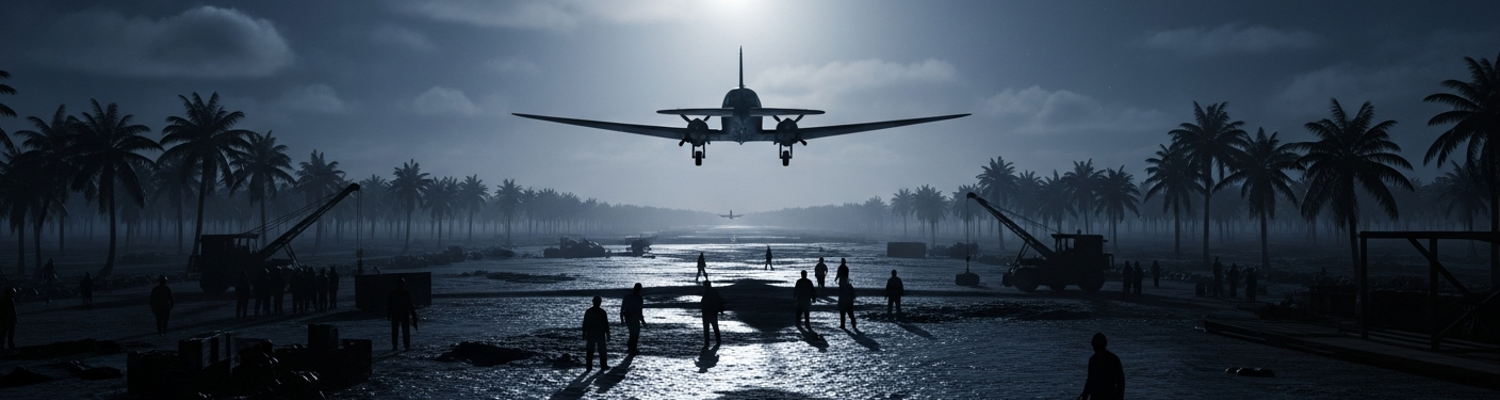
The decision fell to the senior Seabee officer on the ground. With Vagrant 2-5’s fuel state critical and the primary runway unusable, a new plan was devised in minutes. The C-47’s operational specifications confirmed its ability to use rough fields. The only potential landing surface was a 2,000-foot stretch of partially graded service road running parallel to the main strip, a path intended for jeeps, not a 13-ton transport plane. The aircraft's manual specified a landing roll of over 1,200 feet on a prepared surface. This road was a mix of loose coral, soft soil, and half-cleared jungle debris. An attempt to land risked a collapsed landing gear that would cartwheel the aircraft into the swamp. The alternative was the certain loss of the aircraft, its crew, and its cargo to the sea.
The order was given.
Men from the 6th Naval Construction Battalion descended on the service road. There was no time for heavy graders. This was a battle fought with hand tools. Teams used shovels and pickaxes to clear larger coral rocks and severed palm roots. Others filled potholes with loose aggregate, stamping it down with their boots. A jeep was driven at speed down the lane, its bumper used to nudge larger obstacles out of the marked pathway. The greatest challenge was creating a visual guide. With the sun setting, men ran along the cleared edges of the makeshift runway, placing and igniting kerosene lanterns and oily rags stuffed into cans every hundred feet. They were creating an improvised flare path in the growing darkness for an aircraft running out of time.
In the cockpit of Vagrant 2-5, the pilot throttled back, holding a wide, slow orbit at 800 feet. His fuel gauges confirmed less than thirty minutes of flight time remained. Ditching procedures were clear: a controlled, gear-up landing on the water. Survival rates for the crew were estimated at just over fifty percent. For the surgical team and the plasma, the chances were effectively zero. The tower operator relayed updates from the aid station. The surgeon had just lost the first Marine Raider to hemorrhagic shock. Two others were fading fast.
At 14:58 local time, as the C-47 began its final, committed approach toward the string of flickering lanterns, the night ignited. A Japanese reconnaissance floatplane, likely an Aichi E13A launched from a submarine, had been observing the unusual ground activity. The observer deployed a series of parachute flares. The sky was torn open by the brilliant glare of burning magnesium, which descended slowly and cast stark, moving shadows. The intense white light, brighter than a welding arc, destroyed the pilot’s night-adapted vision. The faint, yellow kerosene markers that were his only guide to the landing zone vanished into the overwhelming illumination. He was now flying blind, aiming for a memory of where the runway should be.