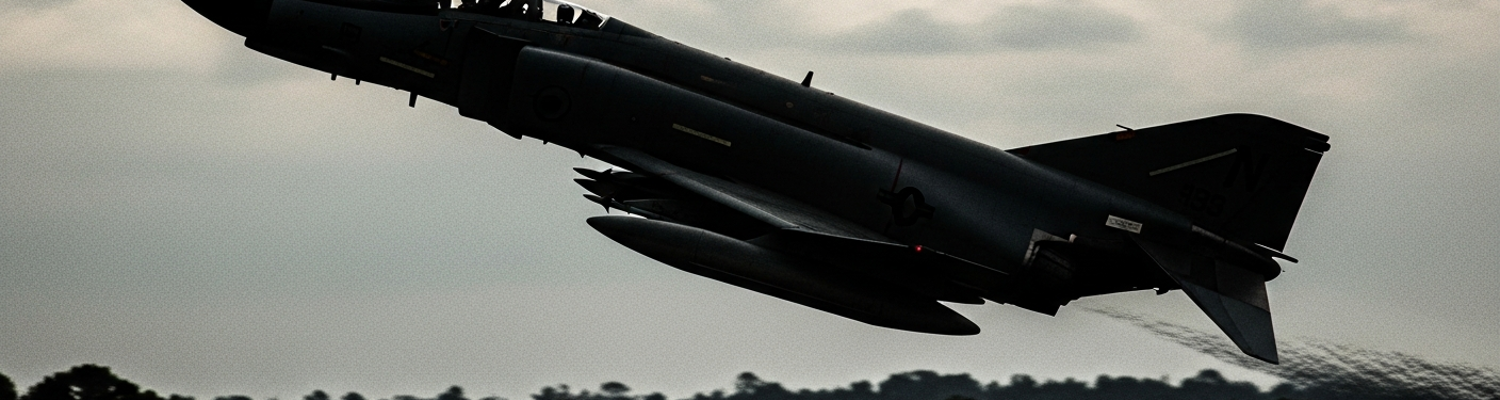

Cold War SEAD Doctrine
The strategic calculus of a potential war in Europe was a function of overwhelming numbers. Warsaw Pact forces held a substantial advantage over NATO, a fact that shaped every facet of Western military doctrine. Projections showed waves of Soviet and allied armor pouring through the Fulda Gap, supported by a dense, layered, and increasingly mobile Integrated Air Defense System (IADS). This network, a combination of overlapping surface-to-air missile (SAM) batteries and anti-aircraft artillery (AAA), was designed to deny NATO air power the ability to blunt the armored assault. Western air forces would be tasked with flying directly into this layered defense to perform battlefield interdiction and close air support. Without a dedicated counter, such missions were understood to be unsustainable.
The dread was palpable in Cold War planning rooms. Without a way to dismantle this electronic shield, NATO’s ground forces would be isolated and overwhelmed. The entire defensive strategy hinged on gaining and maintaining control of the air, a task made nearly impossible by the volume of threats emanating from the ground.
This operational picture gave birth to one of the most dangerous and specialized missions in modern warfare: Suppression of Enemy Air Defenses, or SEAD. The core concept was not simply to destroy enemy air defenses, but to actively suppress their ability to function, creating temporary corridors for friendly strike aircraft to pass through. This could be achieved through physical destruction, a mission subset known as DEAD, or by using electronic warfare to disrupt and jam enemy radar systems.
SEAD missions were often the first to enter hostile airspace and the last to leave. The doctrine evolved from rudimentary tactics in World War II and became a defined, indispensable mission during the Vietnam War, where American aircraft faced a formidable Soviet-supplied air defense network. By the late Cold War, SEAD was a mature and necessary component of any air campaign plan, a direct answer to the Warsaw Pact’s strategy of creating an impenetrable wall of missiles over its advancing ground forces.
Central to this doctrine was the F-4G, an aircraft that became synonymous with the SEAD mission. The F-4G was a modified F-4E Phantom II, but its transformation was profound. The M61 Vulcan cannon was removed to make space for the highly specialized AN/APR-47 electronic warfare suite. This system was the heart of the Weasel, designed not just to detect enemy radar emissions but to analyze and pinpoint their exact location. The F-4G was crewed by a pilot and an Electronic Warfare Officer (EWO) in the back seat. The EWO, navigating a complex array of scopes and sensors, was responsible for interpreting the electronic battlefield, identifying the most immediate threats, and coordinating attacks. The primary armament of the F-4G consisted of anti-radiation missiles (ARMs), weapons designed to home in on the very radar signals that guided enemy SAMs. These included the older AGM-45 Shrike, the AGM-78 Standard ARM, and later, the more capable AGM-88 High-Speed Anti-Radiation Missile (HARM).
The tactical employment of the F-4G was a display of calculated aggression. A common tactic, known as a hunter-killer mission, teamed F-4Gs with conventional F-4E Phantoms or F-16s. The F-4G would act as the hunter, intentionally baiting enemy radar operators to illuminate their aircraft. Once the radar signal was acquired, the EWO would lock on, and the pilot would launch a HARM. This forced the enemy operator into a dilemma: keep the radar on to guide a missile and be destroyed by the incoming HARM, or shut down and render the SAM site blind. While the Weasel engaged the radar, the killer aircraft would follow up with cluster munitions or conventional bombs to destroy the launchers and support vehicles. In Europe, the 52nd Tactical Fighter Wing at Spangdahlem Air Base, Germany, was a dedicated defense suppression wing, mixing F-4Gs and F-16s to perfect these tactics against the anticipated Soviet threat just across the border.
SA-6 Gainful Mobile Threat
The introduction of the 2K12 Kub, known to NATO forces by its reporting name SA-6 Gainful, represented a fundamental shift in the ground-based air defense landscape. Unlike the previous generation of Soviet SAMs, like the massive and largely static SA-2 Guideline systems that defined the air war over Vietnam, the SA-6 was engineered from the ground up for battlefield mobility. A close review of its design shows a system built to move. The entire battery, consisting of a 1S91 Straight Flush radar vehicle and four 2P25 Transporter Erector Launchers (TELs), was mounted on tracked chassis derived from light armored vehicle designs. This gave the SA-6 the cross-country performance to keep pace with the spearhead of a Warsaw Pact armored division. This capability rendered NATO’s existing SEAD doctrine of attacking pre-briefed, fixed locations almost entirely obsolete.
It was a hunter.
An SA-6 battery could displace from a firing position and be on the move in as little as five minutes, then set up to fire again in the same amount of time after halting. This tactical agility was its greatest defense. A battery could fire its three 3M9 missiles, which accelerated to nearly Mach 3, and then immediately relocate before an anti-radiation missile or a follow-on air strike could arrive at its last known position. The tracked GM-578 chassis of the 2P25 launcher and the GM-568 chassis of the Straight Flush radar could traverse rugged terrain, allowing them to hide in unexpected locations far from established road networks. Threat rings on a pilot’s map were no longer static circles but fluid, ever-shifting zones of lethal potential. The system’s combat debut during the 1973 Yom Kippur War was a brutal proof of concept, where Egyptian and Syrian SA-6 batteries inflicted heavy losses on the Israeli Air Force by constantly moving and re-engaging from new, unexpected axes.
The true challenge for Weasel crews was the electronic heart of the SA-6: the 1S91 Straight Flush radar. This single vehicle combined both a target acquisition radar and a continuous-wave fire control illuminator. Unlike the pulse radars of older SAM systems, the Straight Flush used a continuous-wave signal to guide its missiles, a method that gave no warning to the standard Radar Homing and Warning (RHAW) gear aboard most NATO aircraft of the era. An F-4 Phantom pilot could be completely unaware that a missile was guiding on him until the 3M9 missile’s own ramjet engine ignited, leaving only seconds for defensive maneuvers. The system also featured frequency agility, a capability that allowed the operator to rapidly change radar frequencies to defeat jamming. It could use one frequency band for initial target acquisition and another for terminal guidance illumination, making it exceptionally difficult for an Electronic Warfare Officer to jam or for an early anti-radiation missile like the AGM-45 Shrike to maintain a lock.
This combination of physical mobility and electronic agility posed a severe challenge. The established hunter-killer tactics were complicated. The SA-6 operator could illuminate a target, guide a missile, and then shut down his radar and move his battery before the Weasel’s missile could arrive. This forced a difficult calculus on the SEAD crews; they were hunting a threat that could kill them without warning and then vanish. The survivability rate of SA-6 batteries that employed these shoot-and-scoot tactics was exceptionally high, as demonstrated in later conflicts like the 1999 Kosovo War. Archival evidence shows that despite hundreds of anti-radiation missiles being fired, only a handful of Serbian SA-6 radars were destroyed. This forced a complete re-evaluation of SEAD technology and tactics, directly leading to the development of more advanced anti-radiation missiles with memory and inertial guidance systems capable of prosecuting an attack even after the enemy radar went offline.
F-4G Wild Weasel Avionics
The core of the F-4G was the AN/APR-38 Radar Homing and Warning System, later upgraded to the AN/APR-47. This was not merely a defensive receiver but a comprehensive tactical system for identifying, locating, and prosecuting enemy radar emitters. To accommodate the system’s 25 black box line-replaceable units, McDonnell Douglas engineers removed the F-4E’s internal M61A1 cannon and redesigned the nose, creating a distinctive chin pod to house some of the system’s 52 specialized antennas. These antennas fed data from across the electromagnetic spectrum into a central Texas Instruments computer. A close review of the system’s architecture reveals a design focused on precision. It used digital interferometry to measure the angle of arrival of incoming radar pulses with exceptional accuracy. In the rear cockpit, the EWO monitored a suite of new displays, the most prominent being a large, circular Plan Position Indicator (PPI) scope. This display painted a real-time map of the electronic battlefield by showing symbols for detected emitters, their bearing, and their relative threat level as determined by the system’s software. The AN/APR-38 could automatically classify and prioritize threats based on a programmable library, displaying the most dangerous emitters to the crew and computing weapon employment envelopes.
This sophisticated detection suite was paired with the AGM-78 Standard Anti-Radiation Missile (STARM). The AGM-78 was a substantial weapon, built on the airframe of the RIM-66 naval surface-to-air missile, making it significantly larger, faster, and longer-ranged than the preceding AGM-45 Shrike. An F-4G could carry up to four of the 1,370-pound missiles. The integration was seamless; the AN/APR-38 would detect and identify a hostile radar, and the EWO could then hand off that target information directly to the missile. Unlike the Shrike, which required the launch aircraft to point directly at the target, the AGM-78B featured a gimballed broadband seeker that could lock onto a target off-axis, allowing the F-4G crew more tactical flexibility. The most important improvement was the inclusion of a simple memory circuit. This feature was a direct response to the common tactic where radar operators would shut down their emitters to break a missile’s lock. The AGM-78’s memory allowed it to continue flying towards the radar’s last known location, a capability that complicated the survival calculus for enemy SAM operators. The missile also carried a nearly 100 kg blast-fragmentation warhead, a substantial increase over the Shrike's, and some variants could release a phosphorus smoke flare to mark the target’s location for follow-on attacks.
The operational philosophy of the F-4G hinged on the principle of passive targeting and the exploitation of signal intelligence. The aircraft was designed to kill threats by listening. By remaining electromagnetically silent, often flying with their own jammers and radar off, the F-4G crew could build a detailed electronic order of battle without revealing their own presence. The EWO became a tactical intelligence analyst, interpreting the data flowing from the AN/APR-38 to discern the enemy’s defensive posture. Archival logs and mission reports from SEAD operations show that crews used this capability to identify the locations of early warning radars, acquisition radars, and the high-threat fire control radars associated with specific SAM systems. This passive intelligence collection was not for pre-mission planning; it was happening in real-time, at 500 knots, deep inside hostile airspace. This allowed the Weasel crew to function as the electronic director for an entire strike package, directing other aircraft like F-4Es or F-16s to attack newly discovered sites, identifying safe egress routes, and using the AGM-78 to surgically remove the most immediate threats that appeared during the mission.
Cold War Operational Restrictions
The political realities of the Cold War placed an extraordinary burden on aircrews, layering complex legal and strategic limitations on top of the dynamics of air combat. The Rules of Engagement (ROE) were concrete directives that dictated life and death decisions in fractions of a second. For a Weasel crew, the ROE created a perilous state of cognitive friction. The core of their mission was to bait and destroy enemy radar systems, yet they could not fire preemptively. Archival reviews of Cold War operational orders (such as ROE Directive 7C) show that crews had to differentiate between a radar merely searching and one that demonstrated a hostile act or hostile intent. An F-4G pilot and his EWO might see a lethal SA-6 Straight Flush radar appear on their AN/APR-47 display, know it was a primary threat, but be legally required to wait. They had to hold their fire until that radar locked onto them or another friendly aircraft, an action that was often the immediate precursor to a missile launch. This forced Weasel crews into a reactive posture, surrendering the first move to an enemy who could kill them without warning.
The rules were written to prevent World War III.
This procedural friction was compounded by delays in the dissemination of intelligence. The entire NATO intelligence cycle during the Cold War was a time-consuming process. A Weasel crew preparing for a mission over Central Europe would be briefed using maps marked with grease-pencil circles indicating the last known locations of Warsaw Pact SAM batteries. A close review of these procedures indicates that this intelligence was often hours, if not days, old. Against static defenses like the SA-2, this was a manageable problem. Against the fully mobile SA-6 Gainful, it was a death sentence. An SA-6 battery could fire its missiles and relocate in under 15 minutes, rendering a 12-hour-old intelligence report completely useless.
The map was a lie the second the wheels left the runway.
Perhaps the most tactically vexing constraint was the mandated adherence to civilian no-strike zones. Planners, bound by the Laws of War and the political necessity of minimizing collateral damage, would designate large areas around towns, hospitals, and schools as off-limits to attack. For an F-4G crew, this created an operational nightmare. The AN/APR-47 system could provide a highly precise bearing to a hostile emitter, but its ability to calculate the exact range was less perfect, creating an elliptical area of probability where the threat was located. The crew then had to visually acquire the target area and correlate that electronic data with their physical map, all while maneuvering to avoid threats. The problem was that Warsaw Pact commanders understood these restrictions perfectly and often positioned their most dangerous mobile SAM assets on the very edge of, or even inside, these no-strike zones. This presented the Weasel crew with an impossible dilemma: attack the confirmed hostile radar and risk civilian casualties, a violation of ROE that could trigger an international incident, or ignore the threat and allow it to continue targeting the friendly strike aircraft the Weasel was tasked to protect. The decision to release a weapon required a split-second judgment call, weighing the missile’s own flight path and potential impact error against the sanctity of a line drawn on a map by someone thousands of miles away.
Instantaneous Target Identification
In the cramped rear cockpit of the F-4G, the Electronic Warfare Officer’s world was the glow of the Plan Position Indicator scope, a circular screen that painted a real-time, 360-degree map of the electronic battlefield. The AN/APR-47 system fed this display. It processed signals gathered by 52 specialized antennas, translating the invisible electromagnetic spectrum into a series of symbols. A close review of the system’s interface shows a design built for rapid comprehension under extreme stress. Each symbol represented a radar emitter, and the EWO’s primary function was to act as a tactical intelligence analyst, sifting through this storm of data to find the predators. He had to instantly differentiate the rhythmic sweep of a long-range search radar from the insistent, targeted pulse of a fire-control system, all while the aircraft maneuvered violently. The AN/APR-47’s computer would prioritize threats, assigning alphanumeric characters to each, ‘A’ for AAA, ‘2’ for an SA-2, ‘6’ for the SA-6, but the final assessment rested on the EWO’s trained judgment.
The 1S91 Straight Flush radar was a particularly challenging opponent due to its frequency agility. Archival data shows the system operated across multiple frequency bands, using a lower frequency for initial target acquisition and then shifting to a higher frequency continuous-wave illuminator for terminal guidance. This shift was the key. An F-4G EWO might observe a symbol for an SA-6 appear on his scope in its search mode, a serious but not yet actionable threat. Under the restrictive Cold War Rules of Engagement, this was not enough to justify an attack. The moment the SA-6 operator decided to engage, the AN/APR-47 would detect the frequency shift. On the EWO’s display, the ‘6’ symbol would begin to flash, and the steady, low growl of the threat in his headset would change to a piercing, high-pitched squeal. This was the system’s hostile intent alarm. It was an unambiguous indication that the Straight Flush radar was now painting the F-4G or another friendly aircraft, providing terminal guidance for a 3M9 missile that was likely already accelerating towards Mach 2.8. This detection of the frequency shift was the split-second trigger that transformed the SA-6 from a potential threat into an active killer, finally permitting the Weasel crew to return fire.
With the hostile radar identified and locked, the tactical problem morphed into a complex geometric and ethical dilemma. The AN/APR-47’s digital interferometry provided an exceptionally precise bearing to the emitting SA-6, a solid line stretching from the center of the EWO’s scope to the threat symbol. Range was a more difficult calculation, often presented as an elliptical area of probability along that bearing. The crew had seconds to correlate this electronic data with their paper maps and the view outside the canopy. In this narrow window, the pilot and EWO faced the possibility that the bearing line to the SA-6 ran directly adjacent to, or even through, a designated no-strike zone protecting a civilian-populated area. Warsaw Pact doctrine was known to exploit these NATO-imposed restrictions, deliberately placing high-value mobile assets near protected locations. This presented the F-4G crew with an impossible choice. Launching an AGM-88 HARM, an 800-pound missile, carried the risk of the target radar shutting down mid-flight. While the HARM possessed an inertial guidance system to continue toward the last known location, its accuracy would be degraded, increasing the possibility of collateral damage in a sensitive area. To ignore the threat was to abandon the strike aircraft the Weasel was tasked to protect.
Tactical Deviation Decision
The flight plan, a document born from days of intelligence analysis and strategic planning, was now useless. A close review of Wild Weasel combat procedures shows that crews were trained to expect the unexpected, but the sudden appearance of a fully active SA-6 system where none was predicted rendered the pre-briefed threat rings and attack points obsolete. The mission had instantly devolved from a structured execution of a plan into a purely reactive struggle. In the rear cockpit, the Electronic Warfare Officer saw the flashing ‘6’ on his scope not as a symbol, but as the electronic embodiment of a threat that had just declared its hostile intent. The high-pitched, insistent squeal in his headset, indicating the Straight Flush radar was in its terminal illumination mode, confirmed the attack was imminent.
The map was a lie.
The EWO’s immediate cross-check of the electronic data against his paper map revealed the core of the tactical crisis. The bearing line provided by the AN/APR-47 was a solid, undeniable vector pointing directly to the hostile emitter. The system’s calculated area of probability for the transmitter’s physical location, an ellipse stretching along that bearing, overlapped significantly with a designated no-strike zone. This zone, marked in red grease pencil, represented a small town, a place off-limits to ordnance under the strict Cold War Rules of Engagement. This presented a catastrophic dilemma. Launching an AGM-88 HARM from their current position was the standard procedure, but it was fraught with unacceptable risk. If the SA-6 operator shut down his radar after the HARM was launched, the missile’s inertial guidance would direct it to the last known position. With the target located on the edge of a civilian area, the missile’s potential impact error was large enough to cause a major collateral damage incident.
A rapid, terse exchange of information began over the intercom. The EWO, the electronic hunter, communicated the problem with disciplined precision: the threat was active, its position legally ambiguous. The pilot, responsible for the F-4G’s flight path and energy state, had to translate that data into a three-dimensional solution in real-time. Archival mission logs from the 52nd Tactical Fighter Wing show that this collaborative reassessment was a core tenet of Weasel operations. The pilot might suggest a hard turn to change the geometry of the engagement, hoping to create a new bearing to the target that did not pass over the protected zone. The EWO would then have to re-acquire the signal, assess the change, and confirm if the solution was viable, all while the aircraft sustained high-G forces and the SA-6’s missile could be seconds from impact.
The standard attack profile was discarded. To fire from a standoff position was to risk a catastrophic ROE violation. To ignore a confirmed, active threat was to fail the mission. A third option materialized, a tactical deviation born of necessity. They would not fire from a distance. Instead, they decided to close the distance, using the F-4G’s speed to get closer to the threat area. The new, improvised plan was to execute a low-altitude, high-speed pass to gain a positive visual identification of the SA-6 battery, confirming its location relative to the no-strike boundary before employing a weapon. This decision turned the F-4G from a standoff suppressor into a point-blank reconnaissance platform, willingly placing the aircraft deep inside the engagement envelope of the very system it was trying to kill. With the decision made, the pilot banked the Phantom hard, pulling the nose down and committing the crew to a high-risk maneuver that had no precedent in their mission briefing.
Five-Minute Engagement Aftermath
The immediate consequence of the crew’s deviation was the effective abandonment of the primary SEAD mission. With the F-4G now descending rapidly to hug the terrain for a visual identification pass, the protective anti-radar screen it was supposed to provide for the inbound strike package vanished. A close review of SEAD doctrine from this period shows that the hunter-killer concept relied on continuous overwatch; this impromptu reconnaissance run broke that model entirely. The other aircraft in the strike package were now flying blind against electronic threats, their own radar warning receivers their only defense against an active SAM site. The F-4G itself, by dropping to low altitude, had traded one set of threats for another. While the dive might temporarily mask it from the SA-6’s Straight Flush radar, it exposed the aircraft to a host of low-altitude air defense systems, including optically-aimed anti-aircraft artillery and infrared-guided missiles that offered no electronic warning whatsoever.
This was a test of tactical autonomy.
The decision to discard the pre-briefed plan in favor of a high-risk maneuver was a profound validation of the two-man Weasel crew concept. Post-mission analysis would scrutinize this moment, questioning whether the crew’s judgment constituted reckless endangerment or brilliant adaptation. Archival logs from Weasel squadrons show that such autonomy was a core, if unofficial, tenet of their operational philosophy. The intricate problem, a lethal threat, ambiguous location, and restrictive ROE, could not be solved by a distant commander. It required the synthesized expertise of the EWO, interpreting the electronic chaos, and the pilot, managing the aircraft’s energy and position in three-dimensional space. The decision to get eyeballs on target demonstrated an acceptance of personal risk to satisfy multiple conflicting objectives: protect the strike package, neutralize the threat, and avoid a collateral damage incident. This five-minute window became a case study in decentralized execution, where the strategic commander’s intent was fulfilled by the crew’s willingness to deviate from the letter of their orders to achieve the spirit of the mission.
The lessons learned from the engagement were immediate and far-reaching. The incident was a stark illustration of the paradox at the heart of Cold War Rules of Engagement. Rules designed to prevent political escalation were being actively exploited by adversaries, creating tactical safe havens for their most dangerous assets. The crew’s improvised tactic of closing for visual confirmation, while successful in this instance, was not a sustainable solution. It highlighted an urgent need to revise ROE, creating a framework that allowed crews to engage confirmed hostile emitters in proximity to no-strike zones, perhaps by requiring a secondary means of verification that did not involve flying directly into the missile’s kill box. The SA-6’s appearance where none was briefed served as a reminder that against mobile air defense systems, intelligence that was hours old was functionally useless. This event reinforced the doctrinal shift toward relying almost entirely on the real-time, organic intelligence gathered by the F-4G’s own AN/APR-47 suite, treating the cockpit’s electronic displays not as a supplement to the pre-mission briefing, but as the primary source of truth. The after-action reports would emphasize how their combined judgment solved an equation that was impossible to program into a computer, validating the First In, Last Out ethos that placed the ultimate responsibility for mission success on the decision-making of the crew in the cockpit.