
Operational Context in the Plei Trap Valley
Infantrymen assigned to the 4th Infantry Division carried seventy-pound rucksacks through vertical jungle ascents. They operated on fewer than four hours of broken sleep per night. Rations ran low within forty-eight hours of departure from forward operating bases. Daily intake dropped to a single canned meal split between dawn and dusk. Muscle tissue broke down under sustained physical strain. Daily foot marches spanned ten to twelve hours across unbroken forty-degree ridgelines. Salt tablets failed to stem acute dehydration. Ambient temperatures exceeded ninety-five degrees Fahrenheit with ninety percent humidity. Sweat rotted uniform cotton against skin. This created open fungal lesions along the waistlines and shoulders of riflemen before they ever established visual contact with an enemy soldier. Feet softened inside damp leather boots. Skin stripped down to raw tissue within seventy-two hours of sustained movement.
Exhaustion hollowed out these combat companies before the first shot was fired.
A close review of operational logs indicates that in late April 1969, the 4th Infantry Division command pushed elements of the 1st and 2nd Brigades directly against the Cambodian border within Kontum Province. The objective was cutting North Vietnamese Army transit corridors. Major General Donn R. Pepke committed battalions to sweep south along the Plei Trap corridor. This area functioned as a primary dispersal point for regiments exiting the Ho Chi Minh Trail. Division leadership accepted an extreme operational hazard. They deployed combat units into active base areas containing the 66th and 28th North Vietnamese Army Regiments without established ground fallback lines. The calculated gamble relied on forward infantry companies intercepting supply columns. They needed to pin down enemy troop movements before those forces could assemble for a coordinated assault on the provincial capital of Kontum. Combat elements moved on foot past the effective range of conventional field artillery stationed at Polei Kleng. They depended entirely on newly established firebase batteries to provide defensive fire envelopes.
The border trace left zero margin for operational error.
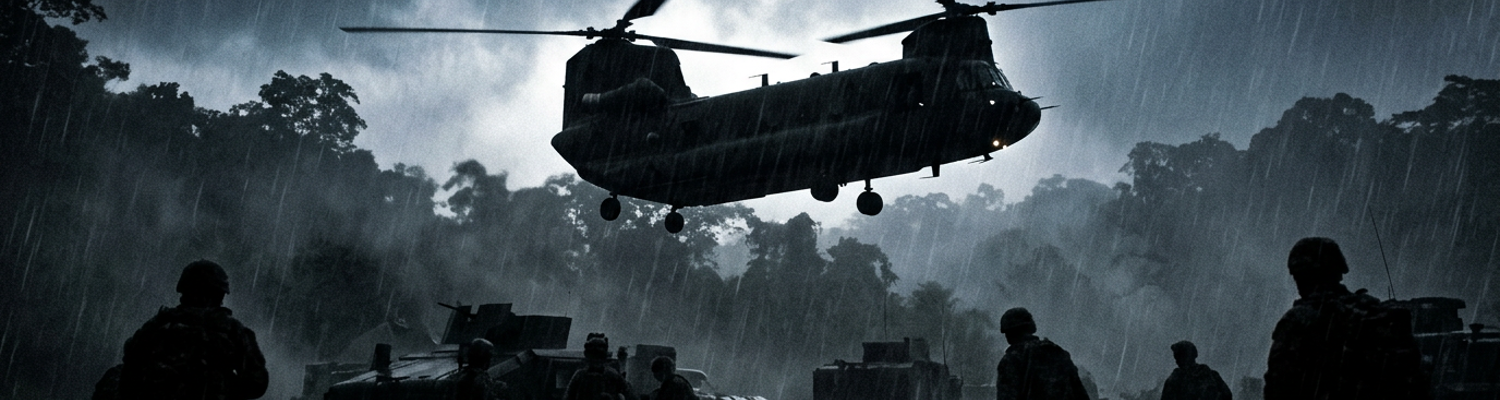
When examining the historical record, the geography of the Plei Trap basin dictated every tactical constraint encountered by the division. The valley floor sat enclosed by sharp granite massifs rising past 1,200 meters. Unbroken double and triple canopy foliage reached heights of two hundred feet. Wheeled vehicles and M113 armored personnel carriers could not enter the terrain. Sheer drop-offs, deep ravines, and thick bamboo undergrowth prevented ground transit from Highway 14. Supply convoys from the logistical depot at Pleiku halted dozens of miles east. Every gallon of potable water, crate of 5.56mm ammunition, and ration case reached forward units through forward landing zones. Combat engineers blew these clearings out of ridge summits using two-thousand-pound general-purpose bombs. Engine heat and high density altitude reduced the lift capacity of UH-1D Hueys and CH-47 Chinooks by roughly twenty percent. Fine red laterite dust ground down Lycoming T53 turbine blades during hover maneuvers. NVA gunners zeroed 12.7mm heavy machine guns directly onto these clearings. This disabled transport helicopters and forced infantry platoons to clear drop zones by hand with machetes on sixty-degree slopes.
Helicopter crews lowered supplies on steel winch cables through gaps in the foliage.
Chloroquine-Resistant Falciparum Outbreak in Rifle Companies
Archival evidence shows that by the first week of May 1969, blood smears processed by the 4th Medical Battalion at Camp Enari revealed an unanticipated biological failure. Standard military doctrine mandated that all personnel ingest one chloroquine-primaquine tablet weekly. This regimen was designed to suppress erythrocyte infection. Deep within the Plei Trap basin, this protocol collapsed. Forward platoons from the 1st Battalion, 8th Infantry and the 3rd Battalion, 12th Infantry moved through the damp river valleys near the Cambodian border. Soldiers began reporting sudden rigors and debilitating nausea despite documented adherence to pill-taking rosters. Medical officers isolated virulent strains of Plasmodium falciparum. These strains demonstrated complete resistance to chloroquine blood-schizonticide intervention. The parasite continued asexual reproduction in human red blood cells without delay. It systematically destroyed hemoglobin and saturated the circulatory systems of combat infantrymen with toxic waste metabolites.
The primary pharmacological defense failed completely.
Field epidemiology reports confirm that the dense valley floor harbored hyperendemic populations of Anopheles balabacensis. This mosquito species fed aggressively during nighttime hours. They bred inside deep bomb craters, stagnant bamboo stumps, and vehicle ruts. Field commanders had anticipated localized outbreaks of benign tertian malaria caused by Plasmodium vivax. That variant typically responded to standard field therapy. Laboratory assays conducted on blood specimens flown back to the 9th Medical Laboratory in Saigon confirmed high-grade resistance across the operational grid. In vitro testing demonstrated that Plasmodium falciparum isolates from the Plei Trap required concentrations of chloroquine more than forty times higher than normal therapeutic thresholds to halt parasite development. Genetic resistance stripped military surgeons of their front-line treatment options. They relied on dwindling supplies of quinine sulfate and experimental combinations of dapsone. These alternatives produced severe side effects under conditions of heat exhaustion.
Rifle companies dissolved from within before reaching their grid objectives.
A close review of operational logs indicates that this parasitic infection reduced the combat effectiveness of forward rifle companies by over forty percent within three weeks of initial insertion. In Company B of the 1st Battalion, 8th Infantry, daily muster rolls saw operational rifle strength drop from one hundred and forty-two men down to fewer than eighty fully ambulatory soldiers. The illness struck with sudden violence. It incapacitated infantrymen within hours of onset through acute prostrating fevers spiking past 104 degrees Fahrenheit. Violent rigors caused soldiers to drop their M16 rifles during active contact patrols. Muscle spasms prevented them from gripping weapon stocks or operating fire selectors. Severe cerebral involvement followed rapidly. Delirious men tore off protective helmets. They threw away water canteens and shouted incoherently in forward fighting holes. This compromised company acoustic security within yards of concealed North Vietnamese listening posts. Transporting a single comatose malaria casualty over forty-degree slopes required four exhausted riflemen. They rigged makeshift litters from poncho liners and saplings. This pulled full squads away from security perimeters and halted company-level combat sweeps entirely.
Platoon leaders found themselves unable to man complete circular defensive perimeters around forward patrol bases.
Night observation posts were abandoned. Forward squads lacked the conscious personnel required to maintain two-man listening watches without collapsing from physical exhaustion. Medevac helicopters attempting jungle penetrator extractions took repeated ground fire through the dense canopy. Field medics treated shivering, convulsing riflemen on wet mud surfaces with improvised saline drips hung from bamboo poles. By mid-May, the 4th Infantry Division had evacuated over five hundred combat troops from the Plei Trap solely for acute falciparum infection.
Environmental Failure of Highland Surveillance Systems
Electronics were deployed to replace missing riflemen along the Cambodian border.
A close review of operational logs indicates that division planners turned to Operation Igloo White unattended ground sensors. They intended to track North Vietnamese Army supply movements across grid coordinates YA 850900 along the Nam Sathay river valley. Air Force F-4 Phantoms and CH-54 Skycranes air-dropped ADSID detectors and Spikebuoy acoustic penetrators into the canopy. The goal was seeding electronic barrier lines across the mountain passes. Highland humidity destroyed these instruments within days of impact. This produced a complete failure of unattended acoustic and seismic ground sensors deployed under Igloo White protocols. Constant ambient moisture forced condensation through the neoprene gaskets of the sensor housings. Water saturated the fiberglass printed circuit boards. Internal BA-1100 mercury-cell battery packs shorted out before completing forty-eight hours of signal generation. Heavy tropical downpours generated persistent acoustic ground noise. This saturated the Acoubuoy audio channels and drowned out low-frequency footstep vibrations. Geophone probes shifted inside water-saturated laterite mud. They generated erratic contact readouts that flooded the Infiltration Surveillance Center at Nakhon Phanom Royal Thai Air Force Base with false alarms.
Signal analysis teams tracked rainstorms rather than infantry columns.
Archival evidence shows that 4th Infantry Division combat commanders gambled on this automated tripwire system to compensate for depleted company rosters in the 1st Battalion, 8th Infantry. The sensor strings went silent across the Chu Mom Ray massif. Forward intelligence officers lost all track of the 66th North Vietnamese Army Regiment. Patrol bases could no longer predict the direction of enemy infiltration through the Plei Trap basin. Lacking remote sensor telemetry, field commands committed sick rifle squads directly into dense terrain. They conducted physical reconnaissance along known trail junctions.
Ground units attempted to counter this visibility loss by mounting AN/PPS-5 ground-surveillance radar sets directly onto forward command vehicles. They also placed them on fortified perimeter bunkers at Fire Support Base 20. The manufacturer designed the AN/PPS-5 to detect moving personnel at distances of six kilometers and vehicles at ten kilometers. The unit transmitted high-frequency pulses in the Ku-band between 16 and 16.5 gigahertz. Field units quickly discovered the complete inability of vehicle-mounted AN/PPS-5 ground-surveillance radars to penetrate the dense multi-tiered jungle canopy enclosing the valley. Radio energy in the Ku-band scattered instantly against multi-tiered rainforest canopies rising one hundred and fifty feet above the valley floor. Moisture-laden broadleaf vegetation and thick stands of thorn bamboo caused severe surface attenuation. This blocked radar pulse propagation beyond thirty to fifty meters. Suspended moisture across the understory generated continuous clutter across the radar operator A-scope display and 50-pulse-per-second audio headsets. Doppler signal processors could not separate the low-frequency acoustic signature of crawling enemy sappers from the background clutter of rain-swept highland foliage.
Mechanics assigned to the 4th Engineer Battalion attempted to lift the radar antenna assemblies onto thirty-foot timber platforms. They built these structures over the fire support perimeters. Elevated mounting masts only exposed the AN/PPS-5 parabolic reflectors to indirect 82mm mortar fire from adjacent ridgelines. The elevation failed to extend the radar beam through the dense canopy. Radar operators at Polei Kleng shut down their sets before the middle of May.
The base perimeter was guarded by eye alone.
Undetected North Vietnamese Sapping and Encirclement
A close review of operational logs indicates that during the third week of May 1969, the 66th and 28th North Vietnamese Army Regiments slipped four complete infantry battalions across the Nam Sathay River. They did this without triggering a single physical contact. North Vietnamese troops moved in rubber sandals along water-carved ravines beneath the triple-tier canopy. They used bamboo poles wrapped in rags to silence equipment rattles. Camouflage disciplines required every soldier to attach fresh foliage to woven reed helmets every two hours. This matched the shifting decay of the forest floor. Heavy weapons sections disassembled Soviet-built 82mm Type 53 mortars and 12.7mm DShK anti-aircraft machine guns into forty-pound man-portable components. They hauled them up sixty-degree granite inclines south of the Chu Mom Ray ridge. Platoon leaders moved by hand-drawn silk maps and compass bearings. They avoided ridgelines to bypass American visual observation posts. Staging concentrations coalesced within eight hundred meters of isolated American defensive perimeters near grid coordinates YA 872895.
Two thousand enemy soldiers walked directly through division tripwires without firing a shot.
Archival evidence shows that American brigade reconnaissance assets could do nothing to track this closing cordon. Malaria evacuations cut patrol strength inside the reconnaissance platoon of the 1st Battalion, 8th Infantry down to nine ambulatory riflemen. This grounded foot sweeps beyond the perimeter wire. Aerial observation helicopters stayed pinned above small-arms range by concealed anti-aircraft fire. North Vietnamese sapper detachments initiated methodical excavation operations under cover of night rain. Teams of three men crept forward using shortened entrenching spades and push-shovels. They cut narrow interlocking approach trenches through the clay during monsoon cloudbursts. The heavy rain masked acoustic signatures. Diggers hauled the loose soil back inside canvas sandbags and ammunition crate liners. They spread it across stream beds to eliminate fresh dirt piles from aerial detection. These zig-zag sapping lines advanced ten to fifteen yards every night. They drove beneath fallen mahogany trunks and pushed within twenty paces of American defensive bunkers.
Forward listening posts manned by Company C at Firebase 20 mistook the scraping of trench tools for falling bamboo limbs and shifting monsoon runoff.
Sapper units from the 66th Regiment used wooden sounding rods and bamboo stakes to locate American M18A1 Claymore mines. They cut command detonation wires and reversed directional blast faces toward the American parapets. They excavated covered crawlways directly underneath the outer loops of standard concertina wire. This established jump-off pits thirty yards from the sandbag revetments. Facing depleted fighting squads and non-functional ground radar sets, American company commanders pulled back their listening posts outside the defensive berm. They needed to prevent malaria casualties from exposing base positions through feverish delirium. Forward NVA combat elements completed over four hundred yards of continuous trench networks that encircled the base by May 22. This established direct assault avenues while battalion headquarters at Polei Kleng recorded the sector as clear of coordinated enemy presence.
Critical Depletion of Firebase Defensive Strength
Archival evidence shows that standard United States Army medical protocol strictly regulated the handling of febrile casualties across the 4th Infantry Division. Directives issued by the 4th Medical Battalion mandated that any soldier exhibiting an axillary temperature exceeding 101 degrees Fahrenheit accompanied by tremors or disorientation had to be classified as an urgent casualty. This required immediate aeromedical evacuation. UH-1D and UH-1H DUSTOFF helicopters assigned to the 283rd Medical Detachment operated out of forward staging airfields at Pleiku and Polei Kleng. They were ordered to scramble within fifteen minutes of receiving an extraction request. Military medical doctrine emphasized that untreated falciparum malaria progressed rapidly to acute tubular necrosis, cerebral coma, and cardiovascular collapse within twenty-four to forty-eight hours of symptom manifestation. Evacuation pilots pushed their Lycoming T53-L-13 turbine engines to maximum continuous power. They guided airframes through violent crosswinds over the Chu Mom Ray ridgelines. Hoist operations placed severe mechanical strain on the Breeze-Eastern rescue winches. Flight medics lowered the steel cable and rescue basket through triple-tier canopy holes while hovering motionless under small-arms fire from North Vietnamese positions. Forward aid stations were forbidden by division medical officers from retaining symptomatic patients for in-theater recovery.
Army medical doctrine treated an acute fever as an automatic order to evacuate the soldier.
A close review of operational logs indicates that this mandatory medical extraction rule clashed with the rigid geometric requirements of perimeter security at Firebase 20. Defensive doctrine formulated by MACV for isolated highland outposts established a strict baseline. A four-hundred-meter perimeter trace required an absolute minimum of one hundred and twenty active riflemen to repulse coordinated infantry penetration. Engineers from the 4th Engineer Battalion calculated this requirement around thirty-six reinforced two-man fighting bunkers spaced roughly ten to twelve meters apart. This allowed overlapping grazing fire for twelve M60 machine guns and three 90mm M67 recoilless rifles. Each squad held responsibility for maintaining three concentric defensive belts. These included trip flare lines at sixty meters, double-apron concertina wire at thirty meters, and directional M18A1 Claymore mines at twenty meters. The mathematical calculations broke down as the pathogen spread through the ranks. Company B and Company C registered an average of twelve to fifteen fresh fever cases per day. Compliance with the aeromedical directive meant dispatching multiple DUSTOFF flights every morning. Daily extractions bled thirty to forty riflemen out of the perimeter each week. This dropped the number of ambulatory defenders down to forty-eight soldiers by the fourth week of May.
Medevac flights stripped whole squads off the parapets before noon.
Tactical calculations proved that continuing medical extractions would reduce the perimeter defensive strength below forty percent of the minimum threshold needed to repel massed human wave assaults. Intelligence summaries recovered at brigade level identified elements of the 66th North Vietnamese Army Regiment staging over eight hundred assault troops in adjacent draw systems near grid coordinates YA 864882. North Vietnamese assault doctrine relied on massed wave formations. Two hundred sappers armed with satchel charges and B-40 rocket-propelled grenades would breach outer wire obstacles to open channels for following infantry battalions. Repelling that volume of concentrated manpower demanded uninterrupted interlocking fire from all defensive sectors. Riflemen had to expend sustained volumes of 5.56mm rounds without weapon manipulation delays. With half the bunkers sitting empty, a single rifleman was forced to cover twenty-five meters of defensive wire alone. They simultaneously loaded magazines, swept observation fields, and handled claymore firing clackers in complete darkness. Perimeter sectors collapsed mathematically when four empty bunkers along the southern tree line created a sixty-meter dead space. Enemy sappers could cut wire obstacles there without drawing direct machine-gun fire. Field commanders realized that another seventy-two hours of routine medical evacuations would leave the remaining artillery batteries at Firebase 20 protected by only thirty riflemen.
Command Moratorium on DUSTOFF Evacuations
On May 24, 1969, forward battalion command halted all routine aeromedical extractions for malaria casualties across the Plei Trap basin.
A close review of operational logs indicates that the leadership of the 1st Battalion, 8th Infantry took direct control of evacuation clearances. They stripped company-level medics of their standing authority to summon DUSTOFF flights. Medical doctrine established by the United States Army Medical Command had guaranteed prompt aeromedical pickup for any service member exhibiting acute systemic fever, vomiting, or altered mental status. Forward commanders overrode that standard operating procedure through direct radio orders sent over secure battalion frequency networks. Radio operators were instructed to cancel incoming UH-1H extraction aircraft dispatched by the 283rd Medical Detachment out of Polei Kleng. The only exceptions were casualties suffering from penetrating ballistic trauma, amputations, or uncontrolled arterial hemorrhaging. Medical personnel at the 4th Medical Battalion clearing station at Camp Enari registered formal administrative protests over tactical radio channels. They warned that withholding immediate intravenous therapy and systemic cooling from acute Plasmodium falciparum patients invited irreversible renal damage, shock, and fatal cerebral complications. Field commanders dismissed the medical warnings outright. They classified company personnel depletion as an active combat crisis that took precedence over clinical treatment standards.
Fever was removed from the list of battle-qualifying evacuation criteria.
Flight logs demonstrate that UH-1H helicopters attempting hoist extractions over dense canopy clearings were drawing heavy 12.7mm anti-aircraft fire from fortified North Vietnamese positions along the valley ridges. Sapper units from the 66th North Vietnamese Army Regiment had zeroed heavy machine guns onto every designated hover coordinate within two kilometers of Firebase 20. Continuing standard DUSTOFF dispatches risked the loss of irreplaceable airframes and flight crews. It also systematically emptied the perimeter bunkers of their remaining combat personnel. Flight crews had already sustained damage to Lycoming T53 turbine engine housings and tail rotor control linkages during low-altitude hoist recoveries in adjacent sectors. Halting routine aeromedical dispatches forced sick men to stay on the line. This stopped the daily operational loss of twelve to fifteen riflemen who would otherwise have been flown back to base hospitals in Pleiku.
Bunkers had to stay manned regardless of body temperature.
Archival evidence shows that forward commanders issued explicit tactical directives. They required shivering, delirious infantrymen to hold their assigned crew-served weapons and maintain their sectors within reinforced fighting bunkers. Platoon sergeants in Company B and Company C dragged fever-wracked riflemen out of company aid shelters. They forced them back into sandbagged parapets facing the perimeter wire. Men registering axillary temperatures above 104 degrees Fahrenheit were wedged upright behind 7.62mm M60 machine guns. Ammunition crates were stacked beneath their arms to prevent their bodies from falling away from the spade grips during violent shivering fits. Medics bound soldiers hands to the firing controls of 90mm M67 recoilless rifles with olive-drab electrical tape. This ensured that weapon stations stayed physically occupied even when the gunners slipped in and out of consciousness. Squad leaders laid firing clackers for M18A1 Claymore mines directly across the chests of bedridden infantrymen lying in shallow trench embrasures. They ordered them to detonate directional charges if enemy sappers hit the perimeter trip wires. Non-commissioned officers rotated through the fighting holes at twenty-minute intervals. They physically shook semi-comatose soldiers awake, forced them to dry-swallow salt tablets, and reoriented weapon barrels toward North Vietnamese sapping lines fifty paces away.
Febrile Bunker Defense Under Mortar Fire
Archival evidence shows that at 0415 hours on May 26, 1969, heavy weapons batteries of the 66th North Vietnamese Army Regiment opened a synchronized barrage against Firebase 20 near grid coordinates YA 872895. Forward observer pits recorded the impact of over two hundred Soviet-manufactured 120mm PM-43 mortar rounds and single-tube 122mm rockets within the first forty minutes of contact. High-explosive blast waves collapsed the forward log-and-earth revetments occupied by Company B, 1st Battalion, 8th Infantry. The explosions tore through double-stacked sandbag parapets and exposed internal fighting positions. Defending riflemen faced this bombardment while experiencing axillary body temperatures exceeding 104 degrees Fahrenheit. Their sensory perceptions were badly degraded by falciparum-induced cerebral edema. Men shook violently from malarial rigors as they reloaded M16A1 rifles. They mistook the physical vibrations of incoming mortar detonations for the involuntary spasms racking their own skeletal muscles. Red laterite mud thrown airborne by fifty-pound mortar bursts coated the receiver groups and bolt assemblies of defensive weapons. This caused repeated extraction failures as delirious soldiers struggled to clear jammed 5.56mm cartridge cases with bare, blistered fingers.
Shivering infantrymen fired blind bursts into the falling dirt.
A close review of operational logs indicates that the physical collapse of defensive revetments forced febrile soldiers to fight from shallow drainage cuts and shattered bunker floors. In the southern perimeter trace, third-stage sapping trenches approached within twenty yards of the berm. Company C defenders suffered acute auditory and visual hallucinations caused by vascular parasite loads. Riflemen fired cyclic bursts at empty patches of bamboo. They completely ignored active North Vietnamese infiltration teams cutting through the concertina wire ten paces to their flank. Non-commissioned officers sprinted through open fire zones to physically orient gunners toward actual threat vectors. They slapped the helmets of semi-conscious soldiers to interrupt febrile stupors. 120mm mortar shells scored direct hits on Bunker 14, detonating stored cases of 7.62mm linked ammunition. Two surviving soldiers with 105-degree fevers crawled out of the burning timbers and dragged an operable M60 machine gun across the open berm. They anchored the bipod legs into raw clay using their own web gear. They held down the trigger assembly until the barrel warped from sustained thermal friction.
Concussion shockwaves cracked the overhead timber stringers across the entire sector.
As forward communication trenches filled with mortar fragmentation, battalion chaplains moved directly into the perimeter fighting pits to sustain the defensive line. Father Donald W. Mudrick, a Catholic chaplain assigned to the 1st Battalion, 8th Infantry, traversed the forty-yard open gaps between revetments. He crawled flat on his stomach through liquid laterite mud while 122mm rocket shrapnel sheared through sandbags inches above his back. He carried holy oils in brass viaticum containers and pocket-sized psychological field manuals inside rubberized waterproof bags. He pushed into partially collapsed bunkers to locate wounded and dying soldiers. The chaplain administered extreme unction to delirious men who had lost the ability to speak. He traced the sign of the cross in sacred oil on sweat-drenched, mud-caked foreheads between incoming mortar impacts. Protestant chaplains crawled alongside company runners. They gripped the trembling hands of nineteen-year-old riflemen undergoing violent chills and whispered audible prayers directly into their ears to anchor them against panic.
Hot steel fragments shredded the canvas litters stacked behind the fighting holes.
The physical intervention of these chaplains prevented multiple defensive sectors from succumbing to psychological collapse under the prolonged indirect barrage. Working without functional helmets after ballistic impacts cracked their fiberglass liners, the chaplains dragged wounded, shivering riflemen away from exposed bunker embrasures. They repositioned them against interior revetment walls. They cleared fouled weapon actions for soldiers whose fine motor skills were paralyzed by fever. They passed freshly loaded twenty-round magazines to infantrymen who could no longer stand unassisted. Sacramental linens were repurposed as emergency pressure bandages when company aid stations ran out of sterile gauze dressings. This stemmed arterial bleeding from fragmentation wounds while North Vietnamese 120mm mortar rounds continued to impact along the southern communication trench at twelve-second intervals.
Tactical Aftermath and Military Medical Revisions
A close review of operational logs indicates that the final North Vietnamese push against Firebase 20 broke at 0640 hours under twenty-four consecutive sorties of tactical air support.
Archival evidence shows that two flights of United States Air Force A-1H Skyraiders from the 6th Special Operations Squadron dropped twenty-four 500-pound BLU-32 napalm canisters across the southern tree line. This scorched the sapping trenches of the 66th North Vietnamese Army Regiment back to the Nam Sathay stream bed. AC-119G Shadow gunships laid continuous 7.62mm minigun barrages along grid coordinates YA 874892. They expended thirty thousand rounds into the ravines to suppress surviving 12.7mm anti-aircraft emplacements. Artillery crews at Polei Kleng fired over eight hundred 105mm high-explosive shells in direct support of the collapsing perimeter. They walked proximity-fuzed airbursts within thirty paces of the American fighting holes. Defending riflemen, still vomiting and shaking from axillary fevers exceeding 104 degrees, swept the wire with remaining M60 barrels. North Vietnamese infantry units broke contact and withdrew westward toward the Cambodian border.
The outer perimeter held.
Emergency extraction operations commenced the moment tactical air strikes silenced the surrounding ridge crests. Flight crews from the 119th Assault Helicopter Company brought sixteen UH-1H transport helicopters into the cratered clearing in four-ship increments. They executed thirty-second hover pickups through dense lingering smoke. Exhausted infantrymen threw sixty-one litter-bound malaria casualties into open cabin doors. They stacked fever-wracked bodies three deep across troop decks to maximize passenger capacity. Medics abandoned destroyed bunker revetments, wet ammunition crates, and burned-out recoilless rifle tubes in the red mud. They prioritized ambulatory riflemen whose physical collapse had left them unable to walk unaided. By 1400 hours on May 27, the last evacuation flights cleared the Chu Mom Ray ridgeline under protective escort from AH-1G Cobras. They flew directly to the 71st Evacuation Hospital at Pleiku with one hundred and forty-two soldiers suffering from acute cerebral and renal complications.
The disaster forced immediate large-scale revisions to United States Army field operations across Military Assistance Command, Vietnam.
Military medical authorities recognized that chloroquine-primaquine prophylaxis had failed as a single preventive measure against Plasmodium falciparum in the Central Highlands. Army surgeons mandated the immediate theater-wide addition of daily 25-milligram dapsone tablets to all combat units operating in II Corps. They backed the regimen with a standard seven-day triple-therapy protocol of quinine sulfate, pyrimethamine, and sulfadiazine for any soldier showing refractory parasites in peripheral blood films. Field triage doctrine underwent a corresponding shift. MACV Medical Command revoked battalion commanders standing authority to halt medical flights. They classified falciparum malaria with progressive neurological symptoms or persistent hyperpyrexia as an absolute Category A tactical emergency requiring mandatory evacuation within two hours of clinical identification.
Signal commands faced an equivalent breakdown of automated border security. Technical analysis of ground electronics led to direct engineering modifications across highland surveillance networks. Technicians from the Defense Communications Planning Group redesigned unattended acoustic and geophone sensor housings. They replaced standard neoprene gaskets with room-temperature vulcanizing silicone seals. They installed chemical desiccant packs inside internal battery wells to prevent tropical moisture short-circuits. Field manuals for the AN/PPS-5 ground-surveillance radar received binding revisions restricting Ku-band radar deployment to open plateau sectors. The updated doctrine strictly prohibited defensive perimeter integration inside multi-tiered jungle canopies where broadleaf vegetation produced total pulse reflection. Procurement offices subsequently redirected highland base-defense contracts toward tactical thermal imaging prototypes and perimeter acoustic-vibration arrays equipped with hermetically sealed geophone probes anchored into bedrock through threaded steel mounting sleeves.