
Japanese forces on Kiska and Attu, occupied since June 1942, could project power directly against American assets and the mainland itself. U.S. planners determined a westward chain of American airfields was the only effective counter. Amchitka, a windswept protrusion of volcanic rock only 50 miles from Kiska, became the focal point. The imperative was absolute: establish an airbase to disrupt Japanese operations before they could occupy the island themselves.
A preliminary reconnaissance in September 1942 delivered a grim verdict. Building an airstrip on the island’s volatile terrain would be a monumental challenge. By December, strategic necessity overrode all engineering concerns. A more detailed survey, conducted from December 17th to 19th, confirmed the forbidding nature of the landscape. Amchitka is a tectonically unstable island, a rugged mix of sea cliffs and low-lying tundra riddled with shallow lakes, all resting on a foundation of volcanic bedrock. There are no trees. The survey concluded construction was possible, if difficult. Their report (NARA Record Group 77) offered an optimistic forecast: a fighter strip operational in two to three weeks, a main airfield in three to four months. This projection, born of operational desperation, set the stage for an arduous engineering effort.
There was no infrastructure.
When the advance elements of the American occupation force, some 2,100 troops, landed unopposed at Constantine Harbor on January 12, 1943, they stepped into a void. No port existed. No road network. No usable structures beyond the decayed remnants of an abandoned Russian fishing village. Every piece of equipment, every barrel of fuel, and every ration had to be brought ashore through treacherous, rock-studded waters. The island’s only inhabitants were the ghosts of Aleut people who had not permanently resided there since 1832.
The engineers and troops who landed were entirely dependent on the supplies they carried with them, ferried from transports like the USS Arthur Middleton. On the first night, a violent squall known as a williwaw descended, smashing landing boats and driving the transport aground. It was a stark introduction to the island’s hostile weather. For the next two weeks, a blizzard raged, halting nearly all progress. Heavy construction equipment had to be painstakingly brought ashore while Navy Seabees began creating harbor facilities from nothing. The initial work on the airfield involved draining frozen lakes and using the gravel scraped from their beds to form a base for the runway, a raw, improvisational operation from its first moments.
The ground of Amchitka was a malevolent opponent. Operational logs from Army and Navy engineers reveal a battle fought not against a human enemy, but against the island itself. The landscape was a treacherous combination of volcanic rock, spongy tundra, and boggy muskeg that turned to a bottomless slurry with the constant rain and thaw cycles. Standard runway construction was impossible. The initial plan involved draining frozen lakes to scrape gravel from their beds. This proved agonizingly slow. The primary solution deployed by Army Engineer Aviation Battalions, including the 813th, and the Navy Seabees was the Marston Mat. These were sections of perforated steel planking (PSP), each ten feet long and weighing about 66 pounds, designed to be interlocked by hand. Laying the matting was the final step. First, engineers had to remove the tundra and create a base that would not sink. On Amchitka, this meant a brute-force campaign of earthmoving, scraping away the saturated organic layer down to the volcanic bedrock and then building it back up with whatever rock and gravel could be blasted from the island’s few usable borrow pits. The steel mats were then laid by hand and sledgehammer, with work crews fighting to link the hooked edges together in the mud and freezing rain. This created a surface that could float on the unstable ground, but it was an imperfect fix. Heavy bombers would cause the matting to ripple in waves; a hard landing could bounce a fighter plane 30 feet into the air.
Unpredictable weather was a constant adversary. The Aleutian Islands are home to the williwaw, a sudden katabatic wind that descends from the mountains with hurricane force. These storms could materialize with almost no warning, with winds clocked at over 100 mph, capable of rattling buildings and capsizing boats. The initial landing on January 12, 1943, was immediately followed by a blizzard that raged for two weeks, halting construction and stranding the transport USS Arthur Middleton. Engineering reports from units like the 18th Engineer Regiment show that weather was the single greatest cause of delay. High winds made crane operations to unload ships a deadly gamble, scattered stockpiles of materials, and physically tore apart partially completed structures. The endless cycle of rain, sleet, and fog turned the entire island into a sea of mud, making survey work for the runway alignment a near-impossibility and bogging down vehicles to their axles. The psychological toll on the thousands of troops, living in tents and working in exposed conditions, was severe.
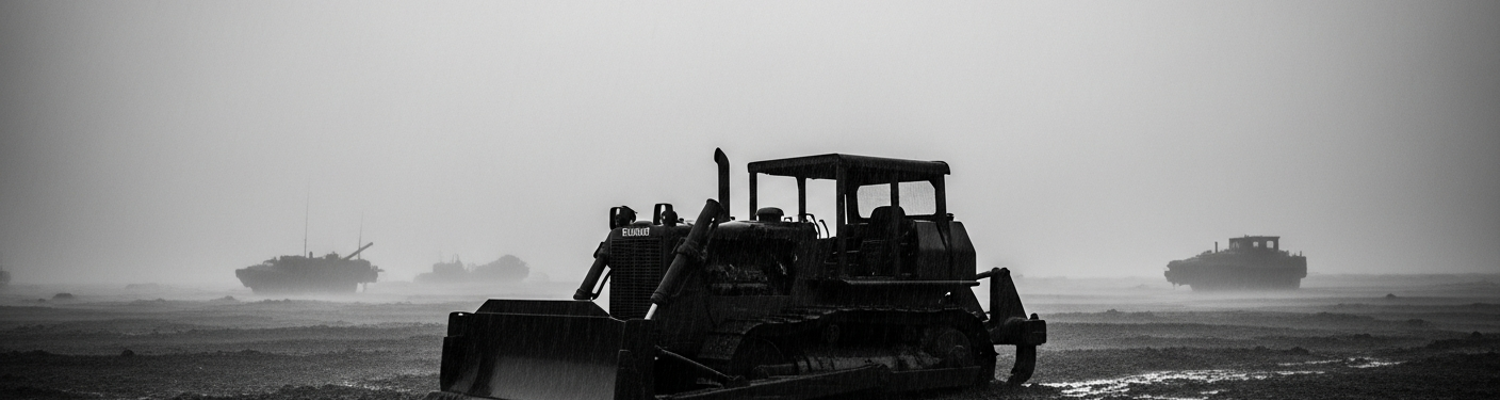
The cold was a relentless saboteur of mechanical equipment. The Caterpillar D8 bulldozers, the 17-ton workhorses of the Engineer battalions, were designed for temperate climates and fought the sub-arctic conditions at every turn. Archival evidence from similar Alcan Highway construction projects shows that in extreme cold, diesel fuel would turn to solid wax, clogging fuel lines and filters. Engines had to idle 24 hours a day, a logistical problem that consumed enormous quantities of fuel that had to be painstakingly brought ashore. Even then, the cold was destructive. Lubricants in transmissions and final drives would thicken to the consistency of tar, rendering the machines immobile. Field manuals contained procedures for sliding open cans of burning gasoline under transmission casings just to thaw the fluid enough to get the gears to engage. The very metal of the machines became a weakness; cast iron components and even high-strength steel bulldozer blades would become brittle enough to shatter on impact with frozen ground or volcanic rock. Maintenance crews from units like the 813th Engineer Aviation Battalion performed heroic repairs in open-air conditions, their bare hands sticking to frozen steel as they struggled to keep the machines from being consumed by the environment they were trying to tame.
The strategic imperative to build an airbase on Amchitka slammed directly into a wall of logistical failure. Shipments of construction materials from the U.S. mainland were subject to catastrophic delays. The transport USS Arthur Middleton ran aground in Constantine Harbor on the first day of the landing. A williwaw smashed into the landing operation, wrecking smaller boats and pushing the Middleton onto the rocks, where it would remain for 84 days. A review of shipping manifests from this period reveals a supply chain stretched to its breaking point. The loss of immediate access to the Middleton’s cargo, which included heavy-duty construction machinery and airfield matting, was a crippling blow. Even when ships successfully made the perilous journey through waters patrolled by Japanese submarines, the lack of a proper port meant that every item had to be precariously offloaded onto smaller craft and shuttled to the beach, a process often halted for days by hurricane-force winds and high seas. The cumulative effect was a construction timeline dictated not by engineering prowess, but by the sporadic arrival of essential supplies.
The island’s environment became a more effective enemy than the Japanese. Non-combat injuries spiraled, becoming the primary source of casualties. The most pervasive afflictions were trench foot and frostbite, direct results of the atrocious living and working conditions. Soldiers and engineers from the 18th Engineer Regiment and the 813th Engineer Aviation Battalion were outfitted with standard-issue leather combat boots that were hopelessly inadequate for the Aleutian climate. The island’s surface, a sodden mixture of muskeg and mud, ensured that feet were constantly wet. When combined with the near-freezing temperatures, this created the perfect conditions for trench foot, a condition where flesh, starved of circulation, begins to die. It was a progression from numbness and discoloration to blisters, open sores, and eventually gangrene. Frostbite was a constant danger, particularly for maintenance crews who had to handle super-cooled metal parts with bare hands to perform delicate repairs. The sheer number of men incapacitated by these preventable conditions represented a significant drain on the manpower needed to build the airfield. In the broader Aleutian campaign, weather, disease, and terrain accounted for thousands of non-battle casualties, often exceeding those from combat.
Unit logs and soldier accounts expose specific breakdowns that crippled daily welfare. The men lived in pyramid tents designed for temperate climates, which offered little resistance to the williwaws that flattened encampments and shredded canvas. These tents were pitched on perpetually saturated ground, meaning soldiers slept in damp or outright wet conditions. The food situation was grim. The initial landing force was sustained largely by K-rations, a field ration intended for short-term combat situations, not as a long-term diet for men performing hard physical labor in extreme cold. The result was poor nutrition and a collapse in morale. Even when bulk supplies of better food made it ashore, distributing them was another logistical hurdle. The trackless, muddy interior of the island meant that vehicles frequently became mired, and it could take a bulldozer to drag a sled of provisions just a few hundred yards from the beach to a forward camp. The Army and Navy Seabees were forced to bury their dead in a temporary post cemetery on the island, a somber testament to the fatal cost of the operation.
With the Amchitka airfields operational, the strategic focus shifted to the direct assault on Japanese-held territory. Invasion force composition for Operation Landcrab, the plan to retake Attu in May 1943, shows a significant concentration of engineering assets. Planners attached multiple specialized engineer units to the 7th Infantry Division. The 1st Battalion of the 50th Engineer Combat Regiment was specifically tasked to the 17th Infantry to manage shore party operations, the critical work of moving men and materiel from landing craft across the beaches. Companies A and C landed with the initial waves at Massacre Bay on May 11, 1943, while Company B landed simultaneously at Holtz Bay. They were joined by the 7th Division’s organic 13th Engineer Combat Battalion and elements of the 18th Engineer Combat Regiment. These were not just construction troops; they were combat engineers expected to fight, build, and keep the invasion moving forward under direct fire. Their assembly on Amchitka represented the largest concentration of engineering capability yet seen in the North Pacific theater.
Once ashore, the engineers confronted a landscape as hostile as the Japanese defenders. The immediate challenge was logistics. After-action reports reveal that wheeled and even tracked vehicles became instantly mired in the muskeg, a thick, spongy layer of tundra that covered a gooey substrate of volcanic mud. This rendered conventional supply lines useless. The initial solution for moving ammunition and rations to the front lines was brutal and primitive: hand-packing supplies up the treacherous, fog-shrouded slopes. To support the infantry’s advance out of Massacre Valley and toward key objectives like Jarmin Pass, engineers had to create roads from nothing. Bulldozers were put to work, not on graded surfaces, but by clawing paths through stream beds, the only ground firm enough to support their weight. Where ravines and swift-flowing creeks bisected the routes, emergency bridges had to be erected. Engineers bulldozed a crude road to Clevesy Pass, a vital artery that allowed artillery and heavy equipment to be moved into position for the final push against the main Japanese defenses in Chichagof Valley. This road-building effort, conducted in freezing temperatures and under the constant threat of sniper fire, was a slow, punishing battle against the island itself.
The victory on Attu directly shaped the engineering preparations for the next objective: the invasion of Kiska, codenamed Operation Cottage. Planners, sobered by the heavy casualties and extreme difficulty of the Attu campaign, anticipated a fight on Kiska that would be exponentially worse. Intelligence estimated the Japanese garrison on Kiska to be over 5,000 strong, more than double the force on Attu, and presumably dug into even more formidable fortifications. Consequently, the engineering support component for the Kiska invasion was massive. The plan involved a combined U.S. and Canadian force of over 34,000 troops. Engineers were tasked with supporting this army on a barren volcanic island. This meant stockpiling enormous quantities of specialized equipment on Adak and Amchitka, from heavy earth-movers and bridging materials to demolition charges and flamethrowers designed specifically to reduce Japanese bunkers. When the invasion force landed on August 15, 1943, they found the island completely deserted. The Japanese had secretly evacuated their entire garrison under the cover of dense fog two weeks earlier, leaving behind an island littered with mines, booby traps, and timed explosives. The engineers’ primary challenge instantly shifted from combat support to hazardous disposal, clearing the remnants of a battle that never happened.
Operational logs from the Aleutian Campaign reveal an environment where command and control was systematically dismantled by the weather. The near-perpetual fog, a thick, low-hanging blanket with visibility often reduced to a few yards, was the primary culprit. This was a constant condition of warfare on islands like Attu and Kiska, with clear skies present on perhaps only ten days a year. For commanders, this meant they were effectively blind, unable to visually confirm unit positions, coordinate movements, or assess battlefield progress. The fog directly neutralized two of the Americans’ most powerful assets: air power and naval gunfire. Pilots from the Eleventh Air Force were frequently grounded or, when they did fly, were unable to distinguish friend from foe, sometimes crashing into mountainsides while trying to get a visual on the enemy. For the powerful naval task forces offshore, including battleships like the USS Nevada, the fog rendered their massive guns almost useless. Spotters on the ground could not see targets, and shipboard observers could not see the shell impacts to adjust fire, resulting in ineffective barrages that churned empty terrain. The Japanese defenders expertly used this, establishing their defensive lines just above the typical fog layer, allowing them to look down and observe American movements while remaining completely hidden from below.
This sensory deprivation created an atmosphere of extreme tension and uncertainty, which led directly to troops firing on one another. The most glaring example occurred during Operation Cottage. After the high-casualty fight for Attu, planners assembled a force of over 34,000 American and Canadian troops. They landed on August 15th into a silent, eerie fog. The Japanese were gone. They had flawlessly evacuated their entire 5,100-man force two weeks prior, completely undetected. In the disorienting mist, with intelligence wrongly predicting a large, entrenched enemy force, nervous American and Canadian units mistook each other for the Japanese. A series of chaotic firefights erupted between friendly forces. An examination of casualty reports from the operation shows a grim tally: the invasion of a completely empty island still resulted in over 300 Allied casualties. This figure includes losses from Japanese booby traps and mines, but a significant portion came from friendly fire. Records indicate that 28 American and 4 Canadian soldiers were killed by their own side, with another 50 wounded in these confused, fog-shrouded engagements.
Compounding the environmental chaos was a fundamental technical and procedural disconnect between the U.S. Army and Navy. Analysis of joint operations in the theater points to a deep-seated rivalry and a lack of interoperable systems. The services employed different radio equipment, often operating on incompatible frequencies, and lacked shared encryption protocols. This created a communications wall between Army units on the ground and the Navy ships tasked with supporting them. An infantry officer on a ridge on Attu, desperate for naval gunfire to break a Japanese strongpoint, might have no reliable way to talk to the destroyer just offshore. The problem was institutional. Separate command structures for the Army and Navy in Alaska, with headquarters not even located in the same place, meant that resolving disputes or standardizing procedures had to be escalated up the chain, a process far too slow for the pace of combat. The “Battle of the Pips,” an incident on July 26, 1943, perfectly encapsulates this command dysfunction. Believing they had detected a Japanese fleet on radar, a U.S. naval task force fired over a thousand large-caliber shells at phantom contacts caused by atmospheric conditions, all while the real Japanese evacuation fleet was preparing to slip through the cordon.
The historical record shows a deep divide in Washington over the strategic importance of the Aleutian Islands. The occupation of Attu and Kiska by Japanese forces in June 1942 sent a shockwave of public fear along the American West Coast, creating intense political pressure for an immediate response. For lawmakers in Washington, D.C., however, the primary focus remained locked on the “Germany First” strategy. The Aleutian theater was widely viewed by high command as a second-tier front, a drain on resources better allocated to Europe or the major thrusts in the Central and South Pacific. This created a constant tug-of-war for men and materiel. The North Pacific Force was a command where resources were scarce, and it often received equipment ill-suited for the environment. Planners sent the 7th Infantry Division to retake Attu despite the unit having spent months training for desert warfare, not subarctic amphibious assaults. The campaign was an operational backwater, a reality reflected in the poor coordination and haphazard logistical support that defined its early stages.
Reports flowing back to the War Department painted a horrific picture that had little to do with combat. In the fight for Attu, for every two American soldiers wounded by the Japanese, three more were incapacitated by the environment. The final tally from Attu was stark: 549 killed and 1,148 wounded in action, but a shocking 2,100 non-battle casualties. These were men crippled by trench foot, frostbite, and disease, a direct consequence of inadequate equipment and a complete underestimation of the terrain’s hostility by planners. Soldiers were sent to fight in sub-zero conditions wearing summer-weight uniforms and thin leather boots that offered no protection against the waterlogged muskeg. These numbers, circulated within the War Department, raised serious questions about campaign efficiency. The high rate of non-combat losses represented a massive and preventable drain on manpower, sparking scrutiny over the poor planning and logistical failures that left soldiers to be defeated by the weather itself.
The victory on Attu became a terrifying piece of arithmetic for military strategists planning the end of the war. Although a small engagement by global standards, the fight for the island provided a grim new benchmark. Of the roughly 2,400 Japanese defenders, all but 28 were killed, most in a final, desperate banzai charge. They had fought to virtually the last man. Planners in Washington, looking toward the eventual invasion of Japan, seized on this data. The “Attu ratio”, the number of American casualties required to kill one defending Japanese soldier, was extrapolated to project the potential cost of Operation Downfall, the planned invasion of the home islands. When combined with the even higher casualty rates from later battles like Okinawa, the projections became astronomical, predicting hundreds of thousands, and perhaps more than a million, American casualties. The brutal, frozen slog on American soil provided a clear, data-driven argument that influenced the highest levels of strategic discussion, directly impacting the eventual decision to seek an alternative to a ground invasion of Japan.