
Tet Offensive Encirclement and Route 1 Isolation
M48A3 tanks fitted with heavy dozer blades slammed into collapsed masonry walls, but the steel blade of the lead vehicle jammed tight against bent rebar and shattered concrete. Marine combat engineers of the 1st Engineer Battalion worked with hand tools and pry bars under the freezing drizzle of the winter monsoon to clear the jammed hydraulic piston while sniper rounds chipped the wet pavement around their boots. The January 31, 1968 Tet Offensive assault severed Route 1, isolating the MACV compound in southern Hue from the main Marine logistics hub at Phu Bai. Radio dispatches from the isolated compound reported that multiple North Vietnamese regiments had infiltrated the city under cover of darkness, encircling the garrison and pinning down American and South Vietnamese defenders inside their concrete perimeter walls. Engineers wrenching the stuck lift cylinder had to abandon their recovery attempt when heavy mortar rounds cratered the road shoulders and tore through the unarmored utility trucks parked directly behind the tank.
Shrapnel battered the cast armor turret as North Vietnamese Army and Viet Cong forces methodically fortified civilian structures and intersections along major avenues of approach, completely interdicting ground supply lines. Enemy infantry units turned two story French colonial villas, brick schoolhouses, and commercial storefronts into reinforced machine gun positions that covered every road junction leading into the southern sector. Rocket propelled grenade teams dug into ground floor drainage culverts and upper balconies, sighting their weapons directly down the exposed asphalt roadway of Route 1. These fortified strongpoints halted all unarmored vehicle movement along the highway, destroying supply trucks and driving back an initial relief platoon that had attempted to push north toward the Perfume River earlier that morning. Casualties inside the isolated MACV compound mounted rapidly as corpsmen carried bleeding infantrymen into makeshift basement aid stations beneath the main headquarters building.
Blood supplies in the compound dispensary dwindled to critically low levels within the first six hours of continuous close quarters fighting. Navy surgeons exhausted their initial stores of type O negative blood while treating penetrating shrapnel wounds, amputations, and massive internal trauma caused by incoming 122mm artillery rockets and mortar fire. Medical officers informed the tactical operations center that dozens of severely wounded Marines would die on the concrete operating tables before nightfall without an immediate emergency resupply of whole blood, plasma expanders, and surgical dressings from the naval hospital at Phu Bai. Low monsoon clouds hung below two hundred feet over the coastal plain, generating a freezing rain that grounded medical evacuation helicopters and stripped the trapped defenders of close air support. Headquarters staff at Task Force X Ray realized that an armored ground convoy organized by combat engineers was the only physical capability left to break the encirclement and transport the perishable medical cargo across the blocked highway.
Engineers of Alpha Company, 1st Engineer Battalion gathered at the Phu Bai logistics perimeter to assemble the emergency relief column under intense pressure. Motor transport mechanics bolted scrap armor plating to the cabs of five ton cargo trucks and secured insulated medical coolers filled with whole blood bottles onto rubber vibration mats inside the cargo beds. Rising floodwaters from the persistent winter monsoon filled the roadside ditches and swirled across low sections of Route 1, threatening to wash out road shoulders and destabilize wooden bridge spans along the eight mile route. Combat engineer squads packed heavy tow cables, oxygen acetylene cutting torches, hydraulic jacks, and C4 demolition blocks into their support vehicles to remove anticipated roadblocks and repair sabotaged culverts under direct fire. Drivers engaged their four wheel drive transfer cases and rolled through the perimeter wire into the freezing downpour, accelerating north toward the fortified enemy positions blocking the highway to Hue.
An Cuu Bridge Demolition and Medical Collapse
Trucks pounded through the flooded potholes of Route 1, taking sporadic small arms fire from concealed tree lines before grinding to an abrupt halt at the southern approach to the city. Enemy sappers blew crucial spans of the An Cuu Bridge on Route 1, eliminating direct vehicular transit to Hue Central Hospital. Jagged concrete stringers hung vertically into the swirling brown waters of the Phu Cam Canal, where detonation charges had severed the center deck and sheared the support piers at the waterline. Marine point men dismounted into knee deep mud along the road embankment, scanning the opposing bank through driving rain while sniper rounds ricocheted off the twisted iron guardrails. Engineer officers clambered onto the cracked south abutment with measuring tapes and binoculars to assess the structural gap separating the convoy from the besieged hospital compound. Concrete rubble and severed telephone poles choked the northern approach, completely blocking any immediate attempt to ford the swollen waterway with wheeled vehicles.
Surgeons across the canal faced catastrophic supply shortages as the dropped bridge spans cut off the only ground access route for the relief column. Official American Medical Association field evaluations recorded that localized stocks of blood expanders and plasma were completely depleted within forty eight hours of encirclement. Navy corpsmen inside the MACV dispensary and Hue Central Hospital resorted to salvaging discarded saline tubing and rationing what little sterile water remained to stave off fatal hypovolemic shock in post surgical patients. Shivering casualties lay packed shoulder to shoulder on cold concrete floors while attending surgeons worked by flashlight, unable to halt lethal internal hemorrhaging without fresh whole blood to replace catastrophic volume loss. Stretcher bearers carried newly wounded infantrymen into already crowded corridors every few minutes, leaving medical officers no choice but to prioritize the dying based on who could survive without immediate transfusions. Radio operators in the compound basement tapped out increasingly desperate transmission bursts to the stalled convoy, warning that the remaining wounded would perish if the blood coolers did not cross the canal before nightfall.
Engineers of Alpha Company received the urgent radio traffic and immediately began rigging recovery gear to force a physical bypass over the destroyed crossing. Heavy winches mounted on the lead wreckers groaned under strain as crews dragged submerged beams and shattered slabs from the southern abutment to clear an anchor point for bridging equipment. Hostile machine gun crews entrenched in nearby two story brick villas opened fire on the work party, drilling bullet holes through the truck cabs and forcing soldiers to duck behind the steel hulls of the armored vehicles. Marine riflemen laid down heavy suppressive fire with grenade launchers and machine guns into the upper windows across the canal, while engineers continued stringing steel winch cables across the fractured masonry. Cold river spray and driving monsoon rain numbed the bare fingers of the mechanics as they struggled with frozen coupling pins and heavy timber cribbing along the muddy canal bank. Crewmen checked the internal temperatures of the insulated storage containers strapped in the truck beds, aware that the melting wet ice threatened to spoil the whole blood units within three hours.
Bulldozers cleared a path through abandoned civilian cars along the canal approach so that crews could move the perishable medical cargo toward the water barrier. Squad leaders split their men into two teams, ordering one group to construct an expedient footbridge out of timber balks and aluminum ladders while the second detachment prepared heavy tow cables to haul vehicles across shallow sandbars downstream. Enemy mortar rounds splashed into the brown canal water, spraying freezing mud and shrapnel across the work crews as they drove steel pickets into the slippery bank. Combat engineers hoisted the heavy insulated blood containers onto their shoulders and scrambled down the muddy embankment, testing the unstable timber spans under direct enemy sniper fire. Platoon commanders motioned the lead infantry fireteams forward into the rain swept crossing, initiating the final push across the canal toward the perimeter of the besieged compound.
Engineer Equipment Obstacles and Urban Rubble
Alpha Company, 1st Engineer Battalion committed M48A3 dozer tanks and armored vehicle launched bridges to clear barricaded street corridors blocking the infantry push toward the besieged compound. Armored vehicle launched bridges swung their massive sixty foot scissors outward, laying aluminum treadways across cratered intersections and blown drainage ditches so tracked armor could advance. Fifty ton M48A3 dozer tanks rumbled forward in low gear, using their heavy steel blades to plow through barricades composed of overturned civilian trucks, light poles, and concertina wire. Enemy machine gun crews in two story brick villas concentrated heavy fire against the lead vehicles, spraying the periscopes and chipping the thick cast steel hulls. Marine riflemen followed closely behind the steel hulls, shielding the stretcher bearers who carried the insulated coolers of whole blood away from the exposed canal approach. Tank drivers throttled forward through the smoldering debris, aiming their blades straight toward the next barricade built across the main boulevard.
Concrete slabs from shattered colonial administrative buildings jammed violently against the tracks and halted the clearing column in the middle of the boulevard. Severe mechanical stoppages occurred when reinforced French colonial masonry and twisted structural rebar repeatedly bound the hydraulic blades of combat tractor dozers. Heavy structural rebar embedded inside the dense, century old concrete wrapped tightly around the lifting cylinders and bent the hydraulic actuator arms under maximum engine load. High pressure hydraulic hoses burst under the extreme strain, spraying fluid across hot engine grates and dropping the massive dozer blades completely immobile onto the asphalt. The stalled vehicles rested immobile in the narrow street, blocking the advance of the medical cargo and pinning the surrounding infantry under intense small arms fire from nearby rooftops.
Engineers dropped from the armored hulls into knee deep mud and broken brick, dragging oxygen acetylene cutting torches and sledgehammers directly into the open street. Marine riflemen deployed along the wet sidewalks to provide immediate suppressive fire, launching 40mm grenades into second story windows to protect the vulnerable work parties. Torch flames sliced through tangled iron rebar wrapped around the drive sprockets, while mechanics used steel chisels to shatter the remaining masonry trapped behind the blade arms. Maintenance crews patched torn hydraulic lines with field fittings, while assistants used manual hydraulic jacks to elevate the bent blades several inches off the road. Heavy tow cables from a rear recovery vehicle snatched the sheared concrete chunks backward, clearing the fouled tracks and restoring steering control to the tractor dozers.
Tractor dozers pushed the shattered debris aside as diesel engines roared back to life, carving a passable lane through the street barricade. Armored vehicle launched bridges rolled immediately behind the tanks, extending their folding spans across a final trench that enemy sappers had blasted across the avenue. Cargo trucks loaded with medical reserves accelerated across the aluminum bridge decking, their tires splashing through flooded ruts as mortar fragments peppered the road shoulders. Sweating engineers guided the lead convoy vehicles around the remaining concrete pylons, maintaining a steady pace toward the outer gate of the MACV compound. Infantry fireteams established perimeter security along the cleared buildings, keeping the narrow corridor open for the critical medical crates to reach the triage basement.
Monsoon Flooding and Approaches to Phu Cam Canal
Stretcher bearers rushed the first insulated crates through the basement entrance, but the remaining supply trucks ground to an abrupt halt where the roadway dipped toward the water. The prevailing northeast winter monsoon produced near freezing drizzle and high standing floodwaters that submerged low lying roads flanking the Phu Cam Canal. Brown river runoff backed up through shattered storm drains and inundated the asphalt under several feet of swirling current, completely hiding deep bomb craters and collapsed masonry beneath the surface. Truck drivers could no longer distinguish the solid pavement from drainage ditches, forcing the convoy commander to halt the five ton vehicles before they slipped into deep water. Combat engineers waded forward on foot to locate the submerged curbs with steel probes, shivering in saturated utility uniforms as the cold wind swept across the open waterway. Rainwater rapidly filled the cabs of the stalled vehicles, threatening to drown engine electrical systems and swamp the remaining medical crates strapped in the cargo beds.
Drivers revved their diesel engines to keep exhaust pipes clear of the rising current, but the roaring machinery drew heavy fire from fortified buildings across the water. Enemy riflemen fired high velocity rounds from concrete belfries and upper story colonial villas, striking the steel cabs and kicking up water sprays around the working squads. North Vietnamese spotters quickly adjusted registered mortar arcs onto the submerged road sections, dropping high explosive shells that threw columns of river mud and shrapnel directly across the vehicle line. Shrapnel sliced through cargo canvas and punched holes in the outer casings of several medical coolers, forcing corpsmen to shield the remaining blood bottles with their own flak jackets. Engineers operated under direct sniper fire and registered mortar arcs to blast cratered approaches with hand placed satchel charges. Squad leaders crawled through the freezing brown water with heavy canvas satchels packed with high velocity demolition compound, dragging waterproof blasting caps and safety fuses toward the obstruction points.
Fuses hissed beneath protective rubber ponchos as squad leaders pulled the friction igniters and shoved the heavy charges deep into the submerged rubble. Violent detonations fractured the gray surface of the floodwaters seconds later, tearing jagged masonry apart and tossing large plumes of brown mud and gravel into the overcast sky. Shockwaves pulverized the submerged stone barricades that blocked the southern avenue, instantly carving a traversable chute through the cratered approach. Falling debris splashed heavily across the road shoulders while the blast concussions pushed standing water away from the newly exposed asphalt. Enemy snipers immediately redoubled their fire at the blast locations, slamming rifle rounds against the freshly cleared roadbed as the smoke cleared in the freezing rain.
Marines laid down continuous suppressive fire with heavy machine guns and shoulder fired rockets, smashing the brick parapets where enemy marksmen continued to target the cleared gap. Engineers leaped into the smoking water with timber planks and heavy steel landing mats, anchoring the metal treadways over the pulverized mud before the current could wash the foundation away. Mechanics flagged the lead five ton supply truck into the waterlogged channel, guiding the dual rear wheels along the improvised steel matting as diesel exhaust churned through the brown foam. Cold floodwaters swirled against the truck floorboards, but the engine maintained traction across the blasted approach and climbed out of the wash toward the canal bank. Alpha Company drivers followed in close succession with the remaining blood reserves, bringing the vital cargo directly to the final embankment where the canal crossing operation waited to begin.
Armored Convoys and Blood Resupply Operations
Engines rumbled along the crest of the canal bank where drivers braked the column to keep the heavy vehicles from sliding down the mud. Marine motor transport units assembled improvised armored convoys of 2.5 ton trucks lined with sandbags and boilerplate to shield crates of perishable whole blood during the eight mile push north from Phu Bai. Mechanics had cut salvage steel from damaged shipping containers and welded thick iron plates over the radiator grilles, windshields, and cab doors to deflect high velocity rifle fire. Heavy sandbags stacked four layers deep along the wooden truck beds protected the Styrofoam containers and insulated metal chests carrying type O negative blood from exploding mortar fragments. Corpsmen stayed crouched inside the dark cargo bays beside the blood boxes, listening to automatic rifle fire ping off the steel plates while water pooled around their boots. Drivers kept their transfer cases locked in low range, watching for hand signals from the lead engineer officer who scanned the fortified buildings across the water.
Clouds hung barely two hundred feet above the canal, blinding aerial observers and preventing the officers from calling in air strikes on the fortified buildings ahead. Low cloud ceilings denied the supply runs close air support, forcing engineer units on foot to clear fields of fire and provide point defense. Marine attack jets and armed UH1E helicopter gunships remained grounded at their coastal airfields because pilots could not identify targets through the thick fog and driving rain without hitting friendly troops. North Vietnamese machine gunners occupied reinforced concrete villas and water towers along the opposite bank, firing unchecked bursts across the canal whenever vehicles exposed their silhouettes. Rifle squads took cover behind the armored truck bodies as high caliber rounds punched through the unarmored canvas canopies and gouged deep chips out of the concrete retaining wall. Platoon leaders signaled their ground troops forward to eliminate the enemy nests with direct fire before attempting to move the medical crates across the water.
Engineers dismounted from the truck running boards into ankle deep mud, carrying rifles, rocket launchers, and satchel charges toward the canal edge. Squads moved along the southern masonry embankment in three man buddy teams, firing short bursts into the shuttered upper windows of a two story French colonial residence that dominated the crossing point. Lance corporals fired shoulder mounted 3.5 inch rocket launchers into the second story brickwork, blowing apart sandbagged firing slits and collapsing the enemy machine gun nest under falling masonry. Engineers rushed forward under the dust cloud of the blast to chop down wooden telephone poles and blast tangled barbed wire entanglements that blocked the line of sight for the truck mounted gunners. Riflemen dropped onto their stomachs along the wet riprap of the canal bank, establishing interlocking machine gun fire to suppress any remaining enemy movement in the surrounding gardens. Demolition men cleared broad lanes through the canal brush with small charges of C4, creating open fields of fire that allowed the convoy machine gunners to cover every foot of the northern shoreline.
Drivers backed their armored 2.5 ton trucks into the newly cleared lanes, positioning the reinforced tailgates toward the water while gunners kept their heavy machine guns trained on the opposite bank. Corpsmen unstrapped the canvas tie downs inside the truck beds and slid the heavy coolers of whole blood toward the rear openings, checking that each sealed container remained intact and free of leaks. Infantry squads took up defensive positions in a half circle around the vehicles, using piles of rubble and truck wheels as firing rests to shield the staging area from sporadic sniper rounds. Motor transport mechanics stood by the running engines with fire extinguishers and spare fuel lines, ready to repair any cooling systems or brake lines damaged by stray shrapnel. Alpha Company engineers slung their rifles across their backs and hoisted the first wave of insulated blood boxes onto their shoulders, stepping down into the waterlogged canal cut to begin the carry across the canal.
Phu Cam Canal Crossing Crisis
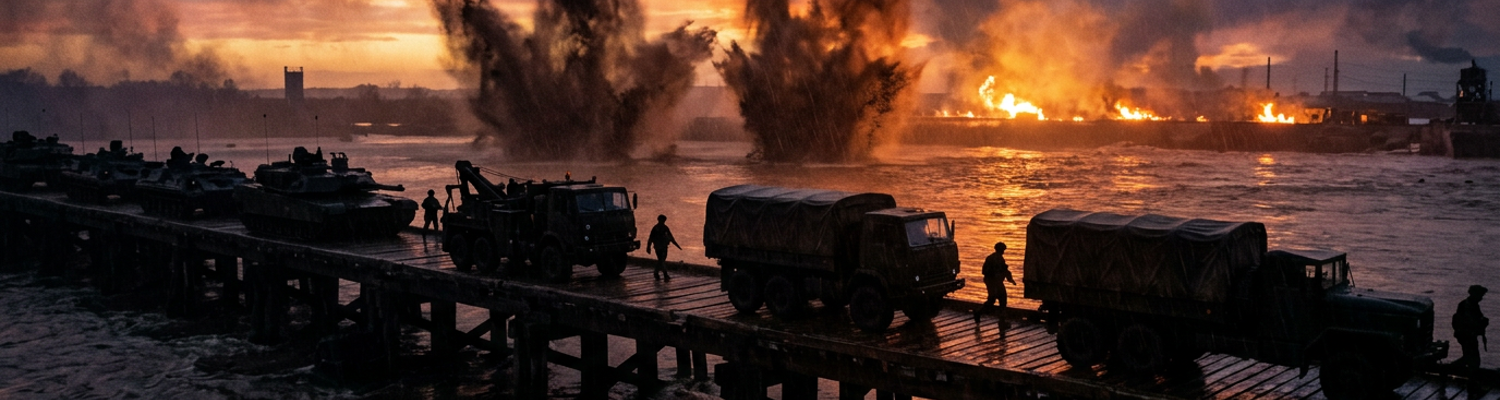
Engineers waded chest deep into the churning brown runoff of the canal, bracing their shoulders against the strong current to keep the heavy containers of type O negative blood above the waterline. Marine motor transport drivers behind them guided their sandbagged five ton cargo trucks down the muddy embankment, testing the loose timber treadways that engineers had lashed across the shattered bridge pylons. At 0942 on February 4, 1968, an essential supply vehicle stalled on the compromised Phu Cam crossing under heavy mortar bombardment. North Vietnamese mortar rounds struck the water ten feet from the crossing timbers, spraying hot shrapnel that punctured the vehicle radiator and severed its main fuel line. Driver mechanics vaulted out of the armored cab into the freezing mud with hand wrenches, frantically attempting to restart the flooded diesel engine while sniper fire chipped concrete chunks off the exposed bridge abutment.
Fuel gushed from the punctured line into the muddy current as the mechanics failed to restart the flooded engine amidst the relentless gunfire. The sudden crossing failure threatened an irreversible choke point that exposed the entire medical logistics column to destruction. Three additional five ton trucks packed with hundreds of whole blood bottles, surgical instruments, and wounded Marines sat bumper to bumper along the narrow descent, blocked on both sides by steep mud embankments and canal floodwaters. Enemy mortar crews across the canal adjusted their sights onto the stationary vehicles, dropping high explosive eighty two millimeter rounds closer to the trapped column with every successive volley. Shrapnel tore through truck canopies and shattered wooden cargo sideboards, striking the auxiliary fuel cans mounted on the running boards and threatening the perishable blood supply inside the beds.
Steel tow cables clattered across the wet mud as Alpha Company engineers dragged two heavy wire ropes from the front winch of an M48A3 tank to the dead truck. Sergeant mechanics crawled beneath the damaged front bumper in waist deep water, pinning the steel clevises around the twisted frame hooks while enemy rifle rounds hammered against the tank armor above them. Tank crewmen gunned the diesel engine and reversed their steel tracks against the slippery riverbank, snapping the tow cables taut to wrench the five ton truck backward off the timber treadway. Structural timbers groaned and shifted under the sideways strain, but the massive tank tore the stalled chassis free of the crossing and shoved it into a deep drainage ditch alongside the abutment. Combat engineers immediately climbed onto the cleared bridge planks with sledgehammers and drift pins, re aligning the splintered boards and securing them to the steel stringers beneath the surface.
Timber planks held firm under the boots of the engineers as they signaled the remaining trucks forward across the reopened single lane span. Drivers floored their accelerators, churning dual rear tires through the muddy gravel and crossing the Phu Cam canal into the northern perimeter before enemy mortars could register on the moving targets. Stretcher bearers and naval corpsmen rushed out from the concrete basements of the adjacent compound, unloading the insulated crates of type O negative blood directly from the truck beds into waiting underground operating rooms. Combat engineers took up defensive positions behind the shattered masonry walls of the crossing, securing the canal route so additional relief columns could haul ammunition and medical supplies into the contested heart of Hue.
Treadway Repairs and Field Winch Recovery
Mortar rounds exploded against the shattered masonry walls, spraying hot metal across the defensive perimeter just as another five ton cargo truck rolled its front wheels onto the canal crossing. Heavy weight from the armored vehicle combined with the shock of nearby detonations caused the underlying bridge timbers to buckle and split with loud cracks. Left rear dual tires broke through the rotted surface decking, dropping the rear axle onto a jagged concrete beam and wedging the loaded chassis at an awkward angle above the swirling canal water. Combat engineers exposed themselves to shrapnel to manually realign and secure fractured timber treadways across the damaged canal span. Squad members knelt on the vibrating framework under direct rifle fire, jamming long pry bars under the splintered stringers and levering the heavy balks back into a level plane. Engineers drove heavy steel drift pins through the overlapping timbers with sledgehammers, locking the loose bridge balks back into alignment beneath the trapped chassis.
Steel winch cables unspooled from an M543 recovery vehicle that backed toward the southern edge of the canal to reach the immobilized truck. A recovery crew rigged a mechanical field winch to drag the stalled 5 ton truck carrying refrigerated blood serum onto solid ground within a five minute window. Mechanics scrambled through freezing spray and flying stone chips to run heavy wire chokers around the front leaf springs and tow hooks of the stuck vehicle. Sergeant mechanics secured the rigging with forged steel clevises, hammering the retaining pins home with hand wrenches while enemy snipers on the far bank targeted the exposed bumper. The winch operator engaged the power take off lever inside his cab, tightening the greasy wire rope until the slack vanished and the cable pulled taut under immense mechanical tension.
Winch gears ground together inside the recovery truck as the heavy drum wound the steel cable in low gear. The stalled five ton cargo truck lurched forward out of the timber depression, scraping its differential housing over the newly secured planks while diesel smoke rose from the strained wrecker engine. Combat engineers stood alongside the wheels with guide poles, directing the front tires along the center of the narrow wooden track so the vehicle would not slide into the open canal gap. North Vietnamese mortar teams dropped another volley of eighty two millimeter rounds into the canal, throwing plumes of muddy water and shrapnel over the cargo bed where insulated coolers held hundreds of blood containers. Driver mechanics inside the cab shifted their transfer case into four wheel drive as soon as the front wheels touched the firm incline of the northern abutment, adding engine power to the pull of the winch. Cable tension slacked as the front bumper cleared the damaged bridge structure, allowing the heavy cargo truck to roll onto solid pavement on the northern shore of the canal.
Navy corpsmen ran forward to meet the recovered truck, unlatching the armored tailgate to verify that the insulated containers of blood serum remained cold and intact. Medical specialists lifted the heavy crates down to waiting stretcher bearers, who carried the chilled bottles directly into the reinforced basement of the nearby hospital compound. Engineers at the canal edge unhooked the recovery cables and dragged fresh timber stringers into place, hammering additional drift pins into the bridge deck to keep the route open for following vehicles. Platoon sergeants repositioned machine gun teams along the concrete rubble to suppress enemy marksmen who continued to fire on the crossing from nearby street corners. Combat engineers shouldered their sledgehammers and took cover behind the fortified abutment, watching the road south for the next supply column.
Battalion Aid Station Preservation and Phu Bai Evacuations
Corpsmen carried the insulated containers of type O negative blood away from the canal crossing and rushed down the concrete stairs into the MACV compound aid station. Doctors inside the crowded basement had exhausted their final units of saline and plasma hours earlier, leaving dozens of critically injured Marines to bleed out on canvas litters laid across the flooded floorboards. Navy surgeons immediately sliced open the chilled boxes, spiking plastic tubes into the glass bottles and running lines into the arms of patients suffering from severe hemorrhagic shock. Delivery of the whole blood cargo directly prevented the collapse of surgical triage operations inside the beleaguered MACV compound aid station. Operating teams working under flickering battery lamps used the fresh blood volume to stabilize internal hemorrhaging, allowing physicians to perform life saving chest tube insertions and limb amputations without losing patients on the tables. Orderlies cleared bloody dressings from the operating tables and stacked empty crates against the masonry walls while triage officers reassessed patients previously categorized as expectant.
Drivers backed their five ton trucks up to the sandbagged clinic entrance as soon as surgeons cleared stabilized litter casualties for immediate ground evacuation. Motor transport personnel loaded three tiers of stretchers into the armored beds of the cargo vehicles, securing each metal litter frame to the side stakes with heavy canvas straps. Securing the crossing over the Phu Cam Canal restored the casualty corridor, allowing transport trucks to evacuate hundreds of critically wounded Marines south to Phu Bai. Corpsmen climbed aboard the loaded truck beds alongside the casualties, holding open plasma bottles and adjusting pressure bandages while drivers secured the armored tailgates. Rifle squads took up defensive positions along the vehicle running boards, aiming their weapons into the second story windows of damaged brick villas flanking the street. Convoy commanders signaled the column forward, moving the loaded vehicles back toward the timber crossing where combat engineers stood guard over the repaired bridge decking.
Engineers guided the tires of each ambulance truck across the reinforced canal span, watching the timber balks flex under the weight of the casualties. Sapper crews kept sledgehammers and steel levers ready at both ends of the bridge, driving fresh drift pins into the split decking whenever heavy axles shifted the supporting beams. North Vietnamese snipers fired from the upper floors of the railway station across the canal, but gunners on an escorting M48A3 tank blasted the brick facade with canister shot to suppress the incoming rounds. The evacuation trucks crossed the waterway without stalling, clearing the southern embankment and accelerating onto the asphalt surface of Route 1. Drivers navigated through standing floodwaters and bypassed abandoned civilian vehicles along the eight mile highway, maintaining high speeds despite intermittent rifle fire from the roadside tree lines. Corpsmen inside the vibrating truck beds monitored vital signs and replaced finished blood units as the convoy pushed through the freezing monsoon toward the southern horizon.
Doctors at the Phu Bai perimeter swarmed the arriving trucks as soon as the convoy rolled through the main security gate. Navy medical teams and litter bearers pulled stretcher after stretcher from the cargo beds, carrying the wounded directly into reinforced hospital bunkers and heated surgical trailers. Surgeons categorized the incoming casualties by the severity of their injuries, sending the most critical cases straight into advanced operating suites while transport helicopters prepared to fly stabilized patients to hospital ships offshore. Motor transport mechanics refueled the empty five ton trucks at the perimeter fuel points, replacing shattered side mirrors and patching shrapnel punctures in the cooling radiators. Alpha Company engineers restocked fresh timber balks, steel cables, and additional boxes of medical supplies onto the cleared truck beds, preparing the vehicles for the next turnaround run north toward the canal.