
Morgue Suite Command Pressure
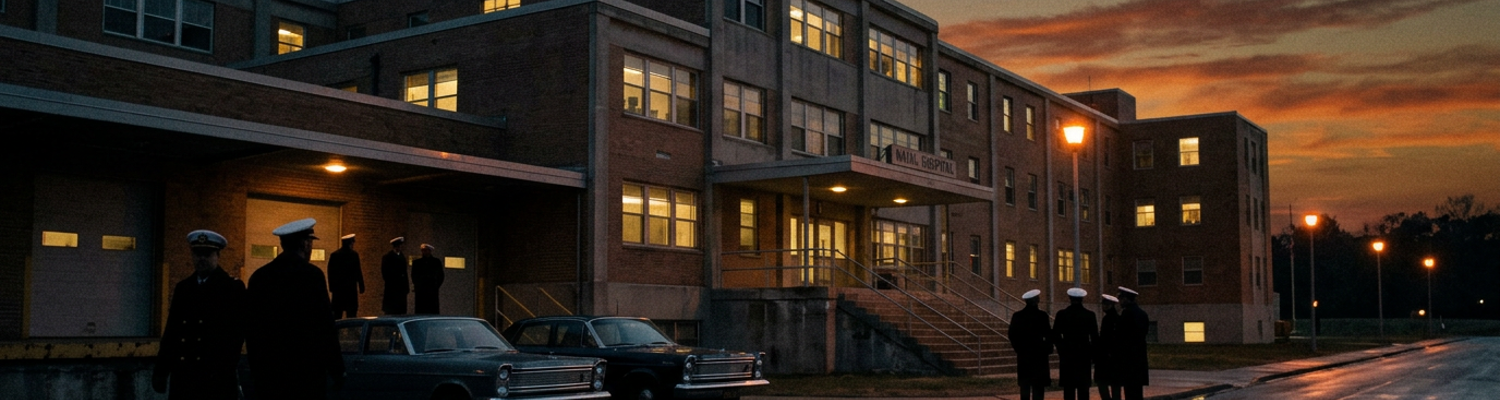
Radio operators at the naval communications station monitored incoming flash messages from Dallas, triggering an immediate mobilization of hospital personnel as Bethesda commanders learned a presidential casualty was en route. Base commanders ordered the morgue staff to clear the basement suite, prepare the stainless steel examination tables, and seal the service corridors before the transport vehicle arrived. Navy pathologists Commander James J. Humes and Commander J. Thornton Boswell hurried to the metal morgue lockers to change into green surgical scrubs without receiving any prior briefings on the specific trauma they were about to examine. Army wound ballistics expert Lieutenant Colonel Pierre Finck received an emergency telephone summons at the Armed Forces Institute of Pathology, ordering him to report immediately to the naval hospital. Finck grabbed his uniform jacket, drove through the dark streets toward the military medical complex, and walked down the basement stairs into the crowded morgue suite.
Lieutenant Colonel Pierre Finck entered the crowded morgue suite just as federal security detachments and uniformed commanders packed the narrow room. Morgue personnel operated in a small space filled with armed military brass and Secret Service agents, creating heavy physical strain for the medical team trying to work around the examination table. Federal agents carrying concealed sidearms stood along the tile walls alongside admirals and generals in dress uniforms who watched every movement the doctors made. Heavy cigarette smoke and the persistent talking of over thirty observers filled the poorly ventilated space, pressing against the pathologists as they laid out bone saws, scalpels, and measuring rulers on their instrument trays. Secret Service agents repeatedly stepped forward with security instructions and pulled preliminary glass photographic plates from the cameras, denying the medical team the calm environment required for complex clinical measurements. Rear Admiral Calvin B. Galloway stepped forward from the line of officers and stood directly beside the examination table.
Rear Admiral Calvin B. Galloway stood beside the examination table and restricted the clinical authority of the forensic team, verbally governing the postmortem examination scope. Admiral Galloway looked down at the body and told the pathologists to avoid any extensive dissections that might delay the scheduled transfer to the White House. Commander Humes attempted to trace the downward trajectory of the upper back wound with his gloved finger, but senior officers instructed him to cease probing immediately and leave the anterior neck tissues undisturbed. Lieutenant Colonel Finck raised professional objections about tracking the projectile path through the muscle tissue, prompting superior commanders to reject his requests for complete dissection and order the doctors to move on to other areas. Subordinate morgue technicians stood by the sinks and watched their medical leaders yield to senior line officers, leaving the physical trajectories of the bullets completely unresolved as the doctors stepped back from the table. Commander James J. Humes laid his metal probe on the instrument tray.
Commander James J. Humes laid his metal probe on the instrument tray as the unresolved wounds were formally bypassed. The medical team followed the direct orders of the flag officers standing around the gurney, allowing physical exhaustion to settle heavily over the three pathologists after hours of continuous technical labor. Finck and Boswell cleaned dried fluids from their rubber gloves and placed their surgical instruments into sterilization basins while armed guards escorted the enlisted technicians out of the room. Secret Service agents collected the preliminary measurements, discarded lead fragments, and anatomical charts from the counters, locking these physical items into transport cases under Admiral Galloway and his direct supervision. Commander Humes wrapped the remaining clinical notes in protective paper and locked them inside his administrative desk.
Rifle Contradictions and Forensic Deliberations
Commander Humes locked his administrative desk, securing his preliminary measurements while glaring rifle contradictions continued to torment the surgical team. Pathologists attempted to assess the shallow posterior back wound and extensive cranial damage without initial knowledge of the Parkland Memorial Hospital emergency tracheotomy. The entrance wound in the upper right back penetrated only into superficial muscle layers, defying normal ballistic expectations for a high velocity military rifle projectile. Shattered parietal and occipital bone fragments across the right side of the skull exposed devastated cerebral tissue, pointing toward catastrophic bullet impact without a corresponding torso exit. Communications between the Maryland naval facility and Texas operating rooms had been completely severed during the emergency transport, leaving Bethesda doctors unaware that trauma surgeons in Dallas had cut their breathing tube incision right through a small bullet entry wound in the anterior neck. Humes and Boswell palpated the shallow posterior cavity with gloved fingers and blunt instruments.
Fingers and blunt instruments met unyielding cervical tissue and intact pleura. Command directives actively discouraged complete tract dissection and standard forensic probing of the cervical wound margins because senior military officers crowding the gurney feared deep cuts would mutilate the body before the planned public viewing at the Capitol. Navy surgeons possessed extensive experience with routine disease pathology and clinical biopsies, but civilian forensic rules required slicing through the neck musculature to establish whether the back wound connected to the throat damage. Flag officers overrode those scientific standards and repeatedly told the autopsy team to abandon any deep surgical tracking, ordering the doctors to leave the projectile path through the neck organs completely alone. Humes withdrew his instrument from the bruised muscle pocket without verifying where the lead slug had traveled, yielding his scalpels to command authority while his colleagues watched in tense silence. Lieutenant Colonel Pierre Finck stood beside the stainless steel basin with clenched fists.
Lieutenant Colonel Pierre Finck stood beside the stainless steel basin with clenched fists, forced to leave the critical anatomical connections unexamined under the gaze of uniformed superiors. Finck confirmed under oath in subsequent legal hearings that high ranking military commanders issued direct instructions restricting complete forensic exploration. The army ballistics expert explained to investigators that whenever the pathologists attempted to dissect the bullet path through the neck, superior officers ordered them to stop and move on to external skull reconstruction. These officers issued verbal boundaries that stripped the medical team of their independent investigative autonomy, using military conditioning to compel the doctors to obey senior rank. The surgeons realized their official autopsy report would lack fundamental ballistic validation because they could not track the bullets, creating severe psychological distress in the room. Commander J. Thornton Boswell stripped his bloodied latex gloves over a metal waste bin.
Commander J. Thornton Boswell stripped his bloodied latex gloves over a metal waste bin as the medical officers faced the unresolved rifle contradictions alone in the morgue office. Physical exhaustion and sleep deprivation weighed heavily on the three pathologists after hours of operating under constant surveillance, loud interruptions, and military command intimidation. The doctors debated whether the shallow back wound had been caused by an external missile that fell out during heart massage or whether an undiscovered bullet fragment still rested inside the spinal column. The absence of confirmed ballistic tracts left their technical documentation vulnerable to fundamental medical errors, heightening their professional anxiety as dawn approached and the deadline for the final report neared. Humes dialed the long distance number to seek the surgical records kept out of their hands all night.
Document Destruction and Physical Evidence Containment
Doctor Malcolm Perry provided the surgical records kept out of their hands all night, explaining the anterior neck incision over the crackling telephone wire. He confirmed that the Dallas trauma team had cut their emergency tracheotomy directly through a small entrance bullet hole. Commander Humes listened in stunned disbelief at his desk, realizing that the mysterious shallow back wound and the damaged anterior neck were part of a continuous bullet path that his team had failed to track because of command restrictions in the morgue. Federal security details entered the room to dismantle medical authority over the forensic materials, confiscating the postmortem registers and laboratory logs to cut off the Bethesda doctors from standard specimen tracking. Armed guards placed the formal tissue jars, paraffin blocks, and bone fragments into locked metal transfer trunks under non medical military custody. Photographers John Stringer and Floyd Riebe handed over their unprocessed film holders and exposure packs.
Photographers John Stringer and Floyd Riebe handed over their unprocessed film holders and exposure packs to military authorities. Intelligence officers immediately classified, sequestered, and seized all original radiographic plates and clinical photography taken by naval medical photographers. Uniformed intelligence personnel stood directly over the darkroom equipment and packing tables, gathering every color transparency, black and white negative, and cranial X ray sheet before the medical officers could develop them. Navy commanders placed strict security stamps across the photographic dossiers and courier bags, locking the visual data away in naval intelligence vaults and denying the doctors access to their own work. The three pathologists found themselves professionally isolated and stripped of physical diagnostic evidence, forced to rely entirely on fallible human memory and hastily written scrap paper. Commander James J. Humes gathered his bloodstained anatomical diagrams and handwritten draft sheets from his desk.
Commander James J. Humes gathered his bloodstained anatomical diagrams and handwritten draft sheets from his desk. He secured them inside a leather briefcase before driving home under heavy security, having reached an acute mental breaking point after two days of unbroken duty under intense pressure. Sitting alone at his desk in his suburban Maryland residence, Humes spent hours painstakingly transcribing the autopsy findings and working the Dallas tracheotomy information into a single coherent narrative on fresh paper. Administrative directives from superior flag officers explicitly ordered the destruction of all preliminary working drafts to prevent conflicting early impressions from surfacing in official government archives. Commander James J. Humes carried his handwritten preliminary autopsy notes and worksheet drafts to his home fireplace, striking a match and burning the papers following the strict administrative directives. Ashes drifted against the brick firebox.
Ashes drifted against the brick firebox as Humes gathered the newly transcribed clean manuscript. He signed his name to the formal autopsy protocol, placed the pages into a fresh folder, and returned immediately to the National Naval Medical Center. Commander Boswell and Lieutenant Colonel Finck reviewed the rewritten text and affixed their signatures under the watchful eyes of hospital administrators. Staff couriers sealed the finished manuscript alongside the formal tissue inventory logs inside a secure dispatch pouch addressed directly to the White House physician. Military officials barred the Bethesda pathology staff from retaining copies of the diagnostic report, reference slides, or investigative logs, leaving the hospital department archives completely empty. Naval command cars waited with running engines at the hospital entrance, loading the remaining forensic materials directly into the trunks before the transport sedans departed into the darkness.
Navy Silence and Staff Duress
Navy security officers cleared the entrance foyer as the transport sedans departed into the darkness. Command personnel turned their attention inward to silence every medical specialist who had witnessed the autopsy, marching the basement staff into hospital administration offices and placing standard military secrecy forms across the wooden desks. Bethesda medical corpsmen, including technicians James Jenkins and Paul O Connor, were required to sign written nondisclosure agreements under threat of court martial. Intelligence agents informed the young technicians that speaking about the autopsy wounds, the room layout, or the senior officers present would result in immediate confinement at the military brig in Fort Leavenworth. Jenkins and O Connor pressed their ink pens against the official forms, binding themselves to legal silence while armed sentries observed each signature from the doorway. Senior administrators collected the finished pages, stamped them with security classifications, and locked the paperwork into headquarters file safes, establishing strict operational rules that permanently altered their daily routines.
Technicians walked out into the morning chill under strict operational rules that permanently altered their daily routines. Hospital corpsmen were forbidden from discussing the night with their spouses, their colleagues, or the physicians who had stood beside them at the morgue table. Enforced institutional silence produced prolonged personal isolation and professional strain across the participating naval medical cadre, causing staff members to watch their words carefully in mess halls and ward rooms. The psychological burden of holding classified national secrets without any operational debriefing caused chronic insomnia and quiet dread among the enlisted assistants. Navy monitors placed special tracking flags on the personnel files of everyone assigned to the autopsy room, restricting future overseas transfers and subjecting their regular correspondence to official security reviews. Pathologists Commander James J. Humes and Commander J. Thornton Boswell discovered that these file flags effectively trapped them within federal investigations.
Pathologists Commander James J. Humes and Commander J. Thornton Boswell discovered that these file flags effectively trapped them within federal investigations. Participating pathologists endured decades of public scrutiny and contradictory inquiries while remaining bound by strict military operational secrecy orders. Government panels cross examined the doctors about missing tissue records, burned notes, and incomplete bullet trajectories while legal counsel and military liaisons sat beside the witness tables warning them against revealing the direct command intimidation. Civilian critics and medical peers accused the Bethesda officers of incompetence and professional coverups, unaware that naval secrecy regulations prevented the surgical team from explaining why flag officers had blocked standard exploratory dissections. Humes and Boswell retreated into defensive seclusion after each hearing, enduring private humiliation and damaged careers while absorbing the entire institutional blame for the examination. Commanders scattered the surviving autopsy crew across distant naval hospitals and shore facilities.
Commanders scattered the surviving autopsy crew across distant naval hospitals and shore facilities to minimize direct contact among the witnesses. Personnel records tracked Jenkins, O Connor, and their colleagues as they completed their enlistments and moved into civilian life, carrying the unspoken events of that basement room into their private households. Former corpsmen experienced recurring nightmares and sudden panic whenever federal agents contacted them for periodic security renewals, reminding them that their original nondisclosure pledges remained legally binding and carried severe criminal penalties. Pathologists turned down university chairs and prestigious clinical appointments, finding themselves unable to publish research papers or answer basic forensic questions without risking prosecution under military law. Senior naval authorities maintained these security classifications inside sealed Pentagon vaults, keeping the operational duress inside the Bethesda morgue locked away behind military discipline and executive privilege for over thirty years. Investigators with the Assassination Records Review Board unlocked those classified Pentagon holdings during the next decade.
Board Investigators and Sworn Depositions
Investigators with the Assassination Records Review Board unlocked those classified Pentagon holdings during the nineteen nineties. The board forced military custodians to surrender decades of sequestered medical files and classified operational logs. Archival specialists unpacked stacks of weathered manila folders, processing registers, and administrative memorandums that naval authorities had withheld from civilian scrutiny. Staff analysts attached standard Record Identification Forms to each folder, entering unique tracking numbers and original security stamps to formally catalog and declassify the Bethesda naval archive for public review. Federal marshals served subpoenas across the country, summoning the surviving Bethesda pathologists, medical photographers, and enlisted corpsmen into closed deposition rooms in Washington to answer questions under oath. Lead counsel Jeremy Gunn laid the newly cataloged autopsy diagrams, photographs, and radiographic plates across the conference table, prompting pathologists to examine the declassified sheets under bright conference lamps.
Pathologists examined the declassified sheets under bright conference lamps, admitting under oath that key physical findings remained impossible to reconcile. Commander James J. Humes and Commander J. Thornton Boswell struggled to explain conflicting entries regarding the postmortem examination of the brain, unable to verify whether the archived photographs matched the organ they had held at the morgue table. Sworn depositions revealed unresolved contradictions regarding missing supplemental brain examination records and missing specimen weights. Official pathology logs registered a preserved brain weight of fifteen hundred grams, a numerical figure that defied medical reality given the catastrophic tissue loss documented during the initial skull examination. Both navy physicians conceded that their handwritten registers lacked standard laboratory tracking data for the supplemental brain sectioning, leaving the exact chain of custody completely unverified and creating massive gaps in the forensic record. Photographers and ballistics experts deepened these discrepancies as attorneys handed them original autopsy prints and processing slips.
Photographers and ballistics experts deepened these discrepancies as attorneys handed them original autopsy prints and processing slips. Former medical photographer John Stringer reviewed the official photographic collection and testified that the brain photographs in the national archives were captured on different film stock than the specific rolls he had loaded into his camera at Bethesda. Stringer told investigators that he had no memory of taking the archived images, suggesting that a second supplemental examination took place without his presence or knowledge. Lieutenant Colonel Pierre Finck testified about the chaotic atmosphere in the morgue, describing how high ranking military commanders had repeatedly ordered the doctors to halt standard dissection tracts. Finck stated under oath that uniform rank had actively restricted the autopsy, confirming that admirals and generals had physically dictated the legal boundaries of their surgical exploration. Technicians James Jenkins and Paul O Connor confirmed this operational paralysis as they stepped before the board.
Technicians James Jenkins and Paul O Connor confirmed this operational paralysis as they stepped before the board to detail the personal cost of that enforced silence. Declassified board interviews formally documented the institutional coercion and psychological toll experienced by Bethesda medical staff, with former corpsmen breaking down in tears on the witness stand as they recounted decades of quiet terror. They described how intelligence officers had cornered them in administrative rooms with explicit court martial warnings, and how the constant threat of confinement at Fort Leavenworth had followed these enlisted men into civilian life. This fear triggered chronic insomnia, broken marriages, and acute panic whenever federal agents contacted them. Pathologists admitted that carrying conflicting autopsy findings through decades of public attacks had wrecked their careers, while military nondisclosure orders prevented them from explaining how flag officers had compromised their work and forced them to abandon basic medical standards. Board attorneys transcribed these accounts into public transcripts, capturing the human cost of the military coverup before boxing the audio cassettes and signed deposition exhibits for permanent transfer to the open research shelves of the National Archives.