
German Escorts and the 1943 Katyn Inspection
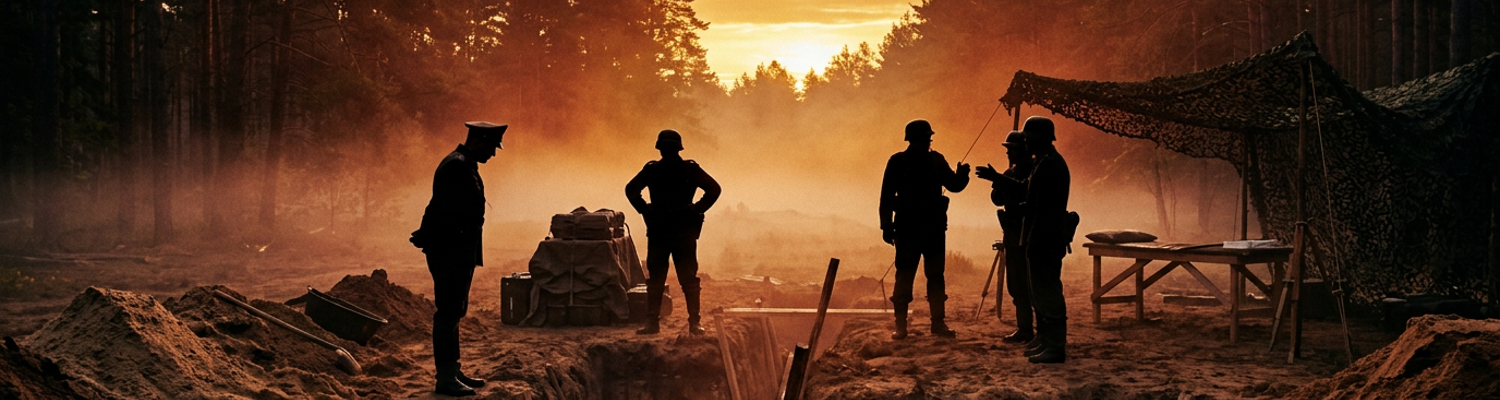
German guards armed with Mauser rifles patrolled the perimeter and barbed wire barricades of Oflag IX-A/Z at Rotenburg an der Fulda, keeping captured American officers separated from the European battlefields by hundreds of miles of hostile territory. German authorities abruptly removed American prisoners of war Lieutenant Colonel John H. Van Vliet Jr. and Captain Donald B. Stewart from this officer camp in May 1943 and placed them under armed military escort for transport to Katyn Forest. Escort details pushed the two Americans eastward through occupied Poland and into western Russia, crossing war torn terrain where rail lines ran past burned villages and military checkpoints toward the Smolensk front. Armed Wehrmacht personnel controlled every leg of the movement by train, vehicle, and aircraft, isolating the captives within a tight security cordon as they entered the pine woods west of Smolensk. German vehicles finally halted along a secluded woodland track where armed sentries guarded a sprawling clearing surrounded by dense pine trees and sandy earth.
Trenches cut deep into the sandy floor of the clearing, exposing thousands of stacked corpses dressed in winter uniforms of the Polish Army. Van Vliet and Stewart inspected open exhumation trenches under German military supervision alongside international delegates and Polish Red Cross personnel who worked directly in the mud to identify human remains. German field officers directed the visiting group along the perimeter of the pits, pointing out matted hair, rotted overcoats, intact leather boots, and uniform buttons bearing the Polish eagle. Polish Red Cross workers extracted pocket diaries, letters, identification tags, and Russian newspaper clippings from the clothing, laying each retrieved item out on wooden tables under the watchful eyes of German handlers. Medical specialists and civilian forensic observers from neutral and occupied European nations examined skull fractures and powder burns at the entry wounds, while armed German guards tracked every movement across the site.
Lieutenant Colonel Van Vliet observed German propaganda photographers and newsreel camera teams adjusting lenses and microphones to record any visible reactions from the Allied prisoners. Both American officers immediately realized that Berlin intended to exploit their presence as an endorsement of the German investigative findings. Prisoners resolved to maintain professional neutrality during the inspection to avoid generating propaganda material for the German Reich. Van Vliet and Stewart kept their hands thrust inside their uniform pockets, maintained blank expressions, and refused to nod, speak into recording equipment, or point at the bodies. German escorts attempted to prompt spontaneous commentary about the bullet wounds or the decay of the garments, but the two Americans answered only with silent stares and neutral requests to view physical evidence rather than prepared propaganda exhibits.
Tree roots growing undisturbed through the rotting uniforms and skeletal remains confirmed to Van Vliet that the graves had been sealed years before the German invasion of Russia. Stewart noted that none of the recovered personal letters, diaries, or newspaper scraps bore dates later than April or May of 1940, while the victims still wore heavy winter coats suited for cold spring weather. German escorts eventually guided the inspection party away from the burial pits toward waiting staff cars as afternoon light faded through the forest canopy. Van Vliet and Stewart boarded the vehicles under armed guard without signing German registry documents or issuing a single public declaration. German military transports flew the two prisoners back to Berlin and returned them to Oflag IX-A/Z, where both men began organizing their mental notes into a sequence of forensic observations for future delivery to American military intelligence.
Forensic Evidence and Polish Uniform Preservation
Van Vliet cataloged every detail of the garments he had touched along the edge of the burial trenches to preserve a precise forensic record for his superiors. Tailored wool uniforms and overcoats on exhumed Polish officers exhibited little wear and soil degradation, ruling out extended labor camp confinement. Field service tunics retained sharp pleats, original brass buttons, and distinctive rank insignia that showed no evidence of the abrasive, heavy physical labor typical of Soviet prison camps. Heavy overcoats made from thick winter fabric still fit the bodies snugly, indicating that the men had not suffered the extreme muscle loss and emaciation caused by months of starvation rations. Mud and damp sand coated the exteriors from three years underground, but the weave of the cloth beneath remained intact and free from the systematic patching seen on long term inmates.
Leather boots fitted to the lower legs of the bodies reinforced this assessment of the prisoners living conditions. Corpses wore high grade Russian leather boots with unblemished soles, confirming that the victims were executed shortly after their capture. Men forced into long months of Soviet penal servitude would have worn through their soles on rock piles or had their valuable footwear confiscated by camp administrators and replaced with crude foot wraps. Officers buried in the trenches still possessed custom equestrian boots with sharp heel edges, intact stitching, and unscuffed leather uppers that had never seen pickaxe work or railway construction. Van Vliet examined the bottoms of several boots lifted from the burial layers and saw no resoling, no wooden pegs, and no signs of forced road marches. Red Cross volunteers placed each clean boot beside the extracted uniform pieces to prepare the personal items for formal documentation.
Diaries, correspondence, identification papers, and Warsaw newspapers retrieved from the graves systematically ceased in April and May 1940. Letters from family members in German occupied Poland and Soviet held territory carried postmarks that stopped abruptly during those two spring months. Red Cross examiners unfolded brittle pages from pocket journals where Polish officers had recorded daily roll calls and camp rumors up to the morning they were loaded onto prison trains. Newspapers printed in Warsaw and Moscow recovered from deep tunic pockets carried publication dates from that same narrow window and contained no references to military operations from the following year. German armed forces did not invade the Soviet Union or occupy the Smolensk region until late June 1941, leaving an unexplained fourteen month gap that undermined any claim of German culpability. Polish Red Cross clerks cataloged these dated artifacts into individual evidence envelopes under the watchful scrutiny of the visiting observers.
Van Vliet filed away each physical measurement, material condition, and documentary cutoff date in his mind while German guards escorted him through the identification area. Captain Stewart assisted him by memorizing matching sets of technical observations to prevent any loss of data if one officer failed to survive the war. Both men reviewed the evidence together back inside their quarters at Oflag IX-A/Z, focusing strictly on the intact wool fabric, the pristine boot soles, and the spring 1940 dates. Prisoners drafted no written reports on German paper to prevent discovery during routine barracks inspections by the camp security officer. Van Vliet instead rehearsed the forensic sequence continuously, waiting for the operational collapse of the German front to deliver his testimony directly to Army Intelligence officers in the Pentagon.
Pentagon Debriefings and G-2 Information Sequestration
Van Vliet reported directly to the Pentagon in May 1945 following his liberation from German captivity and rapid repatriation across the Atlantic, carrying his mental log of the burial trenches straight to the Military Intelligence Division. Van Vliet had reached American lines weeks earlier after escaping during the evacuation from Oflag 64 through Stalag III-A at Luckenwalde, entering evacuation pipelines that moved him through French transit camps and onto military transport flights bound for Washington. Van Vliet bypassed personal convalescent leave to deliver the forensic sequence he had memorized under armed German escort two years earlier. Intelligence officers inside the Pentagon recognized the explosive nature of his testimony, as it directly contradicted the official Moscow position that German forces had executed the Polish captives in the autumn of 1941. Senior clerks routed the newly returned lieutenant colonel through administrative security checkpoints and up to the executive floor of the intelligence directorate. Aides escorted Van Vliet into the private offices of Army G-2, where the leadership intended to handle the delicate matter behind closed doors.
Major General Clayton Bissell, Assistant Chief of Staff for Army Intelligence, received Van Vliet in his private office on May 22, 1945, to record a comprehensive dictation regarding Soviet culpability at Katyn. Bissell summoned a civilian stenographer into the room to take down every physical detail as the liberated officer reconstructed his May 1943 inspection of the mass graves. Van Vliet dictated his observations methodically, recounting the custom Russian leather boots with unscuffed soles, the tailored wool tunics free of hard labor wear, and the living tree roots threaded through the layers of stacked corpses. He explained to the general that every diary, postcard, and newspaper scrap recovered by Red Cross workers had stopped abruptly in April and May of 1940, more than a full year before German troops entered the Smolensk district. Dictation left no room for ambiguity, concluding firmly that the Soviet internal security apparatus had carried out the executions while the Polish officers were held in Soviet custody. Stenographic notes transformed Van Vliet's spoken testimony into a formal, multi page intelligence narrative that placed direct criminal responsibility on the Soviet government.
Bissell classified the dictated narrative as Top Secret and ordered Van Vliet into total silence to protect Allied diplomatic unity before Soviet entry into the Pacific War. American military strategists still anticipated a costly amphibious invasion of the Japanese home islands and considered Soviet participation against Japan essential for reducing projected casualties on the battlefield. Bissell viewed the eyewitness testimony not as an isolated criminal inquest, but as an immediate geopolitical hazard capable of disrupting tripartite cooperation between Washington, London, and Moscow. General Bissell formally instructed Van Vliet never to mention Katyn, never to write about his observations, and never to discuss his report with any person inside or outside the armed forces. Staff personnel collected the typed draft, carbon copies, and original shorthand notes from the stenographer, ensuring that no duplicates entered the standard G-2 distribution desks. Van Vliet signed the written acknowledgment of the verbal gag order and departed the Pentagon, while Bissell retained sole custody of the typed document and deposited it into his personal office safe.
Administrative Bottlenecks and Missing War Department Files
Steel safe doors clicked shut over the classified folder, isolating the typed statement from the regular filing clerks who managed military intelligence distribution across the Pentagon. General Bissell kept the document sequestered inside his private office rather than forwarding it to the centralized Military Intelligence Division registry for standard indexing. Clerks in the G-2 Central Records Section routinely assigned accession numbers and cross reference cards to incoming foreign intelligence items, but no staff member ever logged Van Vliet's testimony into the master ledger. Administrative specialists transferred general staff files into standard storage boxes as rapid demobilization scattered military personnel throughout late 1945 and 1946, yet none of the packing inventory sheets mentioned the Polish folder. The sole typed transcript and supporting materials from Van Vliet's 1945 debriefing disappeared completely from Army G-2 centralized intelligence holdings during this chaotic postwar reorganization. Records clerks who audited the intelligence cabinets at the end of the decade discovered clean drawer rails and empty catalog slots where the Polish massacre file should have rested.
Army Inspector General investigators pulled cabinet drawers and examined routing logs across the Pentagon in 1950 to locate the missing paperwork. Investigators confirmed that the Top Secret document vanished from G-2 possession without leaving tracking entries or cross referenced dispatch manifests. Officers conducting the inquiry interviewed G-2 file custodians, surveyed Pentagon mail couriers, and scrutinized the master control books that logged every sensitive intelligence movement. Standard Army regulations required triplicate receipts whenever a Top Secret asset passed between divisions or exited Pentagon custody, yet the custodians could produce no courier stubs or serial receipts for the Van Vliet folder. Search teams dismantled several filing cabinets in the intelligence records annex to ensure that the thin folder had not slipped behind metal shelf dividers, but personal lockboxes and holding cages yielded nothing. The inquiry team concluded that the dossier had dropped out of the official paper trail without a trace, prompting the investigators to summon Bissell for formal questioning regarding the final disposition of the papers.
Bissell faced the inquiry board and stated under oath that his office had transferred the entire Van Vliet file to the State Department shortly after the original debriefing. Military liaison officers immediately dispatched formal search queries across the Potomac River to the State Department registry at Foggy Bottom to verify the general's claim. State Department registrars scrutinized their incoming classified correspondence logs, searched diplomatic mail binders, and combed through the central filing index for any sign of the Katyn report. Registrars found no record slips, receipt signatures, or catalog entries matching the missing intelligence dossier. Civilian archival clerks checked every locked vault and intelligence liaison ledger within the Office of European Affairs and confirmed that no courier pouches had ever delivered the document. State Department officials returned a formal negative finding to the Army, leaving the original eyewitness transcript untraceable across the executive branch and forcing military authorities to order Van Vliet to recreate his written report from memory.
Congressional Subpoenas and the Madden Committee Hearings
Army G-2 recalled Van Vliet in 1950 to draft a formal reconstruction of his vanished 1945 report from personal memory. Van Vliet sat before staff officers in the Pentagon and typed out the physical details he had committed to memory seven years earlier, including the unblemished boots, the unfrayed wool coats, and the spring 1940 cutoff dates found on the exhumed Polish corpses. He added a detailed account of his May 1945 debriefing with Major General Clayton Bissell, identifying the exact executive office where the civilian stenographer had transcribed his spoken words. Intelligence officials bound the reconstructed testimony into a fresh administrative file, but the sudden recreation of Van Vliet's written account failed to calm growing public suspicions outside the Pentagon. Word of the missing original dossier leaked into national newspapers, prompting veterans groups and Polish American organizations to demand an independent investigation into why the military establishment had concealed the Katyn evidence for over five years.
Congress created the House Select Committee to Conduct an Investigation of the Facts, Evidence, and Circumstances of the Katyn Forest Massacre in 1951, led by Ray J. Madden. Madden organized bipartisan hearings to uncover both the perpetrators of the 1940 executions and the specific bureaucratic mechanisms that had buried American eyewitness testimony inside the War Department. Committee staff established hearing rooms on Capitol Hill, assembled forensic specialists, and called surviving Polish officers and European witnesses to submit sworn depositions. Van Vliet received a congressional summons to testify in open session, where he presented his reconstructed report and walked the committee members through his 1943 inspection of the burial trenches. Public testimony confirmed the physical reality of the mass graves, but the lawmakers shifted their focus toward the Pentagon to uncover why military intelligence had silenced its own returning prisoners of war.
Madden and his committee investigators subpoenaed wartime War Department logbooks and interrogated senior intelligence personnel regarding administrative suppression. Congressional staff members seized daily courier sheets, classified document registries, and dispatch manifests from the Military Intelligence Division to establish the physical chain of custody for the May 1945 debriefing. Committee attorneys cross checked ledger pages against clerk testimonies, discovering that G-2 records officers had never assigned an official tracking code to Van Vliet's original statement. House investigators summoned civilian file room supervisors, stenographers, and intelligence registry clerks to testify under oath about how a Top Secret folder could vanish without leaving a withdrawal slip or destruction certificate. Every clerk confirmed that standard Army security procedures required signed serial receipts for any transferred file, yet no such documentation existed for the missing dossier.
Bissell took the witness stand before the committee to answer direct accusations of administrative concealment. General Bissell admitted under relentless questioning that he had personally placed the report in his office safe in May 1945 and had ordered Van Vliet to keep silent because revealing Soviet guilt at that moment would have damaged Allied unity before the end of the war. Bissell maintained that his staff had delivered the report to the State Department, but he could produce no signed dispatch voucher or courier log to support the claim. Committee members confronted Bissell with the complete absence of State Department records, demonstrating that the document had never reached civilian diplomatic channels. Madden and his fellow investigators formally entered the reconstructed 1950 statement into the congressional record as primary evidence, ordering the Pentagon to continue its administrative search for the vanished original papers.
Counter Intelligence Corps Field Evidence Reconstruction
European Command Counter Intelligence Corps detachments launched recovery sweeps across occupied Germany and Austria to assemble primary evidence after congressional investigators ordered the military to replace the missing War Department files. Field agents fanned out through refugee centers, military archives, and bombed out administrative buildings across the American occupation zone to locate anyone connected to the 1943 exhumations. Special teams screened municipal residency registers and prisoner of war discharge rolls to find former German military escorts, staff drivers, and civilian technical personnel who had stood near the burial pits. Operatives set up secure debriefing centers in Frankfurt, Munich, and Salzburg to process incoming leads and interrogate witnesses under standard military intelligence protocols. Search teams collected crates of captured Wehrmacht paperwork and personal war diaries from private basements, hauling the paper files into regional intelligence headquarters for systematic translation and forensic cataloging.
Agents gathered sworn depositions, photographic plates, and forensic sketches from European pathologists and Polish Red Cross field investigators to turn raw field files into verified legal proof. Case officers tracked down members of the International Medical Commission, including Swiss pathologist Francois Naville and Hungarian professor Ferenc Orsos, who had examined the corpses in Smolensk during the spring of 1943. Agents took formal statements under oath confirming that the anatomical damage, soil compression, and mummified brain tissues pointed exclusively to execution dates in April and May of 1940. Polish Red Cross workers who had conducted the exhumations provided secret technical diaries, grave blueprints, and precise identification lists that had been carried out of occupied Poland inside hidden luggage compartments. Photographers and draft technicians produced high resolution contact prints from original glass negatives, documenting row after row of bound Polish officers with entrance wounds at the base of their skulls. Intelligence couriers packaged these fragile glass plates and certified testimony into steel lockboxes, logging each piece of forensic material on chain of custody manifests before routing them to high level analytical sections.
Steel lockboxes arriving at intelligence evaluation centers yielded spent pistol ammunition and German technical reports that resolved the central mystery of the execution weapons. Recovered ballistic analyses established that German manufactured 7.65mm Geco ammunition had been supplied in bulk quantities to Soviet security organs during the interwar era. Soviet prosecutors at Nuremberg had previously pointed to the German headstamps on the cartridge shells as conclusive evidence of Wehrmacht guilt, claiming that Russian security personnel had never used foreign ammunition. American intelligence officers dismantled that claim by tracing sales contracts and shipping invoices from the Gustav Genschow firm in Durlach, which proved that Moscow had imported millions of these specific 7.65mm rounds during commercial trade agreements in the 1920s and early 1930s. Weapons specialists noted that Soviet execution squads favored German Walther and Mauser pistols chambered for this caliber because standard Russian Nagant revolvers produced excessive recoil and quickly overheated during prolonged mass shootings. Ordnance experts confirmed that the firing pin impressions and extractor marks on the Katyn shell casings matched the internal mechanics of German handguns routinely issued to state security detachments inside the Soviet Union.
Couriers bound these ballistic reports, medical affidavits, and photographic exhibits into a comprehensive master dossier for transmittal to Washington. Military couriers hand carried the bound volumes across the Atlantic, bypassing the standard Pentagon filing desks that had swallowed Van Vliet's original debriefing five years earlier. Committee staff members under Ray Madden received the overseas shipments and cross referenced the European forensic evidence against the reconstructed testimony Van Vliet had dictated from memory. Forensic sketches and pathologist depositions aligned precisely with the American lieutenant colonel's recollections of pristine leather boots, unfrayed wool overcoats, and undisturbed tree roots. Congressional clerks locked the thick volumes of European evidence into secure legislative vaults alongside Van Vliet's deposition, establishing the foundational evidentiary archive for the committee's final public report.
Institutional Reforms in Army Intelligence Document Custody
Ray Madden and his bipartisan committee drew directly upon these vaulted materials to draft the Madden Committee's 1952 final report, which officially censured General Bissell's judgment and documented G-2 failure to preserve critical war crimes evidence. Lawmakers concluded that Bissell had exercised deeply flawed professional discretion when he buried Van Vliet's May 1945 debriefing inside an executive safe and imposed a gag order on the returning prisoner of war. Committee members detailed how intelligence leaders allowed the original typed report, carbon copies, and stenographic notes to disappear without generating an accession number, an internal tracking manifest, or an authorized disposal record. Staff presented physical evidence showing that Bissell had misled the Army Inspector General by claiming the file had been delivered to Foggy Bottom when no receipt, transit entry, or courier signature existed in State Department archives. The final report established that military intelligence had systematically failed its basic institutional duty to collect, index, and safeguard primary accounts of foreign atrocities. Committee members signed the completed legislative inquiry on Capitol Hill, printed thousands of copies for public distribution, and formally transmitted the bound findings to the Secretary of the Army and the Joint Chiefs of Staff.
House investigators used these transmitted findings to show that wartime diplomatic posture had created severe structural friction against military intelligence reporting pipelines. Sworn testimony laid bare a command culture where Pentagon leaders deliberately subordinated objective military fact gathering to diplomatic calculations regarding Soviet participation in the Pacific War. Bissell and his immediate staff had disrupted standard intelligence collection channels by treating explosive eyewitness testimony as private executive correspondence rather than routine War Department records. This administrative bottleneck meant that frontline officers returning from German prison camps had no protected, independent pathway to preserve war crimes data once general staff officers decided that the truth clashed with White House foreign policy objectives. Lawmakers argued that intelligence agencies could not function effectively if general staff officers filtered out verified forensic observations whenever Allied diplomatic interests required public silence. Congressional scrutiny compelled defense officials to draft corrective administrative directives that separated civilian foreign policy concerns from military intelligence cataloging.
Department of the Army officials finalized these directives by initiating comprehensive administrative reforms regarding chain of custody logging and classification retention for sensitive overseas field data. Military intelligence leadership overhauled the central filing division inside the Pentagon, stripping general officers of the authority to sequester classified reports inside personal office vaults without ledger entries. Administrative specialists established rigid logging protocols that required clerks to assign permanent serial numbers, chronological entry slips, and duplicate cross index cards to all incoming foreign intelligence reports. Defense directives instituted mandatory double entry manifests and signed courier vouchers whenever sensitive war crimes dossiers moved between military intelligence sections or crossed the Potomac River to civilian agencies. Records personnel implemented strict retention schedules that prevented commanders from classifying field reports as Top Secret merely to suppress uncomfortable foreign developments or avoid diplomatic friction. Records custodians bound these new evidence handling rules into permanent military intelligence regulations and dispatched updated procedural binders to Army commands across the United States and occupied Europe.