
Warships and Persian Gulf Tanker War Origins
Fighter jets from Iraq and Iranian missile boats contested the shallow, sun scorched waters of the Persian Gulf as their brutal land war extended offshore. Low lying desert coastlines, dense commercial traffic lanes, and jagged offshore oil platforms created an unforgiving environment where radar clutter masked fast moving targets. Baghdad launched air strikes against Iranian oil loading terminals on Kharg Island to cut off its rival oil revenue, using French built fighter jets armed with radar guided Exocet anti ship missiles. Iranian Revolutionary Guard forces answered by deploying armed patrol boats and laying contact mines across international shipping channels to ambush neutral merchant vessels trading with Arab ports. The Iran Iraq War expanded into international shipping lanes during the Tanker War, sending columns of black smoke into the sky and leaving scorched merchant vessels burning off the coast of Kuwait.
Kuwait submitted formal requests to the United States and the Soviet Union in early 1987 for foreign naval protection of its commercial oil tankers. Soviet leaders responded quickly by offering to charter three of their own tankers to the Kuwaiti government, raising alarm inside the White House over expanding communist influence in the Middle East. President Ronald Reagan approved an American naval reflagging plan to place eleven Kuwaiti tankers under the American flag and escort them with United States Navy warships. American defense officials dispatched guided missile frigates and destroyers into the Persian Gulf to secure these trade lanes, despite warnings from military planners about operating surface combatants inside confined waters. Navy commanders deployed these warships into the operational theater with direct orders to maintain stability while avoiding any military clashes that could drag Washington into a wider war.
USS Stark patrolled the central Persian Gulf under restrictive peacetime rules of engagement designed to avoid direct military entanglement with regional combatants. The Oliver Hazard Perry class frigate carried sophisticated air search radar, a Phalanx close in weapon system, and Standard anti aircraft missiles, but its crew operated under tight diplomatic limits rather than combat conditions. Tactical watchstanders could not fire upon an approaching aircraft or illuminate it with fire control radar until the contact demonstrated unmistakable hostile intent or committed a hostile act. American military leaders considered Iraq an unofficial partner against the radical regime in Tehran, leading commanders to treat Iraqi flights as non threatening routines rather than immediate tactical dangers. Sailors inside the ship combat information center tracked dozens of regular military and civilian flight paths every day, logging each blip on their green cathode ray screens as routine regional air traffic.
Radar operators inside the frigate tracked these routine flights across the northern Persian Gulf while the ship cruised eighty five miles northeast of Bahrain. Watch officers regularly observed Iraqi strike aircraft sweep along the Saudi coastline before looping north to hunt for Iranian tankers, rarely expecting any danger directed toward American vessels. Bridge lookouts and combat systems technicians maintained standard readiness, keeping the ship primary weapon systems in standby modes to prevent accidental escalations. Commander Glenn R Brindel remained confident that the frigate presence in international waters provided clear deterrence against mistaken identity. Stark maintained its cruising course at slow speed through calm seas, while an approaching Iraqi jet increased its speed and closed the distance toward the American warship.
Mirage Fighters and the USS Stark Strike
Sensors aboard the frigate detected the modified Iraqi Mirage F1 fighter turning directly toward the vessel at a range of twenty seven nautical miles. Tactical action officers inside the combat information center watched the radar blip drop in altitude and initiate a Cyrano IV targeting lock on the warship. Watchstanders attempted to clarify the aircraft intentions by transmitting standard military distress warnings across emergency frequencies, but the pilot offered no response and pressed forward along an attack vector. Iraqi aircraft fired two French manufactured Exocet AM39 anti ship missiles at USS Stark on the night of May 17, 1987, after locking its radar onto the frigate. The fighter immediately banked toward the north to escape back toward its home base at Shaibah, leaving both sea skimming missiles speeding across the water at over six hundred miles per hour toward the frigate port side.
Lookouts on the forward bridge wings caught sight of the incoming sea skimming weapons only seconds before the first warhead struck the hull, giving the crew no time to deploy defensive chaff or engage the close in weapon system. The first missile penetrated the port side near frame 100 without detonating, releasing unspent propellant, while the second missile exploded directly inside crew berthing spaces. The penetrating nose of the first missile sliced through multiple administrative compartments, spraying volatile rocket propellant that ignited immediately into an uncontrollable furnace. Moments later, the second missile struck three feet forward of the first breach and detonated with shattering force in the enlisted sleeping quarters, killing dozens of off duty sailors instantly. The combined blast crushed bulkheads, ripped open the main deck, and severed electrical cables that powered the ship firefighting pumps and emergency steering systems.
Smoke from burning propellant and melted cabling surged into the central passageways, blinding damage control teams as they rushed to isolate the devastated compartments. Repair parties donned emergency breathing devices and dragged charged hoses across buckled deck plates that were hot enough to burn through their rubber boots. Water pumped into the blazing compartments accumulated rapidly alongside seawater flowing freely through the hull fractures, creating a hazardous sixteen degree list to the port side that threatened to capsize the vessel. Crew members worked in complete darkness under the guidance of emergency battle lanterns to rig portable pumps and clear debris away from critical structural supports. The intense thermal energy reached temperatures exceeding three thousand degrees, weakening the aluminum superstructure and threatening to ignite the frigate forward magazine of Standard anti aircraft missiles.
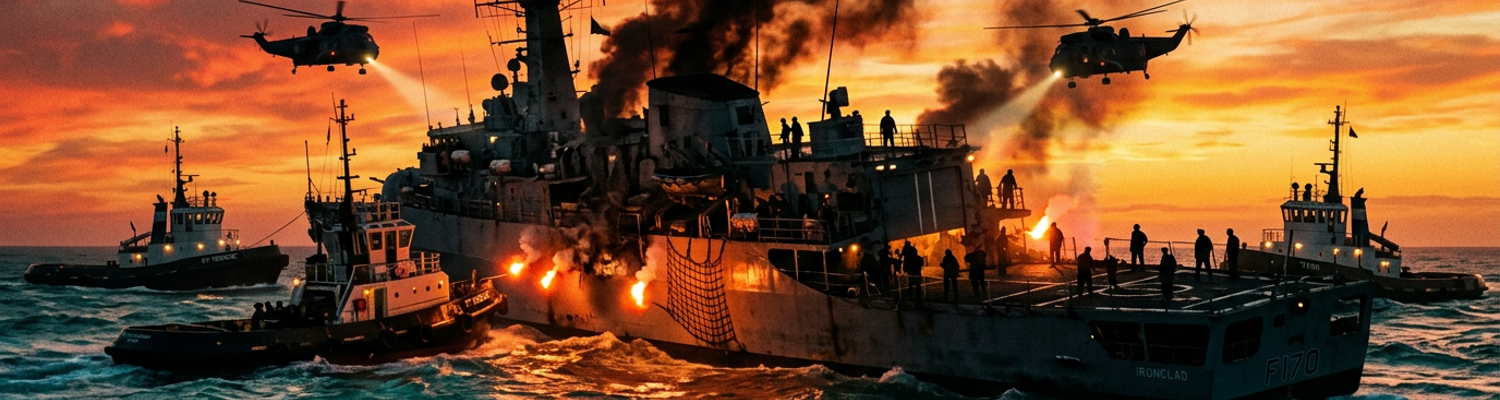
Sailors prevented a catastrophic magazine detonation by counterflooding starboard ballast tanks to level the ship and cooling the missile storage areas with continuous streams of seawater. Commander Glenn R Brindel coordinated with neighboring United States Navy and allied regional vessels to organize medical evacuations for dozens of wounded sailors while search teams recovered thirty seven dead crewmen from the scorched interior. Support ships and commercial tugboats pulled alongside the crippled frigate by morning to supply auxiliary power, salvage pumps, and specialized firefighting foam to extinguish the stubborn embers. The surviving crew managed to control the progressive flooding and secure the cracked bulkheads, keeping Stark afloat under its own buoyancy until fleet tugs could tow the scorched frigate into port at Bahrain.
Firefighters and Shipboard Damage Control
Towlines secured by salvage tugs hauled Stark toward Bahrain while damage control teams deep within the forward hull struggled to contain an escalating thermal disaster that threatened to break the vessel apart. Unspent solid rocket fuel from the first Exocet missile had soaked into mattresses, clothing, lockers, and paper records across both the chief petty officer quarters and the main enlisted berthing spaces. Ignited missile propellant produced an inferno exceeding 3,500 degrees Fahrenheit, melting aluminum bulkheads and destroying primary shipboard electrical lines. Streams of liquefied aluminum ran down warped ladders into lower passageways, pooling on deck plates and igniting secondary blazes that raced through wiring runs, combat systems equipment spaces, and administrative offices. Structural supports throughout frames 100 to 110 softened and buckled under the searing heat, causing upper deck plates to sag toward the burning sleeping compartments below. Dense, oily smoke heavy with hydrogen cyanide and carbon monoxide poured upward into the interior of the ship, choking off escape routes and cutting off the forward compartments from the rest of the vessel.
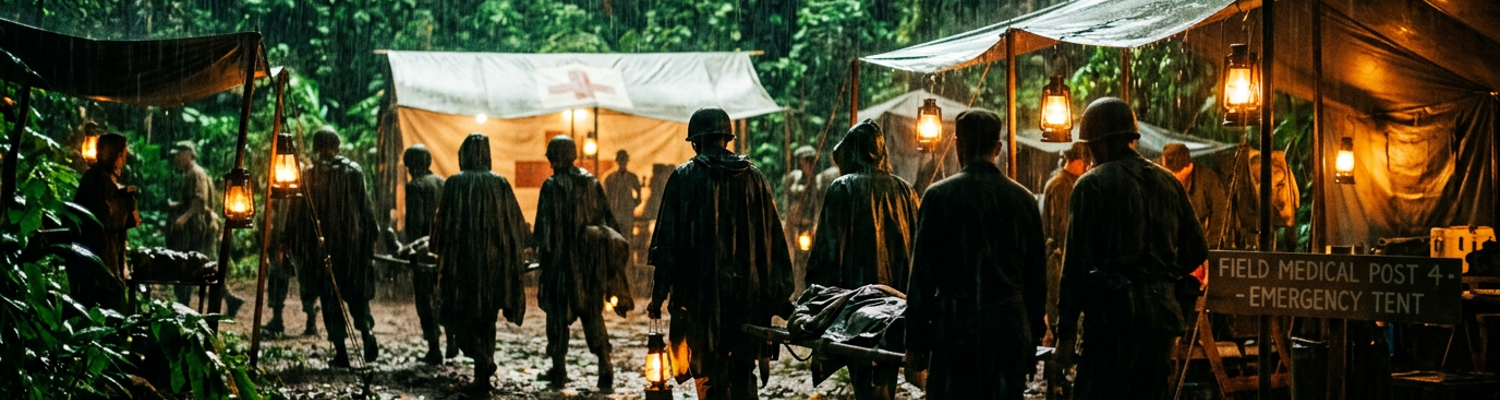
Firefighters plunged into these isolated forward compartments wearing oxygen breathing apparatuses to establish fire boundaries against the spreading heat. Emergency battle lanterns failed throughout the forward section, forcing damage control parties to battle suffocating toxic fumes in complete darkness to save the listing vessel. Intense heat had melted the plastic casings and severed the internal battery connections of the wall mounted lights, leaving repair crews with no visual references inside the smoke clogged corridors. Sailors crawled forward on hands and knees across scorching deck plates, navigating entirely by touch along blistered bulkhead seams and scorched pipe runs. Heavy rubber hoses repeatedly snagged on mangled aluminum ladders and fallen overhead cable trays, forcing crews to haul hundreds of pounds of water filled lines forward through narrow scuttles by sheer physical effort. Chemical canisters inside their breathing gear heated rapidly from the surrounding air, scorching the throats of the nozzle teams and causing several firefighters to collapse from acute heat exhaustion.
Crewmen carried their unconscious shipmates up vertical access trunks to the weather deck before rotating back down into the suffocating darkness with fresh breathing canisters. Water pumped into the burning forward spaces had accumulated rapidly alongside seawater surging through the hull breach, pushing the frigate into a critical sixteen degree port list that brought the main deck edge dangerously close to the surface of the Persian Gulf. Damage control officers ordered the emergency rigging of portable P-250 gasoline driven pumps along the exterior decks to suck thousands of gallons of firefighting water out of the flooded berthing compartments. Sailors wrestled heavy suction hoses down cramped ladderwells, battling noxious fumes from the portable engine exhausts while guiding discharge lines over the starboard side. Starboard fuel and water ballast tanks were systematically counterflooded by engineering watchstanders, gradually reducing the severe tilt of the hull and preventing a catastrophic progressive capsizing.
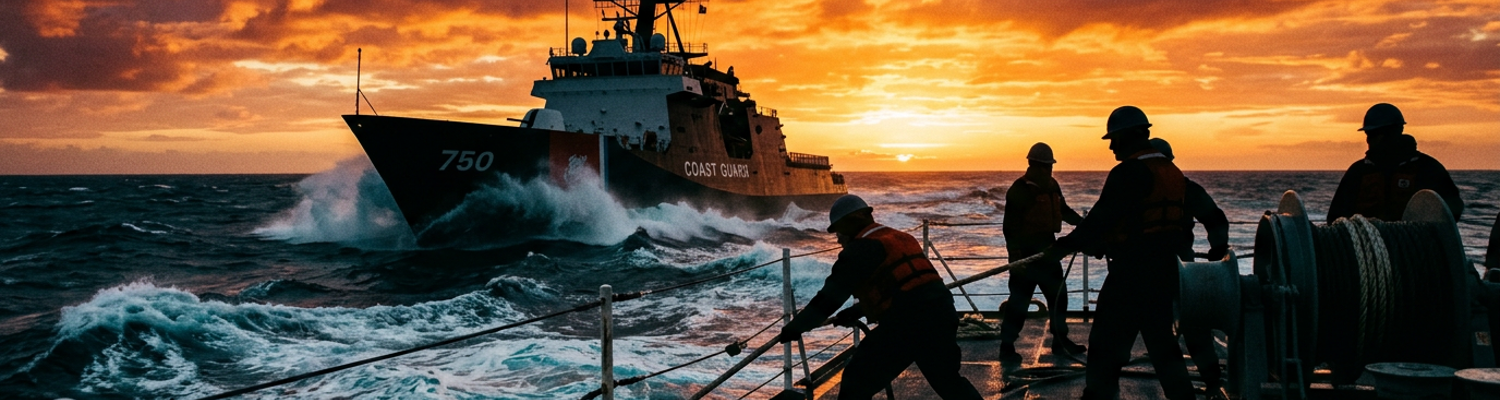
Sailors used the restored stability of the hull to move heavy timber beams into the buckled passageways bordering the forward weapons spaces. Hose teams maintained a continuous spray of seawater against the forward bulkhead of the Mark 13 missile magazine, cooling the steel barrier that separated the raging berthing fire from dozens of live Standard and Harpoon missiles. Hull technicians wedged heavy Douglas fir timbers against weeping bulkheads, using wedges and mauls to brace fractured frame members against the relentless hydraulic pressure of the sea. Relief crews from nearby American warships, including the destroyer USS Conyngham, crossed over to deliver extra oxygen canisters, submersible pumps, and specialized firefighting foam to suppress the stubborn deep seated embers. Exhausted sailors finally extinguished the last open flames after twenty hours of continuous close range combat inside the charred compartments, leaving the shattered frigate securely stabilized in the towlines of the fleet tugs entering the approaches to Bahrain.
Helicopters and Bahrain Medical Evacuations
Sailors pried open the warped steel hatches of the forward berthing spaces as the frigate glided behind the salvage tugs into Bahraini coastal waters. Shipboard hospital corpsmen conducted harrowing blind triage in charred passageways, where survival was dictated by assigned bunk tier elevations. Personnel assigned to the upper bunk tiers near the overhead had absorbed temperatures exceeding three thousand degrees, dying instantly as superheated gases swept along the deck ceilings. Crewmen occupying the lower and middle racks had escaped the direct firestorm along the overhead, but the concussive shock wave of the second Exocet detonation pinned them beneath collapsed aluminum frames and crushed metal lockers. Corpsmen crawled on hands and knees through pools of oily firefighting runoff and liquefied wire insulation, using surgical shears to cut away melted clothing while feeling through the soot for carotid pulses. Stretcher parties loaded survivors onto wire mesh Stokes litters and hauled them through narrow scuttles up to the weather deck.
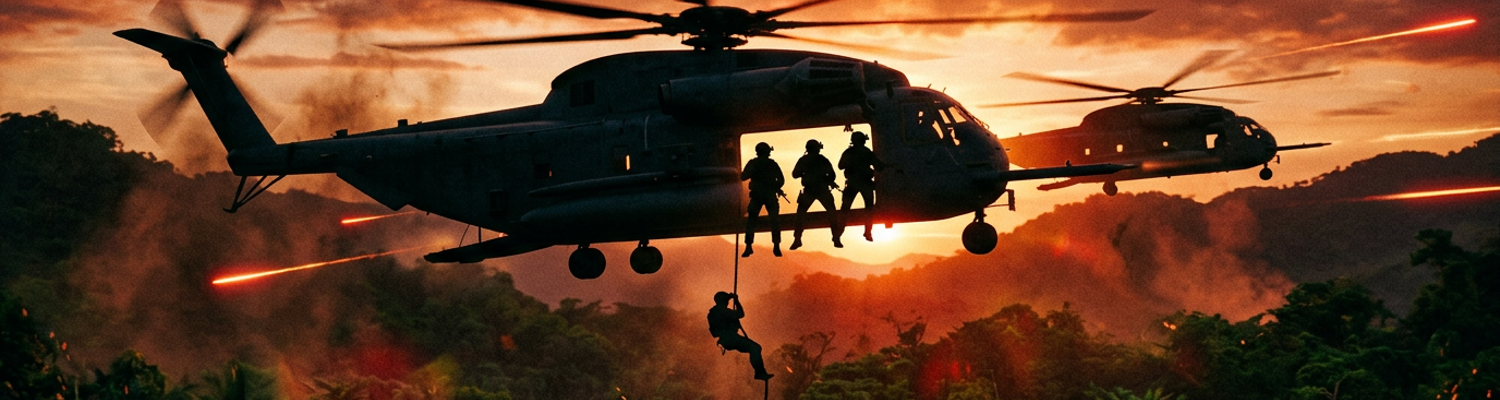
Crewmen positioned wire litters across the flight deck to establish an emergency casualty staging area beneath the smoking helicopter hangar. Thirty seven American sailors lost their lives, while twenty one severely wounded personnel were medevaced under magnesium illumination flares to medical facilities in Bahrain. Support ships and regional patrol aircraft dropped parachute flares across the sea, casting a harsh white light over the water to guide incoming rescue helicopters through the thick smoke pouring from the frigate. Navy pilots maneuvered twin rotor CH-46 Sea Knight and SH-3 Sea King helicopters onto the rolling flight deck, keeping rotors turning while rotor wash battered the medical teams securing each patient. Corpsmen administered intravenous saline and packed deep flash burns with sterile dressings before lifting each wounded sailor into the helicopter cabins. Aircraft took off in rapid rotation into the night, flying west across the Persian Gulf toward Bahraini airfields.
Ambulances lined the tarmac at Bahrain International Airport as the evacuation helicopters touched down in rapid succession. Bahraini health officials and American naval medical personnel mobilized every available surgeon, nurse, and trauma technician across the island to treat the incoming casualties. Medical teams transported the most critically injured sailors to Salmaniya Medical Complex in Manama, where emergency rooms converted immediately into specialized burn units. Physicians performed emergency tracheotomies on sailors whose airways had swollen shut from inhaling toxic hydrogen cyanide and vaporized aluminum fumes. Surgical teams applied topical antimicrobials and wrapped extensive second degree and third degree burns, battling acute fluid loss and shock throughout the early morning. Hospital staff administered blood plasma and heavy doses of antibiotics, stabilizing the wounded crewmen through continuous bedside monitoring.
Aircraft from the United States Air Force touched down in Bahrain to prepare the stabilized casualties for long range evacuation to specialized military trauma centers. Flight surgeons evaluated each sailor to verify that heart rates, blood pressure, and respiratory stability could withstand high altitude flight across the Mediterranean. Ground crews loaded specialized litter systems and oxygen manifolds onto Lockheed C-141 Starlifter transport planes, transferring the burn patients from Bahraini hospital ambulances directly into the cargo bays. Pilots took off from the island runway on direct flight paths toward Landstuhl Regional Medical Center in West Germany and Brooke Army Medical Center in San Antonio, Texas. Naval officers and salvage engineers remained behind on the pier in Bahrain to oversee the arrival of the blackened frigate and secure the bodies of the fallen sailors remaining inside the hull.
Diplomats and Reagan Administration Maneuvering
Aluminum transfer cases containing the remains of the crew moved from the Bahrain tarmac toward Dover Air Force Base while urgent diplomatic cables flooded the White House Situation Room. Physical evidence from the wreckage forced the National Security Council into emergency sessions to determine how to manage an unprovoked attack from a government that Washington quietly favored in the land war. Iraqi President Saddam Hussein acted quickly to contain the crisis by dispatching a formal letter directly to the Oval Office expressing deep regret for the tragic incident. President Ronald Reagan accepted the formal apology and explanation of accidental mistaken identity, steering American diplomatic fury toward Iran instead of Baghdad. Administration officials calculated that retaliating against Iraq would fracture their regional partnerships and risk handing Ayatollah Ruhollah Khomeini a decisive victory in the ground war.
Secretary of State George Shultz stepped before press microphones in Washington to reframe the attack as direct proof that Iranian belligerence was the true threat to Persian Gulf commerce. Shultz argued that Iraqi pilots operated under extreme combat strain produced entirely by Tehran refusal to accept United Nations ceasefire initiatives. Defense Secretary Caspar Weinberger reinforced this diplomatic campaign by showing congressional committees intelligence reports of Iranian Revolutionary Guard speedboats laying contact mines near commercial channels. Lawmakers on Capitol Hill questioned the administration decision to excuse an Iraqi pilot who had launched two anti ship missiles at an American warship, demanding formal investigations and financial restitution. Reagan answered these legislative challenges by dispatching senior State Department negotiators to Baghdad to secure binding commitments on financial liability and future military communication protocols. Iraqi foreign ministry officials agreed in principle to establish direct naval coordination lines with American forces and provide full monetary reparations for the casualties aboard the frigate.
Diplomats from both nations spent months working through financial formulas in Washington to settle the monetary claims without submitting the dispute to international arbitration. Legal teams compiled employment records, survivor dependency statements, and medical evaluations for every crew member killed or wounded inside the charred forward compartments. The diplomatic resolution led to a 27.3 million dollar bilateral compensation settlement paid by Iraq to the families of the thirty seven fallen sailors. Cash wire transfers processed through the Department of State delivered individual allocations to surviving spouses, dependent children, and parents based on rank and active duty pay scales. Iraqi representatives simultaneously resisted American demands to cover the multi million dollar drydock repair costs needed to rebuild the structural frames of the frigate itself. State Department officials chose not to disrupt the broader naval mission by pressing the property claim, leaving the repair costs to the United States Navy so that diplomatic attention stayed locked on the shipping lanes.
President Ronald Reagan ordered the Joint Chiefs of Staff to finalize operational plans for Operation Earnest Will, placing eleven Kuwaiti oil tankers under American flags and direct naval escort. Naval commanders immediately replaced their passive peacetime standing orders with aggressive combat rules of engagement that authorized surface captains to destroy incoming aircraft or vessels displaying hostile intent. Guided missile cruisers and destroyers steamed through the Strait of Hormuz to establish forward anti air defense zones, pointing their target tracking radars at Iranian fighter bases around Bandar Abbas. Combat information centers across the fleet placed standard surface to air missiles on automated guide rails to engage suspicious radar blips before any hostile weapon could be launched. Pentagon planners repositioned aircraft carrier battle groups into the northern Arabian Sea, scheduling round the clock aerial patrols along the merchant shipping corridors. American warships took up tactical stations along the Kuwaiti transit routes, training their primary weapon systems eastward toward Iranian coastal missile batteries.
Lawmakers and the War Powers Resolution
Senator Sam Nunn examined fleet deployment charts inside the Capitol and warned that tracking foreign combat radars meant American crews were entering imminent hostilities. The attack ignited fierce bipartisan debates on Capitol Hill over whether United States naval deployments in the Persian Gulf required formal invocation of the 1973 War Powers Resolution. Reagan administration officials argued that the planned convoy missions were routine navigation patrols in international waters rather than armed combat operations. Democratic leaders and Republican critics countered that thirty seven dead sailors proved the waterway was an active combat zone where hostile fire was a daily reality. Lawmakers insisted that Section 4 of the statute mandated a formal report from the White House, which would trigger a strict sixty day limit on the deployment unless Congress authorized an extension. Administration attorneys refused to file the report, prompting more than one hundred representatives to prepare federal court challenges while legislative committees scheduled immediate oversight proceedings.
Representative Les Aspin opened formal inquiry sessions before the House Armed Services Committee to examine how a modern frigate could be disabled by two missiles. Congressional committees initiated stringent oversight hearings into Navy operational readiness, rules of engagement ambiguities, and regional Foreign Military Sales programs. Naval officers faced intense questioning over why the Phalanx Close In Weapon System aboard Stark sat in manual standby and why shipboard air search radars failed to detect the approaching Mirage until it reached close range. Admirals testified that surface combatants suffered from maintenance backlogs and insufficient training for close quarters anti ship missile defense in crowded coastal waters. Committee members focused heavily on rules of engagement ambiguities that instructed captains to respect regional combatants while simultaneously directing them to defend their vessels against hostile intent. Witness testimony revealed that these conflicting directives left shipboard tactical action officers hesitant to activate fire control radars until inbound missiles were already in flight.
Senator Claiborne Pell expanded the inquiry inside the Senate Foreign Relations Committee to inspect how regional Foreign Military Sales programs influenced the naval balance in the gulf. Senators questioned Pentagon and State Department officials about multi million dollar arms packages containing Stinger anti aircraft missiles, Maverick air to ground missiles, and advanced radar equipment destined for Persian Gulf states. Lawmakers argued that flooding the region with modern weapons increased the hazard to American crews, especially if allied Arab air forces failed to share real time reconnaissance data. Legislative opposition forced the White House to withdraw proposed sales of shoulder fired anti aircraft missiles to regional buyers and attach strict conditions to future arms transfers. Committee members demanded that Arab partners provide emergency landing rights, air cover, and minesweeping assistance before receiving approved military hardware shipments.
Senators Dale Bumpers and Mark Hatfield sponsored floor amendments to block naval appropriations for the tanker reflagging mission until regional allies met those conditions. House members introduced companion legislation to delay Operation Earnest Will, while federal judges agreed to hear arguments in a lawsuit brought by one hundred ten lawmakers seeking to compel compliance with the War Powers Resolution. Administration supporters worked the congressional cloakrooms through June and July, peeling away enough votes to prevent a veto proof legislative cutoff of military funding. Federal courts ultimately declined to intervene in the constitutional separation of powers dispute, leaving the White House free to move forward without statutory authorization. Pentagon commanders acted on that legal opening by ordering the guided missile cruiser USS Fox and two destroyers to weigh anchor at Bahrain and escort the first convoy of reflagged Kuwaiti tankers into the Strait of Hormuz.
Minesweepers and Operation Earnest Will
Cruiser USS Fox took station ahead of the freshly repainted supertanker Bridgeton as the first convoy formed to test Iranian resolve. Rather than withdrawing, the Reagan administration expanded the Navy regional presence by formally initiating Operation Earnest Will to reflag and escort Kuwaiti tankers. Sailors aboard the escort vessels scanned the choppy brown water for floating mines and small skiffs while the three hundred thousand ton tanker pushed past Farsi Island. Contact mines laid by Iranian motorboats tore through the outer hull plating of Bridgeton south of Kuwait, punching a massive hole beneath the waterline without sinking the ship. Navy combatants lacked organic minesweepers in the Persian Gulf, forcing the damaged supertanker to take the lead position and shield the fragile warships behind its double bottom.
Seamen aboard the trailing warships observed the tanker heavy wake while fleet commanders scrambled to close the glaring operational gap. Navy leaders deployed towed wooden hulled minesweepers and airlifted RH-53D Sea Stallion helicopters to locate moored M-08 contact mines across the commercial channels. Special Operations commandos moved onto converted oil service barges anchored in international waters, launching armed MH-6 Little Bird helicopters and patrol craft on night ambushes against Iranian minelaying boats. Army aviators flying from the mobile sea base Hercules intercepted the Iranian amphibious ship Iran Ajr in September 1987, catching its crew in the act of dropping fresh naval mines into the dark shipping lanes. Navy SEAL teams boarded the disabled minelayer, seized Iranian logbooks and explosive ordnance, and scuttled the vessel after gathering undeniable photographic proof of covert mining operations.
Logbooks seized aboard the scuttled vessel proved Iranian culpability before the United Nations, yet Revolutionary Guard gunboats continued attacking unescorted commercial freighters with rocket propelled grenades. Frigate USS Samuel B Roberts entered the central Persian Gulf in April 1988, guiding merchant ships through swept channels where Iranian speedboats routinely laid covert mine lines. Hull technicians aboard Samuel B Roberts spotted three underwater contact mines floating near its path on April 14, prompting the captain to order an immediate reverse of the ship engines. Detonation of a submerged Iranian mine broke the frigate keel, flooded the main engine space, and started raging fires that nearly tore the warship in half. Crew members fought toxic smoke and rising water for seven hours to install jury rigged steel cables around the fractured hull, saving the ship before salvage tugs arrived.
Divers recovered serial numbers from unexploded mines in the surrounding field to prove Iranian manufacture while fleet tugs towed the broken frigate into drydock. The expanded naval posture directly deepened American military commitment in the Persian Gulf, precipitating Operation Praying Mantis in April 1988. Surface action groups built around guided missile cruisers and destroyers steamed toward the southern Persian Gulf at dawn on April 18, targeting armed Iranian oil platforms that served as military staging bases. Naval gunfire destroyed the Sassan and Sirri platform complexes before American carrier strike jets from USS Enterprise joined the battle to defeat attacking Iranian naval vessels. Airstrikes and Harpoon missile salvos sank the Iranian fast attack craft Joshan and the frigate Sahand, while crippling the frigate Sabalan in the largest surface naval engagement fought by the United States Navy since World War II. American surface forces withdrew to their patrol lines along the Kuwaiti shipping channels, leaving burning warships and shattered offshore platforms smoking across the southern gulf.