
French Air Support Requests
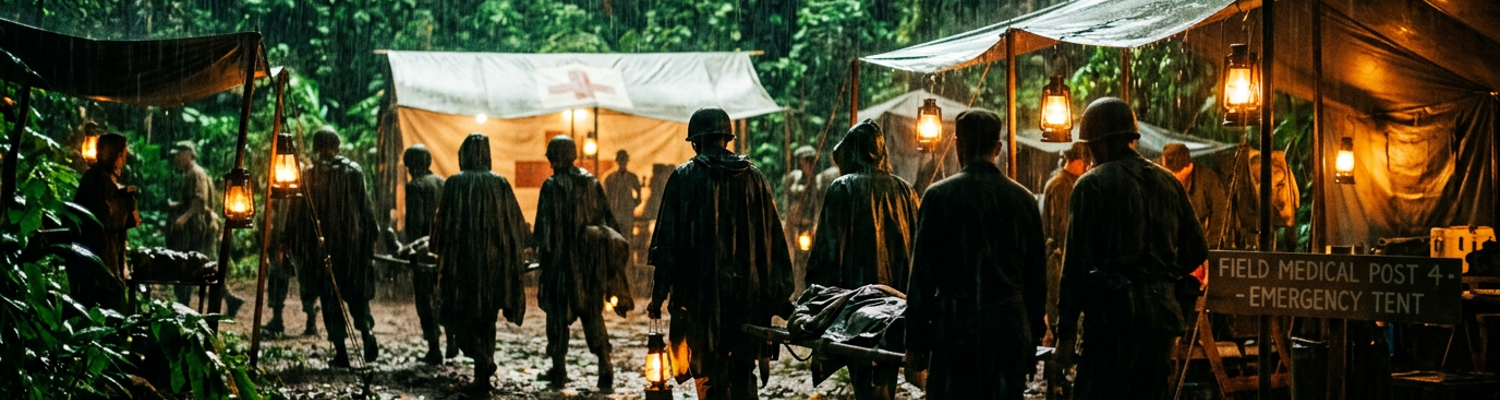
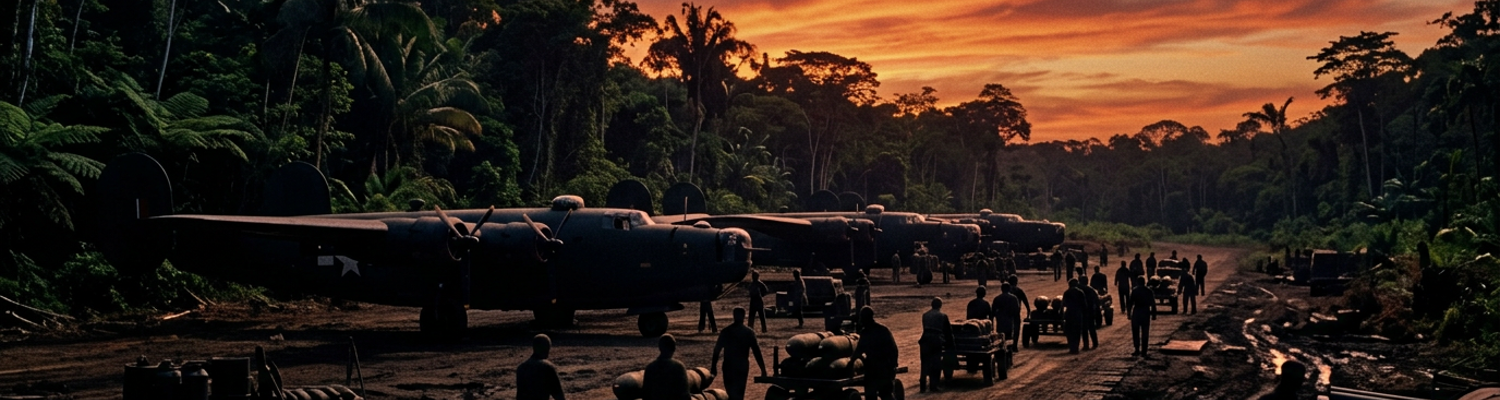
Douglas C-47 Skytrain transport planes and Fairchild C-119 cargo aircraft rattled under intense ground fire as their crews pushed pallets of ammunition and medical crates out of open side doors over northwestern Vietnam. Ground crews inside the French garrison scrambled between fresh shell craters to drag the supplies into fortified bunkers while mechanics worked with hand tools to repair shrapnel holes in the landing gear of damaged planes. General Vo Nguyen Giap directed his Viet Minh forces to completely surround the garrison in the Muong Thanh valley with camouflaged heavy artillery and anti aircraft weapons. Crews of Viet Minh soldiers dragged Soviet supplied thirty seven millimeter anti aircraft guns and American made 105 millimeter howitzers captured in Korea up steep mountain slopes by hand. Infantrymen concealed these heavy weapons inside deep caves that French counter battery fire could not reach. Constant artillery barrages pulverized French command posts, crushed the garrison field hospital, and tore deep trenches across the gravel airstrip, ending all routine aircraft landings and medical evacuations by late March.
Runway craters and burning transport hulls convinced the French government that conventional colonial airpower could no longer break the siege. French Chief of Staff General Paul Ely traveled to Washington in March 1954 to urgently request direct American aerial intervention to relieve French Union forces at Dien Bien Phu. General Ely met behind closed doors with Admiral Arthur Radford, the Chairman of the Joint Chiefs of Staff, to describe how artillery fire was systematically destroying French defenses. Admiral Radford responded by presenting the operational outline for Operation Vulture, a plan to send dozens of American Boeing B-29 Superfortress bombers from bases in the Philippines alongside carrier aircraft from the Seventh Fleet to execute heavy conventional air raids against Viet Minh gun positions around the valley. General Ely seized on this military proposal as the sole remaining tactical option to suppress enemy flak batteries and reopen the air route into the valley.
President Dwight D Eisenhower studied the air strike proposal at the White House with deep caution, refusing to commit American military power based solely on French desperation. Eisenhower remembered the bloody stalemate of the Korean War and insisted that the United States would not intervene without strict political and military conditions. Secretary of State John Foster Dulles convened a secret meeting on April 3 with eight key congressional leaders, including Senate Minority Leader Lyndon B Johnson, to test whether lawmakers would support a joint congressional resolution authorizing air strikes. Congressional leaders questioned the military feasibility of air strikes alone, asking the administration whether bombing would require the eventual commitment of American ground troops to secure the area if the air strikes failed. Lawmakers stated firmly that they would not approve American involvement unless Great Britain and other regional allies agreed to join a collective military coalition.
Winston Churchill rejected the proposed coalition immediately when Secretary Dulles flew to London to request British participation. Churchill and Foreign Secretary Anthony Eden argued that air strikes would not save the garrison and warned that intervention could trigger a direct military conflict with Communist China right before the scheduled peace talks in Geneva. Naval strike groups from the United States Seventh Fleet continued their combat drills in the South China Sea, yet their carrier pilots received no combat orders as London held firm against intervention. General Ely returned to Paris without an American commitment to launch Operation Vulture, leaving the isolated French garrison in the Muong Thanh valley to absorb continuous artillery fire without foreign air support.
Strategic Strike Planning and Operation Vulture
Artillery craters widened across the French perimeter as Chairman of the Joint Chiefs of Staff Admiral Arthur Radford and Air Force Chief of Staff General Nathan Twining drafted the contingency plan known as Operation Vulture behind closed doors in the Pentagon. Both commanders believed that decisive airpower could break the siege and alter the political balance across Southeast Asia before international diplomats gathered in Geneva. The operational concept weighed massive conventional saturation bombing by approximately sixty B-29 Superfortresses against the contingency deployment of up to three tactical atomic bombs. Staging sixty B-29 bombers out of Clark Air Base in the Philippines required ground crews to service banks of heavy Wright R-3350 radial engines and stockpile thousands of general purpose bombs on coastal docks. Flight navigators calculated that nighttime runs over the jagged mountain ridges around Dien Bien Phu would demand precise radar coordination to prevent midair collisions in dense cloud layers. Bombardiers faced extreme difficulty distinguishing camouflaged Viet Minh artillery caves from French frontline trenches nestled only hundreds of yards away across the valley floor.
Warheads of up to three tactical atomic bombs entered the operational discussions as General Twining advocated dropping them on Viet Minh supply routes and mountain artillery emplacements despite the lethal hazard those explosions posed to the surrounding French trenches. Air Force planners argued that atomic weapons dropped from medium altitude would instantly blast through mountain caves, neutralize enemy anti aircraft gunners, and relieve the trapped garrison in a single afternoon. Technicians in the Special Weapons Command drafted contingency flight profiles for the bombers, calculating that the heat and radiation from three nuclear blasts would scorch square miles of jungle terrain. Admiral Radford supported this atomic option as a necessary military measure to halt communist expansion across Indochina, viewing the battlefield through the lens of worldwide containment. French diplomats expressed immediate horror at the prospect of atomic weapons falling so close to their own garrison, realizing that American air strikes might destroy the very troops they were intended to rescue.
General Matthew Ridgway shared the alarm of French officials and challenged the strategic logic of Operation Vulture as soon as Radford presented the strike options to the Joint Chiefs of Staff. Ridgway dispatched a team of military engineers and logistics experts to Indochina to inspect the physical terrain, harbor facilities, and roadway networks throughout the combat zone. Inspectors reported back that air strikes alone, whether conventional or atomic, could not decisively defeat Viet Minh forces sheltered within deep karst caverns and dense jungle canopy. The field report concluded that American air intervention would inevitably require the commitment of seven to ten army divisions, plunging the United States into another bloody ground war across rugged Asian terrain that lacked modern ports or airfields. Ridgway carried these sobering engineering assessments straight to the Oval Office to counter the airpower arguments presented by Radford.
Eisenhower reviewed the logistical findings, locked the operational drafts for Operation Vulture away, and refused to order either conventional saturation bombing or tactical atomic strikes. President Eisenhower recognized that intervening without British alliance support and congressional authorization would isolate the United States diplomatically and draw the nation into an endless land conflict. Secretary of State John Foster Dulles shifted American diplomatic policy toward building a future regional defense pact rather than attempting a last minute tactical rescue in the Muong Thanh valley. Flight crews at Clark Air Base shut down the engines of their B-29 Superfortresses, while carrier pilots aboard the USS Essex and USS Boxer in the South China Sea returned their flight gear to lockers without receiving strike orders. Viet Minh infantry squads launched their final assaults through the shattered French trenches at Dien Bien Phu on May 7, overrunning the central command bunker and taking thousands of French Union soldiers prisoner.
Technical Constraints of Far East Air Forces
Prisoners stumbled past burning French bunkers into captivity because American air commanders had already discovered that their bombers could not overcome the extreme physical geography of northwestern Vietnam. Flight technicians and navigators dispatched by the Far East Air Forces studied aerial reconnaissance film of the Muong Thanh basin, discovering that steep cliffs rising thousands of feet above the valley floor masked incoming strike formations and threw off aircraft guidance systems. Joint Strategic Plans Committee and Far East Air Forces planners determined that all weather target marking was nearly impossible amid the dense limestone crags of the valley. Ground observers could not deploy radio homing beacons or smoke markers along the high karst ridges without being spotted and killed by enemy patrols. Radar scopes aboard Boeing B-29 bombers picked up severe ground clutter from the vertical stone walls, turning electronic returns into scrambled patterns that prevented flight crews from pinpointing camouflaged artillery caves. Navigation officers warned that any ordnance released through the heavy spring cloud cover would scatter across several square miles of rugged jungle rather than striking enemy gun emplacements.
Viet Minh gunners dug their heavy weapons deep into hillside caves to survive whatever stray bombs managed to penetrate the mountain fog. Entrenched Viet Minh 37mm anti aircraft batteries negated low altitude tactical sorties and rendered high altitude night bombing largely ineffective without risking friendly French positions. Twin barrel and single barrel automatic cannons ringed the entire valley, firing explosive shells into every clear flight corridor below five thousand feet. French pilots flying Grumman F8F Bearcats and Douglas AD-4 Skyraiders had already suffered catastrophic losses whenever they dove beneath the cloud base to strafe enemy positions, proving to American planners that low level tactical runs in larger B-26 bombers would result in heavy aircraft losses. High altitude bombers climbing above the flak ceiling faced the opposite dilemma, as ballistic dispersion from twenty thousand feet meant that unguided iron bombs would fall directly onto French command posts clustered around the central airstrip. Ballistic calculations proved that dropping hundreds of tons of high explosives from high altitude would inevitably crush the French defensive perimeter before destroying the enemy guns.
Bomb racks loaded with thousands of general purpose munitions could not solve this accuracy problem, prompting Far East Air Forces planners to analyze whether cutting supply lines along the border could cut off ammunition and replacement parts for the artillery instead. Munitions experts calculated that destroying the reinforced mountain roads leading toward the Chinese border would require continuous round the clock bombardment by dozens of heavy aircraft over several weeks. Staging such an offensive from Clark Air Base required each Superfortress to fly a round trip of over two thousand miles across the South China Sea, burning immense quantities of aviation gasoline and straining maintenance crews who lacked forward operating facilities in Indochina. French airfields at Tourane and Cat Bi lacked the lengthened concrete runways, heavy duty taxiways, and underground fuel storage systems necessary to support fully loaded American four engine bombers. Monsoon rains softened the unpaved dispersal areas at regional fields, threatening to trap fifty ton bombers in deep mud if emergency landings became necessary during bad weather.
General Earle Partridge forwarded these dismal engineering and ballistics reports to the Pentagon, detailing why technical limitations prevented airpower from lifting the siege. Pentagon planners reviewed the flight telemetry, radar field evaluations, and flak density maps, realizing that no amount of aerial tonnage could reverse the tactical reality on the ground without killing the French soldiers trapped in the valley. Admiral Radford and Air Force Chief of Staff General Nathan Twining faced overwhelming evidence from their own operational commands that an air strike would fail to suppress Viet Minh artillery before the garrison was overrun. President Eisenhower used these detailed technical assessments to reject unilateral military intervention and maintain his demand for strict congressional and allied approval. Maintenance crews in the Philippines lowered the bomb bay doors of their B-29s, unloaded the unfused conventional ordnance onto transport skids, and pushed the aircraft back into perimeter revetments.
Congressional Demands and Political Conditions
Transport skids sat loaded with heavy munitions across Far East airfields because President Dwight D Eisenhower mandated that any American military intervention must satisfy strict conditions, including formal congressional authorization and multilateral allied participation. Eisenhower remembered the heavy political costs of the Korean conflict and insisted that the executive branch would never send American forces into combat through unilateral presidential decrees. The president established three non negotiable requirements before considering combat action. France had to grant full independence to the Associated States of Indochina, Congress had to pass a formal joint resolution authorizing the deployment, and regional allies had to contribute ground forces to a shared coalition. American ground troops could not be committed to a conflict that appeared to defend French colonial interests, nor could carrier wings and heavy bombers operate without clear legal backing from Capitol Hill. Chairman of the Joint Chiefs of Staff Admiral Arthur Radford sought to satisfy these political hurdles by convincing senior diplomats that an air strike could succeed without risking an expanded ground war, carrying operational bombing charts directly to the State Department to organize an emergency briefing for congressional leaders.
Lyndon B Johnson walked into a private State Department conference room alongside seven fellow congressional leaders on April 3, 1954, to review the administration strike proposals. Dulles opened the classified consultation by warning that the fall of Dien Bien Phu could cause the rapid collapse of Southeast Asia and asked the bipartisan group to sponsor a joint resolution giving the president authority to deploy naval air wings and bombers. Radford placed military situation maps on display easels and explained how two hundred carrier based aircraft from the South China Sea could bomb Viet Minh trenches to save the trapped French forces. General Vo Nguyen Giap and his forces occupied central points on the maps, but Radford could not reassure the lawmakers that an aerial rescue would succeed without eventually landing American infantry to secure the surrounding airfields. Questions from the assembled legislators quickly targeted the tactical feasibility of the strike and exposed deep fractures within the Joint Chiefs of Staff.
Johnson pressed Radford immediately on whether the other military service chiefs endorsed the proposed air strikes, forcing the admiral to admit that Army Chief of Staff General Matthew Ridgway strongly opposed the operation. House Minority Whip John McCormack joined Johnson in warning that the American public would never accept another open ended conflict in Asia if the United States entered the battle alone. The legislators demanded to know whether Dulles had consulted European partners, forcing the secretary of state to confess that he had not yet approached the British government for military assistance. Johnson informed Dulles and Radford that Congress would not consider a war resolution until the White House obtained firm allied commitments to provide ground units and naval forces.
Dulles returned to the White House that afternoon to report to Eisenhower that the legislative leadership had rejected any unilateral military action. Eisenhower agreed with the congressional decision and reinforced his instructions that no American warplanes would launch against Dien Bien Phu without British participation. Couriers dispatched urgent cables to the American embassy in London, directing diplomats to press Prime Minister Winston Churchill for British involvement in a multinational coalition. British leaders had already decided against military entanglement in Indochina, leaving American combat aircraft tied to their airfields while the siege entered its final weeks. Tactical planning folders for Operation Vulture remained locked inside Pentagon safes as diplomats prepared for the upcoming Geneva peace conference without American air support for the French garrison.
British Diplomatic Rejection and Coalition Failure
Folders containing the strike plans stayed locked in Washington while Secretary of State John Foster Dulles sought to build a multinational coalition under the doctrine of United Action during emergency diplomatic missions to London and Paris. Dulles carried detailed diplomatic drafts designed to unite the United States, Great Britain, France, Australia, New Zealand, and regional Southeast Asian partners into a collective defense organization modeled after NATO. Dulles landed first at Paris Orly Airport on April 11 to confer with French Premier Joseph Laniel and Foreign Minister Georges Bidault, who were desperate for American heavy bombers to smash the Viet Minh siege lines. French commanders argued that a rapid aerial rescue could still save the surrounded garrison in the valley, but Dulles delivered a firm political reality check to the French cabinet. Dulles explained that the United States would not commit combat aircraft alone to defend French colonial holdings and insisted that direct military assistance required France to grant full independence to Vietnam, Laos, and Cambodia while welcoming British ground and naval forces into a shared theater command. French officials agreed in principle to study collective defense arrangements, allowing Dulles to cross the English Channel to present the United Action proposal directly to the British government at Downing Street.
British Prime Minister Winston Churchill and Foreign Secretary Anthony Eden formally rejected participation, fearing the intervention would trigger Chinese retaliation and escalate into global war. Eden received Dulles at the Foreign Office and flatly stated that military action would destroy the diplomatic possibilities of the upcoming Geneva peace conference. British military intelligence assessments warned that tactical air strikes would fail to lift the siege anyway, while bombing runs near the Chinese frontier risked drawing Western forces into another catastrophic ground conflict like the Korean War. Churchill warned his cabinet and American visitors that strikes on northern Vietnam could easily provoke Chinese air and ground counterattacks against vulnerable British holdings in Hong Kong, Singapore, and Malaya. Churchill maintained that the British public and parliament would never accept military entanglement in Indochina to rescue a miscalculated French colonial position on the battlefield. Eden insisted on giving diplomacy an honest trial at Geneva and refused to sign any joint declaration that committed British forces to combat operations in Indochina.
Eden held to this unyielding position throughout three days of emergency meetings at the Foreign Office, effectively crushing American hopes for a multinational allied front. Dulles boarded his military transport plane back to Washington on April 14 with nothing more than an ambiguous British promise to examine long term security concepts after the Geneva peace talks concluded. President Dwight D Eisenhower reviewed the cables from London and reaffirmed that the United States would not deploy carrier wings, heavy bombers, or ground forces to Indochina without full British participation. Senate Minority Leader Lyndon B Johnson and key congressional leaders learned of the formal refusal from Eden and immediately buried any consideration of a joint resolution authorizing presidential war powers. Admiral Arthur Radford conceded behind closed doors at the Pentagon that the collapse of United Action ended every realistic scenario for executing Operation Vulture. American carrier task groups in the South China Sea remained restricted to routine training maneuvers, leaving the exhausted French Union garrison at Dien Bien Phu to fight through its final days without allied air support.
Garrison Surrender and the Geneva Accords
Soldiers of the French Union garrison burned their cipher books and fired their final machine gun belts from collapsed trenches as Viet Minh assault teams breached the central position. The French garrison at Dien Bien Phu surrendered on May 7, 1954, following the final collapse of Operation Vulture and Western intervention plans. Viet Minh infantrymen charged across the Bailey bridge over the Nam Yum River, climbed onto the roof of the central command post, and hoisted their red flag over the bunker. General Vo Nguyen Giap directed his field commanders to take more than eleven thousand French Union prisoners, marching captured officers, paratroopers, and legionnaires away into the jungle in long columns. Telegraph lines carried news of the fortress falling directly to European capitals, ending the remaining political support for the Indochina war across France.
Deputies in the French National Assembly voted to remove the cabinet of Premier Joseph Laniel within weeks of the battlefield disaster. Pierre Mendes France assumed leadership of the government after pledging to negotiate a cease fire by July 20 or resign his office. Mendes France traveled to Switzerland to confront Viet Minh diplomats who held total operational momentum following their victory in the Muong Thanh valley. Chinese Premier Zhou Enlai and British Foreign Secretary Anthony Eden held private consultations to persuade Viet Minh negotiator Pham Van Dong to accept a temporary territorial compromise rather than pushing for immediate national control. Zhou Enlai and Anthony Eden shuttled between private villas on the shores of Lake Geneva to draft armistice boundaries that would satisfy communist leaders while keeping the United States from entering the war directly.
Maps spread across conference tables at the Palais des Nations defined the geographic terms of the final settlement. The military defeat directly shaped the 1954 Geneva Accords, partitioning Vietnam along the 17th parallel and ending French colonial rule in Indochina. Viet Minh divisions regrouped north of the temporary demarcation line along the Ben Hai River, while French Union units pulled back to the south to await national reunification elections scheduled for July 1956. Crews of French sailors and dockworkers loaded artillery pieces, transport trucks, and crated weapons aboard naval cargo vessels at Haiphong harbor to carry out the military evacuation of Tonkin. Engineers dismantled French maintenance depots, packed away aircraft ground equipment, and transferred administrative buildings to incoming local officials as colonial control dissolved across the north.
John Foster Dulles viewed the French evacuation as an opening for communist expansion and refused to sign the final Geneva agreements. Dulles directed the American delegation to issue only a separate unilateral statement acknowledging the cease fire without endorsing the territorial partition. Diplomats from eight nations convened in the Philippines in September 1954 to establish the Southeast Asia Treaty Organization, creating an alliance framework to defend the region from further communist gains. President Dwight D Eisenhower ordered military advisers and economic assistance teams directly to Saigon to build up the southern state led by Ngo Dinh Diem. American freighters docked in southern ports to unload small arms, field rations, and communication sets, taking over military assistance duties from the departing French forces.