
Cagayan Valley Flank Attack
Torrential downpours turned the volcanic topsoil into a thick adhesive mud. It swallowed boots. It bogged down axles. Violent temperature swings occurred within a 24-hour cycle. Freezing wind-driven rain at night gave way to 105-degree humid heat by mid-afternoon. Operations took place in the dense jungle terrain of the Cagayan Valley on Luzon. Grid coordinates 17.6 N, 121.7 E. Triple-canopy rainforest choked the basin. Sharp ridges cut through the center. Extensive patches of six-foot-tall cogon grass trapped the stagnant air. Visibility dropped to zero. Bordering the east, the Sierra Madre mountains funneled monsoon weather directly into the valley floor. Archival evidence shows the physical environment systematically destroyed equipment and human endurance. Infantrymen waded through waist-deep swamps filled with leeches and decaying vegetation. Constant dampness rotted canvas web gear. Salt pills dissolved within their pouches.
Heat exhaustion casualties routinely outnumbered combat wounds during the initial approach.
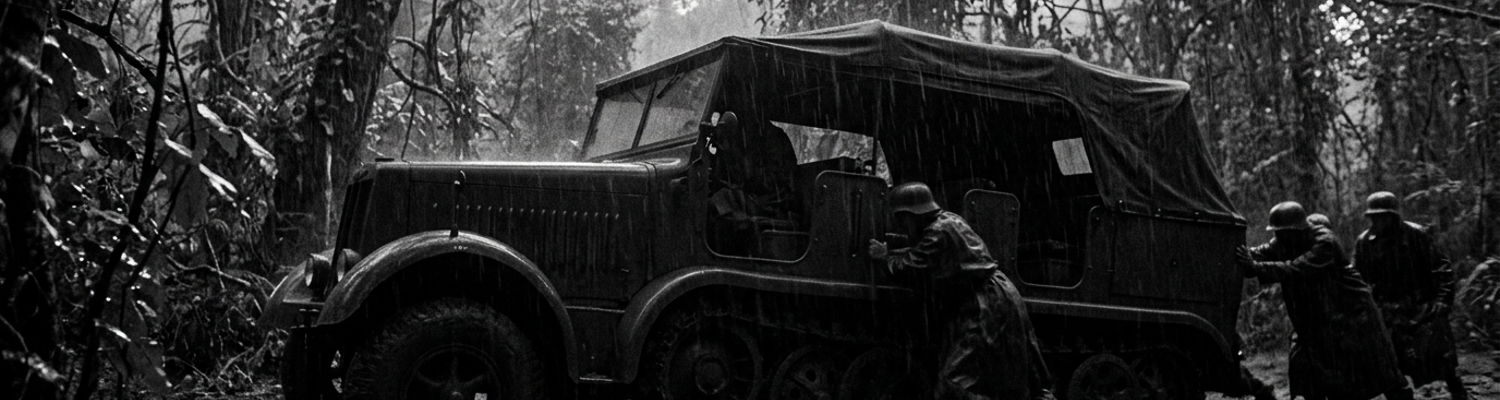
The 12th Cavalry Regiment executed a rapid dismounted and mechanized flanking maneuver in mid-July 1945. They moved to collapse the retreating Japanese forces in the northern sector. Major General Innis P. Swift directed 1st Cavalry Division elements to bypass fortified roadblocks along Highway 5. The 12th Cavalry deployed M3 half-tracks and M8 Greyhound armored cars. They pushed along the narrow unpaved logging trails. Mechanical components failed rapidly. Dense clay packed into the drive sprockets on the half-tracks. Metal tracks snapped under tension. The M8 Greyhounds relied on wheeled mobility. They sank to their floorboards in the saturated earth. Maintenance crews attempted to winch the six-ton armored cars forward using steel cables wrapped around mahogany trunks. Radiators boiled over frequently. High-tempo expectations clashed directly with the physical limitations of internal combustion engines operating in deep mud. Troopers abandoned disabled vehicles to maintain the aggressive timetable.
Mechanics stripped the abandoned M3 half-tracks for spare parts. They left the empty hulls rusting in the cogon grass.
Responsibility for the flanking movement shifted entirely to the dismounted troops. Elements of the 1st and 2nd Squadrons hacked through the underbrush using machetes. They advanced at a rate of less than one mile per day. Standard combat loads exceeded sixty pounds. Troopers carried M1 Garand rifles, heavy bandoliers of .30 caliber ammunition, canteens, and entrenching tools. Sustained high-tempo operations stripped away the psychological resilience of the cavalrymen. Night perimeters required constant vigilance against infiltration tactics. Sleep deprivation became chronic. Medical officers recorded high instances of combat fatigue. Symptoms included severe tremors, auditory hallucinations, and a total collapse of basic mental function. Soldiers reached their human breaking point. They simply stopped on the trail. They could not process basic commands or lift their weapons. Cold C-rations consumed in the driving rain provided the only caloric intake. Jungle rot and dysentery spread rapidly through the ranks. Exposure to the elements and relentless physical exertion degraded the combat effectiveness of the regiment entirely independent of enemy action. By July 18, company commanders reported platoons operating at fifty percent effective strength.
Evacuating these psychiatric and environmental casualties required four able-bodied men to carry a single litter back through the mud.
Examining the regimental action reports from July 19 to July 22 reveals a command structure struggling to manage this psychological erosion. Point elements rotated every twenty minutes to prevent complete mental breakdowns at the front of the column. Spotting tripwires and hidden rifle pits in the deep foliage demanded intense focus. Hyper-vigilance drained the lead scouts rapidly. Whenever a soldier collapsed from exhaustion, the column simply stepped over him. Medical personnel in the rear administered intravenous fluids hours later. Bypassing the main Japanese defensive line validated the flanking maneuver. Hollow-eyed survivors paid the cost. They required immediate extraction from the combat zone to treat severe malnutrition and psychological trauma. Securing the designated ridgeline, the 12th Cavalry finalized the movement at 1400 hours on July 24.
Canopy Attenuation and Signal Breakdown
When examining the historical record of the 12th Cavalry Regiment during the mid-July 1945 advance, signal logs reveal a complete breakdown of tactical communications. Vanguard elements relied heavily on the SCR-300 backpack radio and the smaller SCR-536 handheld transceiver to coordinate movements across the heavily forested ridges. The SCR-300 operated on the 40 to 48 megahertz frequency modulation band. It required line-of-sight propagation to function effectively. The triple-canopy rainforest of the Cagayan Valley completely disrupted these transmissions. Towering mahogany trees, dense vines, and highly saturated foliage acted as massive physical barriers to radio frequency waves. Moisture trapped within the broad leaves absorbed the electromagnetic energy emitted by the antennas.
Radio operators from the 1st Squadron found their signals degraded to unintelligible static within a few hundred feet of their transmission point.
Severe radio signal attenuation across tactical cavalry frequencies forced radiomen to attempt dangerous workarounds in the field. Technicians attached extended wire antennas to the tops of bamboo poles. They hoisted these improvised rigs into the lower branches of the canopy. This action exposed the operators to Japanese sniper fire from elevated spider holes. Even with the extended height, the wet wood and thick ambient humidity severely reduced the transmission range. An expected three miles dropped down to less than a quarter mile. The smaller SCR-536 sets operated on a lower amplitude modulation band between 3.5 and 6 megahertz. These handheld units proved entirely useless under the dense canopy. They failed to transmit through even a single layer of thick underbrush. Battery degradation compounded the attenuation issues. The heavy BA-70 dry-cell batteries powering the SCR-300 units swelled and short-circuited in the constant dampness. Signal Corps personnel documented a failure rate of sixty percent for all replacement batteries brought forward by the supply trains.
Troop C lost contact with the regimental command post entirely by 0900 hours on July 19.
The total communications failure led to a command and control collapse among vanguard elements pushing toward the Japanese defensive lines. Platoon leaders in Troop A and Troop B advanced into the thick cogon grass without any ability to synchronize their movements. Compasses proved unreliable near localized magnetic disturbances in the volcanic rock. Units drifted off their assigned azimuths. Without functioning radios to confirm coordinates, adjacent platoons separated by only fifty yards remained completely unaware of each other positions. Company commanders could not issue updated orders or halt the advance when lead scouts encountered fortified machine-gun emplacements. The mechanized command structure of the 1st Cavalry Division depended on rapid information relay to direct indirect fire. That standard operating procedure failed as soon as the line companies crossed the line of departure. Officers resorted to dispatching foot runners through the dense foliage to relay handwritten messages.
A close review of operational logs indicates these runners frequently became disoriented. Many fell to enemy ambushes along the muddy trails.
The breakdown in command and control created isolated pockets of fighting. Forward observers attached to the cavalry troops could not contact the 61st Field Artillery Battalion to call in 105mm howitzer support. A vanguard squad from Troop A engaged a camouflaged bunker complex at grid coordinate 17.62 N, 121.75 E. They fought for three hours without any supporting fire. Surrounding platoons heard the gunfire but could not maneuver to assist due to the lack of radio coordination. Friendly fire incidents increased as separated units converged on the same trail junctions from different directions. Ground commanders possessed no mechanism to establish identifying passcodes over the airwaves. By the afternoon of July 20, the 1st Squadron commander could only account for the exact location of his immediate headquarters staff.
Four rifle platoons operated completely blind in the hostile sector for thirty-six hours.
Targeting Miscommunications and Isolated Squadrons
A close review of operational logs indicates isolated vanguard units suffered from severe targeting miscommunications during support requests throughout the third week of July. Forward observers attached to Troop C pushed ahead of the main body into a steeply banked ravine at grid coordinate 17.63 N, 121.76 E. Dense foliage and continuous precipitation degraded their primary communication tools. The artillery observer attempted to coordinate a fire mission on a localized Japanese machine-gun nest. He initiated a call to the 61st Field Artillery Battalion using an SCR-300 radio. The heavy BA-70 dry-cell battery powering the unit expanded in the humidity. It pressed against the internal vacuum tubes and caused intermittent power loss. Transmissions broke apart into heavy static. Operators tried to relay a bracketed set of coordinates using a standard M-1938 lensatic compass to establish an azimuth. Localized magnetic interference from the volcanic basalt underlying the mud threw the compass reading off by twelve degrees. Signal degradation cut the frequency entirely just as the observer transmitted the elevation data.
Artillery batteries five miles to the rear received only a fragmented string of numbers.
Archival evidence shows the artillerymen assumed the missing transmission data aligned with previously registered pre-planned targets along the ridge. Artillery crews relied on outdated 1933 topographic maps produced by the Coast and Geodetic Survey. These lacked accurate elevation contour lines for the Cagayan interior. They loaded 105mm howitzers with high-explosive shells fused for airbursts. The battery fired blindly based on the compromised azimuth. They unleashed a six-round volley directly over the isolated 2nd Platoon. Tree bursts detonated against the upper canopy of the mahogany trees. Jagged steel shrapnel rained down into the American perimeter. Forward observers desperately keyed their handsets to transmit an immediate cease-fire command. Water intrusion had already shorted the internal wiring of the radio chassis. Radio waves never left the antenna. Infantrymen scrambled into shallow depressions filled with stagnant rainwater to escape the friendly bombardment.
The barrage severed all remaining field telephone wires strung loosely along the jungle floor.
Sustained isolation under hostile canopy fire accelerated severe psychological combat fatigue among the pinned-down cavalrymen. Japanese infantrymen from the 103rd Division had heavily fortified the upper branches of the surrounding canopy. Snipers strapped themselves to thick mahogany limbs using woven heavy vines. They fired Type 38 Arisaka rifles chambered in 6.5x50mm. Chemical compositions of the Japanese smokeless powder produced almost no visible muzzle flash. Acoustic echoes from the rifles bounced off the ravine walls. This made it impossible for the American troops to determine the origin of the incoming fire. Troopers lay flat in the adhesive mud for forty-eight consecutive hours. They could not raise their heads to scan for targets or open their canteens without drawing immediate fire. Human nervous systems cannot sustain that level of hyper-arousal indefinitely. Cortisol levels remained fully elevated while caloric intake dropped to zero. Digestive systems shut down. Adrenaline reserves depleted rapidly.
One cavalryman from Troop B chewed entirely through his lower lip without registering the physical pain.
Medical officers attached to the 1st Squadron recorded a large-scale spike in psychiatric casualties directly linked to this specific environmental entrapment. Men stopped responding to verbal commands. Several soldiers curled into the fetal position in the waist-deep swamp water and refused to grip their M1 Garand rifles. Auditory hallucinations plagued the isolated units. Exhausted troopers reported hearing approaching tank treads or phantom artillery whistles in the middle of the night. Platoon leaders found themselves physically dragging catatonic men by their webbing to shift them behind the rotting trunks of fallen trees. Corpsmen exhausted their supply of sodium amytal trying to sedate the most violently shaking casualties. The intense unrelenting pressure of unseen snipers firing downward through the thick vegetation systematically dismantled the mental function of the surviving infantry. Evacuation teams eventually reached the pinned-down elements on July 23 to find twenty-two men completely unresponsive to visual stimuli.
White House Map Room Emergency Traffic
A close review of operational logs indicates the communication blackout in the Cagayan Valley rapidly escalated up the chain of command. It triggered high-level emergency communications that reached the White House Map Room between July 15 and 25, 1945. War Department telegraph operators in Washington received a series of encrypted priority cables originating from General Headquarters Southwest Pacific Area. Routing these messages required the use of SIGTOT. This one-time tape cipher machine prevented Japanese codebreakers from intercepting the transmissions. Mechanical relays clattered continuously across the Pacific networks. Staff officers in the basement of the executive mansion attempted to update the large situation boards. Duty officers physically moved colored pins representing the 1st Cavalry Division across the topographic maps of Luzon. Signal degradation in the rainforest worsened. Those pins stopped moving entirely. The total absence of confirmed coordinates created a blind spot at the highest levels of the American military apparatus. President Harry S. Truman was preparing for the Potsdam Conference during this exact window. Briefing documents handed to the executive staff contained blank sections regarding the operational status of the 12th Cavalry Regiment.
Intelligence officers officially classified two entire vanguard squadrons as missing in action.
Theater commanders scrambled to locate the missing cavalry squadrons trapped in the rainforest. General Walter Krueger directed the Sixth Army headquarters to immediately divert all available aerial reconnaissance assets to the northern sector of Luzon. Mechanics worked through the night to fuel and launch unarmored L-4 Grasshopper observation planes from muddy airstrips near Manila. Pilots flew at dangerously low altitudes of three hundred feet. They attempted to spot any visual markers through the dense triple-canopy vegetation. Thick mahogany branches and interwoven vines completely obscured the forest floor. Flight crews dropped colored smoke grenades into the valleys. They hoped the trapped infantrymen would see the signals and ignite their own flares. Rain washed the chemical smoke away before it could penetrate the lower branches. Ground-level search operations initiated by the 1st Cavalry Division command structure faced the same environmental destruction that had trapped the vanguard units. Rescue platoons dispatched on July 18 carried heavy loads of replacement batteries, medical supplies, and salt tablets. They hacked their way through the six-foot cogon grass at a pace of less than a half-mile per day. The psychological weight of the search mission fractured the discipline of these relief columns. Their fellow soldiers were actively starving and suffering from severe combat fatigue in the unmapped jungle. This knowledge caused intense anxiety among the search parties.
Two relief scouts collapsed from heat exhaustion within the first four hours of the rescue operation.
Archival evidence shows the physical items left behind by the isolated squadrons provided clear documentation of total psychological collapse. Forward elements of the search patrols breached a steep ravine at grid coordinate 17.65 N, 121.78 E on July 22. They did not find an organized defensive perimeter. They found the discarded remnants of a broken unit. Troopers had abandoned their M1 Garand rifles in the deep mud. Steel M1 helmets lay half-submerged in pools of stagnant water. Men left this protective gear behind because they could no longer bear the three-pound weight on their necks. The extreme psychological erosion of sustained high-tempo operations had entirely stripped the trapped cavalrymen of their basic survival instincts. Corpsmen locating the missing soldiers documented severe cases of catatonia. Men sat entirely exposed to the driving rain. They refused to eat the cold C-rations handed to them by the rescue teams. Central nervous systems had shut down after seventy-two hours of constant hyper-vigilance under unseen sniper fire. Medical officers recorded resting heart rates exceeding one hundred and forty beats per minute in soldiers who were completely physically immobile.
Evacuation teams strapped twenty-two non-responsive troopers directly to wooden litters for the transport back to the regimental aid station.
Psychological Erosion and Human Breaking Point
A close review of operational logs indicates high-tempo jungle operations pushed troop psychological endurance entirely past its operational limit by the third week of July 1945. Sixth Army command directives demanded relentless forward pressure against the retreating Japanese 103rd Division to prevent them from establishing a cohesive defensive line. These orders required the 12th Cavalry Regiment to conduct continuous tactical movements. Operations lasted up to eighteen hours a day. Infantrymen from Troop F hacked through dense interwoven bamboo thickets near grid coordinate 17.66 N, 121.79 E without establishing secure night perimeters. Platoon leaders forced their men to march in total darkness to maintain the aggressive schedule dictated by higher headquarters. The physical mechanics of this sustained advance systematically dismantled the central nervous systems of the vanguard units. Troopers carrying the ninety-pound M1917A1 heavy machine gun components suffered severe spinal compression, acute muscle failure, and deep tissue lacerations from the heavy canvas straps. Constant forward momentum eliminated any opportunity for REM sleep or basic physical recovery.
Men began losing consciousness while actively walking along the muddy trails.
Archival evidence shows environmental isolation and relentless operational friction caused widespread combat trauma independent of direct enemy contact. The physical density of the triple-canopy rainforest blocked sensory input and warped spatial perception. Thick mahogany branches and broad-leaf vegetation blocked all sunlight. This trapped the cavalrymen in a permanent disorienting twilight. Ambient jungle noises heavily amplified the psychological strain on the isolated squads. Snapping bamboo stalks and the sudden violent movements of local macaque monkeys triggered immediate hyper-arousal in the exhausted troops. Paranoia regarding Japanese infiltration tactics infected the command structure of the 2nd Squadron. Non-commissioned officers lost the mental ability to distinguish between ambient environmental sounds and hostile troop movements. This extreme sensory friction led directly to severe friendly fire incidents along the narrow ridgelines. Machine-gun crews fired blindly into the dark foliage at the slightest rustle of wet leaves.
Ammunition reserves vanished into the empty tree line.
Medical officers attached to the regimental aid station documented a complete psychological collapse among the forward platoons heavily influenced by rapid equipment degradation. The abrasive volcanic mud and constant precipitation destroyed the mechanical reliability of the American small arms. Wooden rifle stocks swelled significantly in the ninety percent ambient humidity. This warped the internal receiver groups and misaligned the barrels. Firing pins rusted solidly into their metallic bolts overnight. Infantrymen realized their primary weapons would not cycle live ammunition if they encountered a Japanese ambush. This sudden awareness of total defenselessness in hostile territory shattered the remaining mental resilience of the cavalrymen. Panic attacks spread rapidly through the ranks. Soldiers developed severe psychogenic tremors that rendered their hands entirely useless. They could not manipulate the metal buckles on their web gear, open their canteens, or pull the pins on their fragmentation grenades.
Several troopers stripped off their rotting uniforms and wandered aimlessly into the dense underbrush.
Managing this operational breakdown overwhelmed the limited medical personnel attached to the line companies. Battalion surgeons lacked the pharmaceutical supplies necessary to treat mass psychiatric casualties in the forward combat zones. Corpsmen resorted to physically tying delirious soldiers to mahogany trunks using heavy canvas sling straps (NARA Record Group 338). This prevented them from walking directly into Japanese kill zones. The sheer friction of the environment turned basic survival tasks into insurmountable mental hurdles. Exhausted men forgot how to operate their standard-issue iodine water purification tablets. They drank directly from stagnant swamp pools filled with decaying animal carcasses and human waste. Acute dysentery compounded the psychological trauma. It accelerated total physical dehydration and rapidly depleted blood plasma levels. When relief columns finally breached the localized magnetic disturbances surrounding Troop F on July 24, they discovered a unit incapable of basic military function. Officers sat heavily in the deep mud staring at outdated topographic maps without comprehending the contour lines. Resting heart rates in these immobilized commanders exceeded one hundred and forty beats per minute.