
Allied Aegean Reconnaissance Infiltration
The Aegean Sea in late September 1943 was a strategic void. Italy’s armistice on September 8th had ripped a power vacuum across the Dodecanese islands, a chain of rock and scrub vital to controlling the Eastern Mediterranean. For British planners in Cairo, this presented a fleeting chance to seize islands like Leros and use them as a springboard into the German-held Balkans. Before any large-scale landings under the ambitious Operation Accolade could proceed, a perilous preliminary phase was required: deep reconnaissance. The questions were simple. How strong were the German forces moving to fill the void, and which way would the guns of the substantial Italian garrisons turn?
The task fell to Britain’s unconventional units, the Special Boat Service (SBS) and the Long Range Desert Group (LRDG). These were not divisions but small, specialized teams built for covert insertion, observation, and hit-and-run attacks. A review of operational logs shows that as British forces began landing on Leros around September 17th, SBS and LRDG detachments were already active. Their methods were high-risk. One team, led by Major George Jellicoe, parachuted onto Rhodes on September 9th in a failed attempt to sway the Italian commander. Others used the sea, deploying from motor launches and submarines to approach the indented coastlines of Leros under cover of total darkness.
Their first objective was to assess the loyalty of the Italian garrisons. On Leros, this meant evaluating the intentions of roughly 8,320 Italian soldiers and sailors under Admiral Luigi Mascherpa. Allied operators made contact with Italian officers, gauging their willingness to resist the Germans, who had already moved to disarm Italian forces on Rhodes. The environment was ambiguous. Yesterday’s enemy was today’s untested ally. While Mascherpa would fight alongside the British, initial interactions were tense. The reconnaissance teams moved discreetly, sending reports back to Middle East Command that painted a picture of an Italian force strong in numbers but weak in resolve, with only about 1,000 first-line infantry troops.
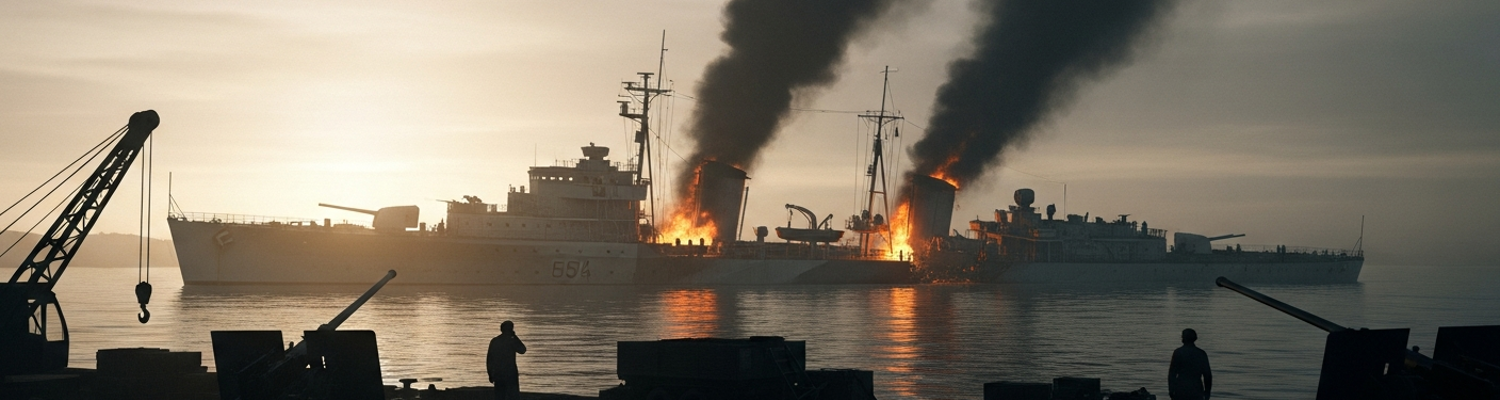
Simultaneously, these units were locating and profiling the German threat. This involved mapping defensive positions and reporting on the scale of the Luftwaffe’s presence. LRDG patrols, experts in desert reconnaissance, adapted their skills to the island terrain. They established clandestine observation posts on the craggy hills overlooking Leros’s key bays and its main port, Lakki. The teams watched as German intentions became clear. The air battle for Leros began on September 26th, with bombing attacks signaling the start of a 52-day siege. Reconnaissance reports detailed the sinking of the Greek destroyer Vasilissa Olga and the British destroyer Intrepid in Lakki harbor, stark evidence of German air superiority. The intelligence gathered by SBS and LRDG patrols, filtered back through unreliable radios, confirmed that the Germans, under Generalleutnant Friedrich-Wilhelm Müller, were preparing for a full-scale invasion.
Reconnaissance Equipment Failures
The insertion into the Dodecanese was a maritime operation. The Aegean Sea immediately began its assault on their equipment. Operational logs from the period document a constant struggle against saltwater corrosion. Teams deploying from submarines or motor torpedo boats were drenched in spray, which infiltrated every part of their kit. The primary man-portable radio was the Wireless Set No. 18, a valve-based HF transceiver highly susceptible to moisture. Saltwater degraded rubber seals and shorted battery terminals. For SBS teams operating from klepper canoes, a small amount of seawater in the fragile craft could render their primary means of communication useless. Optical equipment also suffered. Binoculars and spotting scopes became fogged as moisture penetrated their housings. Salt crusting on the lenses was difficult to clean without causing scratches, degrading the clarity needed for accurate intelligence gathering. Personal weapons, like Sten guns and Lee-Enfield rifles, required relentless maintenance to prevent rust.
The sea was only the first enemy.
Once ashore, the terrain of Leros inflicted a different kind of punishment. Leros is an island of steep, rocky hills covered in thorny scrub. The LRDG, accustomed to vehicle-based operations, was now forced to act as mountain infantry. A man-pack radio like the Wireless Set No. 18 weighed around 30 pounds, a significant burden on the slopes of Mount Klidi. After-action reports reveal that falls on the treacherous ground were common, resulting in cracked radio casings and shattered vacuum tubes. The long wire aerials required for effective HF transmission were a point of failure, constantly snagging on thorny bushes. Erecting these antennas on exposed ridgelines also made operators targets for Luftwaffe patrols. The island’s geography of deep bays and steep hills created numerous radio dead zones, where line-of-sight communication was impossible.
These equipment failures directly hindered the collection of reliable intelligence. The entire British command structure for the Dodecanese campaign was beset by poor communication. On Leros, this problem was magnified. An SBS patrol might observe German E-boats preparing for a landing in Partheni Bay but be unable to transmit a warning due to a waterlogged radio. By the time they could move to higher ground and attempt repairs, hours would be lost. Archival evidence shows that communications between the British units on the island, and between the British and Italian garrisons, were tenuous, often relying on runners. This breakdown created a fragmented intelligence picture for Brigadier Robert Tilney, the British commander. He received delayed and garbled reports, making it impossible to form a coherent understanding of German movements during the invasion on November 12, 1943. The inability to communicate reliably meant that units fought in isolation.
Contradictory Intelligence Reports
The raw intelligence flowing into Brigadier Robert Tilney’s headquarters was a cascade of disjointed fragments. A review of operational logs from the SBS and LRDG patrols reveals a command picture built on guesswork. These small, isolated teams could only report what they saw from their specific vantage points. An LRDG patrol observing German movements from Mount Klidi might report a column moving south. Hours later, an SBS team near the coast would report a different German unit disembarking in that exact area. To the command staff, these were seen as two simultaneous, contradictory reports. The communication problems meant time-stamps were unreliable and requests for clarification went unanswered.
This was a direct consequence of the reconnaissance missions.
The nature of these deep reconnaissance operations guaranteed a flawed perspective. The LRDG and SBS were not a continuous surveillance network. An observation post could provide a detailed report on enemy activity in Alinda Bay but remained blind to the build-up of German assault boats in Gurna Bay. Each report represented only a fraction of the unfolding German plan, Operation Leopard. A patrol might correctly identify the movement of a platoon from the 22nd Infantry Division but have no way of knowing it was part of a coordinated battalion maneuver. This piecemeal intelligence was further degraded by the stress of operating under German air supremacy. From September 26th onward, the Luftwaffe’s Junkers Ju 87 dive bombers were a constant presence, forcing patrols to remain hidden and restricting observation. An observer could easily misidentify units or misjudge their strength.
The map told a dozen different stories at once.
The intelligence failed to provide a complete picture of German capabilities. While patrols had confirmed the presence of German troops, they underestimated their quality and tactical sophistication. The reports reaching Middle East Command and Brigadier Tilney did not adequately convey the threat posed by specialized units like the Brandenburgers, trained for rapid amphibious assaults. The intelligence focused on counting soldiers, not on assessing their combined-arms doctrine. There was no appreciation for how effectively Generalleutnant Friedrich-Wilhelm Müller would integrate his forces. The Allies knew the Luftwaffe controlled the sky, but they failed to predict how methodically that air power would be used to neutralize Leros’s Italian coastal batteries. The intelligence picture was that of a conventional infantry threat, not a swift, multi-pronged amphibious and airborne assault by elite troops.
Rapid Island Occupation Directive
The decision matrix that led to the British landings on Leros was forged in Cairo. It was a direct consequence of Italy’s armistice on September 8, 1943. High-level communications show that General Sir Henry Maitland Wilson, Commander-in-Chief of Middle East Command, was instructed to improvise and dare. This directive prioritized a swift occupation of Kos, Samos, and Leros to exploit the power vacuum. The original plan, Operation Accolade, had envisioned a large-scale assault on Rhodes with American support. With American resources committed to the Italian mainland, Accolade was shelved. What remained was a hastily conceived, British-only operation that relied on speed over strength. The order was to seize the islands with whatever forces were available.
The race for the Aegean was on.
This directive cascaded down to the tactical level, where the 234th Infantry Brigade was tasked with the occupation. This formation, recently the Malta garrison, was not an amphibious assault division. Units began landing on Leros in mid-September, but an underestimation of German capabilities had already sealed their fate. Allied intelligence assessments misjudged the speed of the German reaction. Planners in Cairo did not believe the Germans would divert first-rate assets to a secondary theater. This was a catastrophic error. The Germans had complete air superiority in the region, courtesy of Fliegerkorps X based in Greece. The islands were beyond the range of Allied fighter cover from Cyprus or North Africa. The proof of this vulnerability came swiftly. On September 26, 1943, Junkers Ju 88 bombers attacked Lakki harbor, sinking the Greek destroyer Vasilissa Olga and the British destroyer HMS Intrepid at anchor. This blow was a clear signal of the aerial dominance the British forces would endure.
Air power was only one part of the miscalculation.
Allied command also downplayed the German naval and ground threat. The Kriegsmarine in the Aegean was a flotilla of effective landing craft, including Siebel ferries and E-boats, perfect for inter-island troop movements. The most significant failure was in assessing the quality of the German ground troops. The invasion of Leros, Operation Leopard, was not conducted by second-rate forces. The assault was spearheaded by battle-hardened units, including elements of the 22nd Infantry Division and special forces from the Brandenburg Division. The operation was under the command of Generalleutnant Friedrich-Wilhelm Müller, a commander known for his effectiveness on Crete. His presence indicated a level of German commitment that Allied intelligence had failed to anticipate. Planners did not appreciate how seamlessly Müller would integrate his air, sea, and land components into a swift, combined-arms assault. The British force was unprepared for the multi-pronged attack that began on November 12, 1943.
Operation Leopard Launch
The German response to the British presence on Leros was inevitable. German operational directives show the order was to eradicate the Allied foothold with overwhelming force. The first phase began in the skies. On September 26, 1943, the air battle for Leros opened with a demonstration of efficiency. Junkers Ju 88 bombers of Fliegerkorps X, flying from bases in Greece, appeared over the port of Lakki. Enjoying complete air superiority, the bombers methodically targeted the ships at anchor. Within minutes, direct hits sank the Greek destroyer Vasilissa Olga and the British destroyer HMS Intrepid. This attack was the start of a 52-day systematic dismantling of the island’s defenses from the air. The Luftwaffe’s Junkers Ju 87 dive-bombers became a constant presence, targeting Italian coastal artillery batteries, command posts, and supply depots. British forces had no effective answer. Their nearest fighter bases were far outside operational range.
The sea offered no sanctuary.
While the Luftwaffe terrorized the island by day, the Kriegsmarine worked to strangle it by night. German naval forces under Vice-Admiral Werner Lange initiated a campaign of maritime interdiction to isolate Leros. His flotilla included fast E-boats (Schnellboote), captured Italian destroyers, torpedo boats, and specialized landing craft. Throughout October and early November, these vessels hunted Allied shipping. Royal Navy destroyers attempting to run the gauntlet with troops and ammunition were ambushed in the dark. This campaign turned the Aegean into a graveyard for Allied warships, cutting Leros off and ensuring that when the assault came, Brigadier Tilney’s garrison would fight with only the men and materiel it already had.
The German invasion force began to gather.
The ground assault, Operation Leopard, was placed under the command of Generalleutnant Friedrich-Wilhelm Müller. An examination of the German order of battle reveals the high-quality formations assigned to the task. The core of the invasion force was composed of units from the 22nd Infantry Division. These were augmented by elite special forces. The amphibious landings were spearheaded by the Küstenjäger of the Brandenburg Division, specialists in seaborne commando operations. The plan also involved an airborne component, with paratroopers (Fallschirmjäger) from the 1st Battalion, 2nd Parachute Regiment tasked with dropping onto the island’s narrow central isthmus. In the early hours of November 12, 1943, the operation launched. Müller’s plan was a complex, combined-arms assault. While amphibious forces landed in the north at Palma Bay and Grifo Bay, and in the east near Pandeli Bay, Junkers Ju 52 transport aircraft dropped approximately 600 paratroopers over Mount Rachi to cut the island in two.
Leros Garrison Isolation
The physical entrapment of the Allied garrison on Leros began from the sky. On September 26, 1943, the Luftwaffe initiated a 52-day air campaign. German operational directives reveal this was a methodical effort by Fliegerkorps X to achieve total air and sea supremacy. Junkers Ju 88 bombers appeared over Lakki harbor and sank the Vasilissa Olga and HMS Intrepid. This single attack signaled a new phase of the battle. For the troops on the ground, it was a demonstration that the Royal Navy could not protect them. The air raids were continuous, averaging over four per day in the initial weeks.
The sky belonged to the Germans.
While the Luftwaffe dominated the daylight, the Kriegsmarine worked to strangle the island by night. Vice-Admiral Werner Lange’s naval forces commenced a campaign of maritime interdiction. This was a flotilla of E-boats, torpedo boats, and Siebel ferry landing craft. Archival naval logs show these vessels hunted in packs, ambushing Royal Navy destroyers attempting to bring in troops and ammunition. The Aegean became a graveyard for Allied warships. The blockade sealed Leros off. Brigadier Robert Tilney’s garrison would have to fight with only the men and materiel it already possessed.
This German control of the air and sea rendered further deep reconnaissance impossible. The initial intelligence gathered by SBS and LRDG teams became the last intelligence the Allies would get. No more patrols could be inserted. More importantly, the garrison was blinded by a total cessation of combat photography. Allied reconnaissance aircraft, primarily Spitfires and Mosquitos flying from distant airfields, were unable to operate over Leros. The flight was too long, and German Messerschmitt Bf 109 fighters were always waiting. Without aerial photographs, British commanders had no way to verify the results of Italian artillery fire or identify the assembly of the German invasion fleet at Kos and Kalymnos.
The lack of new intelligence left Brigadier Tilney fighting a ghost offensive. His information was static, a snapshot from weeks earlier. He and his staff were forced to rely on the fragmented reports from the isolated LRDG and SBS patrols, whose radios were failing. They could not see the bigger picture. Generalleutnant Friedrich-Wilhelm Müller was moving his elite forces, including elements of the Brandenburg Division and Fallschirmjäger, with impunity. The British defenders were unprepared for the multi-pronged amphibious and airborne assault launched on November 12. They were reacting to landings based on an intelligence picture that was dangerously out of date.
Aegean Campaign Collapse Repercussions
The surrender of the Leros garrison on November 16, 1943, transformed a tactical failure into a strategic collapse for the Allies in the Aegean. Operational logs show the rapid domino effect. With Leros gone, the remaining British-held island of Samos was indefensible. German Junkers Ju 87 bombers began pounding the island on November 17. Royal Navy assets were withdrawn, and the order was given to evacuate. Between November 19th and 20th, the last British forces were pulled out, leaving the 2,500-man Italian garrison to surrender on November 22. The Germans then occupied the smaller islands of Patmos and Ikaria, completing their conquest of the Dodecanese. The British gamble had ended in a rout. The price was steep. Across the campaign, the British Army suffered approximately 4,800 casualties, the majority taken prisoner.
The failure of the Dodecanese campaign was absolute. The central, unfixable flaw was the lack of Allied air superiority. German Fliegerkorps X operated over 350 aircraft from nearby bases, while the Allies were forced to fly missions from distant airfields. The loss of Kos on October 3rd had eliminated the only usable Allied fighter base in the island chain. This aerial dominance allowed the Luftwaffe to dismantle island defenses and enabled the Kriegsmarine to isolate the garrisons. Royal Navy losses were severe, with six destroyers and two submarines sunk. These included not just HMS Intrepid, but also HMS Panther, and the Greek destroyer Vasilissa Olga. The Germans successfully deployed new Henschel Hs 293 radio-controlled missiles, sinking the destroyer HMS Dulverton on November 13th. The campaign was one of the last clear German victories of the war.
This defeat had immediate repercussions for the wider Allied Mediterranean strategy. Any prospect of opening a new front in the Balkans vanished. A key objective of the campaign, championed by Churchill, had been to persuade neutral Turkey to join the Allied cause. The sight of a swift German victory just off its coast had the opposite effect, reinforcing Turkish reluctance to enter the war. The disaster also intensified strategic disagreements between British and American planners, with the Americans seeing the campaign as a wasteful diversion from the primary effort in Italy, a view the outcome seemed to validate. With the Aegean firmly in German hands, where it would remain until their final withdrawal in 1945, all available Allied men and materiel in the Mediterranean were now funneled into the slow and costly advance up the Italian peninsula.