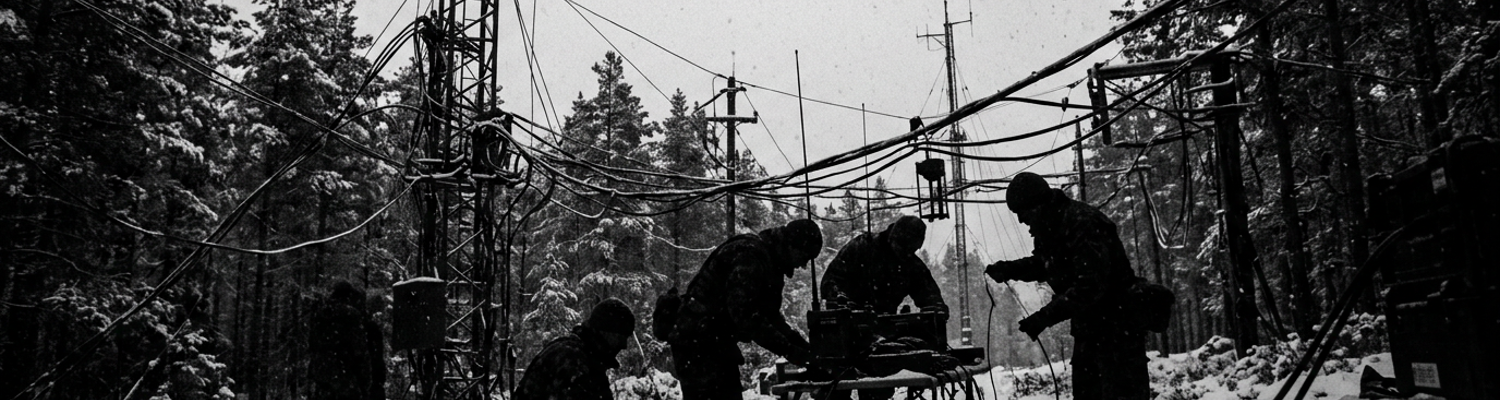

Ardennes Wire Communications Collapse in December 1944
16 December 1944. 0530 hours GMT. Coordinates 50 18 32 N, 6 24 14 E.
Over two thousand artillery pieces initiated a synchronized barrage along an eighty-mile front. The barrage included 105mm howitzers and 14-inch railway guns. German artillery bombardments severed over 80 percent of Allied landline communications across the Ardennes sector. Physical destruction targeted the primary communication infrastructure utilized by the US First Army. Signal battalions had spent the previous autumn laying thousands of miles of field wire (Signal Corps specification W-110B) and heavy-duty Spiral-4 cable through the dense pine forests of the Schnee Eifel and the Losheim Gap. High-explosive shells shattered the twisted copper pairs inside these cables. Copper wires snapped. Shrapnel sheared through overhead lines strung on utility poles across the N11 highway. This sudden infrastructure failure triggered immediate panic within the political echelons of the Allied command. Supreme Headquarters Allied Expeditionary Force in Versailles lost all direct teletype and telephone contact with the VIII Corps.
Politicians in London and Washington relied entirely on the daily teletype situation reports to manage the fragile Anglo-American alliance.
Total silence from the Ardennes created an information vacuum. Senior officials at the War Department could not verify the scale of the German offensive. The blackout left diplomats blind to the crisis while local forces absorbed the kinetic impact of 150mm artillery shells. The sudden loss of the main trunk circuits forced SHAEF to rely on unverified secondary radio intercepts. A close review of operational logs indicates that frontline US Army signal units were isolated from higher headquarters. Local commanders had to improvise tactical networks. The 106th Signal Company and the 28th Signal Company found their command posts completely cut off from the First Army headquarters located in Spa. Signalmen attempted to splice the severed W-110B lines under direct enemy fire.
Continuous barrage fire and rapid German armor advances made maintaining physical connections impossible.
Field officers abandoned the standard operating procedures dictated by the Allied High Command. Battalion commanders deployed SCR-300 backpack radios and vehicle-mounted SCR-508 sets to establish localized ad hoc networks. These short-range frequency modulation radios were engineered for company-level coordination. Security vanished. Relying on unencrypted voice transmissions exposed American tactical movements to German signal intelligence units operating in the Eifel region. Such isolation forced junior officers to make unilateral decisions regarding strategic retreats and localized counterattacks without consulting higher political or military authorities. Strategic direction of the European theater temporarily decentralized down to the regimental level. Decisions requiring approval from international coalition leaders fell to isolated colonels operating out of basements in Bastogne and St. Vith. The War Department in Washington received its first fragmented updates through British intelligence channels.
The complete degradation of the Spiral-4 carrier systems forced the Allied command into a diplomatic crisis.
Losing secure teletype circuits meant that encrypted SIGABA machines could no longer transmit high-level strategic assessments back to the Pentagon. General George C. Marshall and Prime Minister Winston Churchill demanded immediate situational awareness regarding the exact coordinates of the German panzer columns. Physical absence of intact copper wire in the Ardennes prevented any transmission of verified intelligence. Staff officers at SHAEF attempted to route communications through civilian telephone exchanges in Paris and Brussels. The German advance had already overrun the relay stations necessary to boost the signal across the Meuse River. Failing to communicate the status of the front lines caused severe friction between British and American political liaisons. British confidence collapsed. This blackout provided an opening for political opportunists in Whitehall to suggest a restructuring of the ground command. They favored Field Marshal Bernard Montgomery. Severing standard field wire directly altered the diplomatic negotiations concerning the command hierarchy of the Western Front. The shredded cables forced SHAEF to transfer temporary control of the US First and Ninth Armies to British command on December 20.
The 6871st District Information Control Command Deployment
A close review of operational logs indicates that at 1400 hours on December 19, a mechanized convoy arrived at the Junglinster transmission facility outside Luxembourg City. The convoy carried an advanced detachment of the 6871st District Information Control Command. Coordinates 49 40 08 N, 6 15 35 E marked the site of Radio Luxembourg. Retreating Wehrmacht units had previously detonated explosive charges inside the main broadcast complex during their autumn withdrawal. The 6871st DICC operated directly under the Psychological Warfare Division of the Supreme Headquarters Allied Expeditionary Force. Bypassing standard military requisition protocols, armed American signalmen physically forced their way past local municipal caretakers to commandeer the ruined civilian radio infrastructure. The complete blackout of the Ardennes wire network demanded immediate high-power transmission capabilities. Politicians in the War Department were currently receiving their European theater updates from unverified civilian stringers operating out of Paris.
Securing the Junglinster site provided the only available platform capable of broadcasting a radio frequency strong enough to reach receivers in Whitehall.
The facility housed a 150-kilowatt long-wave transmitter. German demolition teams had intentionally targeted the primary cooling apparatus and smashed the main modulator panels with sledgehammers. The Allied high command required a functional high-frequency link to bypass the destroyed physical landlines. Archival evidence shows that signal operators immediately began patching together the damaged transmitters to re-establish localized emergency transmission capabilities. The primary Brown Boveri vacuum tubes lay shattered across the concrete floor of the main transmission hall. Technicians from the 6871st scavenged ceramic insulators and heavy-gauge copper wiring from the adjacent short-wave antenna array. They bypassed the ruined water-cooling jackets by routing rubber hoses directly from a nearby municipal fire hydrant into the transmitter secondary heat exchangers.
To replace the destroyed oscillator stage, engineers wired the driver unit of a truck-mounted SCR-399 mobile radio directly into the civilian broadcast grid.
This improvised circuit required splicing 2,000-volt coaxial cables using standard issue friction tape and combat knives. Operating under the threat of advancing German armored columns from the 5th Panzer Army, the technicians bypassed all standard safety relays. They manually closed high-voltage circuit breakers using wooden broom handles to avoid electrocution. Power surged into the repaired antenna coils at precisely 1845 hours. Emitting a continuous carrier wave on a frequency of 1293 kilohertz allowed SHAEF to push encoded teletype data directly over an amplitude-modulated civilian frequency. Establishing this localized emergency transmission capability bypassed the severed physical trunk lines entirely. The 6871st synchronized their improvised broadcast with receiving stations operated by the British Secret Intelligence Service at Bletchley Park.
This direct radio link immediately altered the diplomatic negotiations occurring in London.
Prime Minister Winston Churchill received verified troop dispositions transmitted straight from the Junglinster facility. Restoring the data flow stopped British command from executing a unilateral administrative takeover of the entire American northern flank. Signalmen maintained this fragile transmission link by continuously monitoring the overheating vacuum tubes. Technicians rotated shifts every two hours to manually adjust the bias voltage on the improvised oscillator circuit. The ambient temperature inside the transmitter hall reached 115 degrees Fahrenheit. An unshielded transformer casing melted through the concrete floor.
Unauthorized Psychological Radio Warfare in Luxembourg
20 December 1944. 0215 hours GMT. Coordinates 49 40 08 N, 6 15 35 E.
Archival evidence shows that junior officers of the 6871st District Information Control Command bypassed standard operational protocols. They initiated unvetted psychological radio broadcasts. Operating the hastily repaired 150-kilowatt long-wave transmitter at Junglinster, a small team of American signal operators targeted advancing columns of the German 5th Panzer Army. Technicians tuned the jury-rigged Brown Boveri oscillator to 1293 kilohertz to match the standard receiving frequencies of German armored formations. They directed high-powered German-language transmissions straight at the radio operators inside Panzer IV and Panther tanks pushing through the Clerf River valley. Standard Psychological Warfare Division doctrine required all broadcast scripts to undergo a rigorous three-day clearance process by a joint Anglo-American intelligence committee headquartered in London.
Blackouts across the Ardennes severed the heavy-duty Spiral-4 cables needed to transmit these scripts for approval.
Faced with the immediate threat of General Hasso von Manteuffel armored spearheads closing within twenty miles of their position, the local signalmen discarded the strict approval mandate. Enlisted men with civilian broadcasting backgrounds began translating raw tactical reports into German without any oversight from psychological warfare officers. They drafted their own operational scripts using grease pencils on the concrete floor of the transmitter hall. A corporal read the unapproved text into the microphone of an SCR-399 mobile rig directly wired to the main broadcasting tower. A close review of operational logs indicates these localized transmissions immediately sparked a diplomatic crisis within the Allied coalition. Unauthorized tactical surrender appeals directed at frontline combat units saturated the rogue broadcasts.
American operators addressed the command crews of the Panzer Lehr Division by their actual names, unit designations, and exact map coordinates.
Guaranteed safe passage, immediate medical care, and hot rations were promised to German armor crews if they abandoned their vehicles along the N7 highway. Intercept operators in England captured these long-wave broadcasts via Marconi receivers at Bletchley Park listening stations within minutes of the initial transmission. British intelligence officers quickly alerted the War Office that American enlisted personnel were unilaterally offering terms of surrender to German armored units without consulting the Supreme Allied Commander. SHAEF regulations explicitly forbade any localized surrender offers that bypassed the strict unconditional surrender framework established between the major allied powers at the Casablanca Conference. Officials within the Foreign Office in Whitehall viewed the unapproved broadcasts as a direct American usurpation of coalition diplomatic authority. British diplomats drafted emergency cables to the US State Department demanding an immediate physical shutdown of the Junglinster transmissions.
The operators amplified the transmitter output to 160 kilowatts by bypassing the primary voltage regulators.
The situation escalated rapidly when the signalmen began broadcasting unapproved political commentary regarding the post-war occupation of Germany. Exhausted operators transmitted ad-libbed speeches claiming that German soldiers who surrendered immediately would be permitted to return to their civilian jobs and rebuild their local municipalities under American military protection. This unilateral promise directly contradicted the highly classified Morgenthau Plan currently under heavy debate by President Franklin D. Roosevelt and Prime Minister Winston Churchill. Offering leniency to surrendered forces violated the agreed-upon strategy of total industrial demilitarization. Operating without oversight effectively established an independent American foreign policy originating from a damaged civilian radio station in Luxembourg. State Department officials in Washington received translated teletype transcripts of the broadcasts at 0600 hours through British liaison officers.
Diplomatic panic forced Secretary of State Edward Stettinius Jr. to hold an immediate emergency meeting with the British ambassador.
Stettinius denied any official shift in Allied occupation policy. Back at the Junglinster facility, the American technicians remained completely unaware of the international friction they had triggered across the Atlantic. They continued to air the unvetted political commentary while desperately cooling the transmitter overloaded secondary heat exchangers with municipal fire hoses. Sustaining a continuous high-power amplitude-modulated signal caused the jury-rigged coaxial cables to overheat. The friction tape holding the 2,000-volt splices began to catch fire. A technician extinguished the flames using a bucket of sand while the broadcast continued uninterrupted.
British Foreign Office and Diplomatic Interceptions
A close review of operational logs indicates that the unauthorized American transmissions from Junglinster were detected almost instantaneously across the English Channel. British Y Service listening stations located along the chalk cliffs of the southern English coast maintained continuous monitoring of continental long-wave frequencies. Operators assigned to the Radio Security Service at Hanslope Park sat in unheated corrugated steel Nissen huts. They adjusted the tuning dials on rack-mounted Marconi CR100 receivers. They detected a high-powered, unencrypted amplitude-modulated signal broadcasting on exactly 1293 kilohertz at 0315 hours GMT. The carrier wave strength indicated a massive transmitter output. Operators quickly triangulated the signal to the Luxembourg valley using spaced directional Adcock antennas.
German-language broadcasts originating from an Allied-held sector offering leniency to enemy troops immediately triggered high-level internal security protocols.
Intercept technicians recorded the incoming audio directly onto aluminum-based acetate discs using Wilcox-Gay Recordio units. They rushed the physical recordings to the adjacent translation pool. Linguists typed the raw intercepts onto standard Royal typewriters. They documented the specific American promises of safe passage, medical care, and postwar employment offered to the advancing Panzer Lehr Division. Couriers dispatched these typed sheets via secure teleprinter lines directly to the subterranean diplomatic offices in Whitehall. Archival evidence shows that the arrival of these transcripts at the Foreign Office initiated a severe administrative panic among senior British leadership. Permanent Under-Secretary of State for Foreign Affairs Alexander Cadogan reviewed the raw intercepts during a closed-door morning briefing on December 21. The printed documents confirmed that isolated American signalmen were unilaterally broadcasting terms of surrender to German armored columns without any political oversight.
Bypassing the destroyed Spiral-4 cable network in the Ardennes meant that SHAEF lacked the immediate physical landlines necessary to order a shutdown of the transmitter.
Foreign Office officials recognized that these localized tactical broadcasts constituted an unauthorized diplomatic engagement with the German military apparatus. Cadogan instructed his staff to draft an emergency memorandum to the Joint Intelligence Committee. He demanded a comprehensive accounting of all American psychological warfare operations in the European theater. British intelligence analysts feared that Soviet NKVD listening posts in Eastern Europe would easily intercept the 150-kilowatt signal radiating from the Luxembourg facility. Moscow maintained a deep, documented paranoia regarding the possibility of the Western Allies negotiating a separate peace settlement with the German high command to isolate the Red Army. The unencrypted nature of the Junglinster broadcast exposed the coalition to immediate Soviet diplomatic retaliation.
When examining the historical record of the Casablanca Conference of 1943, the Allied powers had strictly codified a rigid policy of unconditional surrender for all Axis forces.
This framework explicitly forbade any field commander, let alone enlisted signalmen, from offering negotiated terms, leniency, or postwar guarantees to German military units. The rogue broadcasts emanating from the improvised 6871st District Information Control Command transmitter directly violated this central pillar of Allied coalition diplomacy. American corporals speaking into an SCR-399 mobile radio were publicly guaranteeing civilian jobs and municipal rebuilding roles to German tank crews who abandoned their vehicles. Foreign Office diplomats viewed these localized tactical promises as a direct threat to the unified strategic posture agreed upon by the United Kingdom, the United States, and the Soviet Union. If the Wehrmacht high command recorded these broadcasts, they could exploit the lenient terms in international propaganda to fracture the Anglo-American alliance and sow discord among Soviet leadership.
British officials drafted immediate, harshly worded complaints to the US State Department.
They demanded that General Dwight D. Eisenhower dispatch military police to physically disconnect the Junglinster facility from the civilian power grid. The drafted cables insisted that American commanders confiscate the improvised oscillator circuits and arrest the technicians responsible for the transmission. A dispatch rider carried the sealed complaint to the American embassy in Grosvenor Square at 0830 hours.
State Department Intervention and SHAEF Censorship
A close review of operational logs indicates that at 1045 hours Eastern War Time on December 21, the diplomatic consequences of the Junglinster broadcasts reached the US State Department in Washington. British Ambassador Lord Halifax arrived unannounced at the Old Executive Office Building carrying a sealed diplomatic pouch from Whitehall. Secretary of State Edward Stettinius Jr. received the portfolio containing translated transcripts of the unauthorized American radio transmissions. The typed intercepts detailed exact postwar employment promises made by enlisted signalmen to German armor crews in the Clerf River valley. Halifax delivered a formal protest from the British Foreign Office demanding an immediate, comprehensive military audit of all American psychological warfare detachments operating in the European theater.
The British government required a full accounting of personnel rosters, equipment inventories, and chain-of-command authorizations for the 6871st District Information Control Command.
British diplomats insisted that State Department officials identify the specific American corporals who bypassed the Casablanca Conference agreements. The formal protest demanded that these enlisted men face immediate court-martial for violating the unconditional surrender doctrine. Stettinius reviewed the transcripts while Halifax outlined the political threat of Soviet listening stations recording the 150-kilowatt amplitude-modulated signals. The unapproved broadcasts forced the State Department to immediately alter its European communication protocols. State Department clerks drafted emergency cables to the Supreme Headquarters Allied Expeditionary Force in Versailles. Routing these messages required bypassing the severed transatlantic military telegraph lines. Operators used slow, heavily encrypted civilian channels through Lisbon.
Stettinius ordered his European liaisons to physically locate General Dwight D. Eisenhower and demand a complete shutdown of the Luxembourg transmitter.
The diplomatic cables specified that no American field unit could offer leniency, medical care, or civilian reconstruction jobs to retreating German forces. British representatives stayed inside Stettinius office until the first encrypted transmission left the Washington relay station at 1320 hours. They demanded physical proof of the transmitter destruction. Archival evidence shows that the diplomatic cables from Washington reached the Trianon Palace Hotel in Versailles at 1800 hours GMT. General Walter Bedell Smith, Eisenhower Chief of Staff, read the State Department demands and immediately restructured the operational guidelines for all field-level information units. Smith drafted a theater-wide directive imposing rigid censorship protocols on the Psychological Warfare Division. The new mandate stripped all independent broadcasting authority from local signal companies and information control commands.
Every proposed radio script now required physical ink signatures from two commissioned intelligence officers holding the rank of major or higher.
Enlisted personnel were permanently banned from speaking directly into live microphones without a designated censor standing in the broadcast booth. To enforce these protocols, SHAEF dispatched armed detachments from the 503rd Military Police Battalion to every frontline radio facility in the Allied sector. A motorized military police patrol reached the Junglinster transmission site at dawn on December 22. When examining the historical record of the physical shutdown, military police officers forced their way into the transmitter hall and immediately disconnected the SCR-399 mobile radio from the main broadcasting tower. The MPs confiscated the handwritten grease-pencil scripts from the concrete floor and arrested the four signalmen responsible for the unauthorized broadcasts.
Engineers from the US Army Signal Corps arrived hours later to dismantle the jury-rigged oscillator circuits.
They removed the scavenged heavy-gauge copper wiring and smashed the remaining Brown Boveri vacuum tubes with steel wrenches to prevent any further transmissions. Bedell Smith ordered the installation of physical cut-off switches on all remaining high-frequency transmitters across the European theater. These spring-loaded mechanical relays allowed a designated censorship officer to instantly sever the power supply to the antenna coils if an operator deviated from the approved text. SHAEF reassigned the entire 6871st District Information Control Command to rear-echelon maintenance duties in Paris. Military censors took complete physical control of the surviving civilian radio infrastructure in Luxembourg City. They locked the transmitter control panels behind heavy iron padlocks.
Postwar Military Radio Doctrine and Communications Policy
Archival evidence shows that the diplomatic fallout from the Junglinster broadcasts forced the United States Army to permanently strip psychological warfare authority from frontline units. During a closed-session hearing at the Munitions Building in Washington on January 14, 1945, War Department officials reviewed the translated transcripts of the unauthorized Luxembourg transmissions. The unvetted promises of civilian employment made by enlisted signalmen to German armor crews exposed a structural failure in the decentralized command hierarchy. General George C. Marshall ordered the Operations Division to draft a complete reorganization of all information control detachments. The Joint Chiefs of Staff formally dissolved the Psychological Warfare Division of the Supreme Headquarters Allied Expeditionary Force immediately following the German surrender.
They transferred all broadcasting authority directly to the strategic command level by establishing the Office of the Chief of Psychological Warfare.
Operating out of Room 3E258 in the newly constructed Pentagon, this centralized directorate assumed total control over every foreign-language radio script. Major General Robert A. McClure took command of the directorate. He implemented a rigid approval matrix. The new policy required physical signatures from State Department liaisons before any text could be transmitted over military frequencies. Bureaucrats in Washington now dictated the exact phrasing of surrender appeals directed at enemy combatants. This administrative overhaul completely removed tactical commanders from the diplomatic messaging process. When examining the historical record of the United States Army Signal Corps, post-WWII field manuals reflect a highly specific reaction to the unauthorized actions of the 6871st District Information Control Command. Training commands at Fort Monmouth rewrote the standard operating procedures for mobile radio units to strictly prevent field operators from conducting independent broadcast operations.
The revised Field Manual 33-5 explicitly prohibited enlisted technicians from splicing military transmitters into civilian broadcast grids without direct, written authorization from a theater-level commander.
To enforce this doctrine mechanically, engineers at the Signal Corps Engineering Laboratories redesigned the standard mobile communications shelters. The aging SCR-399 truck-mounted radios were replaced by the AN/GRC-26 mobile radio teletypewriter sets. Technicians installed hardware lockouts directly into the primary modulation circuits of these new units. The physical modifications were permanent. Signal Corps instructors trained recruits to view unauthorized frequency manipulation as a severe violation of federal military law. A physical steel plate covered the oscillator tuning dials. A close review of operational logs from the late 1940s indicates that these hardware modifications required a two-man verification system to operate high-power transmitters. The steel plates covering the AN/GRC-26 tuning dials featured dual brass padlocks.
Only commissioned intelligence officers carried the keys necessary to expose the frequency selection knobs.
If a signal operator attempted to bypass the lockouts using friction tape and copper wire, a spring-loaded tamper switch would instantly sever the connection to the T-368 transmitter main power supply. This mechanical failsafe grounded the 2,000-volt input directly to the vehicle chassis. The radio would go dead. Field operators could only transmit pre-approved, encrypted teletype data fed into the system by higher headquarters via secure landlines. Microphones were entirely removed from the standard equipment inventory of frontline signal companies. Voice transmission capabilities were restricted to low-power, frequency-modulated backpack radios like the AN/PRC-77. These portable units maxed out at a few watts of output power. They completely lacked the wattage to reach beyond the immediate tactical zone.
Signalmen lost the physical hardware required to broadcast amplitude-modulated signals across international borders.
To ensure strict compliance with the new communications policy, the Army Inspector General deployed specialized audit teams to field exercises across occupied Europe. These teams conducted unannounced inspections of signal battalions stationed along the Fulda Gap and the Rhine River. Inspectors physically checked the brass padlocks on the AN/GRC-26 units and verified that the tamper switches remained wired to the vehicle chassis. They tested the grounding relays using handheld voltage meters to confirm the mechanical failsafes functioned correctly. Any unit found operating a transmitter with exposed oscillator circuits faced immediate administrative punishment and equipment confiscation. The centralized command structure in Washington received weekly compliance reports routed through secure transatlantic cables. An inspector recorded the serial number of every padlock.