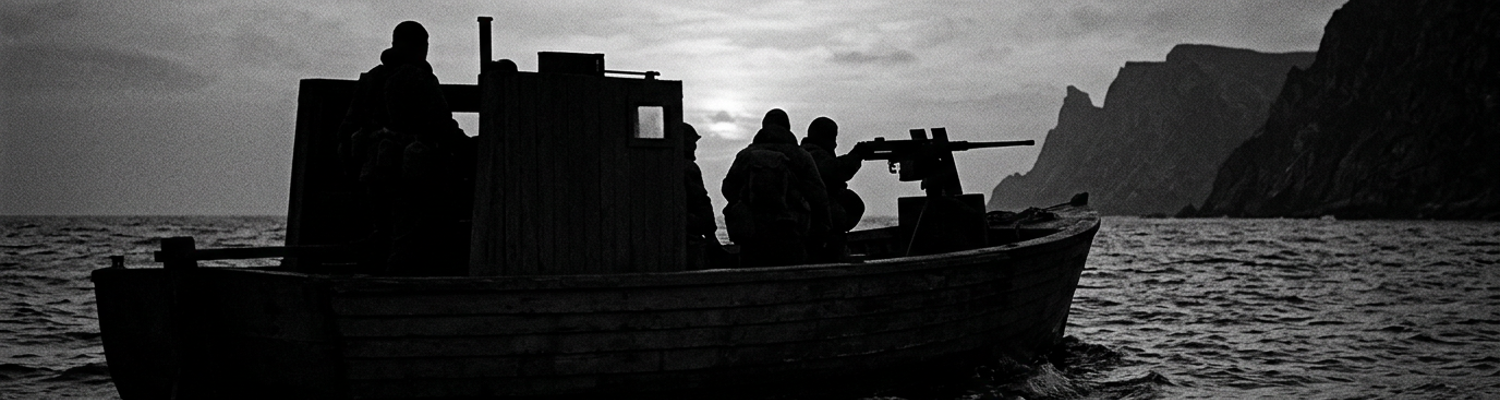

Post-Ambush Extraction and Strait of Otranto Operations
Inside the cramped engine space of the wooden caique, the cast-iron casing of the drive reduction gear split open under excessive torque. The failure ground the internal teeth into metal fragments. The oil pressure gauge dropped from sixty pounds per square inch to zero in less than four seconds. Dense white smoke poured through the hatchway as the dry bearings overheated. The main drive shaft locked. The propeller froze solid. Saltwater surged through a blown sea-cock valve. Bilge water sloshed over the battery terminals, cutting all auxiliary electrical power to the interior cabin. Twelve nautical miles off the sheer cliffs of the Karaburun Peninsula, the forty-foot craft drifted dead in the water. It was trapped in the northern neck of the Strait of Otranto. Albanian border guard searchlights on Sazan Island swept across the rolling black chop behind the stern. The beams illuminated white water crests just four thousand yards away. The crew dismantled the emergency hand bilge pump. Grease-covered mechanics worked in the dark with monkey wrenches to free the seized transmission. They had to clear the flooded bilge floorboards manually before the current dragged the hull into shore-battery range.
Darkness was their only tactical cover.
Archival evidence shows that covert recovery vessels operating out of the CIA maritime station at Brindisi made contact at 0300 hours. The crews secured hemp tow lines to drag the disabled caique west across the international maritime boundary line. The destination was not a commercial dock. It was Fort Cesare (Facility Designation 44-A). This isolated coastal fortification near Taranto had been converted into a secure CIA paramilitary staging base. Emergency offloading began under blacked-out canvas tarps before dawn touched the Apulian coast. Medics hauled wounded Albanian operatives up the stone ramps into makeshift triage bays established inside unheated masonry armories. Tourniquets replaced soaked field dressings on compound fractures and gunshot wounds sustained when Sigurimi machine guns raked the surf. Base handlers ordered the immediate destruction of all personal gear. Salt-caked uniforms and unmarked foreign weapons went into courtyard incinerators. CIA field surgeons performed emergency amputations and stabilized thoracic trauma under low-voltage battery lamps. They avoided any coordination with local Italian civilian hospitals. Municipal records could not confirm the presence of armed foreign paramilitaries on sovereign Italian soil.
Not a single radio channel yielded a friendly voice.
A close review of operational logs indicates that the initial muster reports filed at Fort Cesare during the quiet morning hours recorded total failure for the guerrilla cadre. Out of twenty-eight Company 4000 fighters landed on the rocky beaches near Himare forty-eight hours earlier, only four wounded men reached the extraction caique. Twenty-four trained operatives were marked as missing in action. They had been encircled and eliminated by Sigurimi ambush parties waiting in defensive positions along the high water line. Base cryptographers monitored the RS-1 high-frequency radio sets continuously. They transmitted blind call signs over designated emergency frequencies every twenty minutes. The receivers logged nothing but white noise and low-frequency Soviet jamming sweeps. Case officers tabulated an initial missing-in-action rate of eighty-five percent across the sea-inserted cadre. They noted in pencil that Albanian security units possessed prior knowledge of the primary beachhead coordinates, signal patterns, and fallback extraction windows. The intelligence officers closed the morning log entries at 1100 hours. The casualty ledger remained open without a single confirmed contact in the interior.
Sazan Island Radar Surveillance and Soviet Patrol Craft
A close review of operational logs indicates that during the midday debriefs at Brindisi, technical intelligence officers unrolled hydrographic charts of the Bay of Vlore across drafting tables. They needed to trace the exact intercept angles of the disaster. Analysts matched grease-pencil timeline entries from the extraction caique with shore-based radio intercepts. The patrol craft had not stumbled upon the insertion team by chance. Interception vectors plotted during the post-mission assessment ran in unbroken straight lines directly from the fortified limestone garrison at Sazan Island. The island (latitude 40 degrees 30 minutes North, longitude 19 degrees 17 minutes East) anchored a closed military perimeter. Soviet naval advisors stationed on the island had detected the wooden insertion vessel eighteen nautical miles west of Cape Gjuhez. Tracking data recorded by base cartographers established that shore positions broadcast continuous target telemetry to coastal patrol units sixty minutes before the first ambush shots cracked along the beachhead. Radio direction-finding units in southern Italy logged a sudden surge in low-frequency Cyrillic transmissions emanating from the island central command bunker at precisely 0100 hours. The covert route across the Otranto Channel had ceased to be an invisible corridor.
Sazan Island anchored a closed military perimeter.
When examining the historical record, the technical capabilities of the island installation explain the complete collapse of BGFIEND sea insertions during this phase. Soviet engineers had transformed the triangular outcrop into an advanced electronic tripwire. They mounted surface-search radar systems alongside high-frequency direction-finding arrays directly atop the northern elevation of 342 meters. Operating with narrow pulse-widths designed to register low-profile surface targets among heavy sea clutter, these radar stations swept the deep-water passage between Italy and Albania every twelve seconds. Raw radar returns fed directly into underground plotting rooms carved into the rock. Soviet operators calculated target bearing, speed, and drift before routing firing solutions to coastal gun batteries and naval slips. CIA planning officers had calculated insertion runs on the assumption that wooden-hulled caiques could slip beneath radar horizons by running close to sea level along the Karaburun sea cliffs. Post-mission telemetry proved this assumption entirely false. The high-sited radar arrays painted the low-slung hulls long before they reached territorial waters. The infiltrators lost tactical surprise before they dropped rubber landing boats into the surf.
Western planners had sent wooden boats against an industrialized electronic screen.
Archival evidence shows that the tactical execution of these maritime ambushes fell directly to Soviet-supplied Project 123-bis motor torpedo boats. Displacing twenty tons and propelled by twin twelve-cylinder M-50 water-cooled diesel engines delivering over one thousand horsepower each, these aluminum-hulled Komsomolets-class vessels reached dash speeds exceeding forty-six knots. Albanian crews under Soviet instruction ran these interceptors directly along known clandestine infiltration lines between the Bay of Vlore and the northern mouth of the Corfu Channel. Armed with two 450-millimeter torpedo tubes and twin 12.7-millimeter heavy machine guns mounted in an armored aft turret, a single Project 123-bis possessed enough speed to outrun and destroy any armed fishing smack or modified yacht in the CIA maritime inventory. Field reports from the extraction crew documented that an interceptor vessel appeared out of the northern chop running without navigation lights. It cut across the extraction craft wake at thirty knots. Its twin machine gun barrels sprayed armor-piercing incendiary rounds into the waterline. The high-speed patrol craft did not deploy torpedoes against soft targets. The Albanian commanders used their forty-knot speed advantage to perform aggressive flanking sweeps. They herded the slower Western vessels into shore-battery fields. They forced guerrilla landing parties to dump their radio gear and weapons overboard during panicked beaching attempts.
Recovered wreckage examined at the Fort Cesare repair slip showed twelve-millimeter steel-jacketed rounds lodged in the oak rudder post and engine transom.
Littoral Radar Clutter and Target Identification Failures
A close review of operational logs indicates that technical surveillance officers at Brindisi spent the afternoon hours examining the catastrophic breakdown of shipboard search radars during littoral approach runs. Western support vessels monitoring the Albanian coast carried commercial-grade Raytheon and British Type 268 microwave sets. These systems relied on plan-position indicator scopes to map surface contacts across the channel. Between latitude 40 degrees 05 minutes North and 40 degrees 20 minutes North, the Ceraunian mountain range drops sheer limestone faces into the water. Electromagnetic propagation failed completely in this sector. Radar pulses operating in the three-centimeter X-band bounced off the vertical cliffs. This created continuous ground returns that masked the first four nautical miles of open water. Steep three-foot chop driven by southern Adriatic currents flooded the cathode-ray tubes with persistent sea return. Radar technicians adjusted the sensitivity-time control circuits to dial out the shore clutter. The gain dropped low enough to wipe out low-profile wooden caiques, rubber landing boats, and small hull echoes entirely. Operators were forced to stare into glowing green phosphor screens obscured by rolling bands of static. They could not distinguish between genuine coastal craft and wall-sized rock formations.
The scopes presented a blinding wall of electronic noise.
Archival evidence shows that radar operators on the clandestine support craft were young naval reservists possessing minimal training in rough littoral coastal plotting. They worked inside unventilated radio shacks where temperatures exceeded ninety degrees. These technicians tracked targets on five-inch displays lacking modern moving-target indication. Side-lobe reflections off Cape Gjuhez produced false phantom contacts that drifted across plotting grids. Bridge officers altered course into dangerous shallow shoals off Dukat Bay to avoid these ghosts. Mechanics logging equipment performance noted that the transmitter magnetrons overheated and drifted off frequency after ninety minutes of continuous scanning. This degraded pulse resolution from fifty yards down to half a nautical mile. Every attempt to track Albanian coastal defense vessels running along the base of the cliffs proved impossible. The rock walls reflected ten thousand times more radar energy than an aluminum or wooden hull. Plotting officers lost track of insertion boats the moment they moved within three thousand yards of the surf line. Shore teams were completely cut off from offshore early-warning protection.
Target identification broke down entirely on the water.
When examining the historical record, urgent after-action debriefs filed at Fort Cesare documented severe tactical confusion between Albanian naval patrols and civilian maritime traffic. The waters stretching from Vlore down to Sarande supported dozens of local wooden fishing trawlers and longline smacks. These boats operated at night without navigation lights to avoid state fishing inspectors. On the radar displays of Western monitoring craft, these civilian diesel trawlers presented an identical radar cross-section to wooden Soviet-designed MO-4 sub-chasers and armed auxiliary border craft operated by the Sigurimi naval wing. Skippers commanding the insertion vessels could not verify the identity of approaching hulls until closing inside eight hundred yards. This distance fell well within the effective range of Soviet heavy machine guns. During the aborted Himare beachhead attempt at midnight, the extraction boat captain detected three surface contacts closing from the northwest at eight knots. He assumed they were armed patrol launches and initiated an emergency withdrawal that abandoned twelve agents on the shoreline. Morning debrief logs confirmed that the three suspicious radar blips were unarmed sardine boats dragging gill nets across the bay. Two nights later, the inverse mistake occurred off Borsh. An extraction crew approached what they categorized as a stationary fishing vessel. They took direct 12.7-millimeter fire from a camouflaged Albanian patrol craft idling its engines alongside the rocks.
The naval liaison at Brindisi cataloged seventeen operational aborts caused by misidentified trawler contacts before seasonal operations were suspended on October 14.
Compromised Operational Security and Intelligence Betrayal
A close review of operational logs indicates that during the early morning interrogations inside the Fort Cesare holding cells, intelligence officers mapped out a catastrophic tactical anomaly. Four shivering survivors of Company 4000, stripped of their brine-soaked clothes and dosed with black coffee, traced grease pencils over reconnaissance aerials of the Himare coastline. Their statements matched with terrifying consistency. Albanian Sigurimi troops had not swept the coastline on regular security patrols. Two full battalions of the 1st Security Brigade were already dug into static revetments along the high-water gravel line hours before the rubber dinghies touched the surf. Trenches had been carved directly into the scree banks at the base of the limestone cliffs. Heavy Maxim machine guns sat anchored on fixed tripods. Their barrels aligned along preset interlocking fields of fire that converged directly on the twenty-yard landing lanes. Tripwires connected to Soviet magnesium illumination flares ran across the low-tide shingle. The first flare ignited while the lead dinghy was still six feet off the gravel. Automatic weapon fire cut down the forward rowers before their combat boots reached the water.
The security forces were not reacting to beach sounds. They were holding defensive sectors according to an advance timetable.
Archival evidence shows that debriefing officers initially suspected local visual lookouts or compromised radio operators operating out of Bari. CIA analysts plotted the geographic coordinates of every failed sea landing between Cape Rodon and the Bay of Kakome. The pattern pointed away from shore-based spotters. Sigurimi border units had taken up defensive positions at exact map coordinates where clandestine vessels were scheduled to deliver weapons caches. Field commanders had placed machine-gun nests directly overlooking isolated coves with no road access. These positions made zero tactical sense unless security chiefs possessed the operational plans in advance. Albanian interior ministry reports later captured from regional headquarters confirmed that regional Sigurimi commanders received sealed orders specifying the precise hour, nautical approach vector, and team composition forty-eight hours before Western vessels cast off from Italian staging moorings. Handlers in southern Italy noted in their mission assessments that the probability of Albanian coastal forces guessing three separate landing sites across a seventy-mile perimeter on the exact nights of arrival was zero percent.
The source of the operational disaster sat thousands of miles away inside the British Joint Services Mission in Washington.
When examining the historical record, the architecture of the compromise traces directly to Harold Adrian Russell Philby. He was the Secret Intelligence Service liaison officer attached to the United States covert operations directorate. Working out of the British Embassy on Massachusetts Avenue, Philby served as the primary foreign intelligence representative to the Office of Policy Coordination directed by Frank Wisner. Every naval infiltration manifest passed across his desk. Planners routinely handed him copies of target beach coordinates, radio call signs, emergency recognition signals, and supply depot locations under the assumption of Allied operational integration. Philby copied these operational files. He delivered handwritten summaries to his Soviet handler, Anatoly Gorsky, during clandestine meetings in Washington parks and suburban rail stations. Gorsky encoded the operational data into diplomatic telegrams. He routed the information through Moscow Center directly to the Soviet military advisory group operating inside Tirana. From the desk of Mehmet Shehu at the Albanian Ministry of Internal Affairs, operational orders reached the coastal garrisons before the teams even boarded their caiques at Brindisi.
Philby retained access to every Western penetration plan across the southern Balkans until his recall to London in June 1951.
Project OBOPUS Naval Assets and Caique Vulnerability
A close review of operational logs indicates that maritime technical officers at Brindisi filed scathing engineering assessments against Project OBOPUS vessel selection within thirty-six hours of the failed beach landings. Field reports submitted to the Office of Policy Coordination condemned the procurement of modified Greek-built wooden caiques. These were specifically forty-five-foot double-ended trehandiri hulls purchased covertly through maritime brokers in Piraeus and Corfu. Office of Policy Coordination planners had selected these traditional Mediterranean craft to blend seamlessly with local commercial fishing traffic between the Strait of Otranto and the Bay of Vlore. Post-mortem mechanical evaluations compiled by naval liaison engineers proved that this cover identity came at the cost of tactical survivability. Powered by civilian six-cylinder diesel engines rated at less than one hundred and twenty brake horsepower, the heavily loaded caiques achieved a top speed of barely seven and a half knots when carrying radio gear, weapons pallets, and landing teams. When intercepted by Albanian border guard vessels or Soviet-supplied Project 123-bis motor torpedo boats capable of forty-two knots, the caiques could neither evade pursuit nor alter their heading quickly enough to bring defensive small arms to bear.
Seven knots offered zero margin for tactical retreat.
Archival evidence shows that shipyard assessments conducted at the Fort Cesare repair slips uncovered catastrophic structural flaws in using seasoned oak and pine hulls for contested littoral insertions. Standard commercial caiques lacked watertight subdivision, transverse bulkheads, or any armor plating around the engine compartment. This left the exposed fuel reservoirs and lubricating systems open to direct penetration from shore-based machine guns. High-explosive and armor-piercing 12.7-millimeter rounds fired from Albanian shore batteries penetrated forty-millimeter carvel planking with ease. The brittle dry-cured pine strakes shattered along grain lines instead of absorbing projectile energy. This produced jagged interior splinters that severed copper cooling lines and punctured secondary fuel drums stowed below deck. Shipwrights inspecting the recovery craft logged twenty-eight hull perforations below the waterline. They noted that manual bilge pumps could clear only thirty gallons per minute against an inflow exceeding one hundred and ten gallons per minute through shattered hull frames.
Commercial fishing craft could not withstand naval automatic weapons.
When examining the historical record, acoustic detection profiles proved just as lethal as visual or radar discovery along the southern Albanian shoreline. CIA naval evaluations completed in late October detailed how the exhaust arrangements of the caiques turned each clandestine approach into an open auditory alert for Sigurimi shore outposts. The craft carried low-rpm diesel powerplants that vented untreated exhaust gases through topside dry-pipe stacks lacking water-injection silencers or baffling plates. Along the Karaburun Peninsula and the coastal shelf below the Ceraunian mountain range, sheer limestone cliffs rise vertically from the water between latitude 40 degrees 10 minutes North and 40 degrees 18 minutes North. Engine exhaust pulses, firing at frequencies between fifty and one hundred cycles per second, struck these sheer rock walls and reverberated out over the water. Acoustic energy did not dissipate. Sound waves reflected across the calm surface of the channel, multiplying the auditory range of an idling caique from eight hundred yards to over six nautical miles under calm night conditions. Albanian acoustic monitoring teams stationed on coastal spurs logged engine thrumming ninety minutes before hulls reached visual range of the landing beaches.
Limestone cliffs physically reflected acoustic waves back into the channel.
Technicians at Fort Cesare attempted late-stage modifications by welding improvised water-cooled exhaust mufflers to the manifold assemblies and routing discharge piping below the waterline. These retrofits failed during field trials conducted south of Otranto. Submerged discharge pipes increased backpressure inside the cylinder heads. This choked exhaust scavenging and reduced engine power output by twenty-two percent while driving coolant temperatures past two hundred and ten degrees Fahrenheit. Mechanics logged severe carbon fouling on exhaust valves after six hours of continuous low-speed operation. This forced engines to misfire and emit plumes of black particulate smoke visible against moonlit swells. Special operations handlers sent urgent cables to Washington recommending the total decommissioning of the caique inventory in favor of fast aluminum-hulled offshore interceptors. Procurement authorities refused the transfer due to high acquisition costs and a lack of deniable commercial cover. Naval operations officers at Brindisi permanently logged the caiques as structurally unfit for littoral penetration work on October 22, 1951.
Coastal Ambush Debriefs and Infiltrator Interception Logs
A close review of operational logs indicates that at 0200 hours on August 24, cryptographers at the Brindisi monitoring post copied a fragmented, high-speed Morse transmission on the 4220-kilohertz frequency. The call sign belonged to an eight-man guerrilla element designated Team Willow. They had been deposited by rubber dinghy onto the sand spits north of Vlore near the mouth of the Vjosa River. Hand-tapped keystrokes began with standard operational check-ins. The signal degraded within forty seconds into unformatted distress bursts. Radio operators logged irregular, panic-driven code pulses reporting that four hundred Albanian interior troops had closed a three-sided cordon across the beach grass before the infiltration team could unpack their equipment containers. Background carrier hum carried the rhythm of high-cyclic Degtyaryov machine-gun fire before the transmission broke off mid-sequence without authentication countersigns. Subsequent debriefs recorded from the sole surviving radio operator confirmed the ambush mechanics. He escaped by swimming four miles south through the surf line to an offshore shoal. Sigurimi squads used pre-positioned flare trenches to illuminate the landing lane within ninety seconds of hull touchdown. Six operatives were pinned against an open mudflat, disarmed, and secured with wire bindings before they could bury their RS-1 transmitters.
The beachhead had folded into an armed trap.
Archival evidence shows that debriefing officers at Fort Cesare spent the daylight hours cross-referencing this distress log against field reports from intercepted landing parties taken near the Bay of Vlore. Two Company 4000 scouts recovered by a trailing support vessel testified that Albanian security forces deployed search dogs and searchlight trucks directly along the low-tide mark at Zvernec. This was precisely where the caique had slipped inside territorial boundaries. Interception logs compiled by Western handlers revealed that the Sigurimi battalions operated with full tactical foreknowledge of the landing party assigned dispersal points, march azimuths, and hidden weapon drops. Captive infiltrators had been marched directly into the regional security barracks at Vlore for immediate interrogation under Soviet military supervision. Their capture was completed so rapidly that not a single defensive shot was recorded in the debrief ledger. Handlers documented that Soviet-built GAZ-67 reconnaissance vehicles intercepted three sub-teams attempting to reach the scrub forests of the Narta lagoon. The vehicles cut off escape corridors before the infiltrators could establish a defensive perimeter.
The speed of the interception indicated a highly coordinated shore defense network.
When examining the historical record, the interrogation of surviving operatives revealed the depth of the intelligence failure. Sigurimi officers possessed detailed rosters of the infiltration teams. They knew the aliases, real names, and family backgrounds of the operatives. Interrogators confronted the captured men with exact lists of the weapons and radio frequencies they carried. The Albanian security apparatus used this information to break the morale of the captured fighters within hours of their detention. Soviet advisors directed the interrogation sessions, focusing entirely on extracting technical details about the CIA maritime staging facilities at Brindisi and Fort Cesare. They demanded specific information regarding the operational range of the support vessels and the exact procedures used for emergency extraction. The debriefing logs recorded at Fort Cesare painted a grim picture of the operational environment. The coastal infiltration routes were completely compromised. The enemy possessed overwhelming tactical advantages in speed, firepower, and intelligence. The surviving operatives recommended an immediate cessation of all maritime insertions.
The coastal corridor was sealed tight.
Emergency Doctrinal Shifts and Littoral Covert Adjustments
A close review of operational logs indicates that at 1400 hours on August 26, 1951, an urgent flash precedence cipher originated from the Office of Policy Coordination in Washington. The message directed the immediate formal suspension of all sea-surface covert landing operations into Albanian territory. Dispatched over encrypted radioteletype channels to the CIA maritime base at Brindisi and the staging center at Fort Cesare, the directive rescinded operational clearance for every active littoral penetration plan under Mediterranean covert project OBOPUS. Station handlers aborted two planned Company 4000 insertions scheduled for the rocky shallows north of Himare and the sandspits near the Seman River at latitude 40 degrees 47 minutes North. Port details at Taranto drained hundreds of gallons of diesel fuel from five wooden caiques. They disconnected auxiliary battery banks and padlocked the vessel hulls to shipyard pilings. Supply crews unloaded twenty tons of crated equipment from the cargo holds. They hauled waterproofed bundles of German MP 40 submachine guns (serial blocks 1943-1944), British Sten guns, and RS-1 radio sets back into secure armory vaults. Paramilitary volunteers awaiting midnight embarkation along the Apulian coast were stripped of their maritime infiltration gear. They were restricted to barracks behind barbed wire under armed guard. Operational nautical charts depicting shallow approach lanes through the Strait of Otranto were pulled from tactical briefing boards. The maps were packed into sealed metal transport chests and archived as unusable material.
Surface infiltration across the Strait of Otranto was permanently shut down.
Archival evidence shows that senior paramilitary planners in Washington initiated frantic policy rewrites redirecting Mediterranean clandestine infiltration doctrine away from coastal waters and toward high-altitude aerial drops. Frank Wisner and his special operations staff spent forty-eight hours drafting emergency amendments to Balkan penetration directives. They systematically struck every tactical procedure that relied on small-craft maritime insertion. Intelligence summaries compiled from the Himare and Vlore ambushes confirmed that Soviet-supplied radar arrays on Sazan Island and patrol craft in the Bay of Vlore had turned the coastline into an impassable electronic screen. Planners resolved that future insertions into Albania had to clear the littoral zone entirely by dropping agent teams directly into the high interior mountains. Strategic planning documents quickly designated drop zones in the Mirdite highlands, the Martanesh plateau, and the dense forests surrounding Mount Tomorr at elevations above five thousand feet. Doctrine writers stipulated that airborne insertions would bypass Sigurimi coastal blockades, avoid offshore surface-search radar tracks, and place guerrilla cadres into territory populated by anti-communist tribal clans.
The littoral corridor had become an active kill zone.
When examining the historical record, this doctrinal shift required the immediate reorganization of Mediterranean air transport assets. Riggers at Wheelus Air Base in Libya and Ellinikon Airport outside Athens received technical directives to modify three unmarked Douglas C-47A Skytrains with extra cabin fuel bladders and engine exhaust flame dampers. Western logistics officers canceled pending purchase contracts for Greek-built wooden fishing craft in Piraeus. They diverted those funds to acquire British-pattern steerable parachutes and barometric release mechanisms for A-5 aerial delivery containers. Paramilitary instructors pulled surviving Albanian cadres from salt-water boat drills in the Gulf of Taranto. They transferred the men to military training facilities in West Germany for high-altitude static-line jump instruction. Flight paths were redesigned to skirt Yugoslav airspace, crossed the northern Greek border through the Pindus mountain passes, and descended to drop altitudes between eight thousand and ten thousand feet under total radio silence. Mediterranean operations chief James McCargar signed off on the amended aerial infiltration doctrine on September 18, 1951. The signature terminated covert maritime operations against the Albanian shoreline. The final entry in the Brindisi station logbook recorded the exact number of men lost to the sea.
Two hundred and fourteen operatives left Italian shores and never returned.