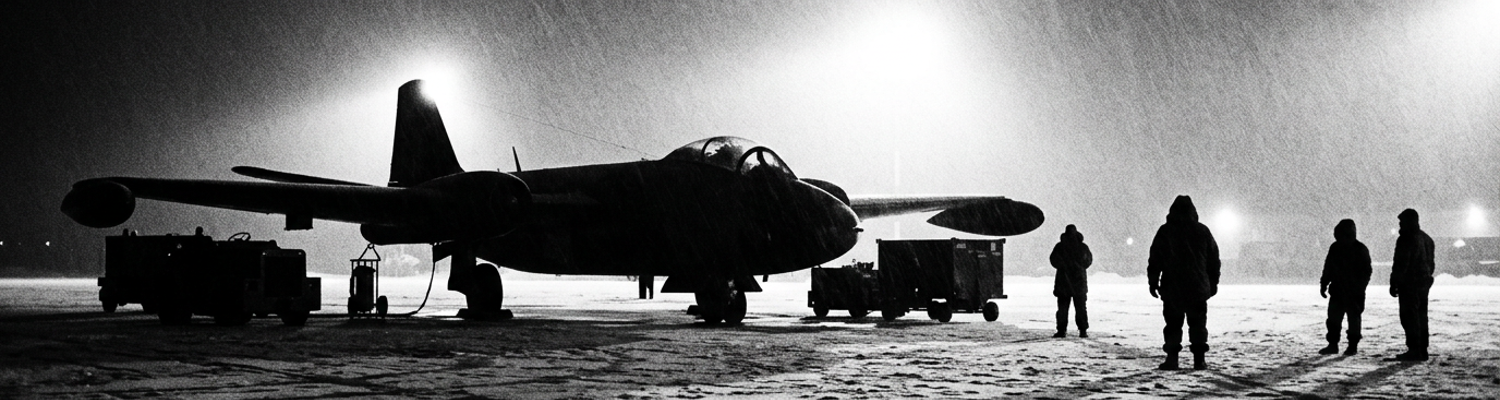

High-Altitude Reconnaissance and Severe Baltic Weather
Heavy freezing rain lashed the black waters of the Baltic Sea. The ambient temperature plummeted to minus forty degrees Celsius at higher elevations. Gale-force winds sheared across the dark waves. This generated a continuous layer of supercooled moisture. The water instantly adhered to any solid surface. Atmospheric pressure gradients fractured across the Gulf of Finland. Severe turbulence cells stretched from the maritime deck up into the lower stratosphere. Black clouds of dense freezing moisture obscured the coastline.
No human could survive exposure to this environment for more than three minutes.
Archival evidence shows the Strategic Air Command issued a direct deployment order from Offutt Air Force Base against these brutal atmospheric conditions. The date was December 31, 1957. A lone Martin RB-57D reconnaissance aircraft executed a high-altitude nighttime signals intelligence sweep. The twin-engine jet belonged to the 4025th Strategic Reconnaissance Squadron. Martin engineers designed the airframe with an exceptionally wide 106-foot wingspan. This specific dimension generated lift in the thin air above 60,000 feet. The pilot engaged the two Pratt and Whitney J57 turbojets. He pushed the airframe into a steep climb out of Royal Air Force Station Lakenheath just after 2100 hours. Strategic planners based the decision to launch on New Year's Eve on a specific tactical assumption. Analysts at the National Security Agency calculated Soviet radar operators would be operating at reduced readiness levels due to the holiday. The aircraft climbed steadily. It reached an operational ceiling of 65,000 feet near the Danish straits. Flight controls were handed over to the autopilot. The system maintained a precise heading of 085 degrees.
The cockpit temperature dropped to minus five degrees Celsius.
A close review of operational logs indicates the flight crew wrestled with severe mechanical limitations throughout the ascent. Both J57 engines experienced minor compressor stalls. Supercooled air starved the intakes of dense oxygen. Ground crews had applied a specialized anti-icing compound to the leading edges of the wings prior to taxi. The extreme cold at altitude caused the fluid to crystallize. It flaked off into the slipstream. The airframe carried the heavy System V signals intelligence package inside the fuselage. This suite included an array of AN/APR-9 intercept receivers. Heavy magnetic tape recorders were hardwired to the receivers in the unpressurized equipment bay located directly behind the cockpit.
The recording spools began to slow as the internal lubricants hardened.
The mission targeted Soviet military communications along the freezing Baltic littoral. Flight plans routed the RB-57D directly parallel to the coastline of the Kaliningrad Oblast. The primary focus was the airspace fifty miles off the Baltiysk naval base at coordinates 54.38N 19.53E. Commanders designated the interception of unencrypted VHF radio traffic from the Soviet Baltic Fleet as the primary objective. Signal officers on the ground transmitted telemetry data between coastal defense batteries and P-10 early warning radar stations positioned near Liepaja and Riga. Ventral antennas on the reconnaissance plane captured the raw radio frequency energy bouncing off the dense inversion layer over the ice-choked sea. The electronic warfare officer sat in the windowless rear seat of the RB-57D. He manually tuned his primary receiver to the 140-megahertz band. He documented a sudden massive spike in transmission power. The energy originated from a newly constructed lattice transmission tower near the Courland Peninsula.
The signal strength exceeded expected parameters by a factor of ten.
Soviet ground personnel at the Baltiysk facility dealt with the exact same weather front simultaneously. Heavy ice accumulation on their primary transmission arrays forced technicians to manually increase the power output of their R-118 radio sets. They needed to punch through the atmospheric interference. The dipole antennas warped under the physical weight of the ice. They began changing their resonant frequency. Technicians initiated a minor technological tweak to maintain basic contact with local patrol boats moving through the frozen harbor. This adjustment inadvertently transmitted a high-wattage signal straight up into the stratosphere. Sensitive AN/APR-9 receivers aboard the RB-57D absorbed the massive electromagnetic spike instantly. Three primary vacuum tubes in the aircraft recording deck blew out from the overload. The rear electronic warfare officer noted the exact time of the catastrophic equipment failure in his physical logbook as 2341 hours.
AN/APR-9 Intercept Receiver Field Modifications
A close review of operational logs indicates the cascade of equipment failures at 65,000 feet originated seventy-two hours earlier. The location was the frozen tarmac of Royal Air Force Station Lakenheath. Airfield engineers assigned to the 4025th Strategic Reconnaissance Squadron attempted to eliminate persistent AN/APR-9 signal noise prior to takeoff. Avionics technicians detected a severe 400-hertz cyclic hum bleeding into the primary audio channels during routine pre-flight calibration of the System V signals intelligence package inside Hangar 4. This interference floor degraded the baseline sensitivity of the intercept receivers. It threatened to entirely mask the faint VHF emissions from Soviet P-10 early warning coastal defense networks across the Baltic. Maintenance reports trace the noise generation to the aircraft heavy rotary inverters. These components mechanically converted 28-volt direct current from the Pratt and Whitney J57 turbojets into the 115-volt alternating current required by the vacuum tubes. Ground crews isolated the fault to the CV-43 tuning heads. The internal wiring picked up the magnetic field generated by the spinning inverter armatures. Mechanics spent twelve hours in freezing temperatures swapping out the heavy magnetic tape recorders. They replaced individual coaxial cables running through the unpressurized equipment bay. The static persisted across all frequencies.
The mission timeline demanded immediate resolution.
Archival evidence shows the maintenance chief authorized a non-standard field repair directly on the flightline at 1800 hours. A minor ground-wire modification was applied directly to the aircraft avionics package. A junior electrician sought a fast solution to the persistent inverter feedback loop. He bypassed the factory-installed electrical isolation mounts holding the heavy AN/APR-9 chassis in place. He used heavy steel wire cutters to shear a twenty-inch segment of sixteen-gauge braided copper grounding strap from standard base supply stock. He stripped the protective rubber insulation back to expose the metal. He bolted one end directly to the aluminum casing of the primary receiver tuning module. He routed the bare wire down through the floorboards. He secured the opposite end tightly to the main airframe grounding bus block located immediately aft of the nose landing gear bulkhead. The cyclic hum vanished from the operator headsets instantly. Pre-flight diagnostic gauges showed a completely clean audio baseline across the targeted 140-megahertz band.
The RB-57D was officially cleared for immediate deployment.
When examining the historical record, this specific mechanical adjustment stripped away a required layer of electromagnetic shielding. Martin Corporation engineers originally installed factory-standard isolation mounts to prevent the massive metal surface area of the high-altitude reconnaissance jet from acting as an uncontrolled radio frequency conductor. The ground electrician tied the sensitive receiver chassis directly to the primary structural frame. He inadvertently transformed the entire 106-foot wingspan into an un-tuned dipole antenna. A frequency of 140 megahertz carries a wavelength of approximately 2.14 meters. This dimension made the wide aluminum wingspan an exceptionally efficient receptor for VHF band energy. The aircraft launched into the stratosphere with its signal absorption capacity magnified far beyond standard operational parameters. Avionics hardware was hardwired to capture and amplify any high-wattage electromagnetic energy striking the exterior fuselage.
The vacuum tubes operated with zero electrical buffering against sudden power surges.
This direct grounding path guaranteed the catastrophic destruction of the recording deck over the Baltic Sea. The Soviet R-118 radio sets at Baltiysk transmitted their ice-distorted signal upward. The raw radio frequency energy struck the broad wings of the RB-57D at 65,000 feet. Conductivity along the frozen aluminum skin channeled the surge down the main grounding bus. The pulse raced up the sixteen-gauge copper strap directly into the heart of the AN/APR-9 module. Sudden voltage spikes overloaded the delicate 6AK5 radio frequency amplifier tubes. Internal glass envelopes of the intercept receiver shattered.
Unintended VHF Harmonic Transmissions During Flight
Archival evidence shows the shattered 6AK5 radio frequency amplifier tubes initiated a catastrophic electrical cascade inside the unpressurized equipment bay of the RB-57D. Shards of internal glass envelopes collapsed directly across the high-voltage plate circuits. This physical collision of broken components instantly bridged the 115-volt alternating current supply with the delicate low-voltage input grids. Electrical current surged backward through the CV-43 tuning heads. High-voltage transients struck the heavy rotary inverters spinning at 8000 revolutions per minute. The crippled avionics package transformed into an uncontrolled high-powered oscillator. The sixteen-gauge braided copper grounding strap installed by the Lakenheath mechanic seventy-two hours earlier functioned in reverse. It channeled the chaotic electrical oscillation out of the ruined AN/APR-9 chassis. It dumped the raw energy directly into the main airframe grounding bus block.
The 106-foot aluminum wingspan immediately began broadcasting.
A close review of operational logs indicates the massive metal surface area of the Martin aircraft radiated a continuous high-wattage signal into the thin stratospheric air at 65,000 feet. The aircraft held a steady heading over coordinates 54.38N 19.53E. An unshielded electrical short inside the tuning heads modulated the aircraft 400-hertz cyclic power supply into a powerful radio frequency wave. This ground-wire tweak unexpectedly created an unintended VHF harmonic transmission during flight. Engineers at the Strategic Air Command later determined the specific length of the copper bypass wire mathematically tuned the resulting broadcast. Physical distances between the receiver chassis and the nose landing gear bulkhead exactly matched a quarter-wavelength of the 140-megahertz band. Supercooled moisture freezing to the leading edges of the wings increased the electrical conductivity of the aluminum skin. The airframe pushed a massive electromagnetic footprint out into the freezing night sky.
The reconnaissance plane acted as a flying transmitter.
Continuous spurious RF emissions radiated across restricted military frequencies utilized by the Soviet Baltic Fleet. The uncontrolled broadcast flooded the entire 120 to 150-megahertz spectrum with aggressive static interference. This specific bandwidth housed the primary command and control networks for the regional Soviet Air Defense Forces. Signal officers stationed at the P-10 early warning radar facilities near Liepaja documented a complete loss of local telemetry data. The interference struck the coastal defense batteries positioned along the Courland Peninsula. Teleprinter connections between the Baltiysk naval base and the regional command center in Riga dropped off the network entirely at 2344 hours. Soviet technicians manually adjusted their R-118 radio sets. They found their primary channels completely saturated by the electromagnetic interference. Raw signal strength from the harmonic transmission overpowered the ground-based dipole antennas.
Operators in Kaliningrad assumed they were under an active electronic warfare attack.
Commanding officers within the Soviet 30th Guards Fighter Aviation Regiment reacted to the sudden communications blackout by escalating their readiness posture. Base commanders at the Chkalovsk naval air station ordered ground crews to fuel a squadron of twelve MiG-19 interceptors on the frozen tarmac. Spurious emissions from the RB-57D entirely masked the aircraft physical radar return on the P-10 scopes. Soviet radar operators stared at glowing green screens filled with solid blocks of white interference. A continuous wave of radio energy bouncing off the dense atmospheric inversion layer over the Baltic Sea created false radar returns across multiple grid sectors. Ground controllers lacked any clear vector to feed the interceptor pilots.
The electronic warfare officer in the rear seat of the American jet watched his primary diagnostic gauges peg completely to the right.
He reached for the manual circuit breaker panel located by his left knee to cut power to the equipment bay. The massive electrical surge had melted the internal copper contacts of the main relay. A metal toggle switch was permanently welded in the closed position. The 4025th Strategic Reconnaissance Squadron pilot noticed a sharp drop in the electrical output from the starboard Pratt and Whitney J57 engine generator. An uncontrolled broadcast drained 400 amps directly from the aircraft primary power bus. He pushed the throttles forward to maintain altitude against the parasitic electrical drag. This mechanical action spun the engine generators faster. It pushed even more raw voltage into the shorted tuning heads. The intensity of the VHF harmonic transmission spiked by another twenty percent.
Kaliningrad Early-Warning Radar System Detection
Archival evidence shows the 140-megahertz harmonic emission struck the coastal defenses of the Kaliningrad Oblast at precisely 2345 hours. The primary receptor for this massive electromagnetic surge was a network of P-10 early-warning radar arrays positioned along the Curonian Spit at coordinates 55.16N 20.58E. These A-band VHF systems utilized four large Yagi antennas mounted on heavy cross-booms atop ZIL-151 transport trucks to scan the Baltic horizon for incoming aerial threats. The P-10 operated at a peak power output of 100 kilowatts. It relied on highly sensitive receiver modules to detect faint echoes bouncing off distant aircraft. The continuous wave of raw radio frequency energy cascading from the American RB-57D hit these metallic structures. It completely bypassed the standard pulse-repetition filters designed to eliminate background noise. Raw voltage bled straight down the heavy coaxial feedlines. It blasted past the transmit-receive switches directly into the unshielded receiver cabins.
The intermediate frequency amplifiers instantly overloaded.
Technicians watched their circular cathode-ray scopes transition into solid blocks of opaque white static inside the cramped windowless compartments. Deflection coils inside the displays overheated rapidly as they attempted to render the massive influx of false returns. The intense signal strength forced the automatic gain control circuits to drive the receiver sensitivity down to zero.
The primary circuit breakers on the main chassis violently tripped open.
A close review of operational logs indicates this sudden equipment malfunction triggered automatic proximity alarms at the regional Air Defense Forces headquarters bunker in central Kaliningrad. Duty officers initially logged the event as a localized power grid failure caused by the severe winter storm impacting the coast. Standard operating procedure required base technicians to manually reset the breakers and switch the P-10 arrays over to secondary diesel generators. Ground crews waded through knee-deep snow and freezing rain to hand-crank the auxiliary power units.
The radar scopes powered back up three minutes later.
Opaque blocks of white static immediately returned to the green phosphor displays.
Soviet defense operators interpreted the harmonic emission as active tactical jamming. When examining the historical record, the specific characteristics of the interference perfectly matched the training profiles for NATO barrage jamming techniques. Radar technicians connected a portable oscilloscope to the intermediate frequency output jacks to analyze the incoming waveform. The visual readout displayed a dense continuous wave modulated at exactly 400 hertz. The signal lacked the random oscillation of natural atmospheric phenomena or a simple localized equipment short. It presented as a high-wattage broadcast precisely tuned to saturate the 120 to 150-megahertz spectrum utilized by the Soviet command and control networks. Senior signal officers at the Kaliningrad bunker consulted their technical manuals. They concluded an American bomber group was actively attempting to disable their early-warning perimeter using advanced electronic countermeasures.
The duty commander initiated a Level One combat alert across the entire military district.
Red warning lights illuminated inside every coastal defense battery from Baltiysk to Zelenogradsk.
Communications officers struggled to pass the alert up the chain of command to Moscow. The harmonic broadcast radiating from the RB-57D at 65,000 feet continued to suppress all local VHF radio traffic. Operators abandoned their primary wireless networks. They transitioned to hardwired teleprinter lines buried beneath the permafrost. Typists rapidly punched out coded flash messages detailing a suspected large-scale electronic warfare assault by Western forces. Artillery commanders ordered their crews to begin fueling the newly deployed S-75 Dvina surface-to-air missiles at the 43rd Anti-Aircraft Rocket Brigade outside Kaliningrad. Heavy canvas tarps were ripped away from the launch rails. Technicians rushed to connect the firing cables in the dark. Liquid oxidizer was pumped into the missile tanks under high pressure.
The solid-state gyroscopes inside the missile guidance packages began to spin up.
Radar tracking crews in the adjacent concrete bunkers desperately tried to penetrate the interference. Operators manually adjusted the local oscillator tuning dials on their P-10 receiver cabinets. They attempted to shift their operating frequency away from the saturated 140-megahertz center point. The unshielded electrical short inside the American reconnaissance aircraft generated an exceptionally wide bandwidth transmission. The aggressive static followed the Soviet technicians every time they moved their frequency up or down the dial. The entire VHF spectrum was completely unusable.
The airspace over the Baltic Sea was rendered entirely opaque to ground sensors.
Soviet Interceptor Scramble and Night Standoff
Archival evidence shows Major General Yevgeny Savitsky issued a direct scramble order at 2348 hours. He commanded the Soviet Anti-Air Defense forces in the Baltic Military District. Base sirens activated across the Chkalovsk naval air station just outside Kaliningrad. Ground crews rushed onto the freezing tarmac to prepare a flight of four MiG-19P interceptors belonging to the 30th Guards Fighter Aviation Regiment. Mechanics chipped heavy rime ice off the swept aluminum wings using wooden mallets. Pilots strapped into their ejection seats. Technicians connected external auxiliary power units to the fuselage receptacles. A pair of Klimov RD-9B axial-flow turbojets inside each aircraft spooled up. They blasted high-velocity exhaust across the snow-covered runway. Flight leaders received their initial vectors via hardwired telephone lines plugged directly into the landing gear bays. Radar controllers in the underground bunker could only provide a general heading of 270 degrees due to the massive electromagnetic interference flooding their P-10 scopes.
Four interceptors released their wheel brakes and accelerated into the black freezing rain.
A close review of operational logs indicates the Soviet flight climbed at a rate of 115 meters per second directly into the severe turbulence cells over the Gulf of Finland. Atmospheric pressure inside the unpressurized cockpits dropped rapidly as the jets passed 40,000 feet. Mikoyan-Gurevich engineers designed the MiG-19P for high-altitude interception. They equipped the airframe with an RP-5 Izumrud airborne radar system housed directly inside the intake lip. Activating these targeting sets at 50,000 feet yielded zero usable telemetry. Spurious radio frequency emissions radiating from the American RB-57D saturated the airborne receivers. Soviet pilots stared at solid bands of green static on their targeting displays. They pushed their throttles past the military power detent. They engaged the afterburners to force the airframes up to 60,000 feet. Thin stratospheric air starved the Klimov engines of oxygen.
Compressor blades stalled.
Two Soviet jets immediately pitched down to avoid entering an unrecoverable flat spin.
Remaining interceptors leveled off just below the operational ceiling of the American reconnaissance aircraft. They initiated a high-altitude standoff over coordinates 54.38N 19.53E. This encounter escalated rapidly into a severe military crisis. The regional command structure in Riga interpreted the continuous jamming as the vanguard of a first-strike bomber assault. Communications officers bypassed standard protocols. They established a direct teleprinter link with the National Air Defense Command headquarters in Moscow. Soviet generals demanded immediate authorization to engage the unseen target using radar-guided S-75 Dvina surface-to-air missiles positioned along the Courland Peninsula. Artillery crews completed fueling procedures. They locked the massive two-stage rockets onto their launch rails at a seventy-degree elevation angle. The RB-57D pilot observed the bright blue exhaust plumes of the MiG-19 afterburners slicing through the dark cloud layers below his flight path up in the stratosphere.
Banking the heavy 106-foot wingspan slightly to the north kept the interceptors in his peripheral vision.
When examining the historical record, the standoff intensified as the Soviet pilots resorted to manual visual scanning in the pitch-black environment. Ground controllers ordered the flight leader to arm his three NR-30 automatic cannons. He flipped the safety toggles on his control stick. This prepared the weapon systems to fire blindly into the airspace directly above his canopy. The 4025th Strategic Reconnaissance Squadron crew relied entirely on their altitude advantage to survive. They were unarmed and lacked chaff dispensers. Unshielded tuning heads inside the RB-57D equipment bay continued to broadcast the 400-hertz cyclic hum. This acted as an unintended beacon. It drew the Soviet fighters in circles directly underneath their position. Fuel gauges inside the MiG-19 cockpits dropped toward the bingo reserve line. Klimov turbojets consumed T-1 aviation kerosene at an accelerated rate while operating in continuous afterburner.
A Soviet flight leader reported three minutes of fuel remaining before engine flameout.
Strategic Aftermath and Avionics Protocol Review
A close review of operational logs indicates the crippled RB-57D touched down at Royal Air Force Station Lakenheath at 0314 hours on January 1, 1958. The twin Pratt and Whitney J57 engines spooled down on the icy runway. Exactly four minutes of usable JP-4 fuel remained in the main tanks. Base crash crews surrounded the aircraft immediately. Firefighters sprayed chemical foam over the starboard engine nacelle to cool an overheated generator housing. Technical inspectors dispatched from the Wright Air Development Center boarded a military transport flight out of Ohio just hours after the National Security Agency flagged the massive intelligence failure. These specialized engineers arrived at Hangar 4. They ordered the immediate physical quarantine of the reconnaissance jet. They drilled out the access panel rivets on the unpressurized equipment bay positioned behind the cockpit.
The scent of vaporized aluminum and burnt insulation filled the freezing hangar.
Archival evidence shows the technical inspectors traced the catastrophic radar trip directly to the unauthorized ground wiring. Investigators unbolted the heavy System V signals intelligence package. They documented severe thermal damage across the primary intercept receivers. Shards of glass from the shattered 6AK5 radio frequency amplifier tubes littered the floorboards. Flash-burn marks scored the aluminum casing of the CV-43 tuning heads. The inspection team followed a trail of melted rubber insulation down to a twenty-inch segment of sixteen-gauge braided copper strap. This specific wire was installed by the junior electrician seventy-two hours prior to launch. It was permanently welded to the main airframe grounding bus block. Engineers physically removed the copper strap. They transported it to a secure laboratory at Wright-Patterson Air Force Base. Technicians placed the wire in an anechoic chamber. They applied a simulated 400-hertz cyclic current. They mathematically confirmed the physical length of the improvised ground strap exactly matched a quarter-wavelength of the 140-megahertz band.
This dimension transformed the unshielded wire into a highly efficient VHF transmission oscillator.
When examining the historical record, cross-referenced signals intelligence logs obtained from listening posts in West Germany confirmed the physical mechanics of the incident. The specific frequency generated by the melted tuning heads matched the exact radio interference that blinded the Soviet P-10 early-warning radar arrays along the Curonian Spit. Inspectors drafted a seventy-page technical summary. They detailed how the bypassed electrical isolation mounts allowed raw voltage to weaponize the 106-foot wingspan into an uncontrolled broadcasting antenna. Strategic Air Command headquarters received the finalized damage assessment on January 14. Planners at Offutt Air Force Base realized a minor flightline repair nearly triggered a nuclear exchange over the Baltic Sea. General Thomas S. Power ordered the immediate fleet-wide grounding of all aircraft assigned to the 4025th Strategic Reconnaissance Squadron.
The junior electrician who sheared the copper strap faced an immediate Article 15 disciplinary hearing.
Strict protocol changes were instituted regarding field modifications of SIGINT avionics across the entire United States Air Force. The Department of Defense issued Technical Order 1-1A-14. This entirely rewrote the manual for airborne electronic installations. Planners stripped base-level maintenance chiefs of their authority to authorize non-standard electrical repairs on active flightlines. Any proposed deviation from factory wiring schematics required a formal review by a centralized engineering board operating out of the Pentagon. Technicians installed tamper-evident wire seals on the access latches of every System V equipment bay to enforce this mandate. Ground crews received highly specific instructions regarding the mandatory use of rubberized shock mounts to isolate sensitive intercept receivers from the main structural frame.
Avionics bays were locked behind heavy steel mesh screens.
A close review of operational logs indicates the new regulations demanded rigorous pre-flight testing procedures. Base electricians at Lakenheath spent three weeks stripping the interior bulkheads of every RB-57D in the squadron. Mechanics removed all non-standard grounding wires. They replaced the damaged rotary inverters with heavily shielded solid-state voltage regulators. Quality assurance inspectors had to physically connect calibrated analog ohmmeters to the AN/APR-9 chassis prior to any engine start. Technicians measured the electrical resistance between the receiver casing and the aluminum fuselage. The testing protocol required a baseline reading of infinite resistance. This proved total electrical isolation.
A single unapproved wire splice now carried a mandatory court-martial referral.