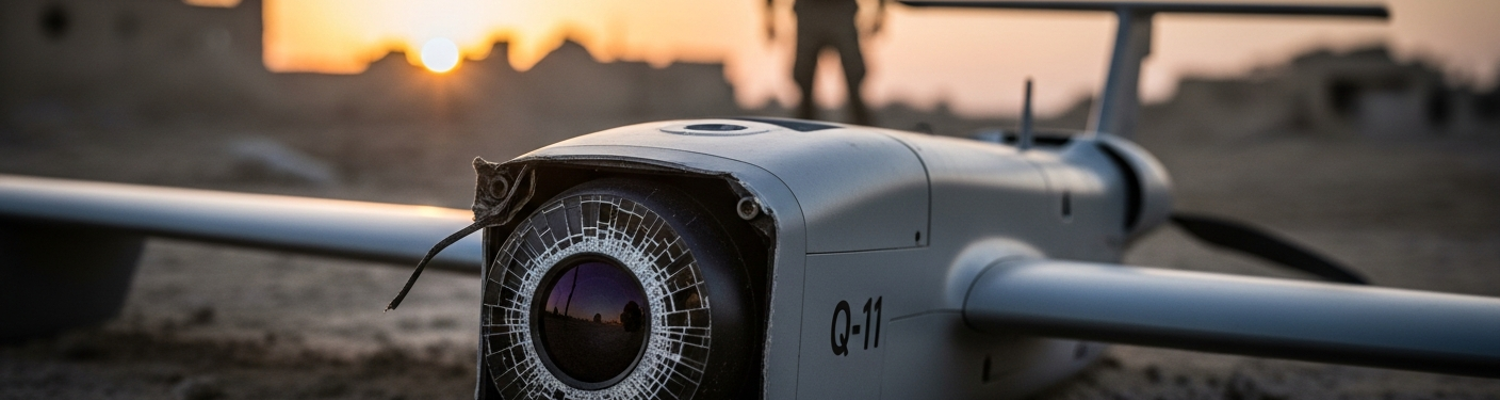

Commanders faced an impossible timeline. The pressure to reclaim the provincial capital of Ramadi cascaded down into every aspect of tactical planning, especially for the intelligence, surveillance, and reconnaissance assets providing digital eyes over the city. A close review of operational logs from the initial phases of the battle highlights a pervasive and immediate problem: severe signal degradation affecting tactical Unmanned Aerial Vehicles. In the dense urban sprawl of neighborhoods like Ta'meem, the city's structure became an adversary. Multi-story buildings of thick, reinforced concrete created a labyrinth of radio frequency blind spots and multipath interference. For small, hand-launched UAVs like the RQ-11 Raven, operating on L-band and S-band frequencies, this environment was effective at scattering and absorbing their command links and video downlinks. Operators found their control ranges, normally measured in kilometers, reduced to mere city blocks. The video feeds commanders depended on for real-time situational awareness would pixelate, freeze, or drop out entirely just as a drone rounded a building corner, leaving ground units exposed at critical moments.
This chaotic electromagnetic environment was not merely a product of the city’s physical geometry. It was actively amplified by the skeletal remains of its pre-conflict technology. A detailed analysis from signals intelligence teams operating on the periphery of Ramadi revealed the battlefield was saturated with unintentional RF noise. Partially destroyed power substations, with arcing and sputtering transformers, broadcasted wide-spectrum electromagnetic interference. Damaged but still intermittently powered cellular towers and miles of severed commercial cabling acted as passive antennas, reflecting and distorting UAV signals in unpredictable ways. Even household electronics in abandoned buildings contributed to the electronic clutter, creating a baseline of RF interference far higher than what operators had trained for. This unintentional jamming proved just as detrimental as deliberate enemy action, forcing UAVs to fly at higher, less detailed altitudes to maintain a stable link. This sacrificed the granular intelligence needed for urban combat and increased reliance on human intelligence from Iraqi forces. The coalition lost an estimated 11 percent of its ISR coverage in parts of Iraq due to this pervasive electromagnetic interference.
Compounding the environmental challenges was an entirely unexpected threat. The widespread deployment of crude, yet effective, improvised jamming devices by insurgent forces. These were not sophisticated military-grade systems, but rather garage-built contraptions, often consisting of little more than modified commercial radio transmitters powered by car batteries and connected to simple directional antennas. After-action reports indicate these jammers were effective because their signals were powerful, uncontrolled bursts of noise across a wide range of frequencies used by coalition UAVs. Unlike military jammers with predictable signatures, these improvised devices were erratic, making them difficult for frequency-agile radios to hop around. Insurgents placed them inside residential homes or moved them sporadically, activating them only for brief periods to disrupt a specific overwatch mission before shutting them down to avoid triangulation. This created a lethal cat-and-mouse game, where a clear video feed could suddenly vanish without warning, leaving a fireteam exposed or a suspected IED planter to escape unobserved.
The digital ISR architecture supporting the assault on Ramadi was fragile. This fact was made clear by the weather. In the week leading up to the main push into the city center in late December 2015, a period of unseasonable and torrential rain descended upon Anbar province. This was not an inconvenience for ground troops; it was a systemic threat to the UAV overwatch on which they depended. A review of operational logs shows a dramatic spike in signal loss incidents correlating directly with the heaviest periods of rainfall. The primary issue was signal attenuation. Water molecules in the atmosphere absorb and scatter radio frequency energy, a phenomenon known as rain fade. This effect is especially pronounced at frequencies above 10 GHz, which includes the Ku-band datalinks used by larger ISR platforms like the MQ-9 Reaper for high-bandwidth video and control. For operators at Al Asad Airbase, this meant their primary long-range, high-endurance assets were flying with degraded capability. Downlink margins, already tight due to distance and the complex urban environment, evaporated. Feeds that were supposed to provide crystal-clear full-motion video were reduced to intermittent, heavily compressed imagery, if they were available at all. The rain also had a physical impact, with moisture accumulating on ground station antennas and the radomes of the UAVs themselves, further scattering and degrading signal quality.
When the rain subsided, it was replaced by another environmental adversary. Sandstorms. The arid landscape around Ramadi, churned up by months of conflict, was prone to sudden, violent dust squalls. These phenomena presented a dual threat to UAV operations, attacking both the optical sensors and the datalinks simultaneously. Maintenance records from forward operating bases show a significant uptick in repairs for UAV gimbal systems, as fine, abrasive sand particles worked their way into sensitive mechanisms and scratched the protective coatings on camera lenses and laser designators. This physical abrasion reduced the quality of available imagery. More directly, the dense clouds of airborne particulate matter acted as a form of natural jamming. High-frequency signals, particularly in the Ku-band, would scatter off the suspended dust, increasing the bit error rate and causing intermittent signal loss. For a UAV operator attempting to maintain a lock on a target, the effect was disorienting. A high-resolution video feed could suddenly dissolve into a pixelated mosaic as a dust cloud rolled through the line-of-sight path between the aircraft and its ground station, rendering precise surveillance or target designation impossible. This forced commanders into difficult choices: either postpone reconnaissance missions or launch assets knowing their imagery would be unreliable.
These environmental factors culminated in the frequent compromise of secure datalinks. Encrypted communication systems, such as the Common Data Link (CDL) mandated for transmitting sensitive intelligence imagery, are not infinitely robust. They depend on a stable signal with a sufficient signal-to-noise ratio to maintain cryptographic synchronization. The signal attenuation from rain and the increased bit error rates from sandstorms consistently pushed datalinks below this threshold. When the signal quality dropped, the encryption hardware on the receiving end could no longer validate the incoming data stream, causing the entire link to sever. It was not a failure of the encryption itself, but a failure of the physical medium. A review of after-action reports from Joint Terminal Attack Controllers embedded with Iraqi Security Forces details numerous instances where secure Ku-band links from overhead Reapers would repeatedly drop during the final stages of the assault on the central government complex. This forced fire support teams to revert to less secure, lower-bandwidth voice communications over radio to guide airstrikes, a slower process that introduced greater risk of error and delayed the prosecution of fleeting targets.
In the hours immediately following the December 2015 climax of the Ramadi offensive, signals intelligence analysts at Al Asad Airbase began the work of piecing together a shattered digital picture. The primary challenge was not a lack of data, but a deluge of corrupted and incomplete information. Datalinks from MQ-9 Reapers and smaller RQ-11 Ravens, subjected to the harsh urban electromagnetic environment and enemy jamming, had arrived in fractured packets. Archival logs reveal that analysts were not dealing with clean video files, but with raw, discontinuous data streams. A single missing or corrupted packet in a Common Data Link transmission could render several subsequent frames of full-motion video unusable, creating a strobe-like effect that hid more than it revealed. Technical specialists worked to manually reconstruct these feeds, employing forensic software to bypass corrupted headers and stitch together viable frames. They had to rebuild files byte by byte, attempting to restore not just video, but the associated telemetry data that was critical for geolocation, the drone’s altitude, coordinates, and gimbal direction at the exact moment of capture. Without this metadata, a recovered image of a suspected insurgent was just a picture without an address.
This forensic effort extended beyond video. It pushed analysts to correlate erratic audio streams and faint radio frequency signatures with battle damage assessments. Audio intercepts, often captured by a UAV loitering above a firefight, were rarely clear. They arrived as heavily compressed, low-bitrate files filled with the noise of the drone’s own rotors and the distortion of urban signal reflection. Yet, within this noise, trained analysts could identify the distinct acoustic signatures of specific weapon systems. They cross-referenced these fragmented audio files with reports from Iraqi Security Forces on the ground. An audio snippet containing the high rate of fire of a DShK heavy machine gun, geolocated to a specific city block, could confirm an Iraqi unit’s report of encountering heavy resistance, even when video was unavailable. RF analysis provided another layer of confirmation. SIGINT teams mapped sudden, localized spikes in specific radio frequencies. An anomalous burst on a frequency known to be used for remote-detonated improvised explosive devices, when correlated with post-blast imagery from a subsequent UAV pass, allowed intelligence officers to confirm the successful detonation of a specific enemy device and map the tactics of IED cells operating in the area.
The entire post-mortem analysis underscored a critical intelligence gap that had plagued the operation from its inception. The delay between real-time ground threats and the delayed, often fragmented, perspective from aerial assets. A Joint Terminal Attack Controller embedded with an Iraqi Army unit moving through the Ta'meem neighborhood might identify a sniper in a third-story window. He would immediately request aerial observation, but the signal degradation meant the Reaper’s feed could be delayed or completely obscured. By the time analysts at a rear base received and reconstructed the damaged data feed to confirm the sniper’s location, the ground situation had changed. The sniper may have moved. The Iraqi unit, unable to wait for air support, had been forced to engage or bypass the threat on its own. Archival evidence shows this temporal disconnect was a constant feature of the battle. Ground units were operating in a lethal, second-by-second environment, while their primary ISR support was often minutes behind, struggling to deliver a coherent picture through a shattered digital lens. This forced Iraqi troops to rely on more traditional, and often riskier, methods of urban warfare, diminishing the technological overmatch coalition forces were supposed to provide.
A post-engagement technical review initiated in the immediate aftermath of the Ramadi operation uncovered weaknesses in tactical UAV communication protocols. Analysts from signals intelligence detachments, sifting through terabytes of captured data and after-action reports, focused on the performance of small, hand-launched systems like the RQ-11 Raven. The investigation revealed a systemic vulnerability rooted in the drone’s design. The Raven, prized for its portability and ease of use, transmitted its full-motion video back to its ground control station using an unencrypted analog signal. This decision, made years prior to prioritize low-latency video and reduce processing power requirements for the lightweight airframe, had become an operational security flaw. The L-band and S-band frequencies used for this video downlink, typically between 1 and 4 GHz, were not secret. A close examination of recovered insurgent equipment and battlefield technical intelligence confirmed that enemy forces possessed the capability to monitor these specific frequency ranges. The lack of encryption meant there was no digital handshake or cryptographic key required to view the feed. If an adversary could tune to the correct frequency, they could see exactly what the UAV operator saw. The review concluded that the accepted risk of analog transmission was no longer tenable in a conflict against an enemy who had demonstrated a growing technical sophistication.
This protocol weakness was exploited with ease. Insurgent technical cells in Ramadi demonstrated the ability to intercept the RQ-11 Raven’s video feed using commercially available wideband scanners, equipment obtainable on the open market. Reports based on captured laptops and forensic analysis of enemy positions showed that militants had successfully used software like SkyGrabber, a program designed to capture satellite data streams that cost less than thirty dollars, to pull down the unencrypted video. An insurgent team could equip a simple laptop with a compatible TV tuner card and a directional antenna, then systematically sweep the known L-band and S-band frequencies used by coalition UAVs. Once locked onto a signal, they were rewarded with a live First-Person View of their own neighborhood from the perspective of the overwatching drone. This gave them a powerful counter-surveillance tool. A Marine squad using a Raven to scout the street ahead was, without its knowledge, broadcasting its position and intended path directly to the enemy forces hiding in the buildings nearby. The very tool meant to provide a decisive intelligence advantage was actively betraying the movements of friendly forces.
The security implications for aerial reconnaissance missions were profound. The ability of insurgents to tap into live UAV feeds systematically undermined the purpose of ISR operations. A review of operational logs (File Ref: CJTF-OIR-AAR-21B) from the battle shows multiple instances where Iraqi Security Forces or coalition units would approach a target building, only to find it suddenly empty. It is believed that insurgents monitoring the drone feeds would simply watch the approach and exfiltrate before ground troops could establish a cordon. This exploit also allowed them to anticipate allied tactics. If a Raven loitered over a specific rooftop for an extended period, it was a clear indicator that the location was suspected of being an enemy observation post or sniper hide, allowing insurgents to either abandon the position or prepare an ambush for the inevitable assault. This forced a change in tactics, diminishing the reliance on the ubiquitous but vulnerable Raven for sensitive reconnaissance. Commanders had to request support from higher-echelon assets like the MQ-9 Reaper, which used more secure, encrypted datalinks. These larger drones were fewer in number and could not provide the same intimate, squad-level overwatch as a hand-launched system, creating a new intelligence gap at the lowest tactical level.
The discovery of compromised RQ-11 Raven video feeds triggered an immediate, top-down directive that fundamentally altered the tactical employment of small UAVs across the Ramadi area of operations. A close review of operational logs from late 2015 confirms that Combined Joint Task Force commanders issued a restrictive order concerning UAV flight patterns. Specifically, the directive prohibited the use of predictable, low-altitude loitering behaviors over contested city blocks. Standard overwatch patterns, such as tight orbits, figure-eights, or repeated racetrack paths directly over a target building, were now forbidden for unencrypted platforms. These patterns, while optimal for maintaining a persistent stare on a single location, had become a liability. They telegraphed allied intent to an enemy that could now see through the drone’s own camera. The order forced a shift in tactics, mandating that Raven operators use irregular, high-speed linear passes or fly at significantly higher altitudes to make their video streams harder to intercept and their focus harder to discern.
The operational consequences of this directive were felt almost immediately at the squad and platoon level. A review of after-action reports from Marine and Army units embedded with the Iraqi Security Forces details a consistent and frustrating new pattern: extended waits for secure aerial reconnaissance. A ground unit preparing to assault a suspected IED factory in the Ta'meem district could no longer rely on its organic Raven for a quick look over the compound wall. Instead, the unit’s Joint Terminal Attack Controller would have to formally request a time slot from a high-demand, theater-level asset, typically an MQ-9 Reaper operating from a distant airbase. This process was not instantaneous. A request logged at 14:32 Zulu might not be fulfilled until 15:58 Zulu. The ground troops were forced into static, exposed positions, waiting for the eyes-on confirmation that would allow them to move. This delay surrendered the initiative, giving enemy forces ample time to reposition, reinforce, or booby-trap the location before the assault could even begin. The momentum of urban combat, which relies on speed and surprise, was crippled by these newly imposed reconnaissance windows.
The identified vulnerability and the resulting tactical shift had a significant operational impact on both troop deployment and intelligence gathering. With the reliable, intimate overwatch of the Raven now curtailed, ground commanders had to revert to slower, higher-risk methods of maneuver. The fluid, sensor-led advance through Ramadi’s dense urban terrain was replaced by a more methodical, building-by-building grind. The value of the small UAV was its ability to provide immediate answers to a squad leader’s questions; this capacity was now severely diminished. Intelligence gathering also suffered. Instead of receiving a continuous stream of full-motion video that could reveal patterns of enemy activity over time, intelligence analysts were now fed a series of disjointed snapshots. A high-speed pass from a Raven or a high-altitude view from a Reaper could confirm the presence of a machine gun nest, but it was less likely to reveal the hidden route the fighters used to supply it. This created a less granular, more ambiguous intelligence picture, forcing units to commit to action based on incomplete information and increasing the reliance on human intelligence from ISF partners, which carried its own set of risks and verification challenges.