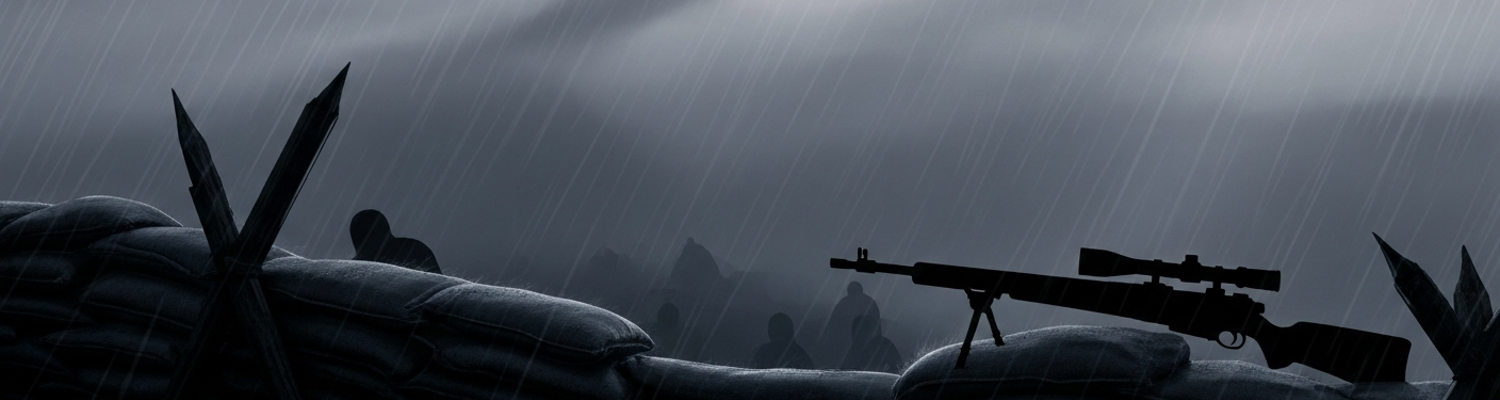

Pork Chop Hill Observation Post Construction
No training manual prepared the men for Pork Chop Hill. The doctrine promised methodical, layered defense construction, a scientific process of sandbags, timber, and steel. The reality in the spring of 1953 was a frantic scramble against time, artillery, and the frozen earth itself. Combat engineers, primarily from the 7th Infantry Division's 13th Engineer Combat Battalion, were thrown forward onto the contested slopes. Their tools were simple: shovels, picks, and a desperate mandate to dig. Construction was not a systematic affair. It was a series of violent, hurried actions under the constant observation of Chinese forces on adjacent high ground. The engineers worked almost exclusively in darkness, their movements illuminated by the flash of enemy mortar and artillery shells.
The ground was a primary opponent. A thin layer of topsoil gave way to rock that shattered pickaxes and resisted entrenching tools. Bunkers were not the deep, timber-braced structures of regulation. They were shallow scrapes in the earth, hastily lined with scavenged ammunition crates, sheets of corrugated metal ripped from destroyed shelters, and sandbags filled with rocky soil that offered dubious protection. Operational logs from the period (NARA Record Group 407) indicate that positions were frequently destroyed by incoming fire almost as quickly as they were erected. Engineers were forced to rebuild the same shattered parapets night after night. Each new forward observation post was less a feat of engineering and more an act of sheer will, a shallow hole purchased with exhaustion and blood.
This desperate effort was driven by geography. Pork Chop Hill was a pronounced salient, a dangerous bulge extending from the UN’s Main Line of Resistance deep into territory controlled by the Chinese People’s Volunteer Army (PVA). Its value was not the ground itself, but the view it offered. From its forward slopes, observers could peer directly down into the Yokkok-chon Valley, a critical artery for PVA troops and supplies. This vantage point allowed UN artillery controllers to bring down devastatingly accurate fire on enemy assembly areas and trench lines. Fire missions called in from temporary observation posts on Pork Chop were directly responsible for breaking up multiple company-sized PVA attacks. To lose the hill would grant the PVA a direct line of sight into the American rear, compromising the stability of the entire defensive line in that sector.
Protecting the exposed engineers became the immediate tactical problem. The solution arrived in the form of specialized riflemen. In response to escalating casualties among the construction parties, the 7th Infantry Division began deploying its first dedicated sniper teams. These were graduates of the division’s own sniper school, tasked with a specific mission: creating a protective overwatch. Operating in two-man shooter-spotter teams, they would crawl into rudimentary hides before dawn. Their positions were often nothing more than a shallow shell crater improved with a few sandbags. Their primary tools were the M1C and M1D Garand rifles equipped with M84 telescopic sights. Their job was twofold. First, they engaged in counter-sniper duels, hunting PVA marksmen. Second, they systematically suppressed any enemy machine gun or mortar crew that revealed itself. After-action reports show these teams focused on creating a zone of denial, making it lethal for any PVA soldier within 800 yards to expose themselves. Their fire was a shield, allowing the engineers precious minutes of uninterrupted work.
Winter 1952-53: The Freeze and The Thaw
The arrival of the Siberian winter in late 1952 was a sudden, punishing assault. Arctic winds swept down the Korean peninsula, dropping temperatures on the front lines to thirty degrees below zero Fahrenheit. For the soldiers of the 7th Infantry Division, this represented an opponent as dangerous as the Chinese forces watching them. A close review of medical logs shows a dramatic spike in non-combat casualties. Frostbite alone accounted for thousands of American casualties in the first winter of the war. Standard-issue lubricants for rifles and machine guns thickened and froze, rendering weapons useless until thawed. Batteries for AN/PRC-6 radios died almost instantly in the sub-zero air, severing communication. Ammunition and C-rations froze into solid, unusable blocks. The ground itself became as hard as rock, making any attempt to dig or improve positions a futile, exhausting effort.
The cold was an enemy, but the water was worse.
More punishing than the static cold was the relentless cycle of freezing rain and sudden thaws. A period of deep cold would be interrupted by a slight rise in temperature, enough to allow for a miserable, sheeting rain that coated every surface in a thick layer of ice. Then, just as quickly, the temperatures would plummet again. This was followed by another marginal warming, not enough to be comfortable, but just enough to turn the top layers of frozen ground and ice into a thick, clinging sludge. Trenches filled with a slurry of mud and slush, which would then refreeze into a treacherous, uneven surface. The process repeated endlessly.
This perpetual freeze-thaw sequence had a catastrophic effect on the structural integrity of the sniper hides and observation posts. The frantic construction had already left them vulnerable. Engineering reports from the front describe a consistent pattern of failure. Water from the rain and thaws would seep into the sandbags and the earthen walls of the bunkers. When the temperature dropped, this trapped water froze and expanded, exerting immense internal pressure. Sandbags ruptured. The frozen soil heaved and cracked bunker walls from the inside out. Timber supports, their footings destabilized by the muddy thaws, shifted and collapsed under the weight of their overhead cover. For the sniper teams, the collapse of their hides was a tactical disaster. A position that had offered concealment and a stable firing platform one day would be a slumped, exposed wreck the next. Water and mud infiltrated everything. Telescopic sights became fogged and useless. Rifle actions were fouled by the pervasive grit. Snipers were forced to abandon compromised positions and constantly seek or build new ones, exposing them to enemy observation and fire. Their mission was severely hampered not by enemy action, but by the simple physics of water turning to ice.
The Relocation Order
A command decision, rooted in a doctrinal adherence to standardized defensive layouts, fundamentally altered the tactical landscape for the 7th Infantry Division’s snipers. The division’s marksmen had proven lethally effective from their ad-hoc hides, positions they had selected based on superior fields of fire and concealment. These locations on the forward slope provided dominating overwatch of the approaches and the adjacent Yokkok-chon Valley. After-action reports from this period show that sniper teams were instrumental in breaking up enemy patrols and suppressing mortar crews. High command, however, observing the non-uniform nature of the outpost defenses, ordered a rationalization of the trench system. This directive compelled sniper teams to abandon their carefully chosen, operationally proven positions.
They were ordered back into the main trench line.
These new positions were integrated into the recently dug, regulation-style trenches. While offering better protection from artillery, they were a tactical disaster for the snipers. The core problem was geographic. Pork Chop Hill's topography was concave, with a significant depression in its center that naturally broke up defensive lines. The original, forward-slope hides had compensated for this, allowing snipers to cover the dead ground created by the hill’s shape. The relocated positions within the main trench line were set further back from the crest. This immediately and severely limited their fields of fire. An examination of tactical maps from February 1953 shows that from these new locations, the snipers' view into the valley floor was almost entirely gone. Their ability to engage targets on the approaches was reduced to narrow, predictable channels, with vast new dead zones where enemy troops could assemble unobserved.
The operational effectiveness of the 7th Infantry Division’s snipers plummeted. Confined to the trenches, their M1C and M1D rifles were largely negated. These weapons, effective to 800 yards and beyond, were now restricted to the short-range, linear confines of the trench network. Chinese forces quickly adapted. Enemy patrols, once harried by long-range precision fire, could now move with greater freedom in the low ground and draws around the hill. PVA mortar crews and machine gunners could set up in previously untenable positions. For the American infantrymen manning the outposts, the protective overwatch was gone, replaced by an increase in close-range firefights. The relocation, intended to create a more orderly and survivable defensive line, had the direct and opposite effect, handing a significant tactical advantage to the Chinese.
Counter-Snipers and Trench Foot
The relocation into the main defensive trenches handed the tactical advantage to the PVA snipers. Confined to the fixed geometry of the trench line, American marksmen lost their crucial fields of fire. PVA snipers, in contrast, were now free to establish their own hides in the dead ground that the American rifles could no longer reach. After-action reports reveal a sharp increase in casualties from single, precision shots. The PVA marksmen, often equipped with scoped Mosin-Nagant rifles, could study the American positions at their leisure, noting the predictable locations of firing ports and observation slits. They systematically targeted periscopes, forcing American soldiers to expose their heads for even a momentary glance over the parapet. Any helmet that appeared above the sandbags drew immediate, accurate fire. This created a lethal zone just inches above the lip of the trench, turning the simple act of observation into a deadly gamble. American snipers, whose Garands were designed for long-range engagements, were now trapped in a short-range fight, unable to suppress the enemy marksmen who were methodically hunting them.
The trenches became a trap.
Simultaneously, a more insidious opponent was consuming the soldiers from the ground up. The same trenches that offered notional protection from shrapnel became breeding grounds for immersion foot, then commonly called trench foot. The constant freeze-thaw cycles kept the trench floors in a perpetual state of muddy, semi-frozen slurry. Soldiers, pinned down for days by the constant threat of sniper and artillery fire, were unable to remove their boots to dry their feet. Medical records from the period document the grim progression of the affliction. Initially, the feet would become numb and turn a blotchy white or red. As circulation failed, the tissue would begin to die, swelling and turning a dark blue, then black. The condition was not a discomfort; it was a debilitating injury that could cripple a soldier as effectively as a bullet. Soldiers with advanced cases had to be evacuated, and many faced amputations. The standard-issue leather boots, once saturated, offered no insulation and held the freezing water against the skin, accelerating the decay.
The psychological pressure was unrelenting. It was a dual siege, fought against a visible enemy they could not effectively engage and an invisible one consuming their bodies. The mind of a soldier on Pork Chop Hill was trapped between the immediate, violent threat of a sniper's bullet and the slow, rotting decay of trench foot. Unit cohesion began to fray under the strain of watching comrades fall to two such different, yet equally final, fates. Medical evacuations show a rise in cases of what was then termed combat fatigue. The constant, high-pitched crack of a nearby sniper shot, the knowledge that you were always in someone’s sights, and the persistent, gnawing pain and numbness in one’s own feet created a state of hyper-vigilant exhaustion.
The Illusion of Reinforcement
The cycle of destruction and repair on Pork Chop Hill was a losing battle. Engineering after-action reports from the 7th Infantry Division detail a litany of structural failures, a direct result of the hill’s geology and the sheer volume of incoming fire. Positions dug into the loose, rocky soil and then battered by the freeze-thaw cycle possessed almost no structural integrity. A direct hit from a 122mm howitzer shell was not required; the ground-shock from a near miss was enough to collapse the shallow bunkers. The overpressure wave would heave the earth, and the loosely packed sandbag walls would simply liquefy and slump into the trench. Men of the 13th Engineer Combat Battalion and the infantrymen they supported were caught in a futile loop of nightly repairs. They would clear rubble from a collapsed section, re-stack sandbags filled with the same unstable soil, and brace the overhead cover, only for a fresh barrage at dawn to undo the work.
With regulation engineering supplies like timber beams and steel revetments expended or destroyed, the infantrymen turned to battlefield salvage. Their efforts were a testament to desperate ingenuity. An examination of the ruined positions after the final battles showed that soldiers used whatever they could find to add some measure of stability. Empty ammunition cans were filled with rock and dirt and stacked like heavy, metal bricks. Sheets of corrugated iron, stripped from destroyed supply sheds, were used as facing for trench walls. In some sections, soldiers wove discarded communications wire into makeshift gabions, wire cages filled with stones, to try and hold back the shifting soil. Steel plates from destroyed personnel carriers were jammed into walls to act as splinter guards. These improvisations were mechanically unsound and offered little real protection against artillery.
This ceaseless, frantic reinforcement created a powerful illusion of control. Pinned down by enemy snipers and facing constant artillery fire, the physical act of digging, stacking, and bracing was one of the few forms of agency available. It was a way to fight back, not against the enemy infantry, but against the environment and the feeling of complete helplessness. A newly-repaired bunker, no matter how flimsy, represented a small victory and a temporary return to a sense of order. Analysis of soldier behavior during the war indicates that engaging in such tasks was a critical coping mechanism, a way to stave off the gross stress reaction that characterized intense, static warfare. The security was entirely false. The improvised walls would not stop a direct hit.
The Final Decay
By the spring of 1953, the defensive network on Pork Chop Hill was in a state of advanced decay. The initial, frantic construction had created shallow, unstable positions, and the winter’s freeze-thaw cycles had shattered what little integrity they possessed. A constant, grinding barrage from PVA artillery ensured that no repair was permanent. The hill was less a fortified position and more a churned, unstable mound of earth and rubble. The very ground the men of the 7th Infantry Division stood on was actively failing beneath their feet.
This structural collapse was not a uniform, slow erosion. It happened in sections, creating a fractured and disconnected battlefield. A trench line that provided covered movement one day would be an impassable ditch of mud and splintered timber the next. The concussion from PVA 122mm howitzer shells was enough to liquefy the water-logged soil, causing entire bunker facings to slide away. This progressive weakening turned the outpost into a series of isolated islands. A platoon holding one sector might find its communication trenches to adjacent units completely gone, severed by a morning's artillery fire. This physical separation made mutual support nearly impossible and turned every resupply or casualty evacuation attempt into a perilous, exposed journey across open ground.
The PVA were masters of exploiting this weakness. Opposing the American forces were veteran units of the Chinese 47th and 23rd Armies, well-trained in infiltration and night assaults. Nightly probes became a constant feature of life on the hill. These were not full-scale attacks but small, platoon-sized teams of PVA infantry who used the darkness and the ruined landscape for cover. Archival records show these teams had specific objectives: to map the ever-changing gaps in the American line, to cut communication wires, and to harass the defenders with grenades and automatic weapons fire. They moved through the dead ground and collapsed trenches that American snipers, now confined to the main defensive line, could no longer cover. These probes kept the American defenders in a constant state of alert, denying them rest and methodically gathering the intelligence needed for larger assaults.
The physical disintegration of the outpost meant that small units were cut off, unable to see or communicate with their comrades. A squad might hold a single, semi-collapsed bunker, entirely unsure if the positions to their left and right were still manned by friendly forces or had been quietly overrun during the night. The inability to evacuate the wounded in a timely manner due to the destroyed trenches had a particularly damaging effect on morale. Watching a wounded comrade suffer for hours because there was no safe path to an aid station eroded the fighting spirit of even veteran soldiers. This sense of isolation, combined with the constant threat of enemy patrols appearing from the darkness and the unending artillery fire, created an environment where every soldier was fighting not just the enemy, but a growing sense of futility and abandonment.