
Intelligence Estimate 11-5-57 and Forward Dispersal
Soviet rocket brigades waited across the Thuringian border behind barbed wire and frozen pine ridges. They aimed heavy artillery tubes and tracked tactical launchers straight at the river crossings and staging bases of West Germany. National Intelligence Estimate 11-5-57 alerted NATO commanders on March 12, 1957, that Soviet 700 nautical mile ballistic missiles and tactical field rockets could strike European supply nodes within minutes of launch. Flight projections showed Seventh Army planners that fixed concrete barracks, rail hubs, and central ammunition depots would turn into ruined craters before ground crews could finish fueling their trucks. United States Army Europe responded to this threat by ordering Seventh Army heavy artillery units to abandon their fortified garrisons and adopt decentralized Pentomic dispersal schemes. Orders forced entire battalions to pack their maintenance shops into wooden crates and push their massive M65 atomic cannons out of heated motor pools straight into the rain soaked countryside.
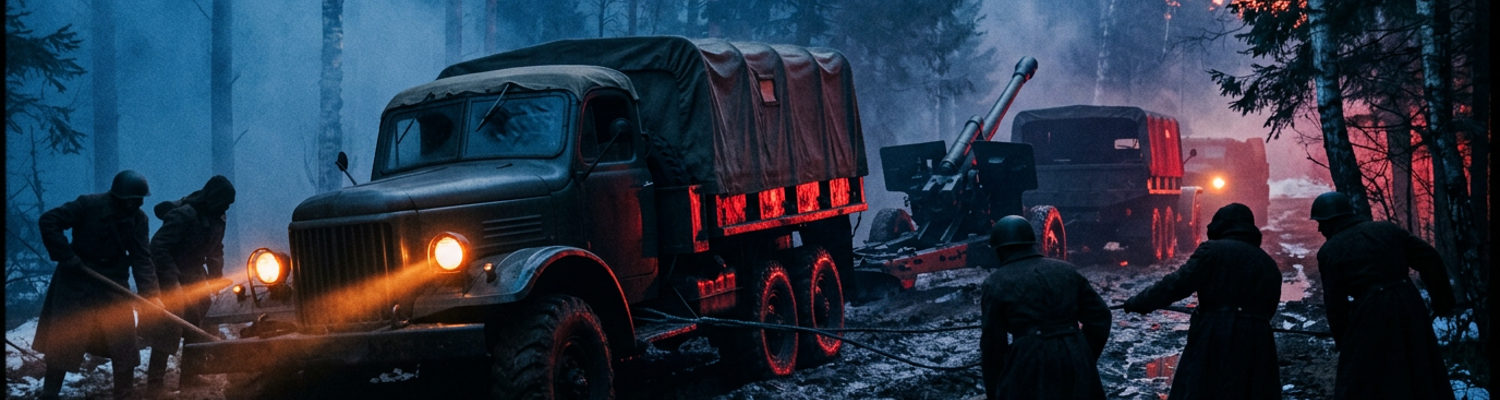
Rain soaked terrain fractured artillery battalions into isolated firing sections hidden across dense West German forests. Ordnance supply sergeants watched the established depot system fall apart as each gun section took two massive Kenworth tractor trucks, an eight man crew, and a pair of support trucks down narrow civilian logging routes. Wet fir branches tore canvas cab covers and slapped against the thirty eight foot gun tubes while drivers wrestled non power steering wheels through knee deep clay tracks. Screaming twin engine transporters burned fifty gallons of gasoline per hour just fighting up narrow forest defiles that German foresters had built only for light timber carts. Sheared transmission gears and ruptured hydraulic lines quickly littered the forest roads, stranding the heavy gun carriages on blind curves and blocking the advance of following supply trucks. Recovery crews jumped into the freezing slush with heavy steel cables and timber blocks, working by blackout flashlights to free trapped tires before enemy reconnaissance planes could spot the convoy.
Convoys stalled as tractor engines groaned back into gear and crews hauled the heavy artillery carriages off the road into dense evergreen hide sites. Supply sergeants unpacked broken wooden crates in the dark to discover that decentralization left their small detachments cut off from depot level fuel reserves, replacement fan belts, and fresh rations. Battery commanders requested emergency spare parts over tactical FM radios, but dead static and mountainous terrain blocked their calls before the transmissions could reach rear echelon ordnance depots. Field mechanics patched cracked hydraulic seals with friction tape and drained fuel from disabled support trucks to keep the main tractor engines running in the biting dampness. Pounding rain soaked through wool field jackets and churned the gun emplacements into deep mud, forcing soldiers to lay corduroy road mats made of freshly chopped birch logs under the transport wheels.
Transport wheels sank until timber beams groaned under the weight as crews dropped the central carriage to ground level to prepare the weapon for action. Camouflage netting went up immediately over the entire clearing, tied to surrounding pine trunks with hemp rope to break up the telltale outline of the twelve foot tall gun mount. Artillerymen unlocked the heavy screw breech and inspected the bore with flashlights, wiping condensation from the rifling lands while ammunition specialists prepared heavy training shells in the mud. Perimeter sentries loaded their rifles and took up forward security posts along neighboring dirt trails, scanning the mist for Warsaw Pact infiltration teams or low flying strike aircraft. Battery officers locked the coordinates of preplanned target sectors into mechanical firing computers, leaving the isolated weapon system prepared to fire its atomic warhead into the Fulda Gap at the first confirmation of incoming Soviet rockets.
Transporter Realities of the M249 and M250
Soviet rockets demanded immediate mobility, so Kenworth prime movers remained coupled to the firing carriage at nearby roadside staging points because battery commanders knew a nuclear launch would draw retaliatory artillery barrages onto their forest hide site. The complete M65 system weighed over 85 tons and required dual Kenworth prime movers, specifically the front facing M249 tractor and the rear facing M250 tractor. These two specialized trucks clamped directly to the heavy steel ends of the gun mount, suspending the massive carriage between them on eight heavy road tires. Each Kenworth tractor housed an air cooled, six cylinder Continental gasoline engine generating nearly four hundred horsepower, but moving such immense weight across uneven forest soil strained every piston and drive shaft to its absolute limit. Drivers sat perched high in exposed front cabs with poor visibility, forced to coordinate every steering correction and gear shift while balancing the swaying gun tube suspended between them.
Gun tubes suspended on the carriage relied on intercom cables running along the structural frame to provide the only direct link between the two cabs. Coordinating two synchronized engines required dual drivers communicating through a fragile hardwired inter cab intercom system that frequently severed in rough terrain. Low hanging pine boughs, flying rock fragments, and the constant flexing of the artillery mount repeatedly snapped the exposed telephone line during cross country movement. Snapping wires instantly cut voice contact, leaving the rear driver in the M250 tractor operating without advance warning about upcoming road hazards or gear changes chosen by the lead driver in the M249. Rear drivers faced backward relative to standard vehicle controls while traveling forward, which forced them to steer toward obstacles in reverse and mirror every sudden braking action purely by mechanical feel. Mismatched acceleration between the two separate engines quickly pushed the central artillery mount sideways into trees and ditch banks whenever intercom communication failed on narrow dirt paths.
Dirt paths destroyed tractor drive assemblies, causing sheared transmission gears and blown hydraulic linkages when navigating steep forest ascents and frozen mud tracks. Unsynchronized power delivery from the dual engines placed uneven torque across the drive axles, twisting hardened steel shafts until gear teeth stripped out of the transfer cases with sharp metallic cracks. Hydraulic steering booster lines burst under extreme pressure spikes whenever the rear tractor tires sank into frozen ruts while the front tractor pulled at full throttle. Pressurized fluid sprayed over freezing undercarriages, instantly robbing drivers of power steering and locking the steering linkages into rigid, unyielding positions. Disabled transporters then skidded downhill under the unchecked weight of the gun mount, crushing roadside saplings and digging deep trenches into the soft logging roadbed.
Roadbed trenches trapped the vehicles until mechanics hauled heavy timber cribbing, replacement gear clusters, and hydraulic hand pumps into the freezing slush to rebuild the damaged drive systems where they sat. Enlisted recovery crews worked under blackout tarps with grease caked hands, using heavy pry bars to realign bent steering rods while winter sleet froze on the bare metal. Support trucks hooked heavy steel recovery cables to the bumper pintles of the M249, attempting to anchor the stalled artillery piece before the entire assembly slid further down the forest slope. Sergeants spliced severed intercom wires with electrical tape and poured cold motor oil into cracked reservoir tanks to restore basic vehicle control. Drivers restarted the twin Continental engines and eased the heavy clutch pedals back into gear, slowly crawling out of the ditch toward the next firing position before dawn.
Infrastructure Collapse Along Rhine Withdrawal Corridors
Dawn light revealed tractor exhausts billowing thick vapor into the cold morning air as the gun rig leveled out onto the narrow asphalt bypass running westward toward the Rhine. West German secondary routes lacked the deep stone foundations needed to support such concentrated steel, and the extreme eighty five foot convoy length placed brutal stresses on local civil engineering. Massive axle loads repeatedly buckled stone culverts underneath the rural roadbed, collapsing underground drainage arches and dropping the multi ton tires deep into shattered stone. Secondary timber bridges spanning small creek beds groaned and cracked beneath the central gun carriage as load bearing stringers snapped under the immense downward force. Ordnance crews scrambled into freezing water with crosscut saws, heavy jacks, and timber baulks, propping up sagging spans from below while the dual Kenworth drivers eased their throttles forward. Artillerymen threw heavy railway ties under the rear transporter wheels to distribute the weight across the fractured decking, pushing the convoy forward across the buckled crossing into the next settlement.
Settlements presented new hazards as cobblestone streets funneled the long transporter pair between medieval stone houses and half timbered barns whose second story overhangs scraped the steel gun mount. Acute turns through tight village intersections proved impossible for the eighty five foot assembly to clear without clipping structures on both sides of the street. Transporter pairs repeatedly wedged tight against ancient masonry structures on these narrow turns, stalling convoy movement for hours at a time while radiator water boiled in the idling Continental engines. Drivers in the rear M250 cab had to coordinate blind reverse maneuvers over severed intercom wires, grinding massive tires against stone steps and tearing gutters off residential walls. Supply sergeants jumped down into the slush with sledgehammers, heavy pry bars, and pickaxes to knock down stone garden walls so the rear tractor wheels could pivot through the sharp corners. Mechanics burned through spare clutch plates and spilled hydraulic fluid while maneuvering back and forth inches at a time, finally clearing the town square to follow emergency route markers pointing toward designated river crossings.
River crossings turned into choked bottlenecks of stalled traffic as retreating artillery batteries collided with civilian cars, abandoned farm wagons, and disabled fuel tankers. Batteries became trapped along these critical designated routes, exposing the nuclear capable artillery to complete gridlock alongside hundreds of stranded combat vehicles. Evacuation plans required dedicated recovery teams to keep the roads open, but batteries remained stranded without heavy recovery vehicle support because corps wreckers were stuck in traffic jams miles behind the column. Ordnance sergeants had to clear the blocked highways without specialized equipment, stringing heavy steel winch cables from the front bumpers of the M249 tractors around overturned trucks and dragging disabled vehicles into drainage ditches. Warhead security details set up hasty perimeter outposts around the stalled atomic cannons in the freezing rain, training machine guns outward into the gridlock to protect the high priority weapons from chaotic crowds. Battery officers refused to abandon the immobilized M65s to Soviet air strikes, ordering the Kenworth drivers to push wrecked civilian sedans off the asphalt shoulders to force an escape path through the jam toward the Rhine bridges.
Warhead Handling and 280mm Atomic Projectiles
Rhine bridges remained distant as steel bumpers on the lead M249 tractors shoved the crumpled sedans aside, clearing an escape lane for the enclosed ordnance vans carrying the atomic shells behind them. Ammunition crews inside those escort vehicles managed the W9 and W19 280mm nuclear shells, each weighing hundreds of pounds and requiring dedicated mechanical hoists and specialized ordnance personnel to move. The older W9 projectile weighed over eight hundred pounds alone, packing an enriched uranium gun type assembly into a heavy steel casing that crushed fingers and dented truck beds if handled roughly. Specially trained ordnance specialists had to guide every inch of movement, because standard artillerymen were barred from even touching the classified warhead casings. Portable crane hoists mounted on the support trucks creaked under the dead weight as operators swung the massive rounds outward, trying to keep the steel cylinders from swinging wild and slamming into vehicle tailgates.
Vehicle tailgates dropped as winches groaned under the strain and mechanical hoists lowered the nuclear projectiles toward timber cradles resting in the mud. Strict custodial safety regulations required continuous armed sentries, locked physical restraints, and two man visual verification protocols whenever personnel exposed a live warhead. These rigid headquarters safety rules clashed directly with freezing field conditions, where ordnance crews lacked shelter, warm grease, and basic battery charging gear. Winter temperatures congealed standard military grease into hard paste inside the hoist gears, forcing mechanics to strike the frozen winches with wooden blocks to free the jammed teeth. Cold weather drained the portable test batteries, forcing ammunition teams to pack the unheated shells back into their transport boxes without completing their electrical diagnostic checks before loading the cargo trucks.
Cargo trucks bounced through frozen ditches and submerged potholes, violently jarring the untested nuclear shells strapped inside the cargo beds. Physical transport of nuclear warheads through off road mud threatened fragile internal firing electronics and electromechanical safing mechanisms. The W9 and W19 shells contained delicate internal arming switches, mechanical timers, and precision firing circuits designed to survive the shock of being shot from a cannon barrel, but constant low frequency road vibration shook internal solder joints loose before the weapons ever reached the gun breech. Shock mounts inside the transport boxes bottomed out against the floorboards, transmitting every impact from the rocky German soil directly into the electromechanical safing plugs. Moisture seeped past rubber gaskets on the warhead access panels, condensing on bare electrical contacts as the frozen metal warmed slightly under canvas covers.
Canvas covers peeled back as technicians wiped condensation off the exposed electrical pins using dry rags while armed sentries stood watch with rifles held ready in the freezing rain. Specialized ordnance personnel inserted handheld test probes into the warhead sockets to confirm that electromechanical safing switches remained fully locked in the safe position. Dead vehicle batteries forced the men to crank hand powered magneto testers in the dark to verify circuit continuity across the firing squibs. Any faulty indicator light on the field test sets meant the entire multi hundred pound projectile had to be tagged defective, winched back onto a support truck, and returned to a rear depot for rebuild. Ammunition teams worked through the night with numb fingers to bolt the transit covers over the certified shells, preparing to hoist the live rounds into the waiting breech of the M65 artillery cannon.
Radio Failures During Nuclear Alert Maneuvers
Artillery breech mechanisms swung open in the wet air, but the firing data required to load the heavy projectiles never arrived because simulated nuclear alert maneuvers in late 1957 caused immediate operational blindness. Line of sight frequency modulation systems on the vehicle radios required elevated ground to maintain contact with headquarters relay trucks parked miles to the west. Deep German ravines and basalt hills deflected the high frequency radio waves, trapping Seventh Army artillery batteries in blind hollows where transmissions could not climb out of the damp draws. Radio operators unspooled heavy field wire to raise auxiliary antenna masts into high pine branches, trying to lift their aerials above the ridgeline to catch the battalion network. Ice formed along the elevated wire elements, snapping copper strands under their own weight and tumbling the improvised masts back into the undergrowth. Communications specialists pressed rubber headphones hard against their ears and worked tuning dials through every assigned operational frequency, pulling in nothing but hollow rushing noise from the empty atmosphere.
Atmosphere conditions worsened as radios hissed with dead static while severe winter weather and thick forest terrain completely severed communication between dispersed gun sections and battalion headquarters. Freezing fog saturated the dense pine needles, creating an unbroken wall of wet vegetation that absorbed high frequency electromagnetic energy before it could travel two miles down the valley. Gun crews stood isolated around their heavy cannons in total operational darkness, unable to determine whether the silence meant their battalion headquarters had been destroyed in a simulated Soviet missile strike or if command posts were simply retreating along the highway. Ordnance sergeants kept the heavy auxiliary generators running to power the mechanical traversing gear, burning precious gasoline while waiting for fire control updates that never crossed the airwaves. Battery officers paced through the frozen mud with grease pencils and map boards in hand, knowing their autonomous dispersal mission was useless if higher command could not transmit authorized firing lock codes for the atomic projectiles. Frustrated commanders finally abandoned the silent radios and ordered their dispatchers to send physical runners into the storm to reestablish the broken command link.
Command links depended entirely on motorcycle couriers and jeep messengers dispatched with paper grid coordinates who were quickly cut off or lost on unmapped muddy logging trails. Dispatch riders straddling heavy military motorcycles hit slick clay ruts hidden beneath wet leaves, throwing their machines into drainage ditches and bending their steering forks beyond field repair. Quarter ton utility jeeps slid sideways off narrow timber access routes, sinking down to their transfer cases in freezing gray mud that defeated tire chains and hand winches. Drivers navigated without updated topographic surveys, relying on outdated civilian road maps that showed solid forestry tracks where local timber crews had left impassable quagmires of churned soil and waterlogged roots. Messengers carried canvas document pouches containing target coordinates and safety code authentications on foot through the driving sleet, wandering miles off course as darkness swallowed the forest trails. Artillerymen back at the hidden firing site waited beside the silent gun tube throughout the freezing night, leaning against the cold steel carriage without a single courier, radio transmission, or firing order reaching the battery perimeter.
Decontamination and Weapon Emplacement Under Simulated Fallout
Battery perimeters collapsed into chaos when simulated fallout markers drifted into the clearing, trapping the stranded crews inside a contaminated corridor without orders or relief from battalion. Enlisted crews pulled on bulky rubber gas masks and prepared their portable decontaminating apparatus, knowing that simulated radiological contamination required an immediate chemical washdown of the entire gun assembly. Freezing water hauled in five gallon cans from an adjacent forest creek filled the hand pumped chemical tanks, turning the spray nozzles into sputtering jets that coated the carriage frame in sheets of glaze ice. Soldiers scrubbed thick road grime, congealed chassis grease, and chalky fallout simulant off the twelve foot tall gun mount using stiff handheld wire brushes, working with bare, numbed fingers whenever wet mittens caught in the steel linkages. Runoff pooled around their combat boots in foul gray slush, splashing chemical neutralizing slurry and icy grit over their saturated field trousers as the bitter winter wind whipped through the pines. Ordnance specialists directed pressurized water straight into the traverse rings and elevation gears, clearing every exposed ball race before the freezing slurry could cement the massive weapon in place.
Weapon emplacement demanded immediate action as gunners seized heavy mechanical hand jacks to lower the carriage and ready the gun for firing before ice could freeze the newly cleaned traverse gears. Preparing the massive M65 mount for firing required manual leveling and jacking the central ball and socket turntable into frozen, shifting mud without crane assistance. Heavy engineering trucks and mobile crane rigs were stalled miles behind in clogged withdrawal routes, leaving the six man emplacement detail to manhandle massive oak timbers under the circular baseplate in the freezing mire. Soldiers pumped ratcheting hydraulic levers by hand to settle the sixty foot carriage, watching the bubble indicators on mechanical spirit levels drift as forty tons of dead steel weight drove the wooden footing unevenly into the thawing clay. Crewmen hammered heavy steel wedges under the sagging edges of the turntable, throwing their full body weight against iron pry bars to keep the central pivot point vertical against the yielding forest soil. Shifting mud forced the men to raise, shim, and relevel the entire central mount three separate times before the heavy ball and socket joint sat flat and stable enough to absorb the brutal downward recoil of a nuclear discharge.
Discharge preparations halted when steel breech cables snapped with a sharp metallic crack as the gunners cranked the elevation gears to test the newly stabilized mount. Total mission isolation left the battery completely cut off from maintenance supply lines, forcing ordnance crews to jury rig the sheared breech cables and blown hydraulic jacks by hand to maintain weapon readiness. Mechanics scavenged braided wire rope from the front recovery winch of an M249 tractor, using hand files and cold chisels to splice the frayed steel strands directly into the breech counterbalance sheaves. Soldiers disassembled leaking hydraulic jacks on greasy canvas tarps, scraping out scored cylinder walls with emery cloth and cutting replacement pressure gaskets from spare truck tire tubes. Artillerymen hauled on manual chain hoists with raw, grease blackened hands, muscling the massive screw breech into its locking ring without the aid of mobile workshop cranes. Crewmen finally slammed the repaired breech plug home and verified the mechanical firing linkages, keeping the atomic cannon primed for action in the silent forest while listening for the distant rumble of approaching enemy armor.
Obsolescence and Tactical Evolution in European Defense
Enemy armor threats materialized as Soviet scouts rattled along the logging roads just two miles north, forcing the isolated battery to face the brutal reality of packing up an eighty five ton artillery piece under imminent contact. Artillerymen struggled against the frozen mud to disconnect the firing platform, but raising the massive central turntable and re coupling the front M249 and rear M250 Kenworth tractors required hours of deliberate mechanical work that a fast moving battlefield simply did not allow. Deep forest tracks, waterlogged drainage ditches, and narrow clearances between thick pine trunks turned every repositioning attempt into a catastrophic logistical delay as heavy tractor tires churned uselessly through freezing clay. Ordnance supply sergeants watched replacement drive axles and steering knuckles snap under the strain of these hasty retreats, leaving entire batteries stranded on secondary logging trails without spare parts or heavy wrecker assistance. Tractor crews repeatedly suffered blown transmissions and shattered hydraulic lines while trying to negotiate steep forest ascents under simulated chemical and missile alerts, creating impassable bottlenecks along critical withdrawal routes. The vulnerability of heavy towed artillery in high mobility forest environments proved the operational impracticality of the M65 system to Seventh Army leaders who watched exercise after exercise end with simulated batteries overrun or destroyed in place by the opposing army.
Army leaders answered these catastrophic exercise failures by developing smaller 203mm atomic shells for the M110 howitzer, stripping away any practical justification for keeping the massive M65 cannon in operational service. Nuclear laboratories successfully packaged enriched uranium and plutonium assemblies into standard eight inch artillery projectiles, allowing self propelled tracked chassis to carry tactical nuclear firepower directly alongside frontline armored divisions without special highway convoys. Guided missile developers simultaneously introduced the MGM 18 Lacrosse, a truck mounted rocket system that could maneuver through rugged forest trails and deliver nuclear strikes across deep ranges with pinpoint accuracy. Ground crews operating the nimble M110 howitzers and Lacrosse launchers could fire and displace to new concealment within minutes, avoiding counter battery fire that would have wiped out a cumbersome towed cannon. Supply units benefited immediately from the shift because the tracked howitzers burned standard diesel fuel and shared mechanical components with conventional field artillery, eliminating the specialized spare parts pipeline required by the Kenworth tractors. Rapid advancements in smaller atomic shells and mobile guided missiles rendered the towed weapon obsolete across the entire European theater.
Theater commanders retired the M65 atomic cannon battalions from West Germany by 1963 in favor of lighter, self propelled nuclear delivery systems, ordering every battery to withdraw permanently from the border forests. Ordnance sergeants supervised the final disassembly of the giant carriages at railheads near Kaiserslautern and Mainz, stripping away camouflage tarpaulins and draining hydraulic fluid into steel recovery drums. Ammunition specialists packed the remaining training rounds and warhead maintenance gear into reinforced wooden crates, returning classified electromechanical firing sets to secure corps depots. Mechanics secured the heavy Continental tractor engines, winched the massive barrels onto reinforced heavy duty rail flatcars, and shipped the prime movers westward toward the coast. Veteran artillerymen transferred into newly formed self propelled howitzer units, trading the exhausting maintenance of twin Kenworth transporters and fractured inter cab intercom lines for the enclosed cabs of tracked armor. Gantry cranes at the Bremerhaven staging docks hoisted the massive guns aboard outbound cargo transports, ending the deployment of towed atomic artillery and leaving tactical nuclear defense entirely to fast moving tracked vehicles.