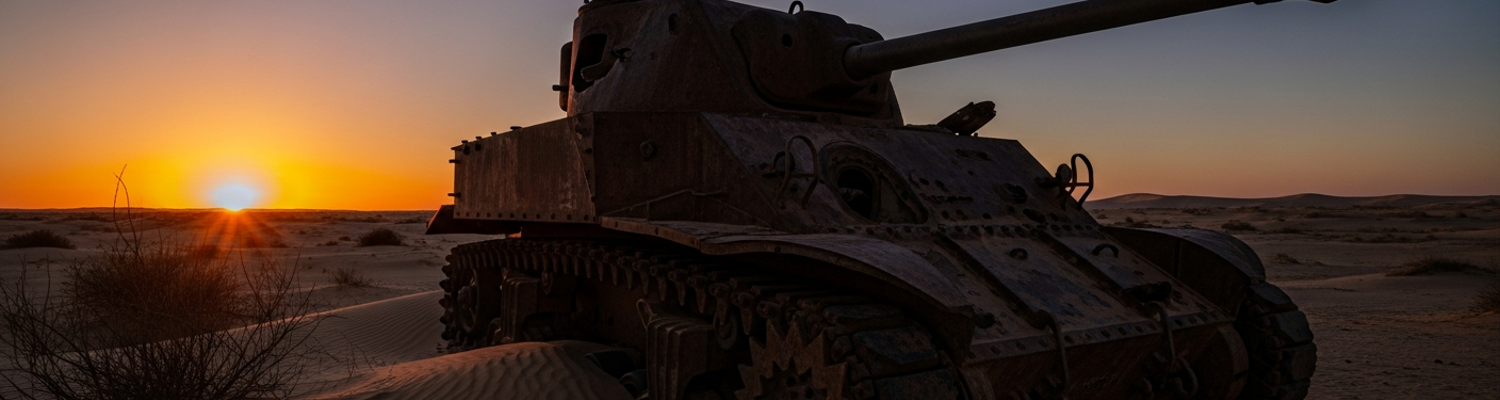

A mechanic with the 1st Armored Division’s reconnaissance platoon wiped grit from the dipstick of an M3 Scout Car. The metal was hot enough to sting through his glove. He already knew the reading. Bone dry. The line of armored vehicles sat motionless under the oppressive Tunisian sun, halted not by enemy action, but by empty fuel tanks. This single act was a microcosm of a systemic paralysis gripping the forward intelligence elements of the entire American II Corps. The initial, rapid thrusts from Algeria into Tunisia after the Operation Torch landings had dangerously overstretched a logistical chain unprepared for the distances and terrain involved.
The problem was distance.
Archival evidence (NARA Record Group 407) shows supply lines snaking over 400 miles from the primary Allied port at Algiers. They ran across poorly maintained roads and a single, dilapidated railway line. Planners had severely underestimated the requirements for a fast-moving armored campaign. Reconnaissance battalions and cavalry troops, intended as the eyes and ears of the advancing divisions, found themselves tethered to an invisible and often nonexistent supply rope. A review of operational logs from the 1st Battalion, 1st Armored Regiment, indicates deep patrols were frequently scrubbed. The reason was not enemy contact. It was the lack of guaranteed fuel for a return trip. Vehicles received just enough gasoline to conduct short-range screening missions, often no more than a few miles from their own lines. This negated their primary function of deep intelligence gathering and forced a reliance on static observation posts. Vast, unobserved gaps opened in the American front, gaps through which German and Italian reconnaissance units could operate freely.
Fuel was only half the equation. The other was water.
The arid climate of central Tunisia made water as critical as gasoline. Its resupply was equally fraught. Patrols operating in the vast, featureless plains and rocky djebels were allocated standard rations. The trucks tasked with delivering water were subject to the same breakdowns and fuel shortages plaguing the rest of the supply network. Reports from II Corps indicate multiple instances where long-range reconnaissance patrols were rendered immobile for days. Their crews were forced to horde what little water they had while awaiting resupply that was often delayed or never arrived. A scout car without fuel is a temporary pillbox. A crew without water is a collection of casualties. This unreliability had a chilling effect on command decisions. Commanders became reluctant to authorize the very deep intelligence probes that were desperately needed, unwilling to risk losing entire crews to dehydration hundreds of miles from friendly lines. The result was an operational blindness that grew more severe as American forces pushed deeper into Tunisia.
This logistical breakdown had a direct impact on intelligence operations preceding the major Axis offensives in February 1943. The primary mission of mobile reconnaissance was to detect, identify, and track the movement of enemy armored formations, specifically the veteran panzer divisions of the Afrika Korps and the newly arrived 10th Panzer Division. With American patrols effectively grounded, this function collapsed. U.S. II Corps, particularly under the command of Major General Lloyd Fredendall, was left to rely on intermittent and often vague higher-level intelligence, such as Ultra intercepts, which lacked the granular, real-time detail of a ground patrol’s report. As Rommel and von Arnim prepared their counterstroke through the Kasserine Pass, their armored columns assembled and maneuvered largely unobserved by American ground forces. Reconnaissance elements that should have provided early warning of the German concentration near Faïd Pass were instead stuck in defensive positions or waiting for the fuel and water needed to operate. The Axis achieved near-total surprise, a failure born not on the front lines, but in the depots and along the broken supply routes hundreds of miles to the rear.
A close review of operational logs reveals the fuel crisis was a failure of containers as much as conveyance. The standard American five-gallon fuel can of the period was a square container made of thin tin plate. Its crimped or soldered seams ruptured easily under the stress of rough handling and the jarring transit over rocky Tunisian tracks. Reports from quartermaster units describe substantial losses. It was not uncommon for a shipment to lose up to a third of its volume to leakage before ever reaching the forward depots. In contrast, German forces used a robust, pressed-steel container with welded seams, an air pocket for expansion, and a design that allowed for easy handling and pouring. Allied troops prized captured German cans, but these were never available in sufficient numbers. The reliance on the inferior American design meant that even when bulk fuel reached depots, distributing it to armored and reconnaissance units became a process defined by waste. A truck loaded with these cans could arrive at the front having lost a significant portion of its cargo, leaving armored units immobile and intelligence patrols grounded.
The problem of water was even more acute, a direct threat to human survival in a theater where daytime temperatures could soar to 122 degrees Fahrenheit. The daily water ration per soldier was a meager 4.5 liters. Half of that was allocated for cooking and topping up vehicle radiators. This left little for drinking, let alone personal hygiene, in conditions that caused constant perspiration and dehydration. The same logistical chain that failed to deliver fuel also failed to deliver water. Trucks broke down, got lost, or were diverted, leaving units isolated for days. Soldiers resorted to desperate measures, sometimes drinking contaminated water from local wells or even the dirty water from their own vehicle radiators. This practice led to widespread outbreaks of dysentery and diarrhea, which in some units caused more casualties than enemy action. The heat also directly attacked the machinery of war. Tank and truck engines frequently overheated, consuming the precious water intended for the crew. A crew forced to choose between keeping their engine running or saving water for themselves faced an impossible dilemma.
The initial landings of Operation Torch in November 1942 were marked by a strategic decision to prioritize speed over a securely established logistical base. Planners at Allied Force Headquarters gambled on a rapid advance from the landing beaches in Algeria to seize Tunis before the Axis could reinforce it. The gamble failed. The offensive quickly outran its supply lines. Logistical units essential for port operations, transportation, and supply distribution were marginalized during planning and arrived late or were improperly equipped. As American II Corps pushed deeper into Tunisia, it did so with an anemic and fragile supply chain. The failure to stockpile adequate reserves of fuel, water, and ammunition near the front left American units dangerously exposed when veteran German and Italian armored forces launched their counteroffensive in February 1943.
The fundamental intelligence failure for American forces in Tunisia was not one of analysis, but of basic geography. The topographical data available to II Corps for the complex mountain ranges of the Eastern and Western Dorsals was dangerously inadequate. Planners and field commanders were operating with French colonial maps, some from the 1:50,000 series dating back to 1928, which provided only a vague approximation of the terrain. A close review of operational logs from the 1st Infantry Division and 1st Armored Division reveals constant, frustrating discrepancies between the paper maps and the ground. Elevations for key hills were frequently off by hundreds of feet, rendering artillery fire missions wildly inaccurate. Fire plans calculated to suppress a German position on a mapped ridgeline would see shells impact harmlessly into the reverse slope of a hill that was taller than anticipated.
Wadis and dry riverbeds that appeared as minor terrain features on the maps were often sheer-walled canyons dozens of feet deep. They were capable of swallowing entire columns of vehicles and halting an advance for hours. Conversely, routes marked as impassable tracks sometimes proved to be viable avenues of approach that went entirely unobserved. For armored units, this lack of accurate cartography was near-fatal. Tank battalions, attempting to maneuver based on these faulty maps, would be channeled into natural traps and box canyons, becoming easy targets for well-sited German anti-tank guns. The maps lacked the granular detail to show the subtle folds, depressions, and covered approaches that veteran Axis troops instinctively used for concealment and movement. American commanders were effectively blindfolded, unable to properly assess defensive positions, plan artillery barrages, or plot secure movement for their own formations.
The absence of reliable maps was compounded by a near-total lack of human intelligence from within the mountain ranges. The logistical breakdown that had paralyzed mobile reconnaissance units on the plains meant that deep penetration patrols into the djebels of the Dorsal were impossible. There were no American eyes and ears in the critical passes. Allied intelligence officers found that cultivating local sources was exceptionally difficult. Decades of French colonial rule had left much of the Arab population deeply suspicious of, or outright hostile to, any Western power. Axis propaganda effectively exploited these anti-colonial sentiments. Information from local inhabitants was scarce and often deliberately misleading. Axis forces, particularly the newly arrived 10th Panzer Division and veterans of the Afrika Korps, exploited this intelligence vacuum with expert fieldcraft. They established defensive positions with superb interlocking fields of fire, dug-in 88mm anti-tank guns on reverse slopes, and camouflaged their assembly areas from aerial observation. These positions were often completely invisible to Allied forces, who were left to probe forward into a series of prepared ambushes.
With no ground reconnaissance and flawed maps, tracking the flow of Axis logistics became an exercise in guesswork. Allied intelligence was forced to depend almost entirely on high-level signals intelligence and aerial reconnaissance to build a picture of the enemy’s supply situation. Both sources proved insufficient for the tactical problem. Ultra intercepts could inform planners that a certain division was receiving fuel or ammunition, but they could not reveal the specific routes, the timing of the movements, or the location of the forward supply dumps hidden in the mountains. Aerial photography, the other primary source, was severely hampered by the terrain itself. The deep shadows, rugged contours, and natural cover of the Dorsals made interpreting aerial photos from K-17 cameras a monumental challenge. German units were masters of camouflage, adept at hiding vehicles, supply caches, and troop concentrations from observation from the air. Axis quartermasters organized their supply chains using a network of small, difficult-to-detect tracks and even mule trails, often moving men and materiel under the cover of darkness. This resilient, low-profile logistical web was effectively invisible to Allied strategic interdiction efforts. Air attacks and artillery harassment fires, lacking precise targets, were unable to sever the arteries that fed the front-line Axis positions.
The logistical paralysis gripping American II Corps in Tunisia directly precipitated a breakdown in established reconnaissance doctrine. Standard U.S. Army field manuals of the period prescribed a specific methodology for armored reconnaissance. This centered on mobile, self-sustaining patrols designed to penetrate deep into unsecured territory. These formations, typically composed of M3 Scout Cars and M3 Stuart light tanks, were tasked with locating enemy forces, identifying their composition, and reporting their movements without becoming decisively engaged. The entire system was predicated on mobility, speed, and the ability to withdraw faster than an enemy could react. With forward units of the 1st Armored Division and other II Corps elements effectively grounded by fuel and water shortages, this doctrine became a dead letter. A close review of operational logs from late 1942 and early 1943 shows a dramatic reduction in the range and frequency of these patrols. Commanders, unwilling to risk losing their limited armored assets to mechanical attrition or fuel starvation, ceased authorizing deep reconnaissance missions. Reconnaissance squadrons trained for offensive information gathering were relegated to static, defensive roles, serving as little more than fixed observation posts.
This doctrinal collapse forced commanders, still desperate for any scrap of intelligence, to sanction dangerous and unorthodox methods. Lacking fuel for vehicular patrols, units began to rely on dismounted reconnaissance. Small teams of soldiers were sent on foot into the vast, exposed desert or the labyrinthine djebels. These foot patrols were slow, had a severely limited observation range, and were acutely vulnerable. A soldier on foot, caught in the open by a German mechanized patrol, possessed no means of escape and insufficient firepower to defend himself. The information they could gather was minimal, often limited to what could be seen from a single hilltop after a grueling trek.
Even more perilous was the adoption of a tactic of forcing contact. This method inverted the core principle of scouting by deliberately seeking combat. Instead of sending scouts to find the enemy, combat formations, often a platoon of M4 Sherman tanks or M3 tank destroyers, were ordered to advance blindly toward a suspected enemy location until they drew fire. The objective was to force the enemy to reveal his positions by shooting. This approach provided intelligence at a high cost. An American tank platoon advancing over a low crest near Sidi Bou Zid would discover the location of a dug-in German 88mm anti-tank gun only at the exact moment a high-velocity shell pierced the Sherman’s thin side armor, often incinerating the crew within. Archival evidence shows that units like the 1st Battalion, 1st Armored Regiment, were repeatedly ordered on these types of probing attacks in the days leading up to the Kasserine offensive. They were not scouting. They were serving as live bait, sacrificing surprise, equipment, and experienced crews to gain rudimentary information about enemy dispositions.
The risk to personnel escalated exponentially. The crews of reconnaissance vehicles, now trapped in static positions, became easy targets for artillery, while the soldiers on foot patrols faced near-certain death or capture if detected. The highest price, however, was paid by the tank and tank destroyer crews sent on these probing missions. An examination of casualty reports from this period reveals a disproportionate number of losses among junior officers and non-commissioned officers leading these probes. These were the experienced small-unit leaders a division could least afford to lose, and they were being systematically sacrificed just to find the enemy's front line.
In the immediate aftermath of the February 1943 debacles at Sidi Bou Zid and Kasserine Pass, the primary evidence for what had gone wrong came not from survivors, but from the unblinking lens of a camera. Teams from the U.S. Army Signal Corps, specifically units like the 168th Signal Photographic Company, were tasked with battlefield survey. Moving through the wreckage-strewn passes, these photographers conducted a detailed photographic damage assessment, documenting the hulks of American armor. Armed with Graflex Speed Graphic 4x5 cameras and Kodak Super-XX film packs, their job was technical, not propagandistic. They captured high-resolution images of knocked-out M4 Sherman and M3 Stuart tanks, focusing with granular detail on entry holes, shatter patterns on armor plate, internal spalling, and the final resting positions of the destroyed vehicles. Each photograph, methodically cataloged with location and unit data, became a piece of raw, objective evidence. These images were rushed back to II Corps and Allied Force Headquarters, providing ordnance and intelligence officers with their first, unvarnished look at the tactical situation.
A close review of these visual records informed a rapid and difficult intelligence reassessment. Ordnance officers, examining the photographs of destroyed M4 Shermans, could clearly distinguish the different types of battle damage. A small, neat hole punched through the thickest frontal armor, often with a corresponding exit hole on the other side, was the unmistakable signature of a German 88mm gun. In contrast, larger, more ragged holes indicated hits from the 75mm gun of a Panzer IV. This visual analysis provided undeniable proof that the 88mm, often used in an anti-tank role, could defeat American armor at ranges where the Sherman's own 75mm gun was ineffective. The photographs of burnt-out M3 Stuart light tanks from reconnaissance squadrons, riddled with dozens of smaller caliber holes, demonstrated their complete inability to survive on a battlefield dominated by high-velocity cannon. This photographic evidence directly contradicted pre-war assumptions about American technological superiority and forced a re-evaluation of tank and anti-tank doctrine. The images became primary data for creating new tactical manuals, circulated to surviving tank crews with blunt instructions on engagement ranges and angles of approach to minimize exposure to the deadliest German weapons.
Supplementing the technical evidence from the Signal Corps were the firsthand accounts of embedded war correspondents. Journalists like Ernie Pyle, attached to front-line infantry and armored units, provided a different, but essential, layer of intelligence. While an ordnance report might clinically describe a tank’s destruction, Pyle’s syndicated columns described the human cost inside the machine. His reporting detailed the exhaustion of the crews, their fear of the 88mm gun, and the sinking morale in units that had been shattered. These journalistic dispatches, read widely by officers and enlisted men alike, gave a qualitative texture to the quantitative data. Pyle’s accounts of infantrymen picking their way through minefields the artillery had missed, or of tank crews knowing they were being sent forward simply to draw fire, provided a ground-level perspective on the tactical failures that official after-action reports often sanitized. An examination of the historical record shows these accounts were not just for the home front; they were passed around within headquarters, offering commanders an unvarnished assessment of their units' psychological state and combat readiness that was often absent from formal reporting channels.
The Tunisian environment waged its own war of attrition against the men and machines of the American II Corps. A close examination of ordnance reports and maintenance logs from the 1st Armored Division reveals a mechanical crisis driven by two pervasive elements: sand and heat. The fine, quartz-like sand of the desert floor was a relentless abrasive. It was blown by the wind into every conceivable opening, fouling the engine intakes of the Wright R975 radial engines in the Shermans, jamming the actions of machine guns and personal rifles, and scouring the lenses of tank periscopes and gunsights. The M4 Sherman tanks, which had only just begun to arrive in theater, were particularly vulnerable. Their air filters were not designed for such conditions and quickly became saturated, starving the engines of air and leading to overheating and mechanical failure. Maintenance crews worked in Sisyphean cycles, disassembling and cleaning weapons and engine components only to have them fouled again within hours.
The high daytime temperatures attacked the equipment directly. Rubber tires on jeeps and trucks became brittle and were easily shredded by the rocky terrain, while canvas covers were bleached and torn apart by constant sun exposure. Track pins on tanks would expand in the heat, increasing the likelihood of throwing a track, an event that could render a 30-ton vehicle immobile for hours and make it a static target for German artillery. The combination of heat and sand created a uniquely destructive synergy, wearing down the mechanical backbone of the reconnaissance units.
The physical toll on the soldiers was just as severe. A review of II Corps medical records from the winter of 1942-1943 (Surgeon's Office Report, March 1943) shows a significant spike in non-combat casualties. Dehydration was a constant threat, with water deficits of as little as 2% of body weight capable of impairing physical and cognitive performance. Soldiers suffering from moderate dehydration experienced dizziness, headaches, and apathy, directly impacting their combat effectiveness. The problem was compounded by widespread gastrointestinal illnesses. With reliable water sources scarce, troops often drank from contaminated local wells, leading to outbreaks of dysentery and diarrhea that incapacitated entire platoons. Medical reports from the period document that in some units, these diseases caused more hospitalizations than enemy action. The psychological strain was equally debilitating. The extreme fatigue, constant thirst, and sickness created a state of nervous exhaustion that increased the incidence of psychoneurotic cases. Photographic evidence from the 168th Signal Photographic Company provides a visual record of this decay, showing tires worn down to the rims and vehicle paint scoured away by windblown sand, leaving behind dull, exposed metal.