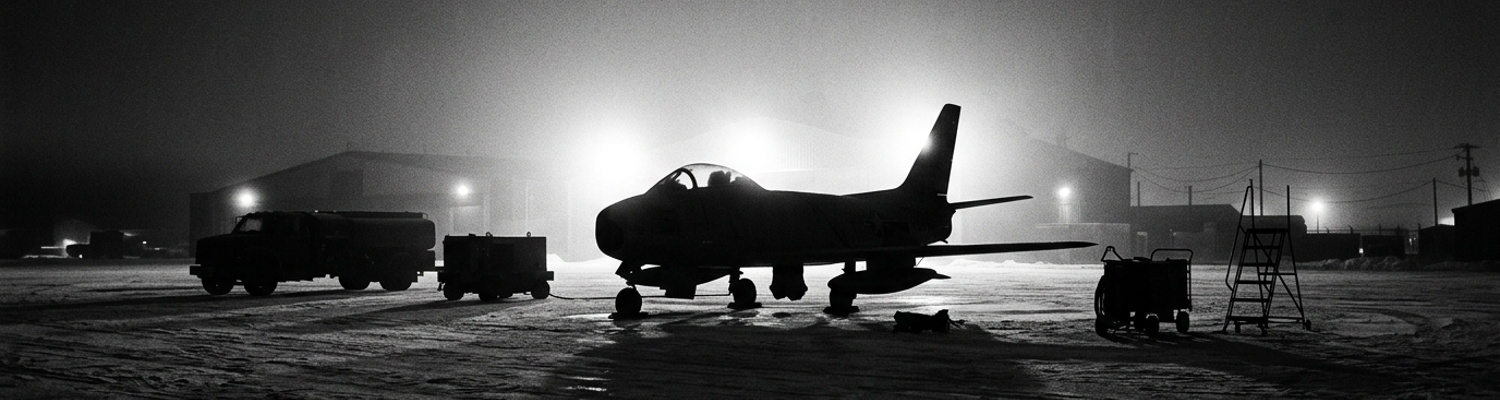

Cold War Arctic Defense Infrastructure
Maintaining complex electronic fire-control systems on a frozen flightline three degrees south of the Arctic Circle was an assignment frontline mechanics executed on a daily basis. Archival evidence shows that in late 1955, Ladd Air Force Base operated as the primary northern interception point against incoming Soviet strategic bomber fleets. Located at coordinates 64.8378 N, 147.6143 W near Fairbanks, Alaska, the installation executed the primary interception duties for the Alaskan Air Command. Intelligence reports crossing the desks of base commanders indicated that Tupolev Tu-4 and newly deployed Myasishchev M-4 bombers could traverse the polar ice cap. These formations could enter North American airspace undetected by conventional ground stations. Planners positioned Ladd AFB to intercept these incoming formations before they reached the continental United States.
The physical base infrastructure was highly inadequate.
It consisted of poorly insulated hangars, temporary Quonset huts, and frozen tarmac built directly over deep permafrost. Supply chains stretching back to the industrial centers of the lower forty-eight states took up to six weeks to deliver standard replacement parts. A complete absence of specialized diagnostic equipment at the base level meant engineers relied on physical observation. They used manual continuity checks to trace electrical faults in the high-voltage aviation hardware. Mechanics cannibalized grounded airframes to harvest relays, capacitors, and simple wiring harnesses. This was the only method available to keep a fraction of the fleet operational. A close review of operational logs indicates the 319th Fighter-Interceptor Squadron executed a continuous all-weather alert status under sub-zero conditions throughout this period. Temperatures on the flightline regularly plummeted to minus fifty degrees Fahrenheit. This created a dense atmospheric particulate phenomenon known as ice fog. Visibility dropped to a few feet.
Ground crews assigned to the 319th FIS worked on the Lockheed F-94C Starfire interceptors in rotating twenty-minute shifts.
The extreme cold caused standard neoprene rubber seals within the aircraft pneumatic systems to shatter upon impact. Engine oil congealed into thick sludge. Mechanics utilized Herman Nelson D-40 portable forced-air heaters to thaw the Allison J48 turbojet engines before ignition. Squadron commanders mandated that at least four interceptors remain armed and ready for takeoff within five minutes of an alarm sounding. Pilots slept in heavy flight suits inside alert shacks positioned directly adjacent to the runway. Achieving this rapid launch window required leaving auxiliary power units running continuously on the ramp. The F-94C Starfire nose radome housed the Hughes AN/APG-40 radar system. This specific electronic unit contained dozens of fragile vacuum tubes, complex waveguide plumbing, and delicate magnetrons highly sensitive to rapid temperature fluctuations.
Sub Zero Operations and Night Interceptions
When mechanics rolled the aircraft from a heated hangar onto the freezing flightline, the sudden sixty-degree temperature drop caused immediate thermal shock. Microscopic solder joints on the radar main circuit boards fractured instantly. Internal gyroscopes tracking the antenna elevation and azimuth seized. Their specialized MIL-SPEC lubricants froze into a solid paste. The APG-40 original testing occurred in Southern California laboratories. The hardware remained completely unprepared for rapid thermal contraction in the Alaskan interior. Technicians diagnosed these microscopic fractures with bare hands in the freezing wind. Radar technicians from the 319th FIS bypassed standard requisition channels entirely to maintain the alert schedule. They fabricated makeshift testing harnesses out of scavenged copper wire and stripped communication cables. This isolated faults within the APG-40 pulse modulator.
When the primary high-voltage transformers burned out due to the constant thermal cycling, engineers manually rewound the coils.
They used hand-cranked spools inside an unheated supply shed. Base command authorized these unapproved field modifications. Waiting forty-five days for a factory replacement would leave the northern approach corridor completely undefended. The maintenance logs from November 1955 show that over sixty percent of the squadron radar systems required this type of invasive repair to function. Operational logs from the 11th Air Division mandate a high operational tempo for the 319th Fighter-Interceptor Squadron. Sirens frequently triggered alarms at 0200 hours. Early warning radar operators at nearby Murphy Dome detected unidentified tracks crossing the polar azimuth. Flight line operations faced temperatures dropping below minus forty degrees Fahrenheit during mandatory night intercept scrambles. Ground crews stationed in alert shacks sprinted onto the frozen tarmac to prep the Lockheed F-94C Starfires.
Intelligence briefings warned that Soviet Tupolev Tu-4 bombers could approach Alaskan airspace under the cover of darkness.
Mechanics possessed exactly five minutes to disconnect ground power cables. They removed heavy canvas engine covers and signaled the pilots for taxi. At forty degrees below zero, exposed skin froze in under sixty seconds. Ground personnel wore heavy N-3B parkas and thick trigger-finger mittens. These garments severely degraded their manual dexterity while handling freezing steel wrenches and grounding wires. Aviation fuel hoses turned rigid and snapped if bent too sharply. Crew chiefs continuously monitored Herman Nelson D-40 portable heaters. These units pumped hot air directly into the intake ducts to keep the Allison J48 turbojet engines from completely freezing over between alerts. Ground crews recorded an average of three major component failures per night scramble.
Mechanical Degradation of APG 40 Radar Systems
Archival maintenance reports detail the catastrophic physical effects of moving aircraft from indoor maintenance bays to the active runway. Crews routinely serviced the F-94C Starfires inside heated hangars maintained at a standard sixty-five degrees Fahrenheit. This allowed technicians to perform intricate wiring repairs without heavy gloves. When the primary alert horn sounded, heavy Clark tow tractors dragged the interceptors directly through the sliding hangar doors into the Arctic air. Rapid transition from heated hangars to the flightline created extreme thermal shock on sensitive radar components. The Hughes AN/APG-40 fire control radar mounted in the nose radome absorbed a sudden temperature drop of over one hundred degrees in less than thirty seconds. Beryllium oxide ceramic insulators inside the radar high-voltage power supply fractured instantly under the rapid thermal contraction.
The 2J42 magnetrons contained delicate glass envelopes.
These envelopes shattered as the surrounding aluminum housing shrunk violently around them. Synthetic rubber gaskets designed to seal the radar pressurization chambers hardened into brittle plastic. Once these seals failed, dielectric gas leaked immediately from the ruptured joints. Loss of this pressurized gas caused high-voltage electrical arcing across the APG-40 internal waveguide plumbing the moment pilots activated the system on the runway. The arcing burned through the primary wiring harnesses. The nose radome filled with acrid smoke. Fire control technicians from the 319th FIS ran alongside the taxiing aircraft to perform last-second diagnostics while the jet engines spooled up to takeoff RPM. They opened the nose cone access panels and applied bare hands to the aluminum radar chassis. They felt for the distinct vibrations of a functioning rotary spark gap.
If the thermal shock had snapped the microscopic solder joints on the pulse network, the radar failed to transmit any tracking data.
Base commanders ordered pilots to launch regardless of radar status. This directive forced interceptor crews to fly into the black Arctic sky relying solely on ground-controlled intercept vectors broadcast via unencrypted UHF radio. Technicians left behind on the tarmac then gathered the shattered vacuum tubes, cracked circuit boards, and ruptured O-rings from the grounded airframes. They carried the frozen components back into the uninsulated supply sheds. They began the slow process of melting the ice off the damaged chassis using handheld soldering irons and chemical solvents. Mechanics logged twelve-hour shifts rebuilding the shattered magnetrons with scavenged copper wire just to meet the next night alert quota. Squadron supply officers logged a complete depletion of spare APG-40 magnetrons by the third week of January.
Field Improvised Antenna Gear Modifications
When examining the historical record of the 319th Fighter-Interceptor Squadron during January 1956, maintenance logs reveal a pattern of failure within the AN/APG-40 radar systems. Interceptor crews executed high-altitude scrambles reaching thirty-five thousand feet to intercept suspected Soviet Tu-4 formations over the Brooks Range. Ambient temperatures at this altitude frequently registered eighty degrees below zero Fahrenheit. The APG-40 utilized a complex antenna drive mechanism composed of alternating brass and aluminum spur gears. These gears swept the radar dish across its designated azimuth and elevation parameters. Thermal contraction at these extreme altitudes caused the distinct metals to shrink at vastly different rates. Clearances between the gear teeth vanished completely within ten minutes of a Starfire climbing past twenty thousand feet.
The electric drive motors powering the scanner assembly continued to apply full torque against the jammed components.
This mechanical force instantly sheared the teeth off the primary drive gears. Radar operators sitting in the aft cockpit of the F-94C watched their cathode-ray displays freeze as the scanner dish locked into a rigid, off-center position. Ground crews opening the radomes after these flights consistently found the internal aluminum chassis buried under a layer of freshly shredded brass shavings. Base commanders at Ladd Air Force Base refused to stand down the alert fleet to await replacement scanner assemblies from the lower forty-eight states. Squadron engineering officers directed mechanics to manually rebuild the destroyed drive mechanisms using basic hand tools. Technicians removed the damaged spur gears and clamped them into bench vises inside temporary Quonset huts. They utilized heavy-duty bastard files to cut rudimentary replacement teeth into blank brass discs scavenged from grounded C-47 transport aircraft.
These field-expedient gears lacked the precise tolerances required for smooth electronic tracking.
The radar dish jerked violently as it scanned. This created massive static interference on the operator display scope. Archival evidence shows that extreme cold at the flightline level generated an entirely separate mode of mechanical failure before the aircraft even left the runway. The APG-40 radar relied on a closed-loop hydraulic system to actuate the mechanical linkages responsible for stabilizing the dish against the aircraft pitch and roll. Standard Air Force requisition protocols supplied Ladd AFB with MIL-H-5606 petroleum-based hydraulic fluid rated for operation down to minus sixty-five degrees Fahrenheit. The severe temperature fluctuations caused by dragging aircraft between heated hangars and the frozen tarmac created heavy condensation inside the F-94C internal compartments. This moisture seeped directly into the unsealed hydraulic reservoirs and mixed with the petroleum fluid.
When ground crews towed the interceptors onto the flightline at minus forty degrees, the trapped water molecules crystallized immediately.
Ice blocks formed within the narrow one-quarter-inch aluminum hydraulic lines routed through the nose section. The fluid froze into a solid, impenetrable mass that seized the pitch and roll stabilization linkages completely. Any attempt by the radar operator to manually adjust the antenna elevation resulted in burst pressure valves and localized internal flooding. Maintenance personnel abandoned standard diagnostic manuals to restore target tracking capabilities. Mechanics unbolted the frozen mechanical linkages and carried the entire hydraulic assembly into the squadron mess hall. They placed the aluminum lines directly inside the industrial ovens set to two hundred degrees Fahrenheit to melt the internal ice blockages. Technicians then flushed the melted water out of the lines using highly toxic trichloroethylene solvents.
High Voltage Magnetron Troubleshooting
To prevent secondary freezing on the flightline, crews bypassed supply regulations. They blended the standard hydraulic fluid with pure grain alcohol sourced from the base medical dispensary. The resulting chemical mixture dissolved the internal rubber O-rings within forty-eight hours of installation. Rebuilding a shattered electronic fire-control system outdoors at forty degrees below zero using only basic hand tools was a daily requirement. Archival evidence shows that by late February 1956, the 319th Fighter-Interceptor Squadron completely exhausted its regional supply of spare APG-40 scanner assemblies. Soviet Tu-4 bomber probing flights crossing the Distant Early Warning Line azimuths near the Brooks Range forced the squadron to maintain a continuous alert posture at Ladd Air Force Base. Interceptor ground crews discovered that removing the damaged radar drive units required unbolting the primary structural mounting brackets from the F-94C Starfire nose bulkhead.
Ambient temperatures at coordinates 64.8378 N, 147.6143 W caused the heavy steel mounting bolts to shrink rapidly.
They fused directly into their aluminum threaded inserts. Mechanics snapping their half-inch breaker bars attempting to free the assemblies realized they could not extract the hardware to repair it inside the heated hangars. Squadron engineering officers directed technicians to repair the destroyed drive mechanisms directly on the frozen tarmac to keep the aircraft armed and ready for immediate launch. Ground crews dragged heavy steel step ladders to the nose of the aircraft. When examining the historical record of these flightline repairs, the physical toll on the maintenance personnel becomes apparent. Mechanics leaned their upper bodies entirely inside the uninsulated fiberglass radomes to access the seized elevation motors. They removed their heavy N-3B trigger-finger mittens. The thick synthetic material prevented them from gripping the narrow wooden handles of their metal bastard files.
Working with bare hands against freezing brass and aluminum components, technicians manually filed new gear teeth into the stripped spur gears while the assemblies remained rigidly attached to the airframe.
The process required a mechanic to scrape the metal file across the ruined gear edge exactly twenty times at a forty-five-degree angle. They rotated the scanner dish a fraction of an inch and repeated the motion. Exposed skin on their fingertips frequently flash-froze to the aluminum chassis. This tore away layers of epidermis when the men pulled their hands back. Crew chiefs rotated the filers every fifteen minutes to prevent severe tissue necrosis and permanent nerve damage. Supervisors standing on the icy tarmac manually spun the radar dish after each shift to test if the hand-cut teeth meshed well enough to restore mechanical rotation to the scanner assembly. The newly filed gears lacked factory tolerances and frequently jammed again during the first high-altitude test flight. A close review of operational logs indicates that Air Force engineers assigned to the 319th FIS realized that purely mechanical repairs would never survive the thermal shock of a night scramble.
Ground Control Intercept Linkage Dependencies
The APG-40 azimuth and elevation drive assemblies required a localized heat source to prevent the dissimilar metals from contracting and shearing the newly filed teeth at thirty thousand feet. Base supply possessed no specialized winterization kits for the Hughes radar systems. Technical sergeants raided the base salvage yard located behind the primary runway to construct custom thermal shrouds out of discarded aviation scrap. They stripped heavy asbestos fire-wall blankets from the exhaust nacelles of grounded C-47 Skytrain transports. They cut the toxic material into small, rectangular patches using aviation snips. Technicians layered these asbestos squares between sheets of thick olive-drab canvas salvaged from condemned general-purpose tents that had collapsed under heavy snow loads earlier in the season. Mechanics stitched these scrap materials together using fine stainless steel safety wire.
The resulting field-expedient blankets were wrapped tightly around the vulnerable drive assemblies and secured with heavy-duty industrial hose clamps.
Engineers designed these custom thermal shrouds to trap the ambient radiant heat generated by the radar high-voltage vacuum tubes and magnetrons during active tracking operations. To provide pre-flight warming on the ground, crews cut four-inch circular holes into the bottom of the interceptors fiberglass radomes. They shoved the corrugated flexible ducting of their Herman Nelson D-40 portable heaters directly through these access holes to blast two-hundred-degree air straight into the asbestos shrouds. The localized heat pockets kept the ambient temperature immediately surrounding the brass and aluminum spur gears well above freezing. Mechanics logged that this specific scrap-material modification allowed the F-94C Starfires to sit on the alert ramp for up to three hours without the drive assemblies seizing. The extreme heat trapped by the canvas shrouds began melting the radar primary wiring harness within six days of installation.
Demanding ground crews to diagnose unshielded fifteen-kilovolt radar components on a completely frozen tarmac in total darkness was a daily order.
A close review of operational logs indicates that during the height of the January 1956 interception schedule, 319th Fighter-Interceptor Squadron technicians faced twenty hours of ambient darkness per day. Ladd Air Force Base sat at coordinates 64.8378 N, 147.6143 W. This plunged the flightline into a near-permanent state of pitch-black, minus-fifty-degree conditions. The F-94C Starfire interceptors relied on the AN/APG-40 radar system. This utilized a 2J42 magnetron to generate X-band tracking frequencies. This specific vacuum tube required a constant fifteen-thousand-volt direct current to function. When the radar failed on the taxiway, mechanics sprinted out to the aircraft equipped only with heavy steel flashlights and basic analog multimeters. They unbolted the nose radome access panels and reached directly into the high-voltage pulse modulator array while the jet engines idled just feet away.
Line Technician Fatigue and Sub Zero Protocols
Standard safety protocols required completely discharging all capacitors with a heavy grounding probe before touching the internal aluminum chassis. Time constraints imposed by the 11th Air Division eliminated this safety step. Technicians diagnosed microscopic fractures in the magnetron glass envelope by manually bypassing the chassis interlocks and observing the exposed electrical arcs with their naked eyes. One slip of an uninsulated steel screwdriver sent lethal amperage straight through the technician arms. Archival evidence shows that this relentless exposure to live high-voltage electronics in severe sub-zero weather generated acute physical and psychological fatigue among the line mechanics. Ground crews worked rotating twelve-hour shifts outdoors without any thermal protection beyond their standard issue N-3B parkas. Operating heavy diagnostic equipment required removing their thick trigger-finger mittens. Bare skin pressed against frozen aluminum radar brackets caused immediate localized frostbite.
The constant threat of electrocution while handling live fifteen-kilovolt transformers in complete darkness triggered acute stress reactions across the entire maintenance unit.
Line technicians developed severe hand tremors. This prevented them from soldering the microscopic copper connections on the magnetron power supply boards. Medical records from the base dispensary detail mechanics suffering from chronic muscle spasms caused by absorbing low-grade electrical shocks through wet boots resting on the icy tarmac. Squadron engineering officers ignored these symptoms entirely. They ordered exhausted airmen back onto the flightline to trace electrical shorts in the APG-40 waveguide plumbing using nothing but their bare hands and a heavy military-issue flashlight. Flight surgeons dispensed heavy doses of dextroamphetamine pills directly on the runway to keep the ground crews awake. When examining the historical record of these diagnostic procedures, the sheer danger of the manual troubleshooting process becomes apparent. Mechanics had to verify the output voltage of the pulse network by pressing the metal prongs of their Simpson 260 multimeters directly against the magnetron exposed cathode terminals.
The severe cold caused the rubber insulation on the multimeter test leads to harden and snap off in jagged pieces.
Exposed copper wiring ran the entire length of the diagnostic cables. Technicians held these bare wires with freezing, numb fingers while the interceptor auxiliary power unit pumped massive electrical currents through the system. If a mechanic lost his grip and dropped the live test lead onto the magnesium airframe, the resulting electrical explosion instantly melted the radar chassis. The psychological strain of executing this precise, high-stakes physical maneuver degraded unit cohesion. Mechanics began refusing to open the radome access panels unless the pilots completely shut down the aircraft engines. Base commanders responded by threatening immediate court-martial for insubordination under the Uniform Code of Military Justice. By the second week of February 1956, thirty-five percent of the 319th FIS maintenance personnel had been medically evacuated to Elmendorf Air Force Base for acute nervous exhaustion and third-degree electrical burns.
Technical Impact on Cold War Air Defense
When examining the historical record of the 11th Air Division in early 1956, the operational dependency on Ground Control Intercept linkages becomes apparent. Early warning stations like the 714th Aircraft Control and Warning Squadron at Murphy Dome utilized heavy AN/FPS-3 search radars to track unidentified contacts crossing the Brooks Range at forty thousand feet. Ground operators tracked these high-altitude bomber formations on large cathode-ray scopes and broadcasted intercept vectors to the F-94C Starfire crews via unencrypted UHF radio channels. Controllers fed pilots a continuous stream of headings, altitudes, and airspeed adjustments to position the interceptors directly behind the incoming targets. The GCI controller could only guide the interceptor to within a three-mile radius of the Soviet aircraft. At this exact distance, the ground station radar beam spread too wide to provide any localized targeting resolution.
The Hughes AN/APG-40 radar system mounted in the interceptor nose had to take over for the terminal attack phase.
If the airborne radar failed due to thermal shock on the flightline, the pilot flew entirely blind through the Arctic night. The APG-40 was mechanically linked to the E-1 fire control computer. This calculated the complex ballistic drop for the twenty-four Mk 4 Folding-Fin Aerial Rockets housed in the nose radome. The radar electronic firing pulse was the only mechanism capable of igniting the rocket motors. Archival evidence shows that a complete failure of the Ladd Air Force Base interceptor fleet would open a four-hundred-mile blind spot in the North American Arctic air defense perimeter. Alaskan Air Command planners calculated that Soviet Myasishchev M-4 formations flying through this specific geographic gap could bypass the primary radar fences entirely and proceed south toward Strategic Air Command bases in the lower forty-eight states. To prevent this exact scenario, 319th Fighter-Interceptor Squadron ground crews developed highly unauthorized repair routines for the APG-40 waveguide plumbing.
Pressurized dielectric gas leaked constantly from the system fractured O-rings during cold weather starts.
Technicians bypassed the frozen supply chain entirely to manufacture replacement seals out of vulcanized rubber sourced from their own cold-weather mukluk boots. Mechanics sat on overturned ammunition crates inside uninsulated supply sheds and cut the thick rubber soles into circular gaskets using heavy aviation shears. They coated these crude rings in a mixture of standard aviation grease and carbon graphite shaved directly from wooden pencils to create a makeshift conductive sealant. This specific chemical paste stopped the high-voltage arcing inside the waveguide for exactly thirty minutes. A close review of operational logs indicates these exact field modifications directly kept the alert fighters armed and flying during periods of heavy Soviet activity. During a concentrated series of probing flights in March 1956, radar operators at Murphy Dome detected six distinct Tu-4 tracks approaching the Alaskan coast from the polar ice cap.
The bombers maintained a steady speed of three hundred knots at an altitude of thirty-five thousand feet.
The 319th FIS scrambled eight F-94Cs into minus forty-five-degree weather to intercept the formation. Seven of those aircraft launched with APG-40 systems held together by boot rubber and pencil graphite. Ground crews stood on the frozen tarmac listening to the UHF radio broadcasts as the GCI controllers vectored the interceptors toward the targets. Pilots engaged the afterburners on their Allison J48 turbojet engines to close the final distance. At thirty-five thousand feet, the patched radars successfully achieved lock-on, forcing the Soviet bombers to break formation and turn back toward the Bering Sea. The extreme heat of the radar magnetron baked the improvised rubber seals into a hardened ceramic state during the return flight. Mechanics logged six hours scraping the melted boot material out of the aluminum waveguide channels with steel picks.