
A close examination of operational records from 1966 reveals the 7th Marine Regiment’s tactical area of responsibility was centered on the sprawling Chu Lai Base Area in southern I Corps. After arriving in August 1965, the regiment’s battalions were handed a complex and often contradictory mission. Their primary function was providing a deep security buffer for the Chu Lai airfield and the massive Naval Support Activity depot, a primary logistical hub for American forces in the northern provinces of South Vietnam. This required broad search and destroy operations against Viet Cong and, with increasing frequency, People’s Army of Vietnam (PAVN) main force units. The regiment’s battalions, including the 1st, 2nd, and 3rd, executed large-scale named operations like Operation Utah in March and Golden Fleece 7-1 in September. These missions pushed them deep into the surrounding districts of Quang Ngai Province, such as Binh Son and Mo Duc. At the same time, they were responsible for the pacification of local villages and protecting vital rice harvests from seizure. This dual requirement to both hunt main force units and hold territory stretched the regiment thin. Its battalions were forced to operate across vast, hostile landscapes, often far from their primary bases.
Nightfall belonged to the opposition. This tactical condition dictated the tempo of the war for the 7th Marines. In the early years of the conflict, Viet Cong and PAVN forces deliberately avoided sustained daylight engagements, instead using the cover of darkness to move supplies, emplace booby traps, and initiate ambushes. An analysis of after-action reports shows a heavy prevalence of nocturnal probes against Marine perimeters, designed to test defenses and inflict casualties without decisive engagement. In response, the 7th Marines conducted a significant portion of their own patrols and ambushes after sunset. These operations were difficult. The main tool available was the AN/PVS-2 Starlight scope, a first-generation image-intensifying device. It weighed nearly six pounds, was bulky, and its effectiveness was entirely dependent on ambient light, rendering it nearly useless on overcast nights or under dense jungle canopy. The scope was also notoriously difficult to keep zeroed when mounted on a rifle, leading many Marines to use it purely for observation. This technological limitation, combined with the constant risk of friendly fire and the enemy’s skill in silent movement, created an environment of extreme tension and fatigue.
The logistical infrastructure supporting these forward operations was brittle. The central artery was the Naval Support Activity at Chu Lai, which handled the massive influx of ammunition, rations, and replacement parts. From this beachhead, supplies were pushed out to the 7th Marines’ regimental and battalion command posts. The final, most perilous leg of the journey was to the company-level patrol bases and temporary firebases scattered throughout the hills and rice paddies. This link was maintained by helicopter and truck convoy. Marine Aircraft Group 36, operating out of Kỳ Hà, provided helicopter support with its fleet of CH-46 Sea Knights, but these were high-value targets. During Operation Hastings in July, multiple CH-46s were lost in a single day, leading Marines to grimly nickname one area Helicopter Valley. The alternative, ground transport, relied on the 7th Motor Transport Battalion. Their convoys faced constant threats along routes like the infamous Ambush Alley, where they were subject to command-detonated mines and harassing fire.
After-action reports from 1966 highlight a persistent gap in night combat capability: the delayed deployment of aerial illumination assets. The primary tool for turning night into day over a large area was the Air Force C-130 flareship. Known by callsigns like Blind Bat or Lamplighter, these aircraft were not organic Marine Corps assets. They belonged to the Air Force, operating under a separate command structure. By 1966, many of these missions originated from bases as far away as Ubon, Thailand. Their main tasking was not the direct support of Marine infantry but the interdiction of truck traffic along the Ho Chi Minh Trail in Laos and North Vietnam. A 7th Marines company taking heavy fire on a remote hilltop in Quang Ngai Province had to relay a request for light up a complex chain of command. That request was then weighed against pre-planned, strategic interdiction missions already underway hundreds of miles away. Diverting a single flareship could disrupt an entire multi-aircraft mission. The result was a significant time lag. A request from a besieged Marine unit could take hours to be actioned, if it was approved at all.
The sky over the 7th Marines’ positions often remained dark.
This forced an immediate reliance on organic and direct-support illumination ordnance. A Marine rifle company defending a perimeter had its own 60mm mortars, but their illumination rounds were few and burned for a short time. The heavier 81mm mortars at the battalion level and the 105mm howitzers of supporting artillery batteries provided more robust options with their star shells. A single 81mm M301A1 illumination cartridge could produce over 500,000 candlepower, but only for approximately 60 seconds. Sustaining continuous light over a perimeter under assault required a rapid sequence of firing. A coordinated multi-pronged probe by a PAVN battalion could force the expenditure of an entire firebase’s pre-staged illumination supply in under an hour. Once those rounds were gone, the defensive line went blind, wholly dependent on a resupply that was frequently impossible. Helicopters attempting to deliver ammunition could not land in a hot landing zone without light, creating a cycle where the solution to the darkness was prevented by the darkness itself.
The consequences were written in casualty reports. During Operation Prairie, the 2nd Battalion, 7th Marines, was heavily engaged with elements of the PAVN 324B Division. On the night of September 24, 1966, Golf Company was ambushed and pinned down on the Razorback ridge. Archival logs (NARA RG 127, AAR-7M-1966-SEP) show that a Marine C-117 flareship did eventually arrive on station, but the engagement had been underway for a considerable time. The report notes a flaw in this sporadic illumination. The lulls between each descending flare gave the PAVN attackers moments of total darkness to crawl closer, reposition machine guns, and prepare for the next rush. The intense ground fire, shrouded by this darkness, aborted multiple helicopter resupply attempts. The inability to secure sustained illumination directly contributed to Golf Company’s losses.
Analysis of 1966 communication logs reveals that the effectiveness of night Close Air Support (CAS) was frequently degraded by systemic issues with radio technology. A Marine Forward Air Controller (FAC) attached to a 7th Marines company managed a congested electronic battlespace. To speak with the infantrymen on the ground, he used an FM radio, typically the AN/PRC-25. To direct inbound strike aircraft, such as Marine A-4 Skyhawks or Air Force F-4 Phantoms, he needed to switch to a UHF or VHF frequency. If the mission involved an Air Force airborne FAC in an O-1 Bird Dog, another layer of communication on a separate VHF radio was required. This created a chaotic environment where multiple nets operated simultaneously in a confined geographic area. A request from a 2nd Battalion, 7th Marines, patrol under fire could be stepped on or garbled by transmissions from an artillery Forward Observer in a neighboring sector, the command net of another battalion, or logistical chatter from units in the rear. The limited number of available tactical frequencies meant that nets often bled over one another, turning a clear transmission of target coordinates into a burst of static.
The physical hardware itself was a point of constant failure. The AN/PRC-25 manpack radio, while an improvement over older models, was a vulnerable piece of equipment. Weighing approximately 25 pounds with a spare BA-386 battery, the unit was cumbersome. Its most common points of failure were its external components. The handset cord could be snagged and severed in dense jungle, and the handset itself was not waterproof. The long, 10-foot “fish-pole” antenna, necessary for long-range transmission in the hills of Quang Ngai, was a liability. It snagged on overhead vegetation, which could trigger booby traps, and it also drew immediate fire from enemy soldiers who knew that eliminating the radioman would sever the unit’s link to air and artillery support. The internal electronics were susceptible to the jarring impacts of nearby explosions. A hard landing could dislodge components, rendering the radio useless.
A direct correlation between these communication breakdowns and misdirected CAS strikes is evident in operational records. During the intense fighting of Operation Prairie, units of the 7th Marines were heavily engaged. On September 24, Golf Company, 2/7, was ambushed on the Razorback ridge and pinned down. In a scenario representative of the period’s challenges, a FAC under fire would attempt to transmit target information. Frequency congestion from other units and the intermittent signal from a damaged radio could result in the pilot of a strike aircraft receiving only a partial set of coordinates. In the disorienting environment of a night battle, illuminated only by the sporadic bloom of artillery flares, a pilot’s misinterpretation of a garbled message could be catastrophic. A request to shift fifty meters east could be missed, or a misheard number in a grid coordinate could place the impact point directly on the Marine perimeter. The result was ordnance delivered on friendly positions, an event that records show caused casualties in multiple engagements.
Operational logs from Marine Aircraft Group 12 (MAG-12) at Chu Lai show that the ability to generate sorties for night CAS was governed by the severe constraints of the ground-based supply chain. The flow of JP-4 jet fuel was a persistent bottleneck. The Naval Support Activity at Chu Lai had established a fuel depot, but the initial infrastructure was temporary. Fuel arrived by tanker offshore and had to be pumped to the base, initially through amphibious fuel lines and later to a tank farm that replaced large, portable fuel bladders in 1967. These bladders and lines were targets for enemy sapper attacks. Damage from heavy seas also caused disruptions. A MABS-13 command chronology from January 1967 notes the dispensing of 2,965,279 gallons of jet fuel for the month, demonstrating the scale of the demand. The chokepoint was often the final transfer from storage to aircraft. A limited number of refueling trucks meant that during high-tempo operations, A-4 Skyhawks returning from missions would have to queue on the taxiway, waiting for their turn.
Maintenance challenges and a shortage of parts degraded the readiness of night-capable attack aircraft. The A-4 Skyhawk was susceptible to the operating conditions of coastal Vietnam. The combination of sand, salt spray, and humidity accelerated corrosion and led to high failure rates for electronic components and hydraulic systems. Maintenance crews from Marine Base Support Squadron 13 (MABS-13) worked around the clock, but they were hampered by a spare parts pipeline that stretched thousands of miles to depots in Okinawa, Japan, and the United States. An A-4E could be grounded for days waiting for a specific hydraulic actuator or a replacement component for its bombing computer. Archival records show that to keep the flight schedule, ground crews frequently resorted to cannibalization, stripping serviceable parts from one damaged aircraft to make another flyable. This practice generated a sortie but steadily reduced the total number of available airframes, creating a downward spiral of readiness.
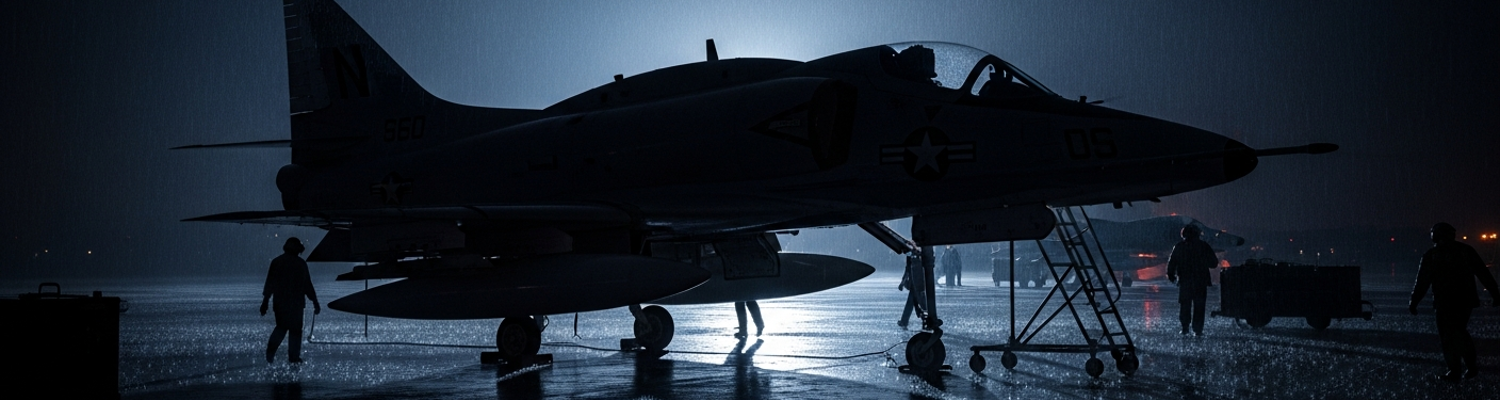
For a Marine company in contact, these logistical frictions translated into deadly delays. The turnaround cycle for an A-4 Skyhawk was a complex, manual process. Aviation Ordnancemen would manually load ordnance, which could include 500-pound Mk 82 bombs with M904 nose fuzes, Zuni rocket pods, or napalm canisters. This was heavy, dangerous work performed on an active flight line, often in darkness. A hot turnaround was rarely as quick as doctrine suggested. Refueling could take 15 to 20 minutes. Loading a full complement of bombs and rockets could take another 30 to 45 minutes. A full cycle often exceeded an hour per aircraft. During a major engagement like Operation Prairie, with multiple flights returning to Chu Lai simultaneously, a backlog would form. A pilot could land, taxi to the re-arming area, and then wait in line for 30 minutes or more before the ground crews could even begin working on his aircraft. All while a forward air controller on a dark ridgeline pleaded for the air support that was sitting on the tarmac just a few minutes’ flying time away.
An examination of after-action reports from 1966 reveals a direct link between the duration of enemy contact and the casualty rates suffered by units of the 7th Marine Regiment. When a rifle company became decisively engaged, its expenditure of ammunition, particularly grenades, 60mm mortar rounds, and M60 machine gun belts, would spike. The pre-planned combat load carried by each Marine was designed for initial contact, not a multi-hour siege. As a firefight extended, ammunition counts dwindled, forcing squad leaders to enforce strict fire discipline that could cede the initiative to the enemy. This dynamic played out with lethal results during Operation Prairie. On September 24, 1966, when Golf Company, 2nd Battalion, 7th Marines was ambushed and pinned on the Razorback ridge, the unit was trapped. The fight’s extension from minutes to hours meant they were running critically low on ammunition, a fact noted in operational logs. This forced reduction in their volume of fire allowed PAVN attackers to maneuver closer, increasing the accuracy and effect of their own weapons and leading to higher Marine casualties. The cumulative effect of these logistical shortfalls crippled operational effectiveness on a broader scale. A single missing part for a CH-46 Sea Knight at the Ky Ha air facility could mean an entire platoon did not receive its scheduled resupply of water, C-rations, or radio batteries. Patrols were forced to curtail their sweeps and return to base not because of enemy action, but because they lacked the basic sustenance to continue. The constant threat of ambush along ground supply routes turned every truck convoy into a high-risk gamble, leading to inconsistent deliveries and chronic shortages at forward firebases. This had a cascading effect on mission planning. A battalion commander, knowing the unreliability of resupply, would be forced to build missions around shorter patrol durations and closer objectives, effectively surrendering large swathes of territory and operational initiative to PAVN and Viet Cong forces, especially at night. The inability to guarantee timely medevac for the wounded further constrained tactical decisions. Commanders became hesitant to commit forces to aggressive night ambushes or deep reconnaissance patrols, knowing that if they took casualties after dark, they might not be able to evacuate them until morning. The final tally for Golf Company in the fight on the Razorback was three killed and twenty-six wounded.