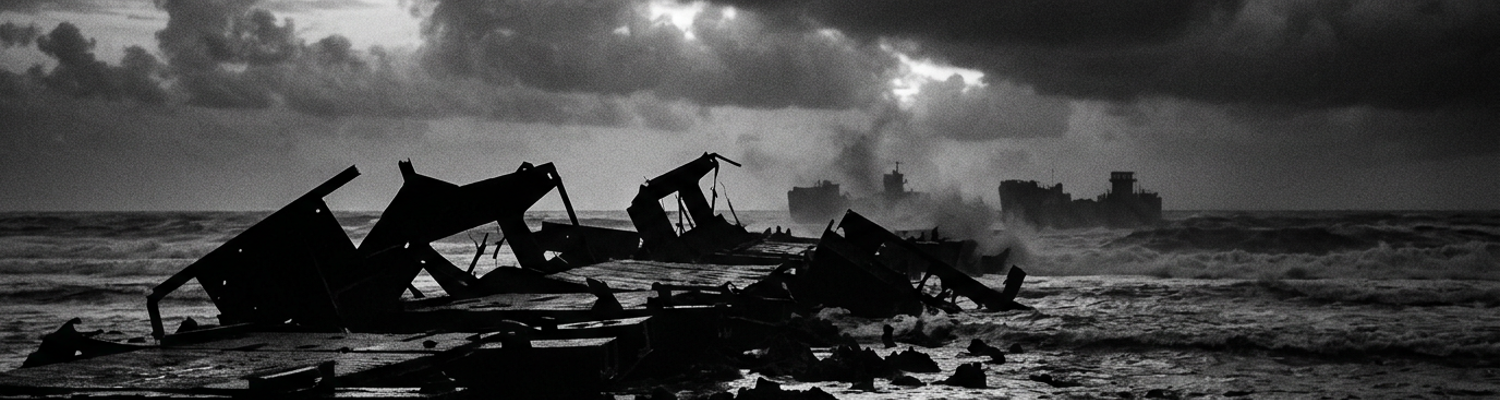

Broken Causeways at Yonabaru
Invasion planners assigned local supply commanders a strict forty-eight-hour window to establish an active cargo artery on the eastern coast of Okinawa. The southern beachheads were secured in late May 1945. Combat forces moving south required three thousand tons of ammunition and rations daily. Engineers received direct orders to assemble thousands of tons of floating steel into a working pier before seasonal weather patterns shifted. Planners tracked the barometric pressure drops closely. Any delay would starve the frontline infantry units of artillery shells. Officers sat in battered command tents on the morning of June 6 documenting the complete failure of that mandate. They recorded exact timestamps of the structural collapse in water-stained logbooks (NARA Record Group 338).
The deadline expired.
Meteorological breakdowns began rapidly on June 5. Typhoon Connie struck Okinawa. The physical force of the storm exceeded pre-invasion weather modeling. The typhoon slammed directly into the eastern shores. Sustained wind velocities pushed water masses into a highly concentrated fetch. Oceanographic forces generated continuous thirty-foot swells along the beachhead. These massive columns of water amplified as they hit the shallow gradient of the Yonabaru reef line. The physical weight of these swells slammed into the coastal infrastructure with thousands of pounds of pressure per square inch. Officers drafting post-action reports noted the water level rose so fast that standard tidal charts became instantly obsolete. They measured high-water marks on surviving concrete pilings. Weather specialists in the command bunkers recorded wind gusts exceeding one hundred knots.
Every safeguard failed.
Damage assessors focused immediately on the pontoon causeways operated by the 111th Naval Construction Battalion at Yonabaru. Seabees had assembled standardized Navy Lighterage pontoons into long floating piers. These structures were designed to bridge the gap between deep-draft cargo ships and the shallow shore. Every welded steel box measured exactly five by seven by five feet. Post-storm archival photographs taken in the gray morning show these causeways suffered total structural rupture. Thirty-foot swells applied extreme kinetic force against the rigid steel assemblies. Thick iron chains binding the individual pontoon cells snapped under alternating tension and compression. Vertical hinge pins sheared completely through their steel housings. Dozens of connected pontoons broke loose from their anchorage. They washed ashore as twisted scrap. Troops of the 111th NCB spent the quiet hours following the climax walking the debris line. Machinists measured the thickness of the sheared structural steel to calculate exact failure tolerances.
Steel plates sheared.
Handwritten logs from the 111th NCB reveal a frantic effort to diagnose mechanical failures before the next tide cycle. Battalion commanders noted that standard anchoring blocks were dragged hundreds of yards across the coral floor. These blocks were cast from reinforced concrete and weighed two tons each. The designated supply route was reduced to a field of jagged iron hazards blocking the landing zones. Engineers calculated the exact angles at which primary connection brackets buckled under sustained wave action. Surveyors mapped the new locations of displaced pontoon strings using handheld transits. They recorded specific topographical grid coordinates of the wreckage. Drafting tables in the command tents were covered in rough schematics detailing specific failure points of the steel linkage systems. Supply officers counted remaining intact pontoon cells to determine if a smaller pier could be constructed from salvaged parts.
Stranded LSTs and Severed Supply Lines
Over forty Landing Ships, Tank (LSTs) were stranded offshore in the immediate wake of the storm. These 328-foot flat-bottomed vessels sat idling in the deep-water anchorage of Nakagusuku Wan. Naval transport officers recorded exact coordinates of the holding pattern on their chart tables. The gray morning light exposed the empty shoreline. Without pontoon causeways to bridge the shallow reef, the LSTs were entirely unable to discharge heavy equipment. Each ship required a minimum draft of three feet forward to drop its massive bow doors. The Yonabaru coral shelf protruded far too close to the surface. Ship logs from LST-808 and LST-124 detail frantic mechanical efforts to maintain position amid residual swells. Twin General Motors V12 diesel engines ran continuously just to keep the bows pointed into the wind. Quartermasters mapped out a rigid grid system. This prevented heavily laden ships from drifting into one another in the choppy water.
Over four hundred heavy armored vehicles sat chained to the steel deck plates.
Transport commanders ordered deck crews to inspect heavy equipment tie-downs every fifteen minutes. Mechanics crawled beneath the hulls of M4 Sherman tanks and 155mm gun carriages. They checked steel tension cables for saltwater corrosion. LSTs were designed to drive directly onto a reinforced pontoon pier. They would open their hydraulic bow doors and deploy a ramp for immediate vehicle offloading. Invasion planners had calculated each vessel could clear its entire cargo deck in under forty minutes using the Yonabaru causeways. Officers drafted frantic messages to the Fifth Fleet command ship requesting specialized shallow-draft landing craft. They intended to ferry the vehicles piece by piece. Post-action reports show these requests were denied. The smaller boats had been pulverized against the seawall during the night. Transport captains recorded exact fuel consumption rates as they burned through their diesel reserves fighting the offshore current.
The idling ships consumed thousands of gallons of fuel per hour.
This infrastructure failure severed supply lines delivering artillery ammunition and rations to the 7th Infantry Division. Quartermaster logs from division headquarters show supply officers frantically calculating active stockpiles in the damp dawn hours. Frontline infantry regiments advancing along the muddy ridges of the Chinen Peninsula consumed an average of four hundred tons of combat supplies every twenty-four hours. Supply clerks noted the division artillery batteries had less than a half-day supply of 105mm high-explosive shells left in their forward dumps. Drivers sat in the cabs of their empty 2.5-ton trucks. They recorded the exact hour the supply caches ran dry.
Artillery gunners received orders to limit their firing rate to two shells per hour.
Handwritten inventory sheets from the 7th Quartermaster Company detail the rapid depletion of basic infantry sustenance. Rations designed to feed over fifteen thousand frontline troops were trapped inside the cargo holds of the idling ships. Officers recorded the exact number of 10-in-1 ration crates sitting in mud-soaked supply tents south of Yonabaru. Division commanders ordered an immediate halt to all offensive maneuvers until the supply chain could be reestablished. Infantrymen in forward foxholes resorted to scraping the bottom of their field mess tins. Transport crews attempted to manually carry ninety-six-pound wooden crates of 105mm ammunition through the waist-deep surf. The undertow dragged the boxes into the jagged reef. Engineers tried rigging temporary rope lines between surviving concrete pilings to guide small rafts loaded with C-rations toward the beach. Planners sitting in the division command post drew red lines across their topographical maps. These marks indicated exact locations where transport vehicles were parked empty. Logistics officers documented specific grid coordinates of the silenced artillery batteries.
Structural Rupture of Causeway Legs
Officers from the 111th Naval Construction Battalion deployed specialized survey teams across the Yonabaru reef line at 0530 on June 6. The typhoon had dissipated. It left behind a heavy fog and a retreating tide along the eastern coast of Okinawa. Battalion commanders ordered Seabee engineering teams to walk the high-water debris line. They surveyed shattered NL-section pontoon strings scattered across the jagged coral shelf. These Navy Lighterage units were originally assembled into continuous floating causeways extending exactly 1,200 feet from the shoreline to the deep-water drop-off at Grid 814-G. Draftsmen holding water-damaged clipboards documented the chaotic resting positions of hundreds of displaced steel boxes. The original assembly mandate required Seabees to lock these individual pontoon cells together using continuous lengths of heavy steel angle iron. They used specialized connection hardware known in naval engineering as jewelry. Engineers operating handheld transits and stadia rods shot lines of sight down the beach. They mapped the exact distribution of the wreckage. The continuous strings were completely dismembered. Heavy steel components lay half-buried in the wet sand. Planners recorded precise coordinates where primary anchoring chains had snapped. The retreating surge had dragged two-ton concrete sinkers hundreds of yards across the shallow ocean floor.
The entire southern causeway lay inverted against a limestone outcropping.
Initial shoreline surveys documented stress fractures across the entire assembly framework. Machinists from Company B inspected ruptured connection points using micrometers and steel calipers. They measured the exact deformation of the structural plates. The standard NL-section framework utilized 1045 carbon steel. It was designed to withstand a maximum tensile load of thirty thousand pounds per square inch. Surveyors noted the continuous thirty-foot storm swells concentrated kinetic force directly onto primary joints. This rapidly exceeded material tolerances. Heavy steel H-beam stringers running the length of the causeways exhibited severe torsion damage. Heavy welded seams connecting top plates to internal bracing bulkheads tore completely open. This exposed hollow interiors to the saltwater. Draftsmen sitting in damp command tents plotted these specific mechanical failures onto large topographical maps. They calculated exact wave vectors that dismantled the pier. They frantically recorded raw data points in waterproof logbooks. They attempted to understand the physics of the collapse before the next high tide washed the evidence away.
A6 connection brackets buckled inward at forty-five-degree angles.
Post-action damage reports detail the complete failure of vertical hinge pins connecting the causeway sections. These thick steel cylinders were engineered to allow pontoon strings to flex vertically with standard tidal shifts while maintaining horizontal rigidity. The violent lifting force of the typhoon surge exceeded maximum shear tolerances of the housings. The pins snapped flush with the steel brackets. Survey teams extracted sheared halves of these pins from twisted wreckage to document exact fracture patterns in the metal. Engineers recorded deep lateral scoring along the steel shafts. This proved the pins were violently twisted before they finally gave way. Officers in the command post used this data to draft immediate redesign requests. They noted standard hinge mechanisms were entirely inadequate for open-ocean fetches. Technicians cataloged surviving intact pontoon cells by painting red identification numbers on rusted steel plates. They searched for any viable components among the wreckage.
Supply clerks counted exactly twenty-two usable cells out of the original four hundred.
Battalion commanders ordered surveying parties to prioritize inspection of pontoon internal bulkheads. Teams of Seabees crawled inside hollow steel boxes washed up on the shoreline at Grid 815-F. They used battery-powered flashlights to illuminate dark, cramped interiors. They searched for hairline cracks along internal bracing ribs. Operational logs show the structural rupture was not limited to external connection hardware. The kinetic impact of the waves caused outer steel skins of the pontoons to flex inward. This compromised the watertight integrity of individual cells. Water marks inside the boxes indicated they rapidly filled with seawater. This drastically increased their weight and exacerbated strain on the entire causeway string. Engineers exhaustively documented the precise volume of water retained in each damaged cell. They recorded these figures on muddy inventory sheets to calculate exact loss of buoyancy.
The sheer weight of the flooded steel dragged the surviving sections into the reef.
Field Investigations Aboard Fleet Tenders
Service Squadron Ten commanders established an emergency technical commission at 0700 on June 7. They analyzed the total infrastructure collapse. Naval engineering commissions convened aboard fleet tenders anchored off the Okinawa coast. They gathered raw evidence directly from the shattered beachhead. Officers transformed damp wardrooms of repair ships like the USS Tutuila into temporary forensic laboratories. The 442-foot vessel sat idling in the deep-water anchorage of Nakagusuku Wan. It fought a residual five-foot offshore swell. Draftsmen bolted large wooden chart tables to steel deck plates. This prevented tools from sliding during the constant rolling motion. Commission members consisted of senior Seabee machinists, metallurgists, and structural engineers pulled from surviving construction battalions. They stared at wet topographical maps of the Yonabaru reef line through the gray morning light. Their mandate was to determine exact mechanical thresholds that caused thousands of tons of standardized Navy Lighterage pontoons to fail simultaneously. Runners carried waterproof canvas satchels filled with raw damage reports up gangways from small transport skiffs.
The wardroom drafting tables were covered in saltwater-stained schematics.
The commission issued strict orders to shore parties forbidding movement of any wreckage. Investigators prioritized recording unprocessed technical data before salvaging damaged equipment from the shallow coral shelf. Lead engineers understood that clearing twisted steel to reopen landing zones would destroy the kinetic footprint of the storm. They needed to map precise vectors of wave action by studying final resting angles of debris. Shore teams received commands via signal lamps to measure exact torsion applied to heavy steel H-beam stringers. Machinists stood in waist-deep water using calipers. They recorded millimeter-scale deformation of sheared vertical hinge pins. They shouted these measurements to radiomen sitting in idling Higgins boats just beyond the surf line. Radiomen transmitted numerical data directly to the Tutuila. Technicians plotted failure points on their master grid.
Technicians recorded the exact degree of inward buckling on the A6 connection brackets.
Handwritten directives from the engineering board detail a frantic race against the incoming tide. The water level was projected to rise by four feet at 1400 hours. This threatened to shift unanchored steel and erase fracture patterns. Supply commanders onshore demanded immediate removal of destroyed pontoon strings to clear a path for shallow-draft landing craft. Naval engineers explicitly overruled them. They demanded uninterrupted access to the site to calculate exact tensile load failures of 1045 carbon steel plates. Surveyors mapped the exact distance two-ton concrete anchoring sinkers had been dragged across the ocean floor. They used handheld transits to triangulate displaced positions against surviving concrete shoreline pilings. The resulting data proved thirty-foot storm swells generated over forty thousand pounds of pressure per square inch against primary linkage systems. Draftsmen aboard the tender calculated the kinetic impact instantly exceeded maximum shear tolerances of iron chains binding the cells.
Engineers logged the exact volume of seawater trapped inside the ruptured bulkheads.
Offshore commissions used unprocessed technical data to immediately draft redesign specifications for the next phase of the Pacific campaign. Structural failures at Yonabaru proved the standard rigid assembly method was entirely inadequate for open-ocean fetches facing typhoon-level oceanographic forces. Technicians on fleet tenders sketched new concepts for flexible, heavy-duty shock absorbers. These would be installed between A6 brackets. They calculated exact thickness of reinforced steel plating required to prevent outer pontoon skins from flexing inward under sustained wave pressure. Machinists documented specific lateral scoring marks found on recovered hinge pins to design a thicker, fluted housing mechanism. The board compiled hundreds of raw numerical data points into a classified technical bulletin before the afternoon sun broke through the fog. Manual transmission of these exact failure tolerances consumed the entire morning watch aboard anchored tenders.
Shore parties began painting red identification numbers on the rusted scrap metal.
Tension Tie-Rod Shears and Material Deficiencies
The naval engineering commission aboard the USS Tutuila directed primary focus toward 1.25-inch diameter steel tension tie-rods. These specific mechanical linkages bound outer pontoon strings to the central causeway spine at Grid 814-G. Draftsmen reviewing raw damage logs from the 111th Naval Construction Battalion noted a consistent failure pattern across all recovered wreckage. The standard assembly manual required Seabees to torque these rods to exactly four hundred foot-pounds. This created a rigid steel deck capable of supporting thirty-ton Sherman tanks. Sustained thirty-foot storm swells from Typhoon Connie generated extreme wave action. This applied alternating vertical and horizontal kinetic loads to the rigid framework. Machinists measuring recovered scrap on the morning of June 8 documented complete transverse shears across threaded ends of rods. The physical weight of the storm surge snapping against the Yonabaru reef line concentrated over forty-five thousand pounds of pressure per square inch directly onto steel threads. Investigators recorded deep galling and thread stripping on surviving turnbuckles.
The carbon steel snapped cleanly across the grain.
Extreme wave action created a rapid levering effect that 1045 carbon steel simply could not withstand. Survey teams wading through waist-deep water along the debris line extracted seventy-two sheared tie-rods from the submerged coral shelf. Salvage crews placed rusted components into canvas bags. They transported them to offshore fleet tenders for immediate metallurgical analysis. Technicians in shipboard laboratories used magnifying loupes to examine fracture planes. They recorded their findings on waterproof chart paper. Draftsmen noted the exact angle of the breaks to calculate directional force of wave action. Data proved the surge did not push the causeway laterally. It lifted outer edges while the central spine held its position. This created a catastrophic bending moment. Metal fatigue accelerated. Every tie-rod along the southern 600-foot section of the pier failed within a consecutive fourteen-minute window at the peak of the storm.
Engineers marked the exact failure timestamps on their master grid.
Findings from these metallurgical tests forced command officers to confront a fatal flaw in established amphibious doctrine regarding storm surge resistance of temporary piers. The Bureau of Yards and Docks had engineered the Navy Lighterage pontoon system based entirely on hydrographic data gathered during Mediterranean and Atlantic campaigns. Standard operating procedures dictated rigid steel connections were sufficient to withstand a maximum ten-foot surf and forty-knot winds. Planners sitting in damp wardrooms of fleet tenders realized this doctrine was completely incompatible with violent oceanographic forces native to the Philippine Sea. The rigid assembly method transformed the entire 1,200-foot causeway into a single, inflexible target for thirty-foot kinetic swells. The investigation board drafted an immediate bulletin to the Pacific Fleet command ship. They explicitly stated constructing rigid temporary piers on shallow coral reefs facing open-ocean fetches would guarantee total structural rupture during seasonal typhoons.
The official manual was rendered instantly obsolete.
Logistics officers recorded specific doctrinal failures in daily situation reports while infantry units onshore continued to ration 105mm artillery shells. The offshore commission recommended an immediate halt to all rigid causeway construction across the Pacific theater. Draftsmen began sketching rough schematics for a completely new connection system utilizing heavy rubber shock absorbers and flexible steel cables. They calculated a yielding joint system would allow individual pontoon cells to ride over the storm surge rather than absorbing the full kinetic impact. The proposed doctrine required transport vessels to completely detach causeways from the shoreline and tow them into deep water at the first sign of a barometric pressure drop. Radiomen transmitted these raw, unprocessed technical revisions directly to naval headquarters in Hawaii. Clerks filed the transmission logs at 1145 hours on June 9.
Doctrinal Changes in Amphibious Operations
Pacific Fleet command officers sitting in the flag plot of the USS Eldorado at anchor off Guam received unprocessed technical data from Yonabaru on the morning of June 10. Radio transmissions contained exact failure thresholds of the standardized Navy Lighterage pontoon system. Staff engineers mapped topographical coordinates of the shattered causeway at Grid 814-G directly onto master planning boards. They realized standard amphibious harbor construction protocols drafted in 1943 were completely incompatible with hydrographic conditions of the Philippine Sea. Pre-invasion modeling assumed a maximum surf height of ten feet. Original doctrine mandated rigid, fixed-pier construction for all continuous cargo offloading operations regardless of local weather patterns. Disaster findings from Okinawa forced an immediate rewrite of Pacific Fleet engineering manuals. Draftsmen worked through the night under red battle lanterns to issue Bulletin 45-B. This document legally forbade construction of inflexible pontoon strings on shallow coral reefs facing open-ocean fetches. Naval architects specified any future causeway extending beyond the protective barrier reef must incorporate a minimum of three breakaway joints. Transport captains were given strict new operational mandates requiring them to detach and scuttle temporary causeways into deep water if barometric pressure dropped below 29.50 inches of mercury. Planners calculated exact tonnage of steel required to replace intentionally sunk sections from forward supply dumps at Saipan.
The rigid assembly doctrine was officially abandoned.
Bureau of Yards and Docks technicians stationed at Pearl Harbor received salvaged 1045 carbon steel tie-rods from the Yonabaru debris line on June 14. Metallurgists examined sheared 1.25-inch threaded ends under industrial microscopes to document rapid metal fatigue. Technicians locked recovered turnbuckles into hydraulic tension machines. They applied increasing loads until remaining threads stripped completely bare. Laboratory findings drove a complete redesign of primary linkage hardware for all postwar offloading operations. Engineers replaced static carbon steel rods with 1.5-inch diameter high-tensile alloy bolts fitted with heavy rubber compression sleeves. These thick neoprene cylinders were engineered to absorb the kinetic shock of alternating thirty-foot swells. Draftsmen removed rigid A6 connection brackets from blueprints entirely. They substituted fixed iron plates with articulated hinge assemblies that allowed individual pontoon cells a full fifteen degrees of independent vertical travel. Machinists at naval shipyards in California immediately began retooling industrial lathes to mass-produce new flexible joint systems. Supply clerks logged the first shipment of modified hardware onto cargo manifests bound for planned invasion beaches of Kyushu. New specifications required every pontoon cell to withstand forty-five thousand pounds of pressure per square inch before structural deformation occurred.
Production lines shifted to the heavier alloy within seventy-two hours.
Offshore engineering commissions completely overhauled standard mooring strategies used to secure floating piers. The Yonabaru incident proved two-ton concrete sinkers simply dragged across the ocean floor under extreme lateral tension. Retreating tidal surges easily displaced concrete blocks. This turned them into underwater hazards. Civil Engineer Corps officers drafted new schematics requiring deployment of dynamic mooring buoys anchored by explosive embedment devices. Landing craft would fire heavy steel projectiles directly into the limestone reef base at a depth of forty feet. Seabee demolition teams were authorized to clear jagged coral outcroppings using specialized underwater shaped charges to create flat anchoring plains. Thick wire-rope cables connected embedded anchors to floating steel drums filled with pressurized air. Causeway strings would then be lashed to these buoys using flexible chain bridles rather than rigid fixed lines. Surveyors calculated this updated configuration would allow the entire floating pier to rise and fall organically with the typhoon surge. Specific topographical grid coordinates of the Yonabaru wreckage were printed directly into appendices of new training manuals at Camp Endicott. Instructors used precise wave vectors and failure timestamps recorded during Typhoon Connie to teach Seabee recruits exact tensile limits of their pontoon bridging equipment. Draftsmen updated standardized load charts. They limited maximum vehicle weight on new flexible causeways to twenty-five tons during elevated sea states.