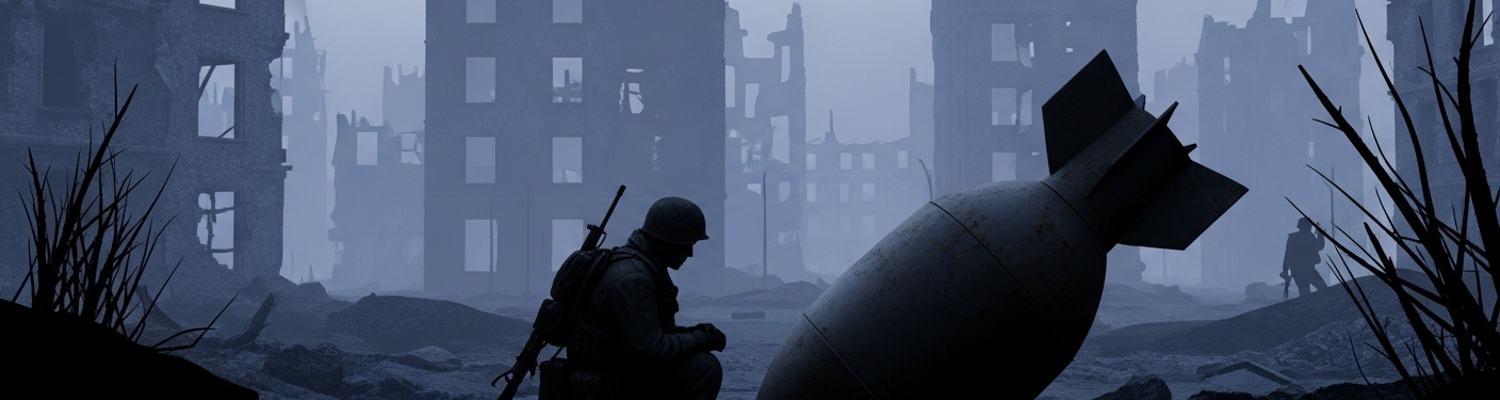

The industrial slaughter of World War I left a lingering legacy on the landscape of Europe: millions of tons of unexploded ordnance. For the United States Army, this was a problem of clearance, not of active combat. The period between the wars saw little institutional thought given to the idea of a munition designed not just to explode, but to wait. The concept of weaponized time was about to be brutally introduced by the German Luftwaffe. As bombs rained on Great Britain during the Blitz of 1940, a new terror emerged. Unexploded bombs, or UXBs, paralyzed London. Some were simple duds, but many were armed with sophisticated delayed-action fuzes, turning entire city blocks into ticking time bombs. The British Royal Engineers became the world’s first true bomb disposal experts, learning their craft through a horrific process of trial and error. American military observers in London watched this desperate fight, sending back urgent reports that the U.S. Army possessed no equivalent capability, no personnel, and no doctrine to counter this threat. This stark vulnerability assessment ignited the hurried creation of a new, high-risk discipline within the Ordnance Corps.
Forged at Aberdeen
The birth of U.S. Army bomb disposal was a direct transfer of hard-won British knowledge. In January 1942, Major Thomas J. Kane, a 42-year-old reservist from Pennsylvania with a background in railway logistics, was dispatched to England. He led a small team of eight officers and sergeants on a critical mission: embed with the Royal Engineers, absorb every lesson on Axis bomb technology, and master their render-safe procedures. Kane was a systems thinker, a man who understood how to build an organization from scratch. He and his team observed the British at work in bomb-ravaged cities, studying the mechanics of German SC250 bombs and the dreaded Hermann parachute mines. They returned to the United States with a complete blueprint for an American program.
On February 16, 1942, the Army Ordnance Bomb Disposal School officially opened at Aberdeen Proving Ground, Maryland. The school’s curriculum and structure were heavily modeled on the British school at Harper Barracks. Kane, now a Lieutenant Colonel in command, appointed the men who had accompanied him to England as the school's first instructors. The initial classes of students were volunteers, often men with technical or engineering backgrounds who had little idea what the job truly entailed. Gerald D. Simon, a petroleum engineer who volunteered in 1944, recalled being sent to Aberdeen because of his degree, arriving with no concept of the life-or-death puzzle solving that awaited him. The training was relentless. Instructors, fresh from witnessing the consequences of failure in London, impressed upon the students that a single lapse in concentration was fatal. The curriculum was exhaustive, covering Allied and foreign ordnance identification, advanced demolition procedures, and the intricate art of dismantling booby traps. A large field, dubbed the 'bomb farm', was littered with inert but realistic training aids, including sectioned bombs that revealed the complex mechanisms they would have to defeat. A final, nerve-wracking test required technicians to work blind, their arms inserted through holes in a wall to assemble or disassemble a fuze mechanism purely by touch. This simulated the grim reality of working in a dark, debris-filled bomb crater where sight was a luxury.
Initial doctrine organized these new specialists into Bomb Disposal Companies. Field experience in North Africa during Operation Torch in late 1942 and 1943 quickly proved this structure was too cumbersome. A company was a slow, heavy asset, ill-suited for the fluid nature of modern warfare. A commander might need a single team to clear a critical road miles away, but had to request the entire company. The organization rapidly evolved into smaller, more agile seven-man squads. A typical squad consisted of a junior officer, two non-commissioned officers, and four technicians, each trained in different specialties. This lean structure allowed them to be attached wherever needed, providing immediate, expert support across a vast theater of operations. Over 2,200 men would serve in these elite squads by the war's end.
The Unseen Enemy's Mechanics
The primary driver of bomb disposal's tactical evolution was the cold ingenuity of engineers in Germany and Japan. They designed fuzing systems not just to detonate a bomb, but to specifically target the technicians sent to disarm it. The German Type 17 clockwork fuze, for instance, was a masterpiece of malevolent engineering. It could be set for delays of up to 72 hours, creating sustained terror and disruption long after an air raid had passed. Disposal teams used sensitive acoustic stethoscopes to press against the bomb casing, listening for the faint, steady ticking of the clockwork, a sound that confirmed the device was active and the countdown was on. The decision of what to do next had to be made in minutes.
A more direct threat came from dedicated anti-handling devices. Reacting to early British successes in removing fuzes, German designers developed the ZUS 40 anti-withdrawal fuze. The ZUS 40 was a purely mechanical booby trap, a small device fitted underneath the main fuze. If a technician successfully neutralized the primary time fuze and attempted to withdraw it from the bomb's fuze pocket by as little as 15 millimeters, a spring-loaded striker in the ZUS 40 would be released, firing a detonator and initiating the main charge. The discovery of this device created a nightmare scenario. The technician now faced a bomb that might detonate on a timer, or it might detonate if he attempted to remove the neutralized timer. The Germans also employed the (50) electric anti-disturbance fuze, which armed itself after impact and was sensitive to the slightest movement or vibration. A single bomb could be fitted with a combination of all three: a long-delay clockwork fuze, a ZUS 40 to prevent its removal, and a (50) fuze to punish any attempt to move it. In the Pacific, U.S. Army squads faced different but equally lethal challenges. Japanese ordnance featured distinct Army and Navy fuze designs that were not interchangeable, forcing technicians to master two separate arsenals of threats. Japanese forces also proved adept at battlefield improvisation, turning their own naval depth charges, aerial bombs, and even captured American munitions into powerful, crudely fuzed landmines and booby traps.
A Toolkit Built on Necessity
The deadly creativity of Axis ordnance demanded a parallel response in Allied tools and procedures. Early equipment was often crude, born from immediate field necessity. The British developed a tool called the 'Crabtree Discharger' to short-circuit the capacitors in early German electrical fuzes. German designers quickly altered the wiring, so that using the Discharger would complete the circuit and detonate the bomb. This deadly cat-and-mouse game defined the technological struggle throughout the war.
To counter clockwork fuzes like the Type 17, technicians developed the magnetic clock stopper, a powerful magnet placed on the bomb casing to freeze the steel components of the mechanism. For the dreaded ZUS 40, entirely new methods were required. One of the most effective was steam sterilization. A special truck-mounted steam generator would use a trepanning tool to carefully drill a hole into the bomb casing. Once breached, superheated steam was injected, which would melt out the TNT or Amatol explosive filling, leaving the fuzing system intact but harmlessly separated from the main charge. This was a slow, meticulous process, but it was far safer than attempting a manual extraction of a ZUS-protected fuze. Major John E. Feldman, Colonel Kane's research and development officer, was a key innovator known as 'Kane's Brains'. He invented a portable flit-gun and a self-tapping needle, tools that allowed technicians to inject 'BD fluid' (a deactivating mixture of alcohol and glycerin) into fuzes, chemically destroying their delicate internal workings without triggering them. These inventions reduced the amount of bulky equipment squads needed in the field. Remote procedures were always the preferred option. The 'Design 7 Fuze Extractor' was a manual winch-and-cable tool that allowed a technician to pull a fuze from a safe distance. This simple principle of maximizing distance from the threat remains a cornerstone of Explosive Ordnance Disposal (EOD) work today.
The Human Cost of Valor
For all the specialized tools and remote procedures, the core of the mission often came down to one technician, a set of hand tools, and a live bomb. The psychological burden was immense. The work was solitary, performed in the confines of a muddy hole or the rubble of a shattered building, where a single mistake meant instant oblivion. Imagine the approach: a lone soldier walking toward a silent, metallic object that has already failed to do its job once. The first step is assessment. Is it armed? What type of fuze is visible? Are there signs of a second, hidden fuze? He places his stethoscope on the cold steel, listening. Silence is good. A tick is bad. If it ticks, he must work fast. If it is silent, he must worry about anti-disturbance fuzes. He chooses his procedure. Perhaps he will attempt to freeze the clockwork with a magnet. He places it gently, listening for the ticking to stop. It does. Now he must deal with the possibility of a ZUS 40. He cannot pull the fuze. The choice is made to steam it out. He calls for the truck, clears the area, and begins the slow, loud, and dangerous process of drilling into a live bomb. Every second is a calculation of risk. The casualty rate was exceptionally high. In the European Theater of Operations alone, U.S. Army bomb disposal squads suffered ten percent casualties, a rate comparable to front-line infantry. Across all services, 389 British bomb disposal personnel were killed during the war.
The personal toll is recorded in terse official reports. Captain Richard Metress, one of the original nine officers who traveled with Kane to England, was killed on Mandog Hill in the Philippines on June 28, 1945. He and three enlisted men were disarming Japanese depth charges used as landmines when one detonated. On the island of Ie Shima, Captain George C. Sarauw and his entire team were killed when a Japanese beach mine destroyed their transport vehicle on April 18, 1945. The work was not confined to distant battlefields. It involved clearing vital ports like Antwerp and Cherbourg, Allied airfields in England, and liberated cities like Paris and Manila so that the war effort could continue and civilian life could resume. Their secrecy and small numbers meant they received little public recognition. The courage required for the job, however, is reflected in the disproportionate number of decorations awarded for valor. The quiet, deliberate walk toward a live bomb became the defining act of this new breed of soldier. They were not engaged in the kinetic violence of a firefight, but in a cold, intellectual battle against a hidden enemy, where the stakes were absolute. Their work saved countless lives and laid the direct foundation for the modern, joint-service Explosive Ordnance Disposal community that operates on battlefields across the globe.