
Forging the Electronic Fist
The path to victory in the Second World War was paved with technological surprise. In 1940, the United States Army’s methods for detecting enemy aircraft and artillery were relics of a previous conflict. Observers with binoculars, large acoustic horns attempting to hear distant engines, and sound-and-flash ranging teams were the primary tools. These systems were slow, inaccurate, and completely dependent on clear weather and daylight. The looming threat of a technologically advanced air war demanded a radical solution. The answer arrived in September 1940 with the British Tizard Mission. A delegation of British scientists, arriving in Washington D.C. under the cover of secrecy, carried a black box containing what they called their most valuable cargo. Inside was a resonant cavity magnetron, a device capable of generating high-power microwave pulses. It was the key that unlocked practical, high-resolution radar.
This revelation catalyzed the formation of the MIT Radiation Laboratory, or Rad Lab. Funded by the National Defense Research Committee and championed by physicist and financier Alfred Loomis, the Rad Lab became a crucible of innovation. Under the leadership of director Lee DuBridge, Project 2 was established with a singular, ambitious mandate: to develop a microwave-based, automated gun-laying radar for anti-aircraft artillery. The team, led by Ivan A. Getting, worked at a feverish pace. They were not just building a new machine; they were weaponizing a new domain of physics against a ticking clock.
The result of their work was the SCR-584, for Set, Complete, Radio No. 584. It operated in the S-band at around 3,000 MHz, powered by the British magnetron design. Its six-foot parabolic dish antenna employed a conical scanning system, where the radar beam rotated in a small circle around the antenna's central axis. This allowed the system's electronics to detect any deviation in the return signal's strength and automatically drive motors to keep the dish aimed squarely at the target. This automatic-tracking, or lock-on, capability was the system's defining feature. It could detect a bomber at 40 miles and maintain a continuous, precise track from 18 miles inward, with a stated accuracy of 25 yards in range and less than a tenth of a degree in angle.
The radar itself was only one part of the system. Its data fed directly into the Bell Labs M9 Director, an electromechanical analog computer of breathtaking complexity. The M9 took the SCR-584's real-time target data, factored in variables like shell velocity, air density, and wind speed, and continuously calculated the future position of the aircraft. It then transmitted electrical commands to the motors of a four-gun battery of 90mm anti-aircraft guns, aiming them not at the target's current position, but where the target and the shells would meet. The entire 10-ton system, housed in a K-78 trailer, was demonstrated on April 1, 1942. The next day, the Army placed an order for over 1,200 units. The electronic fist was forged.
From Skies to Foxholes
The SCR-584's combat debut was dramatic. Two sets were airlifted to the Anzio beachhead in Italy, arriving on February 24, 1944, to counter nightly Luftwaffe raids that were bleeding the Allied lodgment dry. The night after the radar went active, seven of twelve attacking German aircraft were destroyed. The raids stopped. The system's effectiveness against V-1 flying bombs aimed at London and Antwerp was even more pronounced. Paired with proximity-fuzed shells, SCR-584 batteries formed a nearly impenetrable shield, achieving kill rates that climbed above 80 percent. The system performed its designed mission flawlessly.
Yet as Allied forces pushed into France after the Normandy landings in June 1944, the nature of the threat changed. Allied air supremacy was so complete that the Luftwaffe was rarely a factor. The Anti-Aircraft Artillery battalions, equipped with the most advanced electronics on the battlefield, found themselves with little to shoot at. The greatest danger to the infantryman and the field artilleryman was not from the sky, but from the ground. The German army's proficient use of mortars and artillery, particularly the well-hidden 8.8cm guns firing in a ground support role, inflicted a constant, draining toll of casualties. Locating these firing positions was a deadly and frustrating game of cat and mouse.
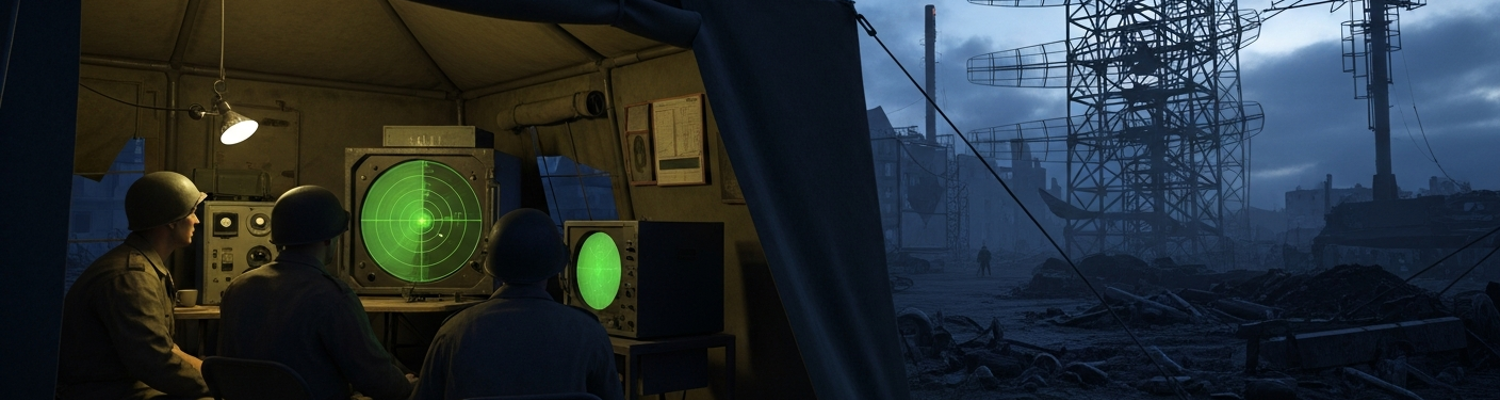
It was in this environment that soldiers, not scientists, initiated the radar's next evolution. The innovation was born of necessity and observation in the field. Radar operators in AAA battalions assigned to support field artillery began noticing fleeting, anomalous signals on their screens. On the A-scope, which showed signal strength versus range, they saw faint, fast-moving spikes. On the Plan Position Indicator scope, a circular screen showing a map-like view, they saw momentary blips tracing a rapid arc. They were seeing artillery shells and mortar bombs in flight. This was an unplanned capability. The system was designed to track a multi-ton bomber, not a 15-pound projectile.
The technique that developed was an exercise in skill and improvisation, often called 'shell-printing' or 'back-plotting'. An operator would orient the antenna toward the front lines, scanning a low-angle sector of the sky. When an enemy battery fired, the operator had to spot the projectile's faint echo amidst the background noise and ground clutter. Using a grease pencil on the scope's overlay, a plotter would mark two or more points along the shell's ascending trajectory. These points, representing range and azimuth at specific times, were enough. Using slide rules and plotting boards, the crew could reconstruct the parabolic curve of the shell's flight path and extrapolate it backwards to its point of origin. This required immense concentration and a feel for the equipment that only came with hours of practice. Some crews dug their trailers into the ground, leaving only the antenna exposed, to minimize their own signature and improve their view of the low-level sky.
The Muzzle Flash Silenced
The operational impact of this field-expedient doctrine was immediate. Traditional sound-and-flash ranging was a time-consuming process, often taking 15 to 20 minutes to triangulate a target, and it was dependent on multiple observation posts and favorable conditions. A German mortar crew could often fire a volley and relocate before a response could be brought to bear. Radar changed this calculus completely. A proficient SCR-584 crew could generate a firing solution for a hostile battery in under three minutes from the first enemy shot. The information was often passed directly over field telephone lines to a nearby US Army 155mm gun battery.
The effect was a dramatic compression of the counter-battery cycle. German artillery crews who had previously operated with a degree of impunity found their positions being bracketed by accurate return fire moments after they opened up. The first sign of trouble was not a distant muzzle flash or the whistle of an incoming shell, but the sudden, violent arrival of American high explosives on their exact location. The SCR-584 could even track friendly outgoing shells, allowing American gunners to adjust their fire with lethal precision, walking their rounds onto the target with guidance from the radar operators.
This capability proved decisive in the brutal attritional battles fought from the Hürtgen Forest to the Ardennes. In the Battle of the Bulge, where persistent cloud cover grounded Allied air power for days, the all-weather capability of radar-directed counter-battery fire became a vital asset. It systematically dismantled the German artillery advantage, a key component of their offensive strategy. The efficiency was not just tactical but also logistical. Instead of expending dozens of shells to saturate a suspected area, artillery could neutralize a known point with just a few rounds. This conservation of ammunition was a significant benefit for an army operating at the end of long and tenuous supply lines.
The psychological impact on German gunners was severe. An unseen electronic eye could now watch their every move, rendering their carefully prepared and camouflaged positions vulnerable. The sense of security was shattered. The SCR-584's adaptation from an air defense weapon to a premier artillery-hunting tool was a testament to the ingenuity of the American soldier. The scientists at the Rad Lab had built a remarkable machine to rule the skies, but it was the enlisted crews on the muddy front lines of Europe who taught it to win the war on the ground.