
Greenland's Strategic Position
Operational logs from the Battle of the Atlantic document the calculus of survival. For Allied merchant seamen, any given crossing during the height of the U-boat war carried a one-in-five chance of being sunk. This statistical threat shaped every aspect of the war at sea.
In this context, Greenland's geographic placement gave it an outsized strategic weight. Its function was twofold. First, it served as a stationary, unsinkable platform for the North Atlantic air ferry route. This corridor was essential for moving thousands of American-built aircraft, from B-17 bombers to P-38 fighters, to the European theater. The trans-oceanic flight was too great for a single leg, which demanded refueling stops. Airfields, literally carved from glacial moraine and coastal plains, became indispensable nodes in this network. The U.S. Army began constructing a major airbase at Narsarsuaq, designated Bluie West One (BW-1), in June 1941. A second key facility, Bluie West Eight (BW-8), was sited at the end of Sondre Strom Fjord. These bases enabled aircraft to hop from Labrador to Greenland, then to Iceland, and finally to Scotland.
Second, and of greater operational significance, was Greenland's role as the origin point for weather systems tracking east across the Atlantic. These systems dictated conditions over the British Isles and mainland Europe days later. Accurate forecasting was a weapon. It determined the timing of bombing raids, the viability of amphibious landings, and the routing of naval convoys to evade wolf packs hunting in storms. Control of Greenland's weather data offered a decisive advantage in planning nearly every major Allied operation.
German high command was acutely aware of this meteorological leverage. The Kriegsmarine and Luftwaffe, desperate for reliable long-range weather intelligence, mounted clandestine operations to implant automated and manned stations on Greenland’s remote eastern coast. These were small, deniable infiltrations. In August 1942, the converted trawler Sachsen landed a 17-man team under Lieutenant Hermann Ritter on Sabine Island to establish the Holzauge station. This unit transmitted weather reports for months, directly aiding U-boat operations before its detection in March 1943. The ensuing skirmish with a Danish sledge patrol resulted in the first combat death on Greenlandic soil during the war. The German trawler Externsteine, another weather ship, was later captured by the cutter USCGC Eastwind in October 1944, the only enemy surface naval vessel captured at sea by U.S. forces during the war.
After the fall of Denmark in 1940, the United States extended its protection over Greenland. An agreement signed on April 9, 1941, effectively made the island a U.S. protectorate. Its defense fell to the United States Coast Guard, a service with extensive experience in polar conditions from its pre-war International Ice Patrol duties. The force was formally designated the Greenland Patrol in October 1941, a unique command placing the Coast Guard in charge of an entire theater of operations. Under Commander Edward Smith, an Arctic expert, the patrol’s mission was grueling. Its cutters, including the hardened USCGC Northland and USCGC Bear, hunted German infiltrators, escorted supply convoys, conducted search and rescue, and supported the construction of the airbases. The environment was a constant enemy. Crews endured temperatures that made steel brittle, navigated fjords choked with icebergs, and constantly chipped away tons of frozen sea spray that threatened to capsize their ships.
Remote Station Logistical Hurdles
Archival records for the Greenland Patrol detail a persistent, grinding conflict against the environment itself. Establishing the remote weather and radio outposts, especially on the eastern coast, was an exercise in extreme difficulty. There were no ports. Cutters like the USCGC Northland had to shoulder through shifting pack ice and navigate uncharted fjords just to get within sight of a potential station location.
Unloading was a high-risk operation. Small boats landed supplies on rocky, ice-slicked shores or directly onto the unstable surface of the sea ice. Every crate of food, barrel of fuel, radio vacuum tube, and bag of coal was manhandled from the boats, dragged across the ice, and then hauled up steep, frozen cliffs. The work parties of Coast Guardsmen and Army engineers faced katabatic winds of hurricane force and temperatures that could shatter unprotected metal. Records from the establishment of Bluie East Two at Ikateq show how landing parties had to physically carve a path, fighting the terrain for every foot.
Conventional methods were insufficient.
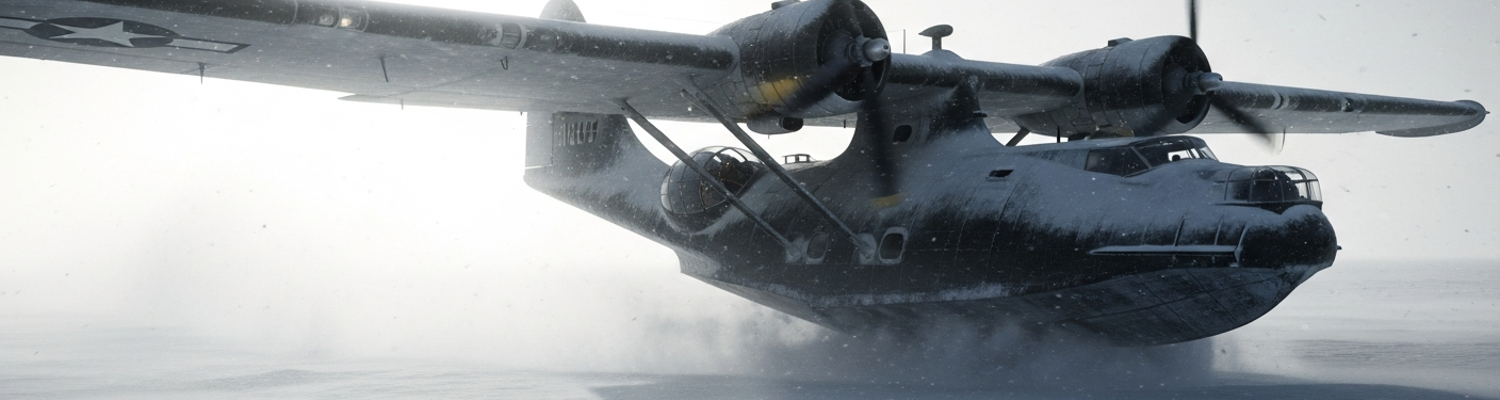
The conditions forced the development of new supply and personnel rotation techniques. The impossibility of reliably reaching many stations by sea for most of the year pushed logistics into the air. Consolidated PBY Catalina flying boats became a lifeline, but a flawed one. Landing a PBY in a fjord required a stretch of water clear of floating ice, a condition that was never guaranteed. For overland transport, the Greenland Patrol formally established the Sledge Patrol, a unit of Danish hunters and local Greenlanders who used traditional dog sleds to patrol the vast coastline. Air supply drops became common for isolated outposts, a hazardous process where pilots flew low and slow in treacherous mountain winds to parachute containers of food and equipment.
This physical struggle was compounded by a bureaucratic one in Washington D.C. The April 1941 agreement between the United States and the Danish ambassador made Greenland a U.S. protectorate, not a territory. This ambiguous political status created significant hurdles for resource allocation. To the larger Army and Navy commands focused on Europe and the Pacific, Greenland was a low-priority sideshow. Commander Smith repeatedly filed requests for purpose-built icebreakers and more ski-equipped aircraft. These requests were often delayed or denied by committees who viewed the Greenland operation as a drain on assets needed for the primary war effort. The initial fleet was a motley collection of converted trawlers and aging cutters. It was not until 1943 that the first of the powerful Wind-class icebreakers arrived, years after the patrol’s inception. For much of the war, the men of the Greenland Patrol were forced to make do with inadequate equipment in the harshest operational environment of the conflict.
Sub-Arctic Equipment Failures
Operational logs from the Greenland Patrol show that the most dangerous adversary was the physics of the polar environment. Standard-issue military hardware failed with alarming frequency in the extreme cold and unique magnetic conditions. For a deep reconnaissance patrol, an equipment failure was a potential death sentence.
The technological foundation of command and control, radio communication, proved especially fragile. High-Frequency (HF) radio, the only method for long-range contact, was rendered unreliable by the region’s atmospheric properties. Solar events, more pronounced in polar regions, could trigger geomagnetic storms that blacked out transmissions for hours or days. The aurora borealis was a visual indicator of the ionospheric disturbances that would absorb radio waves, severing the link between a PBY Catalina crew and its base at Bluie West One. The equipment itself was a source of constant struggle. The vacuum tubes in 1940s radios were sensitive to jarring temperature changes. The lead-acid batteries that powered portable sets for Sledge Patrols would lose a significant portion of their charge in the cold, drastically reducing transmitter power.
Navigation became an exercise in approximation. The proximity to the North Magnetic Pole made standard magnetic compasses dangerously erratic. The magnetic field’s horizontal component, which a compass needle relies on, becomes progressively weaker in high latitudes, causing the needle to swing aimlessly or dip. While some units had advanced gyrocompasses, these were complex, required constant power, and were found on larger cutters, not on PBY aircraft or with Sledge Patrols. Aviators and mariners relied on celestial navigation, but this too was compromised. Frequent whiteouts, a condition where diffuse light from an overcast sky blends seamlessly with the snow-covered surface, would erase the horizon, making it impossible to use a sextant. The cold itself was a mechanical opponent. Extreme temperatures caused lubricants in precision instruments like chronometers to thicken, affecting their accuracy. On aircraft, the rapid accumulation of rime ice on wings and control surfaces altered their aerodynamic properties, creating a constant threat of a stall or loss of control.
The cumulative effect was the constant threat of operational isolation. Records detail frequent and prolonged communication blackouts that left commanders effectively blind. A Sledge Patrol could be out of contact for weeks, leaving leadership to wonder if they had succumbed to the elements or been ambushed. For the aircrews of PBYs, a radio failure combined with navigational difficulty could be fatal. The July 1942 incident of the so-called Lost Squadron, where six P-38 fighters and two B-17 bombers were forced to land on the ice sheet, underscores the perils of operating at the edge of technological capability. The crews were rescued. Their aircraft were not.
The Scoresby Sound Patrol
Greenland Patrol command directives from mid-1942 indicate a strategic focus on the northeast coast. Following a joint decision by Commander Smith and Danish Governor Eske Brun, the coastline north of the vast Scoresby Sound fjord system was ordered evacuated of all hunters and trappers. This policy transformed hundreds of miles of uninhabited territory into a sterile free-fire zone. Any human presence detected there could now be treated as hostile. The directive was a direct response to the high probability of German attempts to implant clandestine weather stations, a threat confirmed by fragmented intelligence. The reconnaissance of Scoresby Sound became an operational necessity, a mission to enforce the new exclusion policy and probe for any signs of incursion.
Official records of the ensuing patrol are deliberately thin. This lack of detailed documentation was a feature of command policy under Smith. The Greenland Patrol operated within a diplomatic gray area, placing constraints on military action. A formal, documented mission to hunt a suspected enemy base would invite scrutiny from Washington. By tasking a cutter like the USCGC Northland with a reconnaissance-in-force under a general patrol directive, Smith retained operational flexibility and deniability. Verbal orders replaced a detailed written trail.
The Northland pushed into the treacherous waters off the mouth of Scoresby Sound in late summer 1942. The vessel was uniquely suited for the task with its reinforced hull, but the environment remained the primary antagonist. Navigators contended with erratic magnetic compasses, forcing a heavy reliance on dead reckoning. Lookouts scanned the ice pack for German vessels and for the growlers and larger icebergs that could tear open the ship’s hull. The patrol’s core mission involved systematic searches. Whaleboats carrying landing parties armed with M1 Garands and Thompson submachine guns were dispatched to promising inlets. These teams moved ashore in near-total silence, their objective being the discovery of unnatural details: a boot print, the glint of a wire antenna, the faint smell of coal smoke. Every potential landing site was assessed for its suitability to house a hidden weather station.
The search yielded nothing. The Northland eventually withdrew, its log noting only routine patrol duties. The patrol had confirmed the immense difficulty of locating a concealed enemy in a wilderness of fjords and glaciers that dwarfed the resources of the Greenland Patrol. While the Northland’s crew searched the approaches to Scoresby Sound, Lieutenant Ritter’s Holzauge team was, at that moment, successfully establishing their station further north, an operation that would go undetected until March of the following year.
Whiteout and Radio Failure
Incident reports from Patrol Bombing Squadron Six, operating out of Bluie West One, show a recurring pattern of near-catastrophic events spawned not by enemy action, but by the convergence of meteorological and mechanical failure. For the ten-man crew of a PBY-5A Catalina on a long-range ice cap reconnaissance mission, the environment was the primary threat.
The crisis began without warning. One moment, the PBY crew flew over the monotonous expanse of the Greenland ice sheet. The next, they were swallowed by a featureless void. A true polar whiteout. Diffuse, overcast light from above merged perfectly with the snow-covered terrain below. The horizon vanished. Sky and ground became a single, luminous, shadowless bowl of white, robbing the pilots of all depth perception and spatial orientation. The danger was collision with the unseen ice. The ice cap is not flat; it features sastrugi, hard, wind-carved ridges of snow that can be many feet high, and gentle, imperceptible slopes that could lead an aircraft into a rising elevation. Flying on instruments was the only option. The gyrocompass fought the magnetic distortions of the high latitudes. The altimeter could only report height above a theoretical sea level, not the deadly, variable surface of the ice just below.
In this disorienting state, the second failure occurred. The radio operator, attempting to transmit their predicament, was met with sudden silence. The hum of the aircraft’s T-47/ART-13 transmitter ceased. Analysis of such failures points to a common vulnerability: the DY-12 dynamotor. This device, a high-speed DC-to-DC converter, generated the high voltages for the transmitter’s vacuum tubes. Its high-pitched whine was a standard part of the PBY’s auditory environment. In the extreme cold, the grease in the dynamotor’s bearings could thicken, putting immense strain on the armature. The silence was the sound of a seized bearing or a short in the windings. The high-frequency link to the outside world was severed.
They were alone and blind. Flying inside a featureless white sphere with no external references, unreliable compasses, and no way to call for help. The navigator’s last reliable position was a point in the past, and every minute of flight introduced a growing circle of uncertainty on his chart. The pilot, fighting sensory illusions, had to place absolute trust in his malfunctioning instruments. The aircraft commander faced a stark choice: climb and burn precious fuel, risking severe icing; descend in a terrifying gamble on a survivable belly landing; or maintain his last heading and altitude, praying that dead reckoning was accurate enough to carry them to clear air before fuel exhaustion.
The Five-Minute Intervention
The crisis escalated. The small, four-stroke engine that powered the aircraft’s heater was housed in the flight engineer’s compartment. In the intense cold, this unit was essential for preventing the thickening of lubricants in flight instruments. During the violent turbulence of the whiteout, a crystallized fuel line to this heater engine fractured. Atomized gasoline sprayed over the hot exhaust manifold and ignited. A sheet of flame erupted in the cramped space. The flight engineer, thrown against his instrument panel, suffered second-degree burns across his forearms and face. His immediate action of smothering the fire with a canvas chart bag saved the aircraft but left him in incapacitating agony.
Now they had a severe medical emergency. The aircraft commander’s voice on the interphone was clipped, demanding a status report. It fell to the Pharmacist’s Mate, a petty officer with a Unit 3 medical bag containing little more than gauze, tape, and morphine syrettes, to intervene. Working by dim emergency battle lanterns, the medic crawled over the main spar to reach the injured engineer, who was going into shock. There were no dedicated burn dressings in his kit.
The next three minutes were a sequence of desperate but calculated choices. He first administered a syrette of morphine to manage the pain and prevent deeper shock. The primary challenge was the burns. With no sterile burn cream, he was forced to innovate. He instructed a crewman to fill the cleanest possible container with water from the crew’s drinking supply. While the water was fetched, he cut away the engineer’s charred clothing. Using gauze pads soaked in the water, he began gently cleaning the burns to reduce the chance of infection. For a dressing, he turned to the galley supplies. Finding a tin of petroleum jelly, a standard item for preventing corrosion, he coated sheets of waxed paper from the crew’s K-rations. This created a crude, non-adherent barrier to place over the burns before wrapping them tightly with all the gauze he could spare.
This action had an immediate tactical effect. By stabilizing the engineer, the medic extinguished the most immediate internal crisis. It freed the aircraft commander from a terrible choice: attempt a blind landing on the ice to render aid, or watch a crewman die. With the medical emergency contained, the pilot could devote his entire focus to flying his instruments. The tactical decision was made to hold their course and altitude, remaining hidden within the whiteout rather than climbing into clear air where they might be spotted by German reconnaissance. For another fifteen minutes they flew through the void, until they broke through the edge of the weather system into the clear, cold air over the coast. The engineer’s improvised dressings held. He was transferred to the infirmary at Bluie West One upon landing.
Unrecorded Lessons
Official squadron logs from the Greenland Patrol are functionally sterile. They document fuel loads, patrol sectors, and return times. An entry for the PBY that survived the crisis would note nothing more than a routine reconnaissance flight with all hands returned safely. The catastrophic failure of the radio, the near-fatal fire, and the medic’s intervention would not be recorded.
This was not an oversight. Under Commander Smith, the Greenland Patrol operated with an autonomy born of isolation. Formal reports detailing multiple critical equipment failures on a single sortie would invite scrutiny from Washington, potentially leading to operational restrictions or a reallocation of scarce assets. Admitting that a crew flew for a significant period completely blind and deaf was an admission of risk that higher commands would not tolerate.
The true story existed only in the oral tradition of the squadron and in unrecorded debriefs at Bluie West One. It was here that the real lessons were learned. The Pharmacist’s Mate’s use of petroleum jelly and waxed paper as a burn dressing was a stark example of innovation under duress. His standard-issue kit was designed for scrapes, not second-degree burns in a sub-zero fuselage. The incident forced an immediate, if informal, re-evaluation of onboard emergency supplies. Subsequent PBY crews leaving BW-1 often carried extra, non-regulation items scrounged from the base infirmary, including more extensive burn dressings and morphine.
While the specific actions remained undocumented, the safe return of the aircraft represented a significant contribution to the intelligence effort. Every crew that survived a near-disaster brought back data on what could and did go wrong. The debrief on the PBY’s return provided planners with granular detail on the operational limitations of their own equipment. They now had a concrete data point on the failure rate of a heater fuel line in extreme turbulence and a clear understanding of the DY-12 dynamotor’s vulnerability to cold seizure. This information, when aggregated with reports from dozens of other patrols, allowed intelligence and operations officers to build a highly detailed risk matrix for the entire Greenland theater. It informed everything from maintenance schedules to the calculation of fuel reserves. The survival of this single aircraft, secured by one man’s improvised action, provided hard data used to predict, mitigate, and prevent the loss of other crews to similar failures.