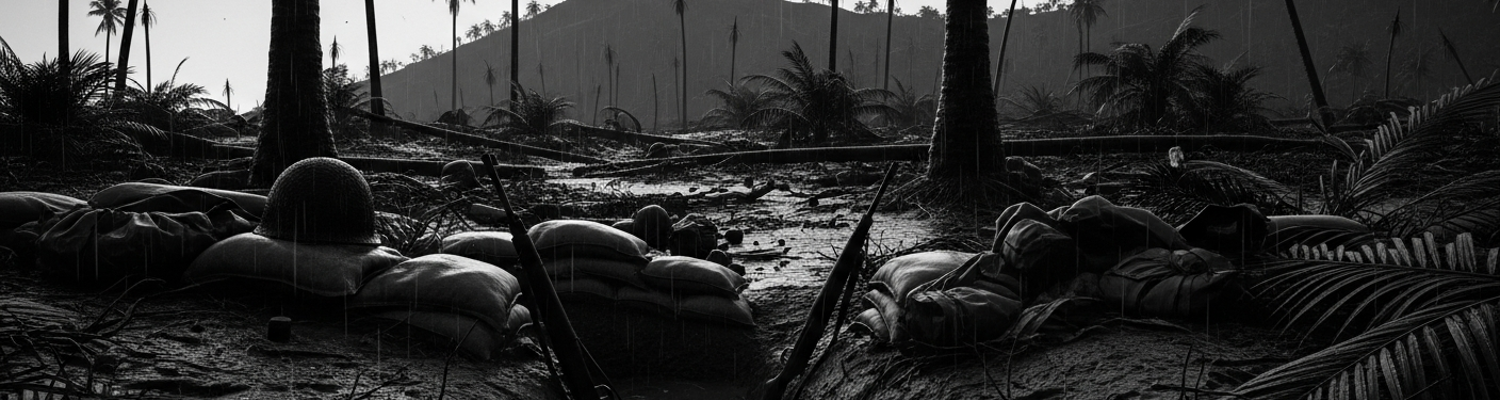

Operation Watchtower: The Opening Hours
06:13 Local Time. 07 August 1942. The grinding sound of Higgins boat ramps on black volcanic sand marked the start of America's first land offensive in the Second World War. This was Operation Watchtower, the Allied counter-thrust to halt Japan’s southern advance. On Guadalcanal, the 11,000 Marines of the 1st Marine Division under Major General Alexander Vandegrift encountered almost no initial resistance. The Japanese construction personnel and their small security elements had fled into the jungle during the pre-invasion naval bombardment. By the afternoon of August 8th, they had secured the objective: a partially finished runway on the Lunga Plain. It was the strategic pivot for the entire campaign.
It was a deceptive calm.
Across the Sealark Channel, a different war was being fought. Another 3,000 Marines were locked in vicious, close-quarters combat for the small islands of Tulagi, Gavutu, and Tanambogo. The defending Japanese Special Naval Landing Force troops fought with a tenacity that stunned the attackers. The fight for these tiny landmasses would take two full days, a dark preview of the fighting to come. The initial plan was already coming apart. On the evening of August 8th, Vice Admiral Frank Jack Fletcher, commanding the carrier task force providing air cover, signaled his withdrawal. Citing high fighter losses and fuel concerns, he pulled his three carriers from the area, stripping the invasion of its air shield.
Disaster arrived in the early hours of August 9th. A Japanese force of seven cruisers and one destroyer under Vice Admiral Gunichi Mikawa slipped past Savo Island, completely undetected. In a chaotic 32-minute night action, Mikawa’s ships tore apart the Allied naval screen. The American heavy cruisers USS Quincy, USS Vincennes, and USS Astoria went to the bottom. So did the Australian heavy cruiser HMAS Canberra. With his screening force destroyed and his air cover gone, Rear Admiral Richmond K. Turner made a fateful decision. He ordered the withdrawal of the entire amphibious fleet. The transports and cargo ships, still holding over half of the 1st Marine Division’s supplies, ammunition, and heavy equipment, turned and steamed away.
By evening, the horizon was empty. Eleven thousand Marines were alone.
The Henderson Field Perimeter
With the fleet gone by the evening of August 9th, the 1st Marine Division's situation became one of immediate survival. Command staff records (NARA Record Group 127) show Major General Vandegrift moved instantly to consolidate a defensive posture around the single asset that mattered: the captured airstrip, now named Henderson Field. The resulting perimeter was a crude line dictated by terrain. It was anchored on the west by the Lunga River, stretched south into the jungle, and bent back north to a point just east of the Ilu River, which the Marines had mistakenly identified on their poor maps as the Tenaru. The 1st and 5th Marine Regiments dug in along this arc, a thin line of rifle pits scraped from the earth.
The Japanese response was swift. Imperial General Headquarters in Tokyo, believing only a small reconnaissance force had landed, directed a counter-attack. The first instrument was the 1st Detachment of the 28th Infantry Regiment, an elite unit commanded by Colonel Kiyonao Ichiki. This force of just under 1,000 men landed east of the Marine perimeter on August 18th. Japanese intelligence was dangerously flawed; Ichiki was confident he faced a weak remnant. He ordered an immediate night assault. In the early hours of August 21st, Ichiki’s main body launched a frontal human-wave attack across the sandbar at the mouth of the Ilu River. They charged directly into the prepared positions of the 2nd Battalion, 1st Marines. Marine machine-gun teams and 37mm anti-tank guns firing canister shot tore the attacking formations apart. The fighting was a one-sided slaughter.
The line held.
The entire defense was predicated on the value of that single, 3,800-foot runway. In Japanese hands, it would sever the sea lanes to Australia. For the Allies, Henderson Field was a forward base from which to project air power up the Solomon Islands chain. This function became reality just hours before Ichiki’s attack. On the afternoon of August 20th, the escort carrier USS Long Island steamed to within 200 miles of the island. It launched nineteen F4F Wildcat fighters from Marine Fighting Squadron 223 and a dozen SBD Dauntless dive bombers from Marine Scout Bombing Squadron 232. Their arrival electrified the defenders and fundamentally altered the campaign. American air power, the force the Marines called the Cactus Air Force, was now based on Guadalcanal.
The Logistical Collapse
The logistical plan for Operation Watchtower had been built on a reduced 60-day supply. It disintegrated within 48 hours. A review of after-action reports reveals a near-complete breakdown in beachhead organization from the first hours of August 7th. A shortage of trained shore party personnel meant supplies were simply dumped on Red Beach in disorganized heaps. Ammunition was mixed with rations, medical kits buried under engineering equipment. The chaos forced a suspension of unloading on the evening of August 8th. Then came the naval defeat at Savo Island and Admiral Turner's withdrawal. When the last transports vanished, they took with them more than half of the division’s food, most of its heavy construction equipment, and a large portion of its ammunition reserves.
A 60-day supply buffer evaporated into a crisis of sustainment.
The 11,000 Marines were immediately placed on a two-meal-a-day ration. This diet consisted largely of captured Japanese provisions, primarily rice and canned fish. Rapid weight loss and malnutrition-related illnesses spread through the division. The medical situation was worse. The withdrawal left the division with catastrophically low stocks of quinine and other anti-malarial drugs. Dysentery became rampant. Ammunition was counted with grim results. While rifle ammunition was adequate, reserves for heavy weapons, particularly the 75mm howitzers, were perilously low.
Survival became a matter of improvisation. The 1st Engineer Battalion, without its own heavy machinery, put captured Japanese bulldozers and trucks to use completing Henderson Field. Scavenging became an official activity. A precarious lifeline began to operate, a system of converted destroyers (APDs) and submarines the Marines dubbed the Cactus Express. These ships would dash into Ironbottom Sound at night, unload what few supplies they could carry, and flee before dawn. These small deliveries were all that sustained the garrison against the far more robust Japanese reinforcement effort, the nightly delivery of troops and materiel known as the Tokyo Express.
The Psychological War
The 1st Marine Division fought two enemies: the Imperial Japanese Army and the island itself. The first enemy waged a sophisticated campaign of psychological warfare. Japanese doctrine emphasized night attacks, or Yasen, and the dense jungle was the perfect environment. Nearly every night, small teams of Japanese soldiers would slip through the Marine lines. Their objective was not always to inflict casualties but to prevent sleep and shred nerves. Sentries heard whispers in English and strange noises in the undergrowth. This created a state of constant, high-strung tension.
The unseen human adversary was compounded by a biological one. The Lunga perimeter was a perfect breeding ground for disease. Clouds of Anopheles mosquitoes brought malaria. Medical records show a catastrophic spike in cases after the fleet withdrew with the anti-malarial drugs. Dengue fever appeared within two weeks. By September, hospitals were admitting over 1,700 men for malaria. For every Marine disabled by combat, at least three were incapacitated by sickness. Amoebic and bacillary dysentery became rampant. Fungal infections, called jungle rot, festered on exposed skin. The average Marine, on a starvation diet, lost between 30 and 40 pounds.
More Marines fell to mosquitos than to bullets.
This fusion of terror and disease produced the defining condition of the campaign’s early months: severe, chronic sleep deprivation. What little rest the sick and exhausted Marines might have found was stolen by nightly Japanese activity. Infiltration probes were joined by naval bombardments from the destroyers of the Tokyo Express. Most infamous was a solitary Japanese aircraft that appeared almost every night, an aircraft nicknamed Washing Machine Charlie for the distinctive, unsynchronized drone of its engines. The plane would circle for hours, dropping the occasional flare or small bomb. Its primary function was harassment. The sound of its engines alone was enough to put the entire perimeter on alert, robbing men of rest. The cumulative effect was a descent into hallucinatory exhaustion. Men became irritable, paranoid, and prone to firing at shadows. The vacant look of a man pushed beyond endurance, the thousand-yard stare, became a common sight.
The Subterranean War
Daily life on the Lunga perimeter was dictated by Japanese artillery. From concealed positions in the hills west of the Matanikau River, a collection of 75mm and 105mm guns, known collectively as Pistol Pete, maintained a relentless program of harassing fire. These bombardments were designed for psychological erosion. Shells arrived without warning, day and night, forcing Marines to dive for cover. The high-explosive rounds tore through the coconut groves and cratered the runway of Henderson Field, but their main effect was on the men. It drove them underground. Life became a subterranean affair, lived in foxholes and bunkers that became foul pits of mud and water. This was compounded by bombardments from the sea. On nights like October 13th, Japanese battleships sat offshore for hours, methodically blasting the Marine positions with 14-inch shells.
This shelling forced combat into the suffocating density of the jungle. The terrain negated the Marines’ advantages in rifle marksmanship, reducing engagement distances to mere yards. A review of operational logs from the 1st and 5th Marine Regiments indicates patrols found themselves in sudden, vicious firefights at conversational distances. Combat devolved into a brawl of grenades, bayonets, and Ka-Bar fighting knives. The Japanese, masters of camouflage, seemed to materialize out of the jungle walls, their positions revealed only by muzzle flash.
The ultimate expression of this close-quarters war was clearing Japanese dugouts. These were not simple pits but sophisticated, mutually supporting defensive systems. They were expertly camouflaged, often connected by shallow tunnels, and sited for interlocking fields of fire. Neutralizing them was a terrifying, step-by-step ritual. A Marine fire team would suppress the position while another man crawled forward with grenades or a flamethrower. He had to get close enough to use his weapon without being killed. The psychological toll of this task was severe. It meant confronting an enemy in a dark, confined space who was doctrinally bound to fight to the death. The discovery of booby traps on the bodies of the dead only reinforced a brutal lesson in survival.
Tactical Paralysis
Admiral Turner’s withdrawal on August 9th transformed an offensive seizure into a desperate siege. It chained the 1st Marine Division to a diet of captured rice and tactical improvisation. An examination of Major General Vandegrift’s headquarters logs reveals the most immediate consequence was the inability to mount sustained offensive operations. The division’s original plan, which anticipated a methodical expansion of the beachhead, was impossible. Shortages of artillery ammunition and fuel were the primary cause. Stocks of 75mm shells were so low that firing was restricted to dire defensive emergencies. Offensive fire support was out of the question. Heavy construction equipment sat in the holds of the departed transports. Without it, the 1st Engineer Battalion relied on a handful of captured Japanese vehicles, assets devoted entirely to maintaining Henderson Field. Any thought of pushing the perimeter out to seize the ridges from which Japanese artillery shelled the field was a fantasy.
This logistical strangulation caged the Marines within their own wire. The perimeter was a thin, permeable line. A lack of transportation was the main constraint. Most of the division’s trucks had been withdrawn with the fleet. The few remaining vehicles shuttled ammunition and rations from the chaotic supply dumps to the front. There was no strategic mobility. Moving a battalion from one sector to another was a slow, exhausting process on foot. The division lacked the capacity to supply units even a mile deeper into the jungle. This forced the Marines into a purely reactive posture. Vandegrift had to wait for the Japanese to attack his fixed positions, ceding the initiative. The only offensive actions possible were limited-objective patrols, rarely larger than a company, which probed the jungle to gather intelligence or ambush Japanese patrols.
The most harrowing impact of the logistical failure was felt in the evacuation and treatment of the wounded. The withdrawal severed the division’s medical lifeline. There were no hospital ships and no means to evacuate seriously wounded men. A Marine hit on the perimeter faced a terrifying journey. He would be carried by his comrades through miles of jungle to a regimental aid station, typically a tent staffed by a surgeon with dwindling supplies. A severe lack of blood plasma, surgical equipment, and anesthetics meant many procedures were crude. For those who survived, the next stop was the division hospital, a collection of tents near the airfield that was a frequent target of shelling. Records from the 1st Medical Battalion show a desperate struggle against infection in a hot, septic environment. Without the ability to evacuate casualties to rear-area hospitals, men with grievous but potentially survivable wounds often died. The policy to bury the dead in temporary cemeteries on the island meant many remains were lost or could not be properly identified after the war.
Geopolitical Shockwaves
The naval debacle in what became known as Ironbottom Sound sent a shockwave of anxiety through the highest levels of the United States Navy. Command correspondence between Washington, Pearl Harbor, and the South Pacific theater reveals a deep-seated fear that the entire Pacific offensive was on the verge of failure. Admiral Ernest J. King in Washington and Admiral Chester W. Nimitz at Pearl Harbor confronted the possibility that the 1st Marine Division would be annihilated. The loss of four Allied heavy cruisers at the Battle of Savo Island was a tactical disaster. Vice Admiral Fletcher’s subsequent withdrawal of his carrier task force created a strategic crisis. The South Pacific Area commander, Vice Admiral Robert L. Ghormley, became paralyzed by pessimism, at one point authorizing General Vandegrift to surrender if necessary. The fear in Washington was that a defeat of this magnitude would be a political disaster, unraveling public support for the war.
Guadalcanal became a crisis the Allies could not afford to lose. The desperate fight forced a violent reassessment of Allied grand strategy. The consensus had been a "Europe First" approach, prioritizing the buildup for an eventual invasion of Germany. Operation Torch, the invasion of North Africa, was the cornerstone of this plan for late 1942. The emergency on Guadalcanal directly threatened this. The campaign became a strategic sinkhole, demanding naval assets, aircraft, and shipping already earmarked for the Atlantic. This ignited serious friction within the U.S. Joint Chiefs of Staff. It pitted the Navy’s demand to save the Marines against the Army’s commitment to Operation Torch. Ships and air groups were diverted, disrupting timetables for the North Africa landings.
This crisis was precipitated by a fundamental Japanese strategic miscalculation. Imperial General Headquarters in Tokyo completely misunderstood the scale and intent of the American landing. Intelligence reports led them to believe the operation was a minor reconnaissance, not a full divisional assault. This flawed assessment dictated their disastrous response: the piecemeal commitment of small, insufficient forces. The first unit sent, the elite Ichiki Detachment, was fewer than 1,000 men hurled against 11,000 dug-in defenders. Japanese planners were hobbled by an institutional overconfidence born from six months of unchecked success. They held a belief that the American will to fight was brittle. They failed to appreciate the industrial capacity of the United States, which, even after the humiliating fleet withdrawal, could still sustain a toehold on the island. This underestimation of American resolve and logistical capability would prove to be Japan’s single greatest error in the campaign.