
Headquarters Ledger Returns and Post-Audit Reallocation
Director William J. Donovan stared down at the thick binder of personnel tallies while his aides struggled to explain why dozens of frontline units in Europe remained critically short of radio operators. Budget officers from the White House had spent weeks combing through desks, barracks, and warehouse rosters, demanding an exact accounting before authorizing more funding for overseas sabotage networks. Staff clerks had just completed the tabulation of personnel returns across twelve thousand civilian and military billets compiled for Bureau of the Budget inspectors in late March 1944. Typewritten tally sheets showed thousands of soldiers, code clerks, and technical specialists scattered across training camps, research desks, and foreign stations without central oversight. Staff members hurried between offices in the Washington headquarters building to gather stray carbon receipts as the audit team demanded proof for every assigned billet. Donovan pushed aside his telephone and demanded an immediate summary of which sections held the bulk of these verified workers.
Auditors handed Donovan a stark summary chart showing that nearly half of the entire agency remained tied to domestic desks in Washington rather than preparing for foreign combat. Initial internal shock over severe staffing distribution imbalances presented directly to Director William J. Donovan on the eve of Operation Overlord rattled the senior planning staff. Planners had assumed that field detachments in England and the Mediterranean held the vast majority of trained personnel, but the ledgers revealed bloated administrative branches at home. Secret intelligence branches and research divisions in the capital had hoarded linguists, clerks, and draft-eligible men while combat teams scheduled to drop behind German lines lacked basic support staff. Budget inspectors noted that several domestic support offices had doubled in size over the previous winter without ever obtaining formal approval from the Joint Chiefs of Staff. Donovan marked the worst surplus offices with red grease pencil, circling entire departments that were consuming rations and payroll without sending men overseas.
Pencil lines covered dozens of clerical programs that had shielded hundreds of able-bodied troops from transfer to staging areas in southern England. Senior division chiefs hurried into the director's office to defend their payrolls, arguing that complex intelligence analysis required large domestic support teams to process incoming European traffic. Donovan refused to accept their explanations, pointing out that Allied troops would land on French beaches within ten weeks while vital field stations in London and Algiers operated with skeletal crews. Logistics officers immediately drafted reclassification notices to strip surplus personnel from research units, printing facilities, and presentation divisions across the capital. Messengers carried the raw tallies directly to the personnel bureau with orders to prepare emergency transfer manifests before the budget examiners delivered their final reprimand to the White House.
Clerks in the personnel bureau received these transfer manifests and began stamping reassignment orders, channeling hundreds of unassigned soldiers into specialized staging camps for parachute and communications training. Administrative teams worked through the night under green desk lamps to match physical file cards with verified theater billets in England. Technicians packed crates of field gear and radio transmitters into transport trucks outside headquarters, reallocating supplies that had sat unused in Washington depots for over a year. Donovan signed the emergency reassignment directive just before midnight, transferring over a thousand civilian specialists and military billets directly into operational units preparing for the cross-channel assault. Couriers sped across Washington in staff cars to deliver the corrected ledger returns directly to the Bureau of the Budget offices before morning inspections began.
Budget Scrutiny and Joint Chiefs Absorption Threats
Budget examiners seized the delivery packets at dawn, opening the heavy paper folders across broad conference tables to inspect the revised personnel adjustments. Federal budget officers immediately issued demands for line-item justifications covering every single military allotment that operated outside conventional Army and Navy command channels. White House budget officials warned that all independent authorizations would be frozen unless the agency proved why its soldiers, technicians, and research specialists could not be handled through standard War Department requisition pools. Examiners marked hundreds of unvetted field allowances and separate payroll positions with blue ink, insisting on written functional descriptions for every clandestine operative stationed from London to Cairo. Field teams operating in North Africa and southern England had drawn military rations, specialized gear, and domestic pay allowances without explicit presidential authorizations on file in Washington. Junior auditors calculated that unapproved staff overhead in domestic supply depots and analytical branches cost hundreds of thousands of dollars each quarter. Messengers carried urgent warning dispatches back to OSS headquarters, alerting Donovan that the Bureau of the Budget was sharing these personnel discrepancies directly with regular military staff officers.
Pentagon staff officers under General George C. Marshall seized on these budget disclosures to challenge the agency's expanding command footprint across every active theater of war. General George C. Marshall directed the Joint Chiefs of Staff to clamp down on unvetted intelligence staff expansions that had proliferated across overseas commands without senior military oversight. JCS planners argued that rogue intelligence detachments were competing for scarce transport aircraft, barracks, and radio frequencies already needed by frontline combat divisions. Conventional military commanders in England and North Africa complained that autonomous espionage teams operated outside established theater chains of command, causing security friction on the eve of the European invasion. Marshall viewed this uncoordinated expansion as an intolerable administrative breach that diluted regular Army authority and weakened theater discipline. JCS planners drafted formal memorandums calling for the elimination of duplicate clandestine branches, urging the high command to absorb all OSS operational personnel into regular Army G-2 and Naval Intelligence bureaus. Senior staff officers noted that every soldier hoarded in an unauthorized intelligence billet represented one less trained technician or infantry replacement available for the upcoming cross-channel assault. Donovan received these War Department directives at his desk as staff assistants stacked the hostile planning memos next to his dispatch box.
Donovan mobilized his branch leadership that same morning to defend the agency's institutional autonomy against total War Department absorption. Division heads from Secret Intelligence, Special Operations, and Research and Analysis hurried into the headquarters conference room with metal filing boxes containing field cables, operational manifests, and target maps. Donovan ordered his subordinates to build exhaustive line-by-line operational defenses, directly linking every disputed military billet to active sabotage networks, partisan supply lines, or critical bomb-damage analysis. Section chiefs spent hours typing tactical justifications to prove that standard military bureaucracies lacked the flexibility and speed to manage clandestine resistance networks behind German lines. Branch officers outlined how conventional military controls would smother psychological warfare operations and sever sensitive contacts with foreign civilian informants. Staff officers bound the finished papers into heavy briefing binders, demonstrating that military absorption would disrupt vital contact with French guerrilla fighters weeks before the planned landings in Normandy. Donovan gathered the completed dossiers from his aides, inspected the final defense manifests, and walked out to his waiting staff car to confront the Joint Chiefs of Staff at the Pentagon.
Communications Branch Stagnation and Transatlantic Shortages
Donovan presented audit data to the Joint Chiefs that exposed how seasoned clandestine radio technicians and specialized SSTR-1 operators remained restricted to domestic desks at Washington headquarters. Inspectors discovered that communications branch leaders had assigned scores of experienced Morse code operators and radio repairmen to routine administrative duties in the capital. These soldiers spent their days processing domestic supply requisitions, managing administrative paperwork, and typing bureaucratic memoranda instead of maintaining overseas field circuits. Veteran technicians who thoroughly understood the compact SSTR-1 radio set, including its delicate crystal receiver, vacuum tubes, and dual-voltage power unit, were filing personnel folders along the Potomac. Bureau examiners noted that men with commercial broadcasting licenses and advanced signal training were assigned to draft daily status logs rather than preparing for combat. Communications Branch directors had kept this experienced technical talent in domestic offices to safeguard daily administrative message flows, leaving combat zones without the radio specialists required for foreign operations.
Officers at London staging detachments and forward stations in Caserta reported severe field shortages of qualified signal corps personnel as a direct result of this domestic hoarding. Signal depots across southern England lacked the trained technicians needed to inspect crystal components, replace burned transmitter tubes, and waterproof radio sets before cross-channel missions. Mediterranean headquarters in Caserta faced an identical crisis, operating with only a small fraction of the radio operators required to handle heavy Morse code traffic from agents in Italy and the Balkans. Radio sets shipped from American factories often arrived in Naples with misaligned tuning dials and corroded terminals, but Caserta had almost no qualified signal mechanics to overhaul the equipment. Field commanders were forced to pull untrained infantrymen from regular replacement pools to copy high-speed wireless messages by hand in noisy canvas tents. These makeshift radio operators frequently misread coded groups, missed scheduled transmission windows, and damaged sensitive radio components during routine maintenance.
Planners circulated emergency operational reviews detailing the severe communication vulnerabilities facing Jedburgh teams and covert networks prior to D-Day because of these erratic wireless links. Each three-man Jedburgh team scheduled to parachute into occupied France relied entirely on a single radio operator to contact base stations, request parachute weapon drops, and pass intelligence on German troop movements. The operational reviews revealed that many assigned operators had received minimal practice on high-frequency field sets and could not transmit rapidly enough to evade enemy direction-finding vehicles. Covert resistance networks across northern France were already losing regular radio contact with London stations due to improper antenna tuning, weak power supplies, and cipher errors. Field reports showed that German tracking units needed less than thirty minutes to pinpoint an active transmitter signal and dispatch search teams. Allied commanders recognized that a single dropped signal could isolate an entire guerrilla network and leave vital invasion targets uncoordinated during the first forty-eight hours of the landing.
Donovan ordered an immediate reassignment of domestic communications staff to push qualified technicians directly into theater staging areas. Personnel clerks revoked domestic assignments for dozens of veteran SSTR-1 specialists, packing their field gear and stamping emergency overseas travel orders before midnight. Technicians boarded transport aircraft at national airfields, carrying crates of spare crystals, vacuum tubes, and signal test equipment directly to London and Caserta. Staging detachments in England put these replacement specialists to work within hours of arrival, establishing intense Morse code drills and antenna alignment workshops for Jedburgh radio operators. Communications instructors forced teams to practice deploying fifty-foot aerial wires in damp hedgerows to guarantee strong transatlantic and cross-channel links under battle conditions. Mechanics rebuilt damaged transceiver units and tested portable battery packs day and night in requisitioned workshops to ensure every clandestine team carried reliable equipment into combat.
Counter-Intelligence Bottlenecks and Field Deficits
Paratroopers carrying those overhauled transceivers remained grounded across British airfields because London counter-espionage sections lacked the personnel to clear target drop zones. Critical personnel deficits in London counter-espionage sections responsible for double-agent control and pre-invasion security vetting created severe backlogs that threatened operational security across the European theater. Case officers tasked with managing turned German agents under the double-cross system worked eighteen-hour shifts without relief, struggling to verify whether French reception committees were authentic or controlled by the German Abwehr. A tiny team of overworked evaluators attempted to review thousands of civilian informant questionnaires, escape-line debriefs, and resistance rosters before invasion forces departed. Every unvetted resistance group presented a lethal hazard, since a single infiltrated radio circuit could betray drop zones, compromise landing beaches, and guide German counter-attack divisions straight to Allied staging areas. Stacks of unvetted agent files overflowed from wooden desks into canvas mail sacks on the office floor because London simply lacked enough trained investigators to read them.
Inspectors examining audit records in Washington traced the cause of this overseas deficit to survey findings revealing that elite cryptanalysts and foreign linguists inside the X-2 Counter-Intelligence Branch were retained in domestic administrative roles. These specialists, including university scholars fluent in French, German, and Italian as well as codebreakers trained to decipher German secret police messages, spent their working days sorting civilian telephone records and typing internal personnel forms. Branch managers had quietly sheltered dozens of master linguists inside domestic headquarters to run routine background checks on civilian typists rather than sending them to overseas stations. Experienced cryptanalysts who knew how to identify enemy radio deception and parse intercepted Abwehr transmissions were assigned to log incoming office mail and organize physical supply cabinets along the Potomac. Counter-intelligence supervisors hoarded these skilled professionals to protect their domestic departmental budgets, arguing that domestic record systems required full-time analytical oversight. Audit examiners presented these ledger sheets directly to agency leaders, highlighting scores of misplaced personnel who sat at domestic desks while London counter-espionage units operated without basic linguistic and cipher support.
Officers circulated direct branch memorandums detailing immediate personnel redistribution to meet European theater operational deadlines before the cross-channel invasion began. These emergency memorandums bypassed standard War Department requisition delays, ordering X-2 branch leadership to strip seventy percent of their domestic administrative desks of qualified linguists and code specialists within twenty-four hours. Personnel clerks worked through the night pulling service folders, stamping overseas travel vouchers, and issuing field uniforms to scholars who had never expected to leave Washington. Supply sergeants packed footlockers with German phrasebooks, radio decrypt logs, and cipher manuals while couriers rushed the specialists to regional air bases in staff cars. Administrative resistance from domestic section chiefs collapsed under direct orders from executive leadership demanding that every qualified intelligence asset report to the European theater immediately. Transport aircraft loaded with reassigned codebreakers and linguists lifted off into the night sky from runways along the Atlantic coast, flying directly toward staging depots in England.
Couriers met these transport flights at British airfields, rushing the arriving cryptanalysts and linguists straight to counter-espionage desks in London to confront the operational backlogs. Newly arrived linguists immediately sat down with stacks of backlogged dossiers, translating French escape-line reports and verifying the identities of partisan leaders across Normandy and Brittany. Cryptanalysts took over monitoring stations to inspect suspicious radio traffic from double agents, detecting subtle transmission rhythms to confirm whether German handlers were controlling the keys. Working side by side with British security officers, these reassigned specialists eliminated the administrative bottleneck in less than two weeks, clearing hundreds of resistance networks for operational contact. Evaluators stamped the final security clearances for French guerrilla cadres and authenticated the double-agent radio channels that fed deceptive invasion plans to German high command. Intelligence officers delivered these verified target packets directly to Allied tactical headquarters just as assault troops began loading into their landing craft.
Sabotage Craft and Naval Jurisdictional Clashes
Coxswains throttled landing craft engines along crowded British docks while federal budget auditors in nearby harbor sheds began inspecting the specialized sea equipment of the OSS Maritime Unit. Budget officers evaluated the operational independence of newly designed submersible sabotage equipment and amphibious personnel assigned to clandestine sea missions. Inspectors examined motorized submersible canoes known as Sleeping Beauties, lightweight rubber paddleboards, and custom waterproof rucksacks lined up on damp wooden pallets. Swimmers demonstrated the Lambertsen Amphibious Respiratory Unit, breathing pure oxygen through closed-circuit scrubbers to show that the underwater gear produced no visible air bubbles on the water surface. Auditors recorded detailed assessments measuring maintenance costs, battery reliability, and whether these amphibious operators truly maintained operational independence from conventional military divers.
Mechanics tested submersible hulls in the harbor maintenance bay to determine whether the battery-powered craft could function independently without fleet support ships. Technicians guided the low-profile electric vessels through murky seawater tanks, proving that solitary frogmen could navigate beneath anti-torpedo nets to clamp magnetic limpet mines onto ship hulls. Auditors noted that each submersible required unique charging docks, rare replacement batteries, and dedicated repair crews that conventional naval supply chains did not stock. Staff examiners concluded that while the specialized apparatus performed well in controlled coastal trials, the amphibious personnel remained dependent on military transports to carry them across open ocean channels. Ledger sheets recorded that maintaining this separate maritime arm consumed hundreds of thousands of dollars in proprietary hardware and diverted dozens of elite divers from conventional service pools.
Officers from the Office of Naval Intelligence used those audit disclosures to lodge formal challenges asserting direct jurisdictional overlap with standard naval reconnaissance missions. Naval liaisons filed official protests stating that Navy Scouts and Raiders alongside underwater demolition units already held exclusive responsibility for coastal hydrography, surf measurements, and beach obstacle reconnaissance. Fleet commanders warned the Joint Chiefs that independent OSS swimmers scouting occupied beaches risked tripping German shore alarms, drawing searchlight beams, and exposing secret landing sectors. Navy dispatches argued that clandestine sea teams operated outside unified theater control and threatened to cross paths with scheduled naval bombardment groups. Senior admirals demanded the immediate disbandment of the separate agency fleet and requested that all maritime personnel, diving sets, and patrol craft be turned over to regular naval dockyards.
Donovan rejected the naval confiscation demands, presenting an exhaustive operational defense of dedicated Maritime Unit assets for clandestine coastal infiltration ahead of continental landings. The director explained that standard naval demolition teams operated exclusively on the surface right before mass amphibious assaults, whereas OSS maritime agents required silent underwater gear to slip ashore weeks earlier to contact resistance leaders. Donovan pointed out that standard naval scout craft were far too large and noisy to deliver secret agents and supply canisters onto heavily guarded enemy beaches without triggering shore alarms. Maritime Unit crews had already proven their value in Mediterranean waters by delivering weapons, radio teams, and coastal intelligence to Italian partisans without alerting enemy patrol boats. Donovan warned the Joint Chiefs that dissolving the specialized maritime arm would cut off clandestine sea infiltration routes right when Allied armies needed ground intelligence from occupied France. Staff planners in the Pentagon recorded Donovan's tactical boundaries, drafting compromise operational guidelines that allowed the Maritime Unit to retain its independent submersible craft for pre-invasion missions.
Cameras and Photographic Preservation Under Commander John Ford
Pentagon compromise orders had barely cleared the distribution desks when Army G-2 intelligence officers moved to absorb the OSS Field Photographic Branch into standard military commands. Budget audit disclosures revealed that Commander John Ford had quietly assembled stockpiles of specialized reconnaissance cameras, custom mobile processing vans, and behind-the-lines documentary units without conventional military authorization. Federal inspectors combed through British motor pools and domestic staging depots, discovering dozens of heavy commercial trucks converted into motorized darkrooms equipped with chemical agitation tanks, water heaters, and specialized drying drums designed to process 35mm film within yards of front-line airstrips. Auditing teams also logged hundreds of modified Eyemo and Newman-Sinclair combat cameras packed into waterproof canvas crates alongside custom battery-powered film magazines meant for clandestine airdrops into occupied France. Technicians had even fitted several light reconnaissance planes with automated belly cameras, using proprietary mounts that budget examiners flagged as unauthorized equipment diversions from regular air corps allotments. Army G-2 evaluators argued that these Hollywood-style documentary teams needlessly duplicated the work of regular Army Signal Corps photographic companies, insisting that all specialized cameras, processing trucks, and enlisted technicians be turned over to standard division headquarters.
Commander John Ford drafted a direct operational response defending his specialized visual intelligence units from total absorption by Army G-2. Ford explained that standard Army Signal Corps photographers operated under rigid administrative procedures with bulky tripod cameras that could never survive covert parachute insertions behind enemy lines. Photographic branch cameramen, by contrast, were combat-trained sailors and soldiers capable of hiking through hedgerows alongside French resistance fighters to document railway sabotage, troop movements, and German coastal batteries. Technicians in Ford's workshops had stripped excess brass from camera housings to reduce field weight, coated internal gears with cold-weather lubricants to prevent mid-battle jams, and mixed custom chemical formulas that could develop negative strips inside drafty farmhouses using muddy stream water. Field cameramen also carried compact editing benches and hand-cranked printers inside wooden footlockers, allowing operatives to produce duplicate photographic prints for partisan commanders within hours of an attack. Ford warned that absorbing these dedicated visual units into conventional divisions would rob Allied command of rapid tactical intelligence that standard military photographers were neither trained nor equipped to collect.
Donovan carried Ford's defense directly to the Joint Chiefs of Staff, submitting detailed tactical justifications that highlighted the unique value of visual combat documentation for strategic deception. Agency briefs explained that specialized camera units worked closely with Allied deception planners to fabricate convincing visual records of dummy landing craft, inflatable tank depots, and staged troop assemblies across southeastern England. Technicians used deliberate camera angles, filtered lenses, and controlled ground elevations to make rubber decoy vehicles appear indistinguishable from steel armored divisions on German aerial survey film, directly supporting the grand deception plan to fix enemy panzers far north of Normandy. Ford's forward documentary units also gathered low-level shoreline motion pictures and surveyed captured beach obstacles across the Mediterranean, rushing the exposed negative strips into mobile darkrooms to produce exact briefing films for assault boat coxswains. Joint Chiefs planners accepted the operational justifications and canceled the G-2 absorption order, signing directives that authorized Ford's camera crews and mobile laboratory trucks to deploy independently across the English Channel. Staff sergeants immediately backed the mobile darkroom trucks onto cross-channel landing craft in southern English ports, securing chemical drums and camera crates for immediate combat operations on the Normandy beaches.
Billet Reallocation Ahead of Operation Overlord
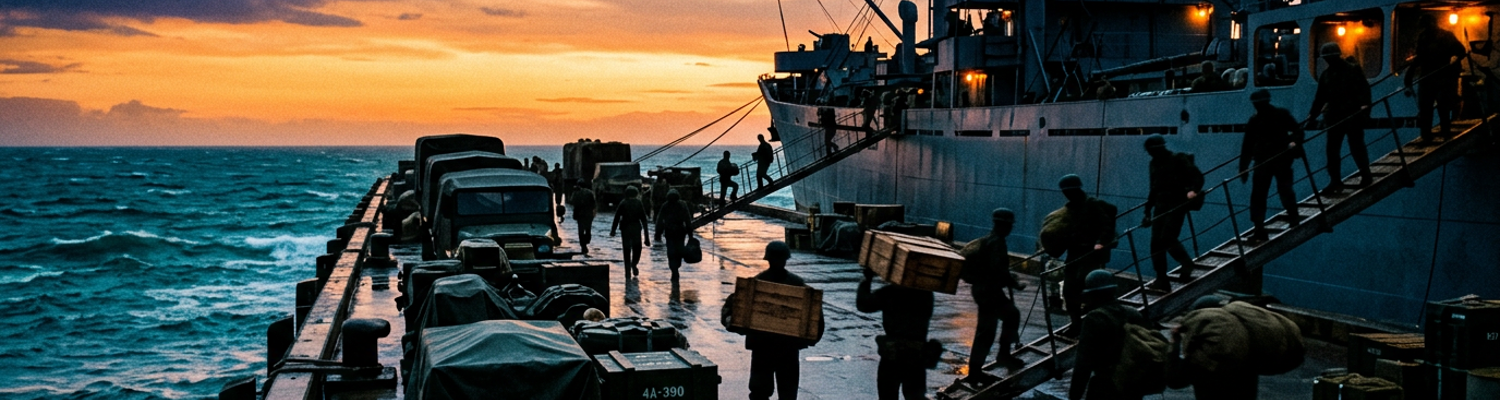
Couriers rushed past those newly loaded photographic trucks along the rain-slicked docks to deliver mandatory reassignment orders directly to hundreds of deskbound technicians, cryptographers, and field operatives arriving at European embarkation ports. Men who had spent months managing supply ledgers in Washington or processing administrative teletype traffic adjusted unfamiliar combat helmets and lugged waterproof kit bags down wooden piers toward Southampton and Weymouth slips. Cryptographers checked canvas satchels containing one-time cipher pads and frequency tables, while radio repairmen hoisted spare vacuum tubes and signal test sets up narrow gangplanks alongside frontline assault units. Tactical detachment commanders met the arriving specialists on crowded slipways, immediately assigning them to operational berths across troop transports and headquarters vessels. Staging officers stamped individual records by the yellow glare of shaded flashlights and routed the reassigned personnel into vehicle bays and lower mess decks. Exhausted technicians huddled on cold steel deck plates among stacks of ammunition crates to review channel crossing plans and operational radio call signs before departure.
Donovan tracked those departing troop manifests and verified radio detachments by transatlantic cable, using the embarkation tallies to complete the formal compliance submissions presented to the Bureau of the Budget that preserved the twelve thousand authorized billets. Budget examiners gathered in government conference rooms to inspect the revised ledgers, checking physical embarkation receipts against each disputed administrative line item. Donovan proved that the agency had eliminated idle domestic headquarters positions, demonstrating that every contested slot now directly supported active combat commands, covert sea teams, or resistance networks in Europe. Federal auditors compared the verified embarkation manifests with War Department allotment tables and certified that the clandestine organization operated at peak operational efficiency without duplicating regular military commands. Bureau officials stamped their formal approval onto the master accounting folders, releasing previously frozen payroll funds and securing the independent personnel allotment under direct presidential authority. Budget inspectors packed their audit files and returned to the Executive Office Building, leaving the agency with full legal authority to direct its global workforce.
Clerks carried the approved personnel folders down headquarters corridors to begin the permanent restructuring of OSS branch administration that solidified the agency's modern special warfare framework. Branch directors dismantled redundant domestic research desks and merged separate overseas logistics cells into unified operational sections tailored for rapid frontline deployment. Secret Intelligence, Special Operations, and Counter-Intelligence branches surrendered their independent administrative offices, binding their personnel rosters to standardized theater commands that answered directly to joint military planners. Operational planners established clear functional chains of command that permanently integrated clandestine communications, visual reconnaissance, and maritime sabotage units into single field mission teams. Administrative officers filed revised organizational blueprints that eliminated duplicate headquarters staff while protecting specialized combat slots from conventional military absorption. Branch executives locked the newly approved staffing charts into steel file cabinets across the headquarters building, ending months of bureaucratic disputes with the War Department and securing the operational structure required to sustain clandestine warfare across occupied Europe.
Typists rolled fresh carbon paper into their machines beside those locked metal cabinets to document the raw administrative lessons of the emergency reallocation. Section chiefs dictated rapid memorandum summaries outlining how domestic hoarding of radio operators and intelligence analysts had brought European sabotage networks dangerously close to failure. Administrative assistants bound the typewritten pages into confidential reference packets, establishing strict staffing formulas that mandated fixed field-to-desk personnel ratios for all future overseas stations. Junior officers stamped the lesson binders with urgent distribution markings and packed them into leather dispatch cases for courier delivery to forward commanders in London, Algiers, and Caserta. Messengers carried the leather cases down the empty marble stairwells toward awaiting staff cars as the first early sunlight reached the Potomac River. Drivers shifted into gear and pulled away from the curb, carrying the finalized doctrine guides that would govern clandestine field detachments during the Allied liberation of France.