
German Campaign Logistical Overview
US Army field manuals outlined a predictable, scientifically managed flow of materiel from factory to foxhole. The doctrine assumed a war of methodical advances, where captured ports and repaired railways would carry the immense weight of a modern mechanized army. The truth awaiting soldiers in the European Theater of Operations was a lesson in friction, where the Allied advance was dictated not by grand strategy, but by the availability of gasoline, tires, and ammunition.
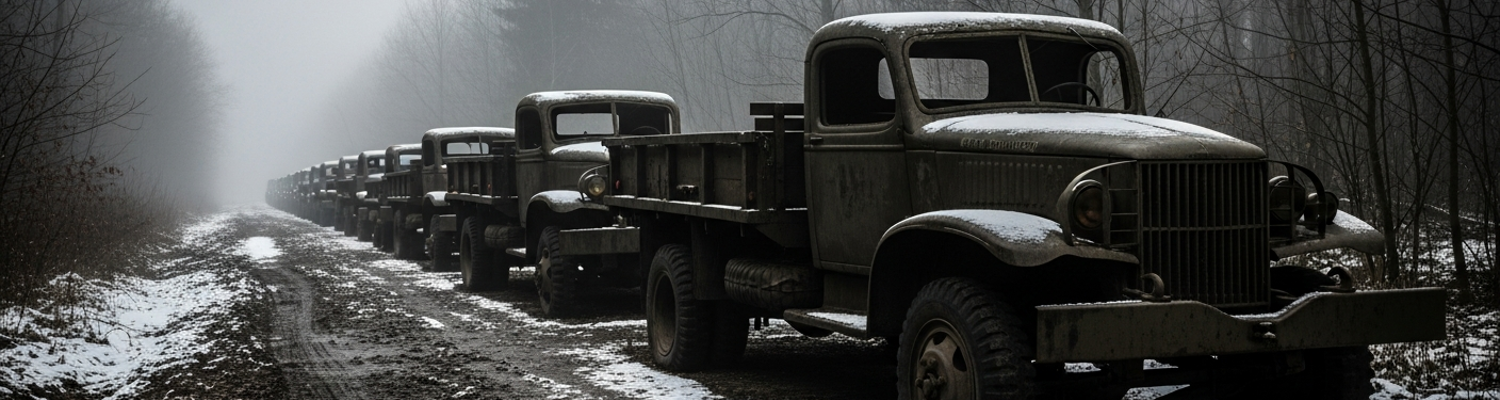
The popular narrative of the American war effort is one of infinite abundance, of endless columns of trucks delivering crates of everything a GI could want. This depiction obscures a far more desperate picture. A close review of operational logs reveals a system stretched to its absolute breaking point. The Red Ball Express, an improvised truck convoy system created on August 25, 1944, was a desperate gamble to sustain armies that had outrun their supply lines. At its peak, the Express operated nearly 6,000 vehicles, hauling approximately 12,500 tons of supplies daily over a dedicated, one-way loop of roads closed to civilian traffic.
The system was staffed primarily by African-American soldiers from segregated Quartermaster and Transportation Corps units. It was plagued by constant mechanical failure. The standard GMC CCKW 2.5-ton truck, the backbone of the effort, suffered from brake systems vulnerable to moisture and corrosion, frequent tire blowouts, and overheating engines. Drivers were pushed to the point of exhaustion, while maintenance crews struggled to keep the vehicles running on roads that turned to mud and chewed through transmissions. The Red Ball itself consumed a colossal 300,000 gallons of fuel daily, nearly as much as an entire field army, simply to operate.
The strategic importance of the US Army Quartermaster Corps in the European Theater cannot be overstated. It was the foundation upon which all combat operations were built. While combat arms units engaged the enemy, the Quartermaster Corps fought a parallel war against consumption, distance, and entropy. Its responsibilities extended far beyond the provision of food and ammunition. By the spring of 1945, Quartermaster units were responsible for the support of over seven and a half million people, including Allied soldiers, prisoners of war, and displaced civilians. Archival evidence shows their mandate included the procurement and distribution of millions of gallons of gasoline, oil, and lubricants (POL), the management of mobile laundry and bath facilities, and the grim task of Graves Registration, which involved recovering, identifying, and burying the dead. The loss rate of items like five-gallon "jerry cans" for fuel was astronomical; by October 1944, 3.5 million cans were unaccounted for, used for everything from trench supports to camp chairs, creating a crisis that required shipping 1.3 million new cans per month to resolve.
Initial logistical planning for the campaign in France was fatally flawed. Allied planners, working on Operation OVERLORD, assumed a slow, grinding advance from the Normandy beachhead. The plan called for a 90-day push to the Seine River, followed by a deliberate month-long pause to allow for the capture of deep-water ports like Cherbourg and the systematic repair of the French railway system, which had been intentionally destroyed by Allied bombers prior to the invasion. This methodical timeline was shattered by the unexpected speed of the breakout following Operation Cobra in late July 1944. General George S. Patton’s Third Army, activated on August 1st, tore across France at a pace that planners had deemed impossible, covering hundreds of miles in weeks. This rapid advance, while a stunning tactical success, was a logistical catastrophe. The armies completely outran their supply lines, which still stretched back to the Normandy beaches. By the end of August, Patton’s armored divisions, which required 400,000 gallons of fuel per day for sustained operations, were receiving less than a tenth of that amount. On August 31, the advance ran out of gas and ground to a halt just miles from the German border, giving German forces time to regroup and man defenses along the Moselle River.
Red Ball Express Initial Strains
The rapid Allied breakout from Normandy after Operation Cobra in late July 1944 created a logistical dependency of immense proportions. Planners had anticipated a slow advance, relying on the eventual capture of deep-water ports and the methodical repair of French railways deliberately destroyed by Allied bombing. The speed of the advance, particularly by General George S. Patton’s Third Army, completely outpaced this deliberate timeline. This left the armies dangerously overextended, with supply lines stretching hundreds of miles back to the Normandy beaches and the single, partially functioning port of Cherbourg. In response, Allied command devised the Red Ball Express on August 25, 1944, as the only option. It was an improvised, high-stakes gamble to funnel fuel and ammunition over a one-way loop of existing French roads closed to civilian traffic. This absolute over-reliance meant that the entire Allied offensive was tethered to the carrying capacity of nearly 6,000 trucks, making the unproven system a single point of failure.
The mechanical strain on the vehicle fleet was immediate. The workhorse of the operation, the GMC CCKW 2.5-ton truck, was a robust vehicle but was not designed for the relentless, overloaded, high-speed abuse it was subjected to. Operational logs document a litany of chronic maintenance failures. Drivers, often ignoring the mandated 25 mph speed limit and disabling engine governors to push speeds past 56 mph, shredded tires at an alarming rate. In the first month alone, 40,000 tires were worn out. Transmissions and clutches were burned out by inexperienced drivers and the strain of constant operation. Drive shafts would simply fall off. The unsealed hydraulic brake systems of the CCKW were highly susceptible to corrosion from moisture and mud, causing cylinders to leak or seize entirely. Roving maintenance units and designated repair facilities at towns like Saint-Lô and Chartres were overwhelmed. A lack of spare parts forced crews to cannibalize "deadlined" vehicles, creating a landscape of truck carcasses lining the French byways. By the fall of 1944, of 15,000 U.S. Army vehicles rendered useless in Europe, 9,000 of them were the trucks the Red Ball Express depended on.
The operation was paid for with the physical and mental exhaustion of its personnel. The drivers, nearly 75% of whom were African-American soldiers from segregated Quartermaster and Transportation Corps units, were pushed beyond the limits of human endurance. Standard procedure called for two-man teams to handle round trips that could take over 54 hours to complete. Drivers were known to stay behind the wheel for more than 30 or 40 hours with minimal or no sleep, often switching seats while the truck was still moving. Fatigue was the primary cause of a dramatic increase in accidents; an average of 70 trucks were wrecked each day. On one notorious stretch of road marked with a steep hill and dangerous curve, a single convoy saw eight gasoline semi-trailers flip over, followed by eight more the very next day. The high turnover was not a planned rotation but a consequence of breakdown. Able-bodied soldiers from units waiting for supplies, including from the 26th and 94th Infantry Divisions, were hastily pressed into service as drivers, many with no prior experience operating heavy trucks. This constant churn of exhausted, inexperienced men only compounded the high rate of accidents and mechanical failures.
Winter’s Paralysis of Supply Routes
The winter of 1944-1945 attacked every facet of the Allied logistical chain. Beginning in November 1944 and intensifying through the Ardennes Offensive in December, temperatures plummeted, bringing deep snow, persistent fog, and freezing rain. Archival records from ETOUSA (European Theater of Operations, U.S. Army) show that planners had grossly underestimated the impact of this weather, leaving frontline troops and logistical units dangerously unprepared. Many reinforcements rushed to the Ardennes front arrived without proper winter clothing, leading to tens of thousands of cold injury cases that further strained medical and evacuation systems. The weather effectively grounded Allied air power, neutralizing one of its key advantages and allowing German forces to operate with a degree of freedom they had not enjoyed since D-Day.
The road network effectively collapsed. The terrain of the Hürtgen Forest and the Ardennes was characterized by a limited number of primary roads and a vast network of secondary tracks, little more than logging trails in many areas. The combination of heavy rain and a constant freeze-thaw cycle turned these routes into deep, impassable quagmires of mud. A close review of operational logs from units like the 28th Infantry Division details how even tracked vehicles became hopelessly bogged down, while wheeled transport simply ceased to move. When the deep freeze set in, this mud solidified into frozen, rutted terrain that was just as destructive, shattering vehicle suspensions. The paved roads offered no escape, as freezing rain coated them in thick layers of ice, causing supply trucks to slide into ditches and creating massive, multi-hour traffic jams. For ordnance units tasked with delivering replacement tanks and vehicles from rear depots, these journeys became perilous, slow-motion treks over glazed highways, severely reducing the flow of hardware to combat units.
Underneath the ice and mud, a more insidious mechanical crisis was unfolding within the engines of the supply convoys. The extreme cold, with temperatures dropping below zero, attacked the physics of internal combustion. The standard-issue diesel and gasoline began to experience fuel gelation, a process where the paraffin waxes within the fuel crystallize and thicken, blocking fuel lines and filters. This choked engines of their supply, stalling vehicles in the middle of convoys and compounding the already catastrophic traffic jams. Compounding the problem was a shortage of effective antifreeze. While ethylene glycol-based antifreeze, commercialized as Prestone, was the standard, supply could not meet the theater’s demand. Units often received insufficient quantities or were forced to use less effective alcohol-based solutions, which could accelerate corrosion in engine components. A review of maintenance records from ordnance battalions reveals a litany of cold-related failures: dead batteries unable to hold a charge in the frigid temperatures, lubricants thickening to the consistency of grease, and cracked engine blocks from water freezing in the cooling systems. Crews resorted to desperate measures, including lighting fires under the oil pans of their trucks in the hope of thinning the lubricant enough to turn the engines over, a hazardous practice that often resulted in vehicle fires.
Critical Shortages at the Front
The perception of infinite American industrial might was tested against the harsh terrain of Eastern France and the Ardennes. By the autumn of 1944, the logistical system was so broken that it forced a theater-wide rationing of the one commodity an army requires to fight: ammunition. A close review of operational logs from the 12th Army Group reveals a grim arithmetic. The recommended daily allocation for a 105mm howitzer, the backbone of divisional artillery, was 65 rounds per gun. Yet, during the fighting around Aachen in late October, First Army units were firing an average of only 30 rounds per gun per day. The situation in General Patton’s Third Army, then clawing its way through Lorraine, was even more dire; its 105mm batteries were sometimes restricted to firing just 1.1 rounds per gun per day. This was not a tactical choice. It was an involuntary silencing of the guns, dictated by empty supply trucks. The shortage extended to 155mm howitzers and even small arms ammunition, forcing infantry commanders to make impossible choices about which attacks to support and which defenses to prioritize. This ammunition drought was a direct consequence of overstretched supply lines, the failure to open the port of Antwerp, and a strategic miscalculation that the war would end before winter, which had led to insufficient production back in the United States.
The rapid armored advance across France in August had been a stunning success, but it came at a cost measured in fuel. By the time Patton’s Third Army reached the Meuse River at the end of August, its spearheads ran out of gas. A mechanized army required a colossal volume of fuel; Patton’s divisions needed approximately 400,000 gallons a day to sustain their offensive. Archival evidence shows that on some days, they received less than a tenth of that amount, a mere 32,000 gallons. Whole armored columns sat motionless in the fields of northeastern France, engines cold, just miles from a collapsing German border. This halt was not a strategic pause but a forced paralysis, a direct result of Supreme Allied Commander Dwight D. Eisenhower’s decision to prioritize fuel allocations for Field Marshal Bernard Montgomery’s push in the north. The crisis cascaded downwards, affecting every vehicle. Trucks of the Red Ball Express, the very system meant to solve the supply problem, were themselves consuming 300,000 gallons of fuel daily just to operate. The shortage became so acute that frontline units resorted to draining fuel from rear-echelon vehicles, while some of Patton’s officers were documented commandeering fuel convoys meant for other armies.
As winter closed in, the supply failures became intensely personal. A catastrophic underestimation of the European winter’s severity, combined with the belief the war would be over by Christmas, meant that frontline troops faced the Ardennes winter dangerously ill-equipped. Tens of thousands of men went into the Battle of the Bulge wearing the same standard field jacket and leather combat boots they had been issued in the summer. There was a widespread deficiency of overcoats, woolens, and, most critically, proper winter footwear. Records from the 108th General Hospital during the Bulge’s first week show that of the men admitted with cold injuries, 38% had never received waterproof overshoes, while another 10% received them only after their feet were already damaged. The standard combat boots leaked, and soldiers stuffed them with extra socks, which only made them tighter and cut off circulation, accelerating the onset of trench foot. Between October 1944 and April 1945, the U.S. Army in Europe suffered approximately 71,000 casualties from cold injuries like trench foot and frostbite, the equivalent of losing nearly five infantry divisions. This was compounded by a failure to provide hot rations, with men in the Hürtgen Forest and the Ardennes often subsisting for weeks on cold K-rations, draining their physical and mental endurance in the freezing foxholes.
Signal Corps Combat Photography Role
The War Department vested the U.S. Army Signal Corps with the sweeping mandate to create the official visual record of the war in Europe. This was not a passive activity; it was a core military function formalized by regulations that made the Signal Corps responsible for nearly all photographic work. The demand for imagery was immense, driven by a complex array of consumers. The Bureau of Public Relations required pictures for newspapers and newsreels to sustain public support for the war; training commands needed visual aids to instruct soldiers; and field staffs demanded tactical photos for immediate strategic use. To meet these needs, the Army established dedicated Signal Photographic Companies, assigning one to each field army. A typical company consisted of roughly seventy-five men, including still photographers, motion picture cameramen, darkroom technicians, and maintenance personnel. These units operated in small, mobile teams, dispatched wherever they were needed to document the conflict. The resulting archive was colossal, with the National Archives now holding approximately one million images from the Signal Corps' World War II operations alone.
The work involved two distinct and often contradictory missions: public information and military intelligence. The first, and most visible, role was to provide images for public consumption. These images, however, were heavily curated. Photographs intended for public release were scrutinized by censors to ensure they presented a narrative that supported the war effort without revealing sensitive information or shattering morale. For much of the war, this meant images of dead or grievously wounded American soldiers were forbidden, with censors ensuring no identifying features like faces or unit patches were visible. The goal was to create a version of the war that was realistic enough to be compelling but sanitized enough to be palatable.
Combat photographers also produced a constant stream of imagery for purely operational purposes. A close review of Signal Corps assignments shows that photographers were regularly tasked with specific intelligence-gathering missions: documenting the effectiveness of Allied tank-destroyer fire on German armor, recording the design of newly captured enemy equipment, or taking reconnaissance photos of enemy positions for after-action reports. This imagery was raw data, treated as usable information by military planners. Aerial reconnaissance photography, in particular, transformed terrain into analyzable military knowledge, allowing commanders to map defenses, identify targets, and assess bomb damage. These were not pictures meant to inspire; they were created for filing systems and report chains, forming a granular, internal record of the war that was far more technically focused than anything shown in magazines.
To secure these images, the combat photographer operated in a uniquely dangerous space. They were soldiers first, receiving basic infantry training before specializing in photography at facilities like the Signal Corps Photographic Center in Astoria, New York. In the field, they carried a sidearm, but their primary tools were cameras like the bulky 4x5 Speed Graphic (designated PH-47) for still images and the Bell & Howell Eyemo for motion pictures. These men were expected to go where civilian journalists could not or would not, often moving with the lead assault elements to capture the action. This proximity to the fighting exacted a heavy price. From a distance, a photographer’s equipment could be mistaken for a weapon, and their presence at the front lines made them just as vulnerable as the infantrymen they documented. Archival records for the European Theater show that of the 1,400 U.S. Army Signal Corps cameramen deployed, 32 were killed in action and over 100 were wounded. This casualty rate underscores that their job was to run toward the fire, camera in hand, to capture the official record of the conflict.
Film and Equipment Transport Woes
In the rigid hierarchy of wartime logistics, Signal Corps photographic supplies were classified as an administrative luxury. A close review of operational logs from the Communications Zone (COMZ) and the Red Ball Express reveals the calculus. Logistical planners operated with a tonnage-first mindset, where every inch of cargo space was measured against the urgent demands of combat. The priority cargo was always fuel, ammunition, and rations. A single 105mm artillery shell weighed fifty pounds; a standard 2.5-ton truck could carry one hundred of them. That same truck could carry tens of thousands of feet of motion picture film, but to the G-4 logistics officer facing requests from an artillery battalion that was rationing shells, the choice was simple. Photographic equipment, including bulky tripods, delicate cameras, and chemical kits, occupied a space that could hold life-saving medical supplies or engine parts. Consequently, requisitions from Signal Photographic Companies were systematically deprioritized, pushed down shipping manifests, or ignored entirely. Consignments of film and photo paper were frequently offloaded at ports like Cherbourg to make way for cargo deemed more essential, left to sit for weeks in unprotected supply dumps.
This low logistical priority created a state of chronic scarcity for combat camera units operating in forward areas. A Signal Photographic Company, such as the 165th or 166th, was responsible for documenting an entire field army’s operations, yet its teams often arrived at the front with only the film in their cameras and a few spare rolls. Securing fresh stock was a constant struggle. Archival evidence shows photographers going "off-record" to barter with other units for a few rolls of 35mm film or a box of 4x5 sheet film for their Speed Graphic cameras. The problem extended to the fundamental materials required for processing. Field darkrooms needed a reliable supply of developer, fixer, and photographic paper to produce usable prints for intelligence and after-action reports. These items were just as difficult to transport as the film itself. Some units attempted to use captured German chemicals, but differences in formulation often led to ruined negatives. This material drought meant photographers were forced to self-censor their work, saving their limited film for what they judged to be the most critical moments of an engagement, inevitably missing irreplaceable scenes of tactical importance.
Even when a photographer successfully captured images, the logistical chain failed in reverse. For footage to be useful for tactical intelligence or timely for newsreels, it had to be transported from the front lines back to major processing centers, the most significant of which was established in Paris. This journey was a microcosm of the entire supply-line collapse. A canister of exposed film, holding potentially vital reconnaissance imagery of enemy defenses, had no priority status. It would wait for days at a collection point for a courier who might not have a vehicle or for a free spot on a truck heading west. That truck was subject to the same frozen roads, fuel shortages, and mechanical breakdowns that plagued the convoys heading east. By the time a film canister completed the arduous journey from the Hürtgen Forest or the Ardennes to the laboratories in Paris, the tactical situation it depicted had often changed completely, rendering the intelligence obsolete. The delay also meant that footage intended to inform the American public was perpetually out of date, presenting a vision of the war that was always weeks behind the fighting.
Post-Surrender Logistical Collapse
The moment of victory in Europe on May 8, 1945, did not trigger an orderly, planned drawdown of US Army forces. It initiated a chaotic, system-wide process driven by public and political pressure from home. The War Department had devised a seemingly equitable system called the Adjusted Service Rating Score, which GIs simply called "the point system." A close review of the regulations announced just two days after Germany’s surrender shows a formula based on time in service, overseas deployment, combat awards, and dependent children. Every month of service was worth one point, another point was added for each month overseas, decorations like the Silver Star or a Purple Heart were worth five points, and each child was worth twelve. The magic number was 85. Any soldier with 85 points or more was eligible to go home. The effect on the Army as a functioning organization was severe. This system did not release whole units but instead cherry-picked individuals, meaning the most experienced combat veterans, senior NCOs, and long-serving technical specialists were the first to be pulled from their formations. The command structure and institutional knowledge of veteran divisions and, critically, of the logistical units that supported them, were gutted almost overnight. A massive reshuffling of personnel began as soldiers were transferred into units designated for deactivation, creating a whirlwind of internal movement that further strained a transportation network already on its last legs.
This internal chaos of demobilization collided with an external humanitarian crisis of a scale that planners had failed to grasp. As Allied armies pushed into the Reich, they uncovered not just the horrors of the concentration camps, but a continent of uprooted people. SHAEF records indicate the presence of between seven and eleven million non-German "Displaced Persons" (DPs) inside the occupied zones. This population was a desperate mix of former forced laborers, freed prisoners of war, and concentration camp survivors. They were starving, sick, and traumatized, and they immediately became the responsibility of the nearest Allied military unit. Combat divisions that had been fighting for their lives just weeks earlier now found themselves as camp guards, administrators, and aid workers. The initial Allied plan assumed a rapid repatriation, and in the first few months, millions were indeed sent home, with SHAEF overseeing the return of up to 80,000 people per day in May and June 1945. But by the autumn, a core of over a million DPs remained who refused to return to their countries of origin, many of which were now under Soviet domination. This "Last Million" created a semi-permanent refugee population that the disintegrating US Army was now tasked to house, feed, and control indefinitely.
This new, enormous responsibility fell squarely on the shoulders of the Quartermaster Corps, the very organization being dismantled by the points system. The mission had fundamentally changed. Instead of delivering ammunition and fuel to advancing armies, Quartermaster depots and truck companies were repurposed for a massive civilian relief effort. Archival evidence shows their mandate expanded to supporting over seven and a half million people, including Allied soldiers, POWs, and the swelling DP population. This had to be accomplished amidst crippling resource scarcity. The same truck fleet that had been abused and worn out by the Red Ball Express was now expected to haul food, blankets, and medical supplies to hundreds of makeshift DP camps established in former military barracks, factories, and schools. Quartermaster units were forced to improvise, taking over German bakeries to produce bread, distributing captured German army rations, and using DDT powder to run mass delousing stations to prevent typhus outbreaks. It was a race to avert mass starvation and disease, fought by an organization that was simultaneously losing its most experienced men and operating with exhausted equipment.
Occupation’s Moral and Economic Decay
The collapse of the Third Reich left a vacuum that was filled not by order, but by a lawless economy of survival. A close review of records from the American occupation zone reveals the immediate and pervasive rise of black markets, vast illegal exchanges that operated openly in the ruins of cities like Berlin, Frankfurt, and Munich. With the Reichsmark rendered worthless and official Allied food rations for the German population set at dangerously low caloric levels, a new currency emerged from the logistical overflow of the US Army. This was a system built on American cigarettes, coffee, chocolate, gasoline, and penicillin. Archival evidence shows that these Post Exchange (PX) and Quartermaster items, intended for soldiers, became the de facto monetary standard. A single carton of cigarettes, purchased for one dollar at a PX, could be bartered for German cameras, valuable antiques, or services worth hundreds of dollars. The German population called it Zigarettenwährung, or cigarette currency. This was not a small-scale affair; it was the primary engine of commerce for millions, completely outside the control of the Allied Military Government.
The existence of this market created a massive gravitational pull on the discipline and morals of the occupying American forces. For GIs, many of whom were bored, disillusioned, and awaiting demobilization under the points system, the opportunities for profit were immediate and immense. A Seventh Army Counter Intelligence Corps report from late 1945 noted the widespread German perception of American soldiers as men who drank to excess and enriched themselves through the black market. It was a systemic breakdown. Records from the U.S. Army’s finance office in Berlin for July 1945 show that while the garrison’s payroll was one million dollars, soldiers sent over three million dollars home, a discrepancy fueled entirely by black market profiteering. The corruption ranged from individual soldiers selling their PX rations to organized rings of officers and NCOs diverting entire truckloads of army supplies. Gasoline was siphoned from military vehicles, food intended for army messes was sold to German restaurateurs, and valuable non-ferrous metals were stripped from army depots and sold as scrap. The loosening of non-fraternization policies further entangled soldiers in the local economy, with relationships often becoming transactional, based on access to goods that meant the difference between comfort and starvation for the German populace.
The long-term consequences of this systemic decay were severe. The black market actively sabotaged the official Allied mission to stabilize the German economy and lay the groundwork for a democratic state. Every gallon of gasoline sold on the black market was a gallon that could not be used to transport relief supplies to Displaced Persons camps. Every crate of K-rations diverted to a private seller was food taken from a system already struggling to prevent mass starvation. This diversion of resources created a vicious cycle. The Allied Military Government would attempt to inject goods into the official German economy to bring prices down and restore normalcy, only to see those goods immediately siphoned off and sold illegally at inflated prices. A Strategic Services Unit intelligence report from early 1946 detailed how a single carton of American cigarettes could sell for the equivalent of $200 in Berlin, a bottle of whiskey for $150, and a pair of army boots for $200. This shadow economy disincentivized legitimate work, undermined currency reform efforts, and fostered a deep-seated cynicism toward the occupying authorities, delaying Germany’s economic reconstruction by years.