
North American Aviation Expansion at Grand Prairie
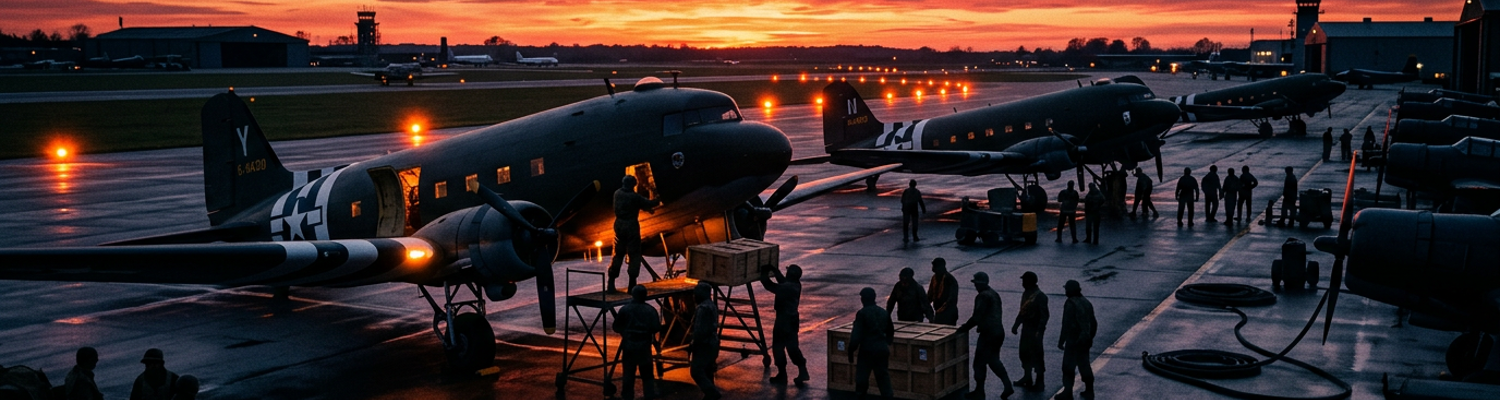
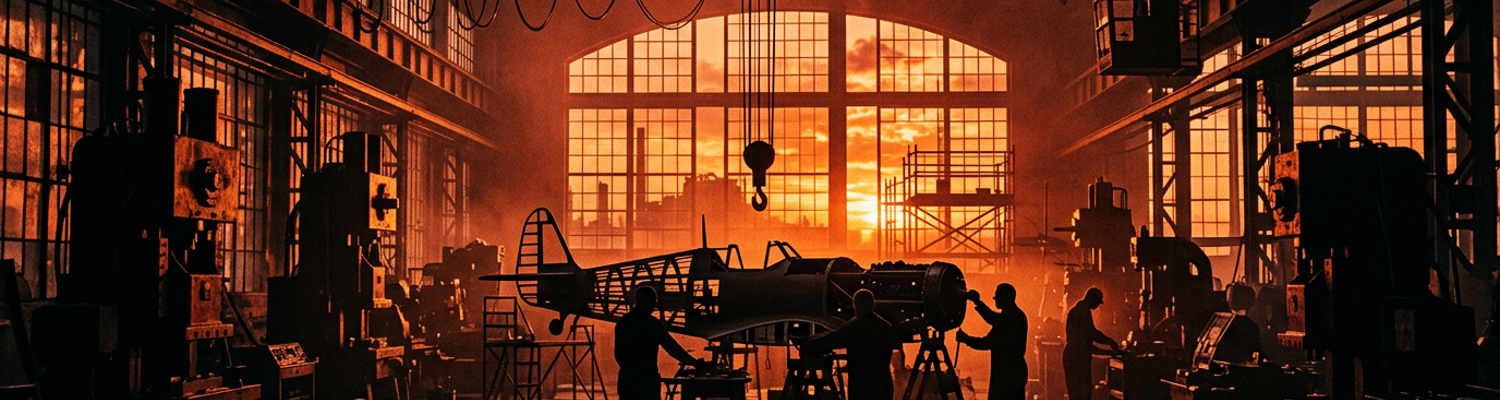
Army Air Forces procurement officers delivered rigid production deadlines demanding hundreds of combat aircraft before the close of the quarter. Construction crews worked twelve hour shifts through heavy mud and summer heat to finish North American Aviation Plant B in Grand Prairie, Texas. Bulldozers graded new test runways while electricians strung primary high voltage cables through open roof rafters directly above operating work areas. Plant engineers hauled heavy hydraulic presses, steel stamping dies, and massive overhead cranes into position so the sprawling complex could mass produce AT-6 Texan trainers, P-51 Mustang fighters, and B-24 Liberator bombers. Mechanics hurried to anchor metalworking machinery and calibrate rivet guns while roofer crews still laid corrugated decking overhead. Factory department heads inspected the newly opened assembly bays and warned visiting military representatives that output quotas would collapse without thousands of additional assembly workers.
Machinists and skilled metalworkers vanished from civilian tool shops as military mobilization and armed forces draft quotas drove acute industrial labor shortages across the Dallas and Fort Worth metroplex by mid 1943. Selective Service calls systematically emptied machine shops, parts depots, and maintenance garages just as aircraft contractors attempted to operate continuous shifts. Consolidated Vultee Aircraft Corporation fiercely competed for those same mechanics at its heavy bomber plant in neighboring Fort Worth, while Gulf Coast shipyards lured toolmakers away with elevated defense wages. Factory foremen in Grand Prairie watched lines of half assembled trainer wings stall at fabrication stations because draft boards continually inducted experienced airframe fitters faster than classroom instructors could train novices. Production directors pleaded with regional selective service boards for occupational deferments, but draft quotas took priority over factory retention requests. Plant security guards watched the resulting personnel deficit worsen each morning as dozens of qualified Black and Mexican American job seekers stood outside the personnel gates seeking technical employment.
Managers enforced corporate employment policies restricting Black and Mexican American workers exclusively to low wage custodial, janitorial, and manual yard labor positions. Personnel clerks methodically stamped minority job applications for maintenance duties, completely ignoring applicants with prior manufacturing experience or specialized defense training. Men possessing federally funded vocational certificates in aircraft sheet metal layout, precision riveting, and mechanical drafting received assignments to push wide floor brooms, scrub grease pits, and shovel gravel across outdoor drainage ditches. Plant foremen informed incoming minority hires that fabrication positions, tool room duties, and airframe assembly classifications were strictly preserved for white workers under company policy. Supervisors assigned white teenagers with no mechanical background to high paying rivet teams while experienced minority mechanics cleared rubbish from the hangar entrances. Gatekeepers handed push brooms and wheelbarrows to these qualified tradesmen and marched them out into the yard while unriveted fighter fuselages sat motionless on the assembly dollies inside.
Executive Order 8802 and Region X Oversight
Fighter fuselages sat idle on the assembly dollies because factory managers openly defied Executive Order 8802, a presidential directive banning discriminatory employment practices across national defense contractors. The executive mandate required all military procurement contracts to include mandatory non discrimination clauses, establishing the Fair Employment Practice Committee to investigate corporate personnel records and force defense contractors to place qualified minority workers into skilled industrial jobs. Corporate executives and military procurement officers across the southern states resisted the mandate, viewing the federal order as a social experiment disrupting local employment patterns. War Department officials repeatedly sided with factory managers, treating non discrimination rules as secondary suggestions rather than binding federal laws taking priority over production totals. Federal authorities insisted that racial exclusion directly sabotaged military readiness by locking thousands of experienced mechanics out of vital airframe plants during a severe nationwide labor crisis. Federal officials countered this corporate resistance by creating administrative enforcement districts, selecting Dallas as the base for Fair Employment Practice Committee Region X to bring federal oversight directly into North Texas.
Region X headquarters opened in downtown Dallas to oversee defense manufacturing across Texas, New Mexico, and Louisiana. The newly formed district spanned hundreds of vital industrial facilities, including coastal shipyards in Houston and New Orleans, synthetic rubber plants along the Sabine River, high octane petroleum refineries, and massive aircraft assembly complexes throughout North Texas. Staff members faced immediate hostility from Dallas commercial clubs and municipal officials, who warned the committee that federal investigations would disrupt southern racial customs. Army Air Forces procurement officers reinforced that resistance by shielding company executives from federal scrutiny, arguing that outside interference would provoke white factory workers to stage wildcat strikes and halt aircraft deliveries. Military liaison officers routinely withheld plant employment logs, refused to arrange factory access passes, and pressured investigators to dismiss minority complaints without formal hearings. Committee supervisors refused to abandon their legal mandate and began assembling a specialized investigative unit to audit personnel filing cabinets, collect sworn affidavits from rejected tradesmen, and confront defense contractors directly on the shop floor.
Investigators Carlos Castaneda and Don Ellinger assumed leadership of this new inspection unit to monitor Southwestern defense plants and ensure Black and Mexican American workers received equal access to skilled tooling positions. Castaneda applied his background as an archivist and university researcher to the task, organizing incoming grievance records by factory department and cross referencing rejected applications with regional vocational school rosters. Ellinger gathered affidavits from applicants possessing state defense certificates in sheet metal layout and rivet operation who held broom handles instead of pneumatic tools at Grand Prairie. Army Air Forces procurement colonels visited the Dallas office to demand that Castaneda drop his inquiries, warning that racial integration would cause riots inside the hangars and ruin monthly fighter delivery quotas. Castaneda refused to yield to the military officers, signed the formal regional docket for the Grand Prairie facility, and instructed Ellinger to pack his case notebooks for an immediate inspection of the North American Aviation personnel department.
Filing of Investigative Docket 10-BR-249
Examiner Don Ellinger loaded his leather briefcase with signed complaint affidavits and drove west toward Grand Prairie under the authority of newly registered Fair Employment Practice Committee docket 10-BR-249. Regional staff had formally entered the docket into the Dallas ledger in mid 1943 following a wave of joint grievances submitted by Dallas minority civic leaders and frustrated factory workers. Local civil rights advocates, trade unionists, and rejected applicants had compiled dozens of signed statements detailing how North American Aviation systematically turned away skilled tradesmen while begging regional draft boards for manufacturing labor. Ellinger arrived at the security gates with legal inspection orders signed by Castaneda, demanding immediate access to the hiring logs, shift rosters, and payroll ledgers stored in the factory administrative offices. Plant security guards held the federal examiner at the perimeter fence while calling corporate directors, but Ellinger refused to turn his vehicle around and insisted that military contractors had no legal authority to lock out federal investigators.
Managers unlocked the personnel office doors and placed heavy stacks of intake folders across the examination tables. Ellinger combed through three months of hiring records, uncovering proof that company screeners routinely rejected qualified Black and Mexican American applicants for skilled assembly line tasks. Screeners had written code letters on application margins to flag non white applicants, automatically disqualifying them from mechanical interviews regardless of their test scores. Black tradesmen with state vocational diplomas in precision airframe riveting, structural sheet metal assembly, and aircraft blueprint reading were stamped as eligible only for janitorial labor or outdoor dirt hauling. Mexican American machinists who had operated metal lathes, drill presses, and hydraulic shears in local civilian shops received outright rejection slips or were steered away from tool fabrication bays into grease cleaning pits. Ellinger recorded the names and certified technical qualifications of dozens of rejected applicants, transcribing specific file numbers into his notebook to prove that management deliberately fabricated claims of minority worker incompetence.
Payroll ledgers stored in the accounting division revealed systematic wage suppression designed to keep minority employees locked in the lowest compensation brackets. Black and Mexican American personnel managing to slip onto factory floor work teams through temporary reassignments received base hourly rates thirty to forty percent below those of white apprentices performing identical tasks. Corporate records documented the complete exclusion of minority workers from company production apprentice programs, barring them from classroom instruction in advanced machining, engine installation, and airframe inspection. Company supervisors refused to sponsor non white candidates for trade upgrades, reserving all technical promotion pathways for newly recruited white trainees possessing far less mechanical experience. Ellinger walked the assembly floor to verify these payroll entries, noting that the plant maintained segregated physical facilities with separate drinking fountains, isolated restrooms, and divided dining sheds located far away from the heated main fabrication hangars.
Procurement officers from the Army Air Forces intercepted Ellinger near the final assembly line, demanding he surrender his inspection notes and vacate the reservation immediately. Military liaisons argued that documenting segregated facilities and unequal wage scales would agitate the factory floor and jeopardize emergency deliveries of P-51 fighters and AT-6 trainers. Ellinger refused to yield his carbon copies, locked his completed dossiers inside his field case, and walked past the officers to his car. Castaneda received the gathered evidence at the Dallas regional headquarters that evening and immediately filed formal compliance demands against North American Aviation under docket 10-BR-249. Federal examiners attached the sworn worker affidavits and payroll audits to an official notice of violation, dispatching copies to War Department procurement chiefs in Washington to force executive intervention.
Materiel Command Aircraft Production Priorities
Department chiefs in Washington tossed the violation dossiers into administrative pending files and reinforced their own military authority over Plant B. Army Air Forces Materiel Command had already deployed resident procurement officers and uniform clad plant representatives directly to Grand Prairie to supervise delivery schedules and enforce strict contract fulfillment. These military officers occupied private offices right inside the administration building, where they tracked manufacturing milestones on grease pencil wall charts and answered exclusively to Materiel Command headquarters at Wright Field in Ohio. Captains and majors walked the factory floor daily, inspecting subassembly jigs, checking parts inventory bins, and pressing factory managers to accelerate final assembly handoffs to the military acceptance pilots waiting on the tarmac. Major General Charles Branshaw and his staff at Materiel Command evaluated factory performance solely by the quantity of operational warplanes rolling out of the hangar doors each week. Every administrative directive coming down the military chain of command instructed local officers to eliminate any shop obstacle threatening to slow manufacturing velocity by even an hour.
Commanders of the Strategic Air Forces in Europe and the Pacific established strict production targets demanding uninterrupted monthly outputs of P-51D Mustang escorts and B-24 Liberator heavy bombers for overseas combat operations. Daylight bombing offensives over Germany consumed bombers and fighter escorts at an alarming rate, leaving Eighth Air Force bomber groups desperate for long range P-51D fighters equipped with drop tanks to protect vulnerable B-17 and B-24 formations deep inside hostile airspace. Air staff planners warned that any drop in Grand Prairie output would leave front line squadrons without replacement airframes and crews during crucial strategic air campaigns. Flight delivery schedules dictated that completed bombers and fighters move straight from the factory modification centers to overseas staging bases in England and Italy without missing a single transport convoy window. Resident procurement officers at Grand Prairie treated these combat quotas as absolute wartime laws superseding all peacetime administrative regulations and local civil disputes. Military liaison officers consequently monitored the moving assembly tracks with stopwatches and daily production clipboards, measuring every minute of shift time against the operational needs of combat theaters thousands of miles away.
Personnel from Materiel Command viewed the Fair Employment Practice Committee investigations as disruptive federal meddling threatening vital airframe production timetables. Uniformed supervisors argued that civilian examiners lacked any comprehension of combat logistics or aviation industrial engineering. Field officers warned that enforcing racial integration or reassigning minority workers into skilled rivet bays would antagonize white assembly mechanics, provoke widespread wildcat walkouts, and instantly paralyze the P-51D and B-24 assembly tracks. Resident procurement majors told North American Aviation executives to ignore civilian compliance demands whenever those inquiries clashed with master delivery agreements signed by the War Department. Base commanders insisted that the military held ultimate jurisdiction over plant operations because the federal government financed the tooling, owned the aircraft designs, and bought every finished plane rolling onto the runway. Armed guards acting under military orders barred civilian labor investigators from entering secure assembly hangars, telling federal examiners that national defense secrets and delivery deadlines took precedence over peacetime social reforms.
Colonels at Wright Field drafted sharp memorandums to the War Department in Washington, demanding executive leaders restrain the Fair Employment Practice Committee from serving further subpoenas in North Texas. Military procurement directors insisted that civilian committee staff possessed no legal power to dictate shop floor job assignments inside plants operating under emergency defense contracts. Staff officers compiled internal assembly records to show Washington officials that North American Aviation met its monthly delivery commitments only because management maintained uninterrupted control over its assembly workforce. Resident officers at Grand Prairie backed up these memorandums by confiscating labor survey questionnaires distributed by union organizers and ordering factory security guards to escort outside examiners off the premises. Military representatives instructed factory foremen to maintain their existing job classifications and keep every rivet crew working on the fuselages without pause.
Bureaucratic Clashes Over Interagency Authority
Foremen pinned those military directives to their shop clipboards and drove their assembly lines forward, directly defying the federal non discrimination mandates that Castaneda sought to enforce from his Dallas headquarters. Castaneda challenged War Department procurement bureaucrats in a series of heated administrative conferences, insisting that Executive Order 8802 held full legal weight inside every federally funded aircraft facility. Military procurement officers flatly rejected his claims, arguing that emergency defense contracts granted the armed services sole jurisdiction over plant discipline, labor management, and production priorities. Bureaucrats in uniform asserted that civilian agencies had no right to dictate hiring standards or disrupt factory routines while the nation fought a two front war for survival. Castaneda refused to back down, firing back formal legal memoranda accusing military authorities of shielding corporate lawbreakers and sabotaging the national mobilization effort by wasting qualified minority labor. Officers in Washington and Dallas responded by treating committee correspondence as non binding requests, insisting that factory output took absolute priority over social reform.
Examiner Ellinger broke the bureaucratic deadlock by entering the Grand Prairie plant to conduct unscheduled on site inspections of the active work stations and tool cribs. Ellinger moved methodically between the towering steel jigs, jotting down worker badge numbers, recording wage classifications, and questioning minority janitors sweeping metal shavings right beside vacant rivet guns. Plant supervisors shadowed his footsteps, while armed military police demanded to see his special security clearance and ordered him to halt his interviews immediately. Ellinger refused to put away his notepad, documenting how foremen deliberately bypassed certified Mexican American sheet metal workers and relegated qualified Black mechanics to outdoor slag pits. Factory foremen tried to block access to the airframe docks, but the examiner continued inspecting the rivet benches and recording the names of white apprentices hired without mechanical experience. Resident Army Air Forces officers reacted with immediate fury, drafting formal military protests accusing Ellinger of unauthorized civilian interference on defense floors vital to national security.
Liaisons from Materiel Command seized on these military protests to build a protective administrative wall around North American Aviation executives, shielding them from incoming noncompliance citations and threatened federal sanctions. Uniformed procurement officers intercepted the violation notices issued by the Fair Employment Practice Committee and instructed company directors to disregard any summons to appear at public regional hearings. Military liaisons warned civilian officials that canceling contracts, withholding progress payments, or applying federal penalties against the Grand Prairie facility would instantly halt fighter deliveries and compromise Allied air offensives over Europe. War Department representatives assured factory executives that the armed services would absorb any political backlash and handle all future communications with the White House committee. Army lawyers informed corporate counsel that no federal agency could shut down a prime defense contractor without direct personal authorization from the Secretary of War. Procurement colonels then met privately with corporate leaders in the plant executive suites, coordinating a joint strategy to stonewall regional investigators while keeping the P-51D and B-24 production lines running under existing discriminatory hiring practices.
Labor Union Complicity and Factory Grievances
Representatives from United Auto Workers Local 645 reinforced those discriminatory company policies, meeting with plant personnel directors to craft collective bargaining terms insulating skilled factory jobs from outside applicants. Bargaining teams constructed a rigid departmental seniority system preventing workers from carrying their accumulated service time across different divisions of the factory. Labor agreements dictated that seniority accumulated strictly within isolated units, meaning that Black and Mexican American workers trapped in janitorial or yard labor classifications forfeited all accrued job security if they transferred into airframe assembly or metal fabrication. White mechanics in skilled tooling departments thereby retained total control over master promotion ladders, even when minority maintenance staff possessed superior mechanical qualifications or longer overall factory service. Local 645 officers defended this restrictive structure as standard labor procedure, deliberately ignoring how the separate seniority lists preserved white dominance over the highest paying production trades across Plant B.
Mechanics on the day shift enforced these departmental boundaries with open hostility, warning shop stewards that any attempt at mechanical integration would trigger immediate wildcat strikes. Racial friction spread rapidly through the airframe bays as rumors circulated that federal examiners were preparing to transfer Black maintenance men into the wing assembly jigs. Skilled white metalworkers staged informal work slowdowns, gathered in angry clusters near the tool cribs, and openly threatened to shut down P-51D and B-24 production lines if company foremen permitted minority tradesmen to handle pneumatic rivet guns. Shop stewards carried these walkout threats directly into management offices, insisting that white employees would walk off the job en masse before sharing workbenches with integrated crews. Factory foremen cited this shop floor defiance to justify freezing minority job transfers, claiming that preserving racial segregation was the only practical way to avoid crippling wildcat strikes and keep deliveries on schedule.
Examiners Castaneda and Ellinger tackled this joint resistance by summoning Local 645 leadership and corporate personnel managers into intense grievance conferences. Federal examiners placed audited wage records and job complaint logs onto the bargaining table, demonstrating that the union contract operated as an illegal tool to suppress minority earnings and block skilled promotions. Ellinger confronted union delegates with evidence that Local 645 was protecting uncertified white trainees while abandoning fully certified Black and Mexican American defense school graduates paying union dues. Castaneda pressured corporate personnel directors to eliminate the segregated departmental seniority ladders and adjust unfair wage scales paying minority workers far less for identical mechanical labor. Both examiners demanded that the company and the union rewrite contractual promotion clauses immediately to allow qualified maintenance staff to transfer their full seniority directly into the primary fabrication bays.
Negotiators from both management and Local 645 stalled every proposed contract modification, refusing to alter the promotion language without mutual concessions. Company representatives insisted that altering seniority rules would breach their binding labor agreement and provoke the very wildcat walkouts that military procurement colonels had ordered them to prevent. Union officials similarly refused to adjust wage scales or dismantle departmental barriers, claiming that any sudden reorganization of shop seniority would alienate the rank and file factory membership. Ellinger marked the contested clauses in red pencil, entered formal citations of union and management noncompliance into the case file, and ordered both parties to submit revised transfer protocols to the Dallas regional office. Castaneda packed the disputed contract copies into his leather satchel, leaving the deadlocked conference room to file updated federal violation notices against North American Aviation and Local 645.
Administrative Compromise and Technical Training Programs
Investigators forwarded those violation notices directly to War Manpower Commission officials to force factory directors into an administrative compromise. Federal authorities responded by establishing federally supported War Production Training courses opening industrial airframe curricula to minority trainees in early 1944. Vocational centers across the Dallas area set up continuous training programs, installing aluminum sheet stock, riveting guns, and layout benches in vocational classrooms previously excluding non white students. Black and Mexican American workers locked into janitorial roles entered these technical courses after completing their regular twelve hour factory shifts. Instructors taught the trainees how to read mechanical engineering blueprints, calculate bend allowances on alloy sheets, and operate pneumatic rivet sets to exact military standards. Trainees practiced these techniques for hundreds of hours, drilling test holes into aircraft grade aluminum, aligning rivet holes, and driving flush rivets until their work passed rigid military inspection tests.
Graduates carried their signed vocational certificates directly to the Grand Prairie personnel office, demanding immediate transfer out of the maintenance pool. Clerks in the employment office verified these state credentials under pressure from federal examiners and began processing transfer slips for dozens of qualified minority workers. Department foremen oversaw the gradual promotion of Black and Mexican American personnel into skilled riveting and sheet metal bending stations inside the main production hangars. Promoted workers set down their floor brooms and picked up pneumatic rivet guns, stepping onto elevated wooden platforms to join fuselage assembly teams. Pairs of workers operated as rivet teams along the P-51D Mustang lines, with one mechanic driving rivets from the outside while another bucked them flush from inside the cramped fighter cockpit. Mexican American metalworkers took charge of hydraulic brake presses and sheet metal bending rollers in the fabrication shop, shaping flat aluminum sheets into curved wing ribs, flap covers, and fuselage skin sections without cracking the metal.
Metalworkers in the fabrication shops routed these bent aluminum sections directly to engine subassembly stations across the central assembly floor. Promoted mechanics moved into these engine bays to assemble heavy mounts, route hydraulic lines, and connect electrical wiring harnesses for high powered aircraft engines. Workers mounted oil coolers, supercharger ducts, and throttle linkages onto Packard built Merlin engines for P-51 fighters, and installed fuel pumps and ignition cables onto twin row radial engines for B-24 bombers. Shop foremen and white union stewards watched these integrated subassembly crews closely, waiting for technical mistakes or mechanical failures that could justify halting the transfers. Mechanics worked steadily through their shifts, torquing engine bolts to specified inch pounds, safety wiring oil connections, and checking fuel lines without missing a single manufacturing deadline. Inspectors examined every finished engine mount with calibrated torque wrenches, stamped their approval numbers onto the inspection tags, and rolled the subassemblies directly toward the final assembly docks.
Timekeepers collected those stamped inspection tags and compiled comprehensive factory audit data to track production rates across the newly integrated bays. Plant accountants compared shift performance ledgers from early 1944 against previous all white assembly benchmarks, calculating the exact labor hours required to finish each airframe section. Factory audit data demonstrated conclusively that workforce integration did not decelerate aircraft quotas or reduce manufacturing quality in any department. Materiel Command procurement officers examined these audit charts in their Grand Prairie headquarters and conceded to permanent worker reclassification across all skilled production trades. Military liaisons notified company directors and union officials that defense contract rules now required full recognition of minority mechanics in skilled pay brackets with matching departmental seniority. Foremen distributed skilled badge classifications and higher wage slips to the promoted tradesmen, who picked up their tools and continued riveting combat aircraft for immediate delivery to overseas air bases.
Wartime Legacy of Docket 10-BR-249
Directors of the regional office inspected those skilled badge classifications and higher wage slips during an administrative walk through at Grand Prairie in mid 1944 to confirm that minority mechanics held certified production jobs across the assembly bays. Don Ellinger walked beside Castaneda through the wing subassembly docks, checking worker names against corporate personnel registers to ensure that Black and Mexican American tradesmen received the full wages guaranteed to white rivet operators. Inspectors from the plant accounting division submitted audited performance logs showing that the integrated crews completed P-51D fuselages and B-24 engine sections at or above military delivery schedules. Materiel Command liaisons reviewed these output tallies inside the factory administrative offices and formally withdrew their objections to civilian oversight, admitting that racial integration had not caused the wildcat strikes or assembly slowdowns that procurement officers had predicted. Castaneda approved the official administrative closure of Docket 10-BR-249 in mid 1944, signing the resolution documents after certifying that North American Aviation had fulfilled every factory floor reclassification mandate.
Examiners in Washington circulated the closed Grand Prairie docket as an administrative precedent proving that civilian fair employment mandates could operate successfully within defense aerospace manufacturing. War Manpower Commission directors studied the Dallas files alongside War Department staff, utilizing the Grand Prairie settlement to demonstrate that federal non discrimination clauses held legal authority inside federally contracted plants. Field representatives of the Fair Employment Practice Committee cited this operational precedent in contentious disputes with defense contractors across the country, showing skeptical military officers that minority inclusion solved acute shop floor labor shortages. Army Air Forces procurement colonels at Wright Field adopted this administrative model during contract negotiations with other major aircraft builders, conceding that federal oversight did not undermine military production schedules. Castaneda leveraged the established legal standard to initiate compliance audits at oil refineries, ammunition plants, and shipyards throughout Texas, New Mexico, and Louisiana. Factory managers across the Southwest yielded to these regional inspection teams, assigning certified Black and Mexican American mechanics to skilled tooling and machine stations until the end of hostilities in 1945.
Officers at Materiel Command canceled prime military contracts across North Texas within days of the Japanese surrender, triggering widespread demobilization layoffs that dismantled these wartime factory gains. North American Aviation immediately idled its massive fabrication machinery at Plant B, halting P-51D and B-24 production lines and discharging thousands of aircraft builders within weeks. Company executives sent rapid termination notices to assembly personnel as production bays emptied out, slashing the total plant payroll down to a small custodial and maintenance crew. Plant security guards collected employee badges and tool crib passes at the perimeter gates, turning away minority tradesmen whose hard won positions vanished as military aircraft assembly ceased completely.
Clerks inside plant employment offices immediately reinstated pre war seniority ladders, locking out these discharged tradesmen as post war labor rollbacks swept through North Texas. Union delegates from United Auto Workers Local 645 supported the reinstatement of strict departmental seniority lists, applying last hired first fired contract clauses that systematically eliminated Black and Mexican American workers from the few surviving airframe fabrication jobs. Congressional budget cuts eliminated regional Fair Employment Practice Committee offices shortly thereafter, stripping minority defense workers of the federal administrative channels that had secured their wartime promotions. Commercial manufacturing firms across the Dallas and Fort Worth industrial basin reestablished rigid color lines during peacetime retooling, refusing to recognize aircraft assembly certifications or mechanical apprenticeships completed by non white veterans. Displaced mechanics packed away their state technical diplomas and toolboxes, taking lower paying jobs as agricultural field hands, railway maintenance laborers, and municipal janitors across North Texas.