
CCKW Armored Mobile Depository Van Field Modifications
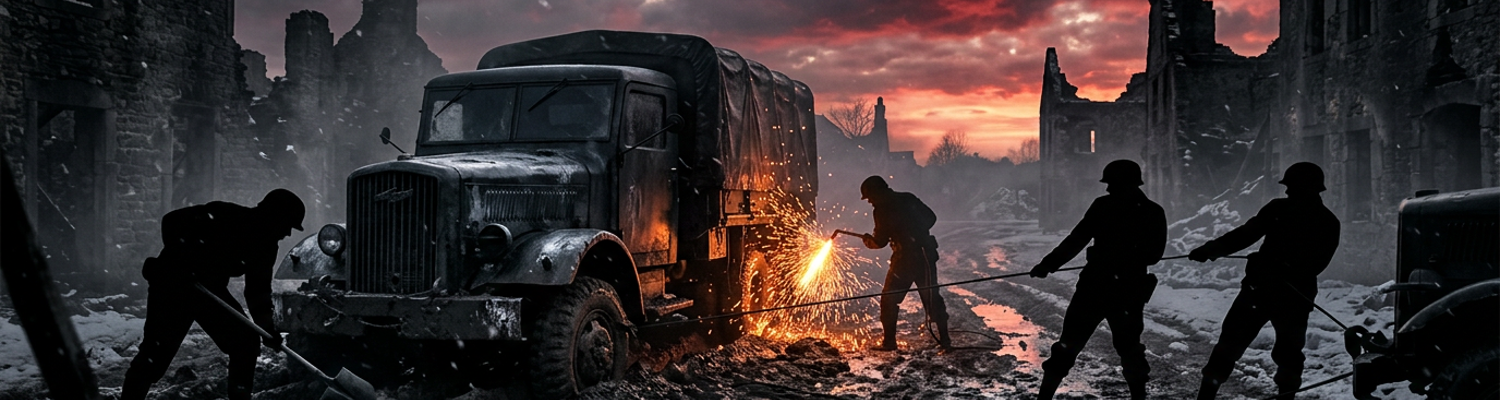
Sleet coated the narrow secondary roads of the Rhineland in early 1945, turning every shell-pitted detour between Aachen and the Rhine River into deep trenches of freezing mud. Heavy division traffic had already pulverized the roadbed, breaking up the crushed stone foundation until only deep ruts and waterlogged clay remained. Constant winter storms dumped snow that quickly melted into grey slush, blinding drivers and concealing washouts that could submerge vehicle axles. Troops cleared fallen trees, pushed abandoned civilian carts into roadside ditches, and shoveled mounds of wet earth just to advance a few hundred yards through the corridor. Cold wind seeped through canvas coats and leather gloves, stiffening fingers and freezing hand tools before crews could finish basic roadside repairs. The armored truck slid off the crowned center of the route near a blasted culvert, sinking its spinning tires directly into the muck down to the brake drums.
Mud packed around the brake drums because this CCKW two-and-a-half-ton six-by-six chassis carried twice its intended combat weight. Field workshops had heavily retrofitted the standard cargo truck, replacing its canvas sides with field-welded steel armor plates salvaged from scrap yards to shield the crew from small-arms fire and artillery splinters. Mechanics had bolted reinforced floor vaults directly across the longitudinal frame members, creating locked interior compartments intended to hold crates of seized currency and foreign exchange assets. These improvised steel plates and secure boxes pushed the gross vehicle weight past six tons, placing an unsustainable burden on the original factory suspension. Heavy Rhineland mud worked directly into the wheel hubs, while the massive overload produced severe drivetrain and axle fatigue that threatened to twist the intermediate driveshafts under continuous low-gear torque. The rear tandem axles bent under the extreme load, leaving the differential housings dragging flat against the frozen ground.
Sergeants from the Quartermaster Corps stepped out of the armored cab into the freezing slush beside recovery and security details to inspect the immobilized undercarriage. Displaced German civilians gathered along the treeline in wet rags, watching the stalled convoy with empty hands and forcing the security details to level their carbines to keep the perimeter clear. Financial specialists from the SHAEF G-5 Currency Section checked the heavy combination locks on the floor vaults, worried that muddy water and constant road shocks would ruin the paper notes and financial ledgers stored inside. The Quartermaster recovery crew cared little about the banknotes, focusing their energy entirely on the bent spring shackles and leaking axle seals. The lead sergeant knew that a cracked gear casing would force the unit to abandon the cargo on an open road where desperate local mobs or isolated enemy stragglers could overwhelm the small guard force. Every passing minute in the freezing drizzle dropped the temperature further, hardening the mud around the sunken wheels.
Mechanics unpacked heavy steel shovels from the running board racks to dig the hardened mud away from the sunken tires. Recovery specialists fastened a thick steel tow cable from a tracked recovery vehicle directly to the front frame brackets of the depository van. Crewmen placed heavy oak planks beneath the tires to give the treads traction against the slippery clay. The winch operator engaged the power take-off lever, drawing the cable taut until the wire strands hummed under the strain of pulling the six-ton truck out of the ditch. Mechanical force dragged the depository van back onto the gravel roadbed, where the Quartermaster sergeant inspected the groaning suspension before waving the vehicle back into the slow-moving column.
Rhineland Winter Route Obstacles and Transport Strains
Gravel crunched beneath the dual tires as the mobile depository lurched forward into the convoy, its overloaded chassis swaying heavily over every icy dip in the bypassed rural corridor. Severe late-winter conditions had battered these western German borderlands with freezing rain, deep blizzards, and relentless freeze-thaw cycles that shattered stone pavements into jagged fragments. German demolition teams had systematically blown out every masonry culvert and small stream crossing during their retreat toward the Roer, forcing logistical convoys onto narrow cart tracks that quickly turned into bottomless troughs of frozen slush. Drivers slammed their floor pedals down into the lowest transfer-case gears to keep the armored six-by-six moving across black ice, but the massive weight of the field-welded safe boxes dragged the frame downward whenever the wheels struck a hidden washout. Freezing runoff surged through collapsed stone culverts directly into the ruts, flooding the roadbed and freezing solid around the undercarriages of three trailing supply trucks that slipped sideways off the crown.
Wreckers from the Quartermaster company maneuvered into position along the muddy embankment to untangle the trapped convoy before the ice locked the axles in place. Recovery specialists unspooled heavy braided steel tow lines from the vehicle winches, wading through knee-deep slush to shackle the hooks directly around the reinforced bumper mounts of the mired transports. Heavy winches groaned against their chassis crossmembers as operators engaged power take-offs, dragging the immobilized trucks out of the flooded bypass one by one while steel cables hummed under lethal tension. Mechanics packed rough oak planks, crushed brick, and salvaged fence posts under spinning tires to maintain traction on the sheer ice, knowing that any prolonged halt would allow the heavy depository van to sink past its wheel hubs. Sleet battered the faces of the recovery crews as they rewound the slick wire ropes and hammered damaged shackle pins loose, finally opening a narrow pathway through the choked logistical corridor before a broken civilian handcart brought the entire column to another abrupt halt.
Riflemen from the attached security detachment deployed in a tight perimeter around the immobilized transports, keeping their M1 carbines unslung as crowds of displaced civilians surged toward the road from nearby ruined farmsteads. Displaced German refugees and liberated foreign laborers pressed close against the muddy verges in search of food, fuel, and unguarded supplies, watching the heavily armored depository van with growing desperation. Squad leaders shouted continuous warnings in German to keep opportunistic looters away from the running boards, using rifle stocks to enforce an exclusion zone around the padlocked rear doors and bolted vault plates. Quartermaster sentries took up tactical positions at each corner of the vehicle body, sweeping their weapons across the nearby hedgerows to deter organized bands of stragglers who might exploit the breakdown to plunder the cargo. Bitter wind whipped through the open sentry lines as the riflemen held the restless crowd at bay, chambering rounds whenever desperate civilians edged toward the exposed fuel tanks and side tool boxes.
Exhaust smoke billowed from the depository van as the driver re-engaged the transmission, signaling to the perimeter security team that the obstacle had been shoved clear of the track. Soldiers scrambled back onto the running boards and rear steps, keeping their weapons leveled outward while the six-ton truck rolled across fresh timber planks laid over the mud. Drivers wrestled the heavy steering wheels to keep the tandem axles centered on the narrow corduroy path, feeling the leaf springs groan under the immense dead weight of the internal currency safes. Cold sleet continued to glaze the armored cab windshields as the lead vehicle crested the frozen ridge, pulling the mobile vault clear of the hostile crossroads. Quartermaster sergeants signaled the column into low gear for the steep descent, guiding the armored transport onto the main macadam highway leading toward the forward financial collection post.
Vault Breaches in Aachen and Mönchengladbach Municipalities
Brake shoes smoked against the cast-iron drums as the heavy depository van rolled off the highway and backed up to the blast-damaged steps of the municipal Reichsbank building in Aachen. Quartermaster teams repeated the same brutal entry procedures days later among the pulverized avenues of nearby Mönchengladbach, where bomb strikes had collapsed upper masonry floors directly over the subterranean strongrooms. Engineers dragged hissing oxyacetylene torches down through the flooded stone stairwells to cut through the hardened steel hinges of the subterranean security gates. Blue flames burned against the thick vault doors for hours in the damp air, softening the laminated iron plates until thermal cutting tips punctured the inner locking bars. Recovery crews then unspooled the front winch cable from the CCKW chassis, feeding fifty yards of heavy braided wire rope down through sidewalk coal chutes and hooking it around the subterranean vault door handles. Winch drums on the six-by-six groaned in reverse gear against the truck chassis, snapping the melted hinges and dragging the three-ton vault doors outward across the wet concrete floor with an ear-splitting screech.
Carbide lamps cast harsh white beams across the newly exposed doorway, revealing flooded vault chambers where rows of steel safe-deposit boxes sat rigged with improvised anti-handling devices. Demolition specialists crept through knee-deep basement water to inspect tripwires hooked directly to the pull rings and brass handles of the inner strongboxes. German bank personnel had lashed friction igniters and explosive blocks behind several locker rows, setting concealed charges intended to blast the records into paper pulp if salvage crews forced the handles. Sappers worked with wire snips and inspection mirrors to disarm the brass firing pins, carefully clearing the booby traps without breaking the fragile acid vials placed inside the hinges. Slime, fuel oil, and contaminated sewer runoff covered the opened drawers, soaking the official currency manifests that documented the movement of local branch reserves. Soldiers lifted the dripping ledger books out of the muddy sludge with bare hands, laying the wet paper across canvas litters so officers could still read the blurred serial numbers and branch signatures.
Finance officers from the G-5 Currency Section sat behind folding field desks beside those litters to begin the immediate cataloging of millions in captured banknotes. Clerks counted banded stacks of Allied Military Marks alongside German municipal drafts, foreign government securities, and industrial bonds that local bank managers had hidden away from Allied bombers. Hand-cranked adding machines clicked constantly in the drafty entryways as specialists verified bundle counts, sorted damp notes into waterproof canvas pouches, and logged every batch onto official tally sheets. Quartermaster guards signed and stamped the transfer vouchers at the doorway to establish an unbroken military chain of custody before any cash left the cellar. Exhausted soldiers hauled the heavy wooden currency chests up the cracked cellar staircases and loaded the verified paper assets straight into the field-welded floor safes of the mobile CCKW van. Guards slammed the reinforced steel vault covers shut and padlocked the internal deck compartments, securing the entire seizure for road transport under armed escort.
Financial Intelligence Operations and Document Exploitation
Brass padlocks rattled against the deck plates as search details sprinted up the interior stairwells to seize municipal accounting registers before retreating German officials could incinerate the remaining administrative records. Retreating municipal clerks had shoved bound ledger books into basement heating boilers and cast-iron office stoves, filling the corridors with thick ash and stinging smoke. Soldiers kicked open glowing firebox doors, poured buckets of slush over burning paper heaps, and pulled heavy cloth-bound town registers away from the embers with gloved hands. Bayonets and rifle butts pried open locked metal cabinets, revealing municipal tax rolls, budget balance sheets, and communal treasury records that German administrators had tried to destroy in their final minutes. Squad leaders stacked the scorched volumes onto wooden litters and carried them straight out to the idling CCKW van, covering the damp paper beneath oilskin tarpaulins while the engine vibrated against the curb.
Investigators from 21st Army Group Military Government financial teams climbed directly into the rear cargo bay of the mobile depository van to analyze the captured commercial ledgers alongside local municipal files. Specialists cleared space on folding desks illuminated by vehicle inspection lamps, cross-referencing customer ledger entries against local branch balance sheets to identify hidden bank accounts. Analysts traced complex duplicate payments, unmasked dummy business partnerships, and uncovered undeclared corporate holdings that district authorities had sheltered from Allied property controls. Each recovered business ledger revealed cross-border deposits, undisclosed branch reserves, and numbered accounts disguised under false supplier names in regional commercial banks. Clerks underlined these hidden balances with red grease pencils and transcribed the account numbers onto mimeographed intelligence rosters for immediate seizure by tactical field commanders.
Tally sheets piled up on the folding desks as clerks began the field reconciliation of seized banknotes against recovered Reich debt certificates and regional transfer logs. Cash counting crews unstrapped bundles of paper currency retrieved from the floor vaults, matching the serial blocks directly against central bank remittance slips found in the captured accounting packets. Accountants compared stacks of Reichsmark notes with official Reich debt certificates discovered inside hidden wall safes, checking the stated interest coupons against regional telegraph transfer logs from Cologne and Düsseldorf. Discrepancies between the physical paper currency and the bank branch balance logs exposed missing reserve boxes that local officials had diverted during their withdrawal eastward. Soldiers used these reconciled audit trails to track down unaccounted strongboxes abandoned in railcars and bombed-out post office basements, recovering millions in unregistered currency before local civilians or deserters could strip the caches.
Steel security cases containing the verified currency and matching bank manifests were hoisted back over the tailgate into the armored CCKW cargo bay. Quartermaster sergeants verified the serial numbers on every lead wire seal before bolting down the floor hatches over the newly recovered reserves. Drivers topped off the fuel tanks with jerry cans, cleared spent shell casings from the cab floorboards, and checked the leaf spring shackles for fresh fractures under the growing weight of the document chests. Guard details strapped heavy canvas covers across the rear cargo opening, took up their perimeter posts on the running boards, and waited for the column leader to signal the next run toward the Rhine.
Ruhr Pocket Asset Interceptions and Clandestine Caches
Clutch pedals snapped upward as drivers accelerated toward the river crossing after the column leader flagged the convoy forward toward the Rhine, beginning the April 1945 mobile sweeps through the collapsing Ruhr encirclement. Quartermaster crews deployed their CCKW mobile depository trucks as forward consolidation nodes immediately behind combat elements of the First and Ninth Armies. Combat divisions had compressed German Army Group B into a tightening pocket, throwing regional banking administration into utter chaos as local bank directors evacuated Reichsbank assets on secondary roads and bypassed rail routes. Technical teams drove the heavily armored six-by-six trucks directly into newly captured rail yards and industrial sectors, tracking paper manifests and telephone records before retreating German detachments could destroy or disperse the treasury funds. Scouts from the security detail followed fresh wagon tracks and damaged rail spurs to locate three camouflaged boxcars hidden beneath pine branches on an industrial siding.
Crowbars forced open the rusted sliding doors of the abandoned boxcars, revealing stacks of unpainted wooden crates containing dispersed monetary reserves and foreign currency. German railway personnel had shunted these freight cars away from the main lines during Allied air attacks, abandoning millions of Reichsmark notes alongside bundles of Swiss francs, British pounds, and American dollars. Quartermaster soldiers smashed the reinforced crate lids with pickaxes and transferred the paper currency bundles into canvas bags under the supervision of G-5 Currency Section officers. Soldiers carried the loaded bags straight to the idling CCKW van, where clerks verified the official bank seals and logged serial blocks directly onto field audit registers. Crews loaded the verified currency chests into the field-welded floor safes of the mobile depository, feeling the truck rear leaf springs compress under the dense cargo. Interrogations of captured rail clerks at the siding uncovered handwritten shipping invoices indicating that additional central bank reserves had been diverted into regional salt mines further inland.
Miners operated the heavy hoist engines to lower Quartermaster recovery teams down deep shafts into the dry drift tunnels of the regional salt mines. German authorities had chosen these subterranean salt caverns as emergency vaults because hundreds of feet of solid rock provided total shelter from Allied bombs and artillery fire. Search teams navigated the white crystalline galleries with battery lanterns, locating hidden timber partitions that concealed rows of evacuated Reichsbank security boxes and paper reserves. Soldiers stacked the heavy currency crates and canvas money bags onto steel ore carts, pushing the rolling loads down narrow-gauge tracks to the primary lift cages. Electric hoists hauled the recovered wealth back to the surface minehead, where mobile depository trucks stood with their rear doors open to serve as immediate processing centers.
Chains clanked against the steel floorplates as Quartermaster specialists guided heavy lifting straps around the extracted crates to hoist them onto the depository truck bed. Finance officers sat at folding wooden desks set up directly inside the vehicle cargo bay, checking each batch of currency against the captured branch manifests while armed guards secured the perimeter. Mechanics inspected the CCKW chassis under the swelling payload, tightening loose spring shackles and checking the dual rear tires for signs of sidewall failure under the massive tonnage. Drivers filled the fuel tanks from five-gallon cans and warmed the six-cylinder engines, keeping the mobile vault ready to relocate the moment frontline units expanded the perimeter. Guards bolted the steel hatch covers over the loaded floor vaults, drew the exterior canvas curtains tight over the tailgate, and signaled the convoy commander that the forward consolidation was complete.
Asset Consolidation at Frankfurt Foreign Exchange Depository
Engines roared as drivers shoved the floor gear levers into forward drive, lurching the heavily weighed mobile vault trucks onto the battered southern highway toward Frankfurt am Main. Broken leaf springs slapped against the frame rails as the overloaded chassis carried the newly seized gold bullion, crates of mixed foreign notes, and stacks of captured municipal manifests across pontoon bridges over the Rhine. Escort jeeps mounted with machine guns cleared civilian foot traffic and stalled military ambulances away from the convoy route, keeping the six-by-six trucks moving at steady speeds to prevent overheating the strained transfer cases. Cooling fans roared behind clogged radiator grilles, pulling air over hot engine blocks as the convoy descended out of the Taunus hills into the damaged streets of the city. Drivers steered the shuddering trucks past ruined office blocks directly toward the fortified Reichsbank complex, which Allied commanders had designated as the Frankfurt Foreign Exchange Depository. Squealing brakes brought the mobile vaults to a halt along the reinforced concrete loading ramp of the subterranean bank facility, where armed sentries swung open the blast gates to admit the armored cargo bays into the central receiving tunnel.
Quartermaster crews swung down the heavy tailgates and unbolted the interior steel safes to begin offloading the recovered wealth directly into the subterranean security chambers. Soldiers loaded canvas currency sacks filled with British pounds, Swiss francs, and American banknotes onto rolling wooden carts alongside heavy boxes of recovered gold bullion and bundles of Reich debt manifests. Armed guards from the military police lined the granite corridors as civilian banking specialists and Allied accountants pushed the loaded carts into the main underground vaults. Centralized Allied Military Government monetary authorities assumed direct and permanent legal custody of every incoming chest, checking the lead shipping tags against the field tallies prepared in the field-modified vans. Officers of the Currency Section signed formal transfer vouchers on long wooden inspection tables, transferring hundreds of millions in recovered bullion and foreign exchange to the supreme Allied command. Clerks stamped the final audit ledgers with official receipt seals, ending the temporary custodial authority that tactical field units had maintained since the border crossings at Aachen.
Welders unbolted the field-welded floor safes with impact wrenches, sliced away the thick cab armor with cutting torches, and removed the reinforced steel deck plates that had warped truck frames for six months. Permanent bank buildings and heavily guarded military supply depots eliminated the tactical necessity for improvised, armor-plated cargo trucks to protect cash near the front lines. Quartermaster commanders withdrew the battered mobile vault fleet from frontline service, sending the trucks to regional ordnance depots for systematic stripping and mechanical disposal. CCKW armored depository trucks rolled back out of the bunker ramps into motor pool staging areas the moment these centralized vaults and regional banking hubs began full operations. Crane operators hoisted the stripped safes onto salvage flatbeds, leaving the CCKW chassis to return to ordinary general cargo transport duties or scrap yards across the theater. Ordnance sergeants signed the final decommissioning orders for the mobile vault conversions, parking the bare utility trucks in neat supply rows alongside standard divisional transport.