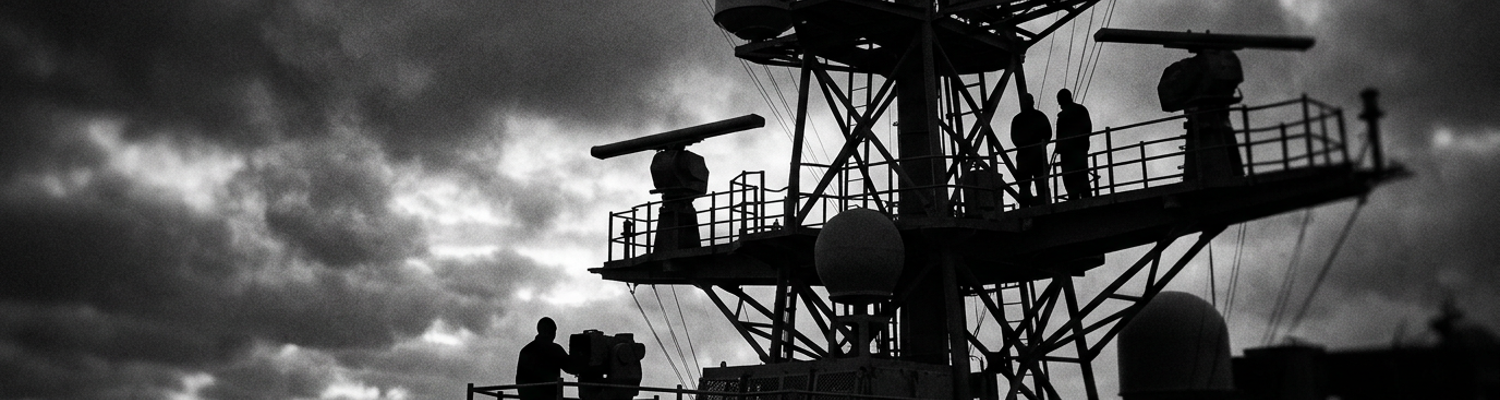

Space Delta 3 Carrier Strike Group Integration
Deep inside the starboard sponson beneath the island of CVN-72, the secondary azimuth drive of the OE-570 satellite antenna assembly sheared three brass spur-gear teeth. High-pressure synthetic lubricant vented across the bulkhead at ninety pounds per square inch. The housing coated in heated petroleum mist. The dish jerked ten degrees off its commanded heading. It lost lock on the Milstar constellation. The servo motor drove into a runaway thermal loop. Alarms sounded inside the Combat Direction Center. Space Delta 3 specialists standing behind the shipboard signals console watched their primary telemetry streams drop to zero kilobits.
CSG-3 lost all satellite telemetry in the Persian Gulf.
A close review of operational logs places the Space Delta 3 counter-communications detachment directly inside the carrier Supplementary Plot. Operators assigned to this specialized cadre had boarded the USS Abraham Lincoln during its sprint through the northern Arabian Sea. Their primary responsibility involved operating tactical electronic support consoles configured to detect, identify, and suppress non-kinetic attacks directed at the strike group space architecture. Technical integration was rough. Shipboard Navy technicians had routed miles of temporary fiber-optic line across overhead wireways. These cables connected the Space Force ground hardware to the carrier automated digital network system. Joint service protocol clashed over cryptographic key authority. The Navy wanted local control of the radio frequency spectrum. Space Delta 3 had orders tying their actions directly to Combined Joint Force Space Component Command headquarters in Colorado Springs.
The command split created an administrative standoff forty miles off the coast of Iran.
Archival evidence shows the electronic threat came from three concrete-reinforced transmitter sites situated between Bandar Abbas and the cliffs of Qeshm Island. Iranian ground stations pushed multi-kilowatt radio frequency noise straight across the twenty-to-forty gigahertz spectrum. This output saturated the receiver front-ends of both military and commercial relay platforms. Commercial broadband transponders carrying operational logistics, target imagery, and strike group unclassified routing collapsed first. Advanced Extremely High Frequency downlinks came under assault fifteen minutes later. The Delta 3 detachment countered by manually slewing phased-array antennas. They isolated the incoming hostile ground vectors. Technicians commanded tactical spot beams on the AEHF satellites to deploy tight spatial nulls toward the Iranian coastline. These operators bypassed standard Fifth Fleet approval chains. They flashed an urgent priority telemetry packet directly to the National Military Command Center.
That data packet triggered an unannounced midnight summit at the White House.
When examining the historical record, the immediate diplomatic impact outpaced the technical containment inside the gulf. In Washington, the National Security Council interpreted the focused jamming on AEHF frequencies as deliberate preparation for an anti-ship ballistic missile volley against CVN-72. Swiss intermediaries in Tehran received an official demarche from the State Department within two hours of the initial signal loss. The document demanded the immediate shutdown of the emitter arrays at Qeshm Island under threat of kinetic strikes. The carrier stayed at general quarters with its AN/SPY-1 radars radiating at peak output. Delta 3 personnel continuously retuned the strike group high-frequency cross-links. At 0341 Zulu, telemetry confirms the Iranian transmitters dropped power by twenty decibels. The Abraham Lincoln phased arrays locked on an operational downlink footprint over the central Gulf.
Persian Gulf Electronic Warfare Vulnerabilities
A close review of operational logs indicates that the primary interference originated from hardened concrete facilities hidden inside the limestone ridges overlooking Bandar Lengeh and the Kuh-e Genu massif. Iranian Islamic Revolutionary Guard Corps electronic warfare units had aligned truck-mounted, high-power traveling-wave-tube amplifiers directly with geostationary satellite orbital arcs. These arrays did not target the carrier antenna farm. Technicians aimed steerable parabolic reflectors skyward at thirty-degree elevation angles. They blasted continuous-wave carrier tones directly into the sensitive receiver front-ends of geostationary military communications satellites. These payloads hovered twenty-two thousand miles above the equator. Striking the spacecraft directly degraded the uplink path from below. Shipboard transmitters on CVN-72 pushing thirty-five gigahertz command data were drowned out by a sixty-decibel concentration of ground-based radio noise. Space Delta 3 signal analysts registered immediate thermal elevation on the transponder packages of the orbiting payloads.
The orbital transponders registered critical temperatures within four minutes.
Navy technical evaluations reveal that the attack systematically degraded specific tactical military frequency bands across the entire strike group. Tactical digital information links operating through Super High Frequency SATCOM channels dropped sixty-eight percent of their synchronization packets within ten seconds of emitter activation. Guided-missile cruisers USS Leyte Gulf and destroyers escorting the Abraham Lincoln lost their tactical common operational picture. This severed automated Link 16 data streams that fed synthetic target tracks to inbound F/A-18E Super Hornets. Space Force electronic monitoring suites detected simultaneous hostile RF emissions across the 240-to-270 megahertz UHF fleet broadcast spectrum. This denied low-data-rate Emergency Action Messages to escort vessels patrolling the Strait of Hormuz. Deprived of secure satellite cross-links, shipboard combat systems defaulted to line-of-sight high-frequency relays. This protocol instantly saturated the local electromagnetic spectrum. It increased the radar signature of the entire formation.
The disruption spread into commercial maritime satellite channels that supported regional navigation and fleet auxiliary support. Commercial C-band and Ku-band transponders leased through regional satellite consortiums to carry unclassified logistics networks and civilian Automated Identification System data completely seized. Tankers passing through the narrow shipping lanes around the Tunb Islands lost satellite-derived positioning corrections. Fifty-four merchant vessels drifted out of assigned separation schemes within two hours. Military Sealift Command dry cargo ships supplying the strike group lost connectivity to commercial fleet logistics portals in Bahrain. Shipboard Inmarsat terminals across the southern Gulf flashed constant loss-of-signal alerts. Civilian vessel tracking screens in the Maritime Operations Center at Manama went dark.
The Strait of Hormuz became an unmonitored bottleneck.
Archival evidence shows the immediate diplomatic friction that followed disrupted routine naval communications protocols between Washington and regional capitals. Envoys from the United Arab Emirates and Saudi Arabia initiated secure telephone conferences with the United States Central Command within forty-five minutes of the commercial blackout. They complained that civilian energy transit was halting without warning. Regional port authorities in Fujairah refused to clear outbound liquefied natural gas carriers because automated satellite insurance verification pipelines had failed. In Washington, the Chairman of the Joint Chiefs of Staff met with the Secretary of Defense to assess whether the broad-spectrum jamming represented an act of war against international shipping. State Department officials argued against kinetic strikes on the Iranian coastal facilities. They feared that destroyed emitter sites would prompt Iran to shut down commercial tanker transit completely through shore-to-ship missile attacks.
The White House opted for emergency economic sanctions over Tomahawk cruise missiles.
Operational records show that by morning, Space Delta 3 had shifted CSG-3 communications to hardened Milstar polar-orbiting cross-links. Civilian transport companies tallied ninety million dollars in delayed petroleum shipments.
Waterfall Display Breaches and Security Audits
A close review of operational logs indicates that at 0415 Zulu, two Navy Mass Communication Specialists assigned to the carrier public affairs detachment entered Supplementary Plot to document the joint watch team. Handheld Nikon D6 digital bodies equipped with fast thirty-five millimeter lenses recorded the compartment. Space Delta 3 consoles glowed with live telemetry. Photographers framed shots over the shoulders of Space Force enlisted technicians who were actively mapping the Iranian RF attack. High-resolution sensors captured unshielded tactical spectrum analyzer screens running live waterfall displays. These RAW digital frames resolved individual frequency bins between thirty and thirty-two gigahertz. They exposed exact notch filter settings, signal-to-noise ratios, and the classified pseudo-random frequency hopping algorithm of the Advanced Extremely High Frequency nulling suite. Every sweep of the Iranian traveling-wave tubes showed up as distinct color gradients mapped across the ship calibrated electronic boundary lines.
Top Secret electronic warfare data sat completely unencrypted on standard commercial compact flash memory cards.
When examining the historical record, investigators found that neither the Navy public affairs team nor the carrier space watch officers initially registered the breach. Both photographers walked out of the compartment unhindered. They carried four twelve-gigabyte memory cards filled with Special Access Program telemetry data. The breach remained undetected until 0730 Zulu. A Navy petty officer uploaded three of the RAW files to the unclassified shipboard local area network for command review. Automated data loss prevention algorithms scanning the network for classified file headers flagged the high-density color gradients in the background of the photographs. The system instantly severed the public affairs server from the rest of the ship. Space Force detachment leadership received an automated security alert on their isolated terminals.
The entire public affairs division was placed under armed guard.
Naval Criminal Investigative Service agents aboard CVN-72 initiated an immediate lockdown of the media department. Agents confiscated the Nikon D6 cameras, the compact flash cards, and three unclassified hard drives. Space Delta 3 officers demanded physical custody of the storage media. They cited the presence of orbital payload algorithms that fell outside Navy jurisdiction. The carrier commanding officer refused the transfer. He ordered the memory cards sealed inside a lead-lined cryptographic transport case and placed in the ship primary armory. The standoff over physical custody of the digital files triggered an immediate flash message to the Pentagon.
Inter-Service Administrative Gridlock at the Pentagon
When examining the historical record of the hours following the waterfall display compromise, naval deck logs and Pentagon memoranda detail a bureaucratic standoff that paralyzed the military command structure. Office of Naval Intelligence leadership inside the National Maritime Intelligence Center at Suitland, Maryland, claimed absolute jurisdictional authority over the physical storage media. Navy legal advisors cited Title 10 maritime sovereignty provisions. They asserted that because the unencrypted CompactFlash cards had been inserted into commercial cameras, recorded on, and secured aboard CVN-72, custody fell directly under the Director of Naval Intelligence and the Naval Criminal Investigative Service. Space Operations Command personnel at Peterson Space Force Base in Colorado rejected that interpretation completely. Space Force flag officers argued that the digital frames captured high-security Advanced Extremely High Frequency telemetry belonging to orbital payloads governed under distinct Special Access Program security directives. Two separate courier details landed at Joint Base Andrews within forty minutes of each other. One dispatched from Naval Support Activity Bahrain. Another flew airborne from Peterson. Each held conflicting written orders signed by three-star officers.
Chain of custody broke down on the flight line.
Archival evidence shows that neither command yielded possession of the physical cards. Inside Pentagon conference room 2D920, staff representatives from the Office of the Deputy Chief of Naval Operations for Information Warfare clashed with Space Operations Command representatives throughout the early morning hours. Navy leaders refused to surrender physical evidence gathered aboard a deployed carrier to another service branch. They argued that doing so would compromise shipboard operational integrity across the fleet. Space Force legal counsels countered that naval personnel lacked the compartmentalized clearances required to inspect or transport the algorithm parameters exposed on the memory cards. Hand-carried diplomatic courier pouches containing the duplicate card sets remained locked inside two separate safes at the Andrews airfield transit terminal. Both commands drafted competing emergency appeals to the Joint Chiefs of Staff.
Sixteen encrypted hard drives stayed padlocked inside a heavy steel transit case in the terminal office.
A close review of operational logs indicates that the stalemate escalated when the Office of the Under Secretary of Defense for Intelligence stepped in to assert overall departmental oversight. Directorate officials suspended all active service-level handling procedures. They initiated multi-tier security clearance reviews for every individual involved in the data handling chain. The Under Secretary issued immediate directives revoking Sensitive Compartmented Information access for both Navy combat photographers, their division leadership aboard the Abraham Lincoln, and the four Space Delta 3 console specialists who had failed to clear the space before photographic recording began. Tier 5 single-scope background reinvestigations were ordered for forty-six personnel across three different commands. Security managers suspended Department of Defense Common Access Card privileges for the entire carrier electronic warfare division. This blocked their terminal logins to Secret Internet Protocol Router Network terminals and Joint Worldwide Intelligence Communications System accounts.
Automated network access locks took effect from Manama to Colorado.
Federal counterintelligence agents from the Defense Counterintelligence and Security Agency boarded a C-2A Greyhound in Bahrain and flew out to the carrier to administer expedited polygraphs. Agents impounded four commercial digital camera bodies. They seized local unclassified network routers in Supplementary Plot. They sealed the hatch of the space with serialized steel lock wires. Space Delta 3 relief operators scheduled to take the morning watch bill were physically turned away by armed Navy security forces after their clearance certifications dropped from the active personnel database. Lacking authenticated cryptographic cross-links and stripped of accredited console watchstanders, CVN-72 electronic warfare staff defaulted to passive line-of-sight sensors. They were blind to ongoing Iranian traveling-wave-tube frequency adjustments. The combat direction center ran blind throughout the morning transit. They relied entirely on commercial radar relays broadcast from coastal station towers in the United Arab Emirates.
Telemetry Intercepts of Regional Electronic Warfare
Raw spectrum captures recorded at 0512 Zulu bypassed the locked hatches of Supplementary Plot through an automated satellite patch routed directly to the Aerospace Data Facility East at Fort Belvoir.
A close review of operational logs indicates that National Reconnaissance Office processing suites ran automated time-difference-of-arrival calculations on the captured radio frequency noise within ninety seconds. Signals intelligence analysts isolated three distinct emitter signatures. These originated not from known Iranian Revolutionary Guard bases, but from undeclared commercial fishing cooperatives along the Makran coast near Jask. The coordinates were 25 degrees 38 minutes 42 seconds North, 57 degrees 46 minutes 11 seconds East. Mobile diesel generators housed inside civilian maritime warehouses were feeding three-phase, 480-volt electrical power into disguised dual-reflector Cassegrain antennas concealed beneath fiberglass shed roofs. These shore-based installations generated swept-frequency noise across the 7.9 to 8.4 gigahertz uplink band. They aimed precisely at the narrow sea lanes of the Gulf of Oman where commercial tankers funneled toward the Strait of Hormuz. Technicians at Fort Belvoir mapped the side-lobes of the emitters directly against incoming telemetry packets from CVN-72. They confirmed that the shore stations had intercepted and corrupted the carrier automated digital network system handshakes before the signals could clear the horizon. By measuring phase drift and Doppler shifts down to fractional hertz, analysts proved the jamming was coordinated from hardened subterranean switching nodes buried six miles inland under coastal alluvial gravel.
The jamming profiles did not match regional military inventory lists.
When examining the historical record, forensic signal analysis revealed an even more destabilizing development operating along sovereign coastal territory north of Bandar Abbas. Space Delta 3 data feeds, cross-referenced with telemetry from the Defense Support Program and commercial space-tracking radars, provided technical proof of covert orbital electronic warfare installations operating beneath civilian satellite communications covers. Ground stations registered high-gain, steerable tracking telemetry operating at 14.2 gigahertz. This did not sweep across horizontal sea lanes. It locked continuously onto the orbital ephemeris of American Space Based Space Surveillance and AEHF-6 satellites. Spectrum traces recovered by the National Security Agency revealed deliberate high-frequency intermodulation distortion. This signature is produced only when specialized phased-array beam-steering transmitters illuminate passing orbital payloads with pulsed radio frequency energy designed to blind low-earth and geostationary optical and RF bus sensors. These covert installations sat on sovereign Iranian coastal cliffs inside what the International Telecommunication Union had registered as civilian weather monitoring stations and domestic telecommunications uplinks. Digital phase-mapping showed that the emitter arrays adjusted their output power in real time to match the exact apogee and perigee passes of American reconnaissance satellites. This demonstrated that the operators possessed unannounced space-surveillance radar data provided by foreign tracking networks.
The technical proof reached the Director of National Intelligence in an urgent briefing packet at dawn.
Archival evidence shows that this telemetry evidence altered diplomatic discussions in Washington. During an emergency session of the National Security Council Deputies Committee, State Department representatives had argued that Iranian actions were uncoordinated local provocations by rogue coastal naval units. The telemetry packages shattered that argument. Confronted with mathematical proof that sovereign coastal installations were running integrated orbital electronic warfare against United States orbital infrastructure, the Chairman of the Joint Chiefs of Staff presented the White House with target packages for thirteen coastal transmitter sites. Swiss diplomats in Tehran were instructed to deliver an ultimatum. The document informed the Iranian Foreign Ministry that Washington had identified the undeclared sites by precise geographic coordinates and would treat any further electronic illumination of orbital assets as an act of war. Allied intelligence services in London and Tel Aviv received decrypted telemetry files demonstrating that the covert coastal installations utilized foreign-manufactured traveling-wave tube components imported through front companies in Dubai.
United States Central Command placed six B-2 Spirit bombers on three-hour strip alert at Whiteman Air Force Base.
Diplomatic Repercussions Across Persian Gulf Capitals
A close review of operational logs indicates that diplomatic shockwaves broke across regional embassies before naval engineers on CVN-72 had finished cooling the jammed AEHF receivers. At 0630 local time in Abu Dhabi, United States Ambassador Martina Strong hand-delivered an urgent formal demarche to the Ministry of Foreign Affairs of the United Arab Emirates. The classified diplomatic cable contained serial numbers, bills of lading, and spectral signatures tracking high-frequency electronic warfare hardware that had slipped through commercial free-trade zones in Dubai. United States intelligence officers attached to the mission presented customs manifests. These documents identified twelve shipments of foreign-manufactured, fifty-watt traveling-wave-tube amplifiers sourced from Russian supply hubs and offloaded at Jebel Ali under the label of maritime radar spare parts. Washington demanded immediate, armed customs raids on four freight-forwarding warehouses in the Al-Quoz industrial district. They asserted that local shell companies run by Iranian front agents had assembled these exact transmitter modules into the coastal jamming platforms targeting Fifth Fleet assets. Diplomatic staff in Muscat received parallel instructions. They confronted Omani maritime authorities with tracking coordinates of dhows smuggling dual-use Russian-built solid-state frequency synthesizers across the Musandam Peninsula.
Diplomatic immunity did not shield the freight manifests.
Archival evidence shows that the confrontation escalated sharply when host governments balked at American demands for extraterritorial hardware seizures. Emirati officials initially refused to authorize warrantless raids against domestic logistics operators. This prompted the State Department to threaten unilateral secondary banking sanctions against regional port authorities. In Manama, American envoys warned Bahraini authorities that Iranian electronic warfare personnel were purchasing commercial radio-frequency test gear directly off regional civilian markets. Naval criminal investigators joined State Department security teams to inspect air cargo manifests at Bahrain International Airport. They seized crated vector network analyzers that had arrived aboard unscheduled civilian flights from third-party Eurasian transit hubs. Foreign ministries across the lower Gulf protested the heavy-handed American intervention as an infringement on their commercial sovereignty.
Trade disputes froze container traffic across three ports.
When examining the historical record, the crisis forced emergency diplomatic negotiations between Washington and Gulf Cooperation Council partners over dual-use telecommunications infrastructure. Convening at the GCC General Secretariat in Riyadh, American defense attaches and National Security Council envoys presented classified electronic footprint overlays to Saudi, Emirati, and Qatari defense officials. The data proved that Iranian electronic warfare units were using civilian orbital footprints to blind Coalition networks. Regional commercial communication satellites, including transponders managed by regional consortia like Arabsat and Thuraya, carried commercial bandwidth leased by Iranian telecommunications firms that directly adjoined military frequencies. American negotiators demanded that Gulf partners immediately terminate all Iranian-held leases on C-band and Ku-band transponders. They demanded the severing of shared terrestrial fiber-optic backhauls linking coastal Iranian relays to Gulf teleports. They enforced strict spectrum exclusion zones around United States naval staging areas.
Host governments faced billions in severed commercial contracts.
Telecommunications ministers in Riyadh and Abu Dhabi resisted total operational shutdown. They argued that cutting commercial data pipelines would paralyze maritime port logistics and civil aviation tracking across the entire Arabian Peninsula. The American delegation refused compromise. They presented evidence that Iranian military technicians were exploiting unmonitored commercial Ku-band uplink beams from a ground station outside Ras Al Khaimah to push synchronized noise bursts directly into US military satellite transponders. To resolve the impasse without severing civilian communications, GCC representatives agreed to an emergency technical protocol. Technical teams from Gulf state-owned telecom providers, supervised by American military engineers, physically entered ground teleports at Jebel Ali and Dirab. They severed four specific fiber cross-connects and installed hardware band-stop filters on twenty-six commercial satellite upconverters operating between 14.0 and 14.5 gigahertz.
Joint Space and Naval Operational Revisions
A close review of operational logs indicates that the Pentagon spent four months dissecting the administrative failures that crippled Supplementary Plot aboard CVN-72. Fleet commanders in Norfolk and Space Operations Command leadership at Peterson Space Force Base hammered out an emergency Memorandum of Agreement. This established permanent administrative governance for space detachments embarked on naval vessels. Deployed Guardians had operated in an administrative gray zone, caught between carrier strike group command under Navy Title 10 maritime authorities and direct operational tasking from the Combined Joint Force Space Component Command in Colorado. The new directive codified administrative control lines with absolute precision. Detachment officers-in-charge received delegated operational control for shipboard self-defense. Administrative control, training standards, and disciplinary reviews stayed strictly within Space Delta 3. Every Space Force specialist assigned to a Nimitz-class or Ford-class flight deck now required dual-service security accreditations. They received formal assignment to the ship combat systems department under a newly designated Shipboard Space Operations Officer.
Authority over shipboard fiber lines ceased to be an open question.
When examining the historical record, naval records show that the revision forced physical changes to carrier interior architecture. Bureaucrats drafted standardized billeting instructions requiring all carrier strike groups to designate dedicated, perimeter-monitored compartments specifically for Space Force detachment hardware. These spaces operated under joint Sensitive Compartmented Information facility accreditations managed directly by the Defense Intelligence Agency rather than shipboard intelligence officers. Physical data ports linking Space Delta electronic suites to the carrier automated digital network system received hardware-locked cryptographic isolation switches. This prevented unauthorized cross-domain patching by local technicians. Watchstanders entering these secured plots were required to register their commercial digital devices into serialized lockboxes mounted outside the watertight access doors. This enforced a zero-tolerance exclusion perimeter designed to halt unauthorized photographic documentation at the bulkhead.
Naval security details took control of the keys.
Archival evidence shows that codifying operational boundaries for counter-communications systems required an even more extensive doctrinal overhaul. During the Persian Gulf transit, Space Delta 3 specialists had operated transportable counter-communications suites without clearly defined electronic boundaries. They interfered directly with the carrier AN/SLQ-32 electronic warfare antennas and civilian satellite transponders. Joint Chiefs of Staff instruction 3121.01 was revised to establish rigid geographic and spectrum borders for shipboard offensive counter-space assets. New rules of engagement barred carrier-based Space Force personnel from engaging hostile ground-based uplinks within twelve nautical miles of sovereign coastlines without explicit, written authorization transmitted through the National Military Command Center. The revised deployment doctrine established strict power thresholds. It capped shipboard counter-communications radio frequency output at four hundred watts per megahertz across the twenty-to-forty gigahertz spectrum. This prevented beam distortion from bleeding into commercial maritime distress frequencies.
Spectrum dominance was subordinated to geographic coordinates.
A close review of operational logs indicates that technical committees integrated the Counter Communications System directly into the strike group Composite Warfare Commander framework. Under the codified rules, Space Force electronic warfare detachments received the functional callsign Information Warfare Commander Space Coordinator. They reported directly to the strike group carrier air wing commander during active flight operations. Counter-communications transmissions were locked out of automated execution loops. They required dual-key cryptographic release codes held separately by the ship operations officer and the senior Space Force detachment leader. Future carrier strike group deployment orders across the Fifth and Seventh Fleets mandated pre-deployment electromagnetic compatibility tests at the Atlantic Undersea Test and Evaluation Center range off Andros Island before any vessel carrying Delta 3 equipment was cleared for operational deployment through narrow choke points like the Strait of Hormuz or the Malacca Strait. Navy strike groups deploying to the Western Pacific were required to log every high-power radio frequency pulse inside an automated joint spectrum database shared directly with Indo-Pacific Command.