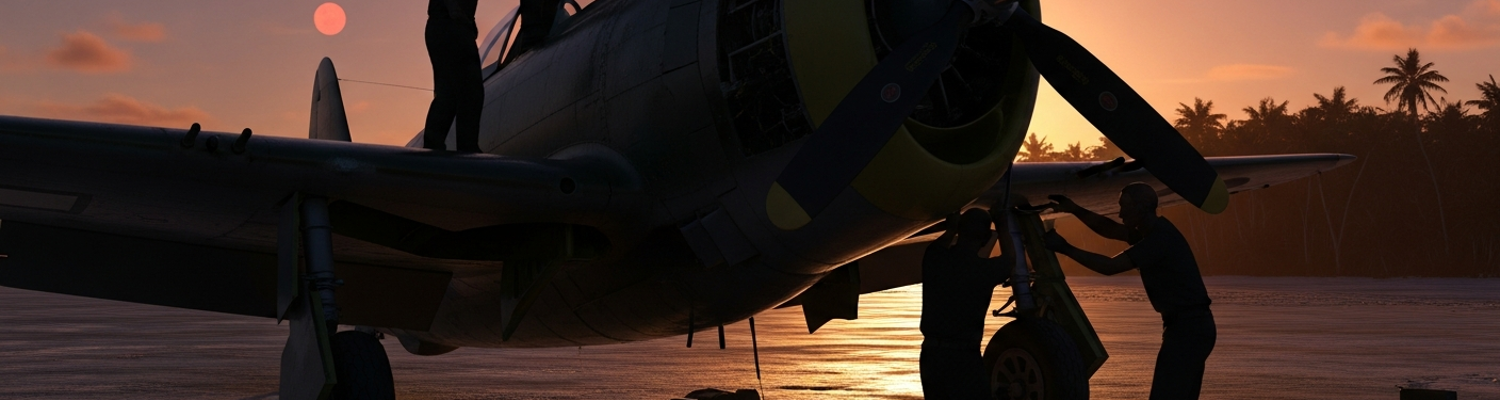

Central Pacific CAS Operational Context
Forward air controllers supporting Marine infantry on Saipan went silent. Multiple AN/ARC-5 and SCR-522 radio sets, the link for directing Close Air Support (CAS), had failed. The cause was not enemy action. A cascade of failures in their power amplifier vacuum tubes had occurred, and replacements were not available.
By November 1944, the Central Pacific campaign had reached a relentless operational tempo. Following the invasions of Saipan, Tinian, and Guam, these islands were being converted into massive airbases. Naval Construction Battalions worked around the clock, expanding captured Japanese airfields like Isely Field on Saipan into complexes capable of handling the new B-29 Superfortress bombers. The first of these long-range bombers arrived in October. On November 24, 1944, a force of 111 departed for the first major raid on Tokyo from the Marianas. This strategic bombing campaign became the new logistical focus.
It did not halt the other facets of war in the region. Japanese forces, staging through Iwo Jima, mounted their own air attacks against the B-29 bases throughout November, destroying or damaging dozens of bombers on the ground. Concurrently, fighting continued on Peleliu, an operation that began in September and would not be declared secure until the end of November.
The Seventh Air Force’s fighter and attack squadrons were stretched thin. Units like the 318th Fighter Group, operating P-47 Thunderbolts from Saipan, flew a multitude of missions. They conducted interdiction strikes against remaining Japanese outposts, provided fighter cover for B-29s, and delivered close air support to ground troops. A close review of operational logs indicates that CAS sorties were a daily occurrence, targeting bypassed Japanese positions and cave networks that remained a threat long after an island was officially designated as secure. These missions demanded precise coordination between pilots and air liaison parties on the ground, a system developed since the early days on Guadalcanal. The entire system hinged on the reliability of VHF radio sets.
The high number of sorties placed an enormous strain on this equipment. The radio sets, such as the AN/ARC-5 command set and the SCR-522, were advanced for their time but fragile. Maintenance records from the period show a high rate of failure for components like vacuum tubes, capacitors, and dynamotor power supplies. These parts were never designed to withstand the Pacific’s corrosive humidity, salt spray, and abrasive coral dust. The supply chain for these specialized parts was a thousand-mile-long thread stretching back to depots in Hawaii and factories in the United States. Requisitioning a simple box of 832A transmitting triode vacuum tubes involved layers of paperwork. That paperwork had to compete for shipping space against B-29 engines and combat rations. Army, Army Air Forces, Navy, and Marines ran largely separate supply systems, creating further complications. When a radio operator’s set failed on Saipan, the breakdown exposed the weakness of this entire system. A single, low-priority electronic part, lost in a sea of competing logistical demands, could ground fighter-bombers and leave infantry without their aerial fire support.
Forward-Deployed CAS Communication Hurdles
The physics of radio transmission became an adversary. The primary tools for air-to-ground coordination, the SCR-522 and AN/ARC-5 sets, operated in the Very High Frequency (VHF) band. Their signals were limited to line-of-sight, a significant problem in the jungle-choked ravines and steep volcanic terrain of islands like Saipan. A Marine air liaison party at the bottom of a ridge was often completely cut off from the P-47 Thunderbolts circling overhead. The tropical atmosphere itself was a constant source of interference. Intense solar radiation and frequent weather fronts created unpredictable atmospheric conditions, such as Sporadic E propagation, which could cause VHF signals to skip hundreds of miles, garbling local tactical communications.
A review of 7th Air Force logs reveals frequent notations of poor signal or lost contact, directly attributable to these atmospheric phenomena.
The hardware was just as vulnerable. Inside the radio sets, vacuum tubes were delicate glass components susceptible to failure from the jarring landings on crushed-coral airstrips or the percussive shock of nearby artillery. Humidity corroded contacts and caused capacitors to fail. Fine, abrasive dust worked its way into mechanical tuning assemblies, causing sets to drift off-frequency. A dynamotor, required to convert the aircraft’s electrical power to the high voltage needed by the transmitter, could burn out without warning, rendering a fighter-bomber mute.
While Allied electronic warfare against Japan’s radar was advanced, the threat of enemy jamming against tactical voice communications was a localized problem. U.S. intelligence assessments often downplayed Japanese jamming efforts, but for a forward air controller in a firefight, any interference could be disastrous. Japanese signal units, though not always equipped with high-powered jamming transmitters, became adept at nuisance tactics. A common method involved broadcasting a fluctuating continuous wave carrier on the known VHF frequencies used by American air liaison parties. This noise was designed to inject enough static to make voice transmission unintelligible at the worst possible moment. Another documented technique was the transmission of dummy messages, sometimes from captured American radios, intended to sow confusion. While American pilots and controllers used authentication codes, the momentary hesitation caused by a spurious transmission could break the rhythm of an attack. On Tinian, Japanese defenders in bypassed pockets used their own portable radios to monitor American frequencies, giving them seconds of warning before a strike arrived.
The consequences of these communication failures were immediate. A P-47 pilot from the 318th Fighter Group arriving over a target zone with a failing radio was effectively blind. After-action reports are filled with instances of aircraft circling for extended periods, burning fuel, while the ground party tried to make contact using signal panels or colored smoke. These methods were crude and imprecise. A sudden gust of wind could blow a smoke grenade into a friendly position. The high speed of the attacking aircraft could make identifying a small panel on the jungle floor nearly impossible. These delays handed the tactical advantage to the defenders, allowing them to shift positions. The worst-case scenarios involved ordnance being dropped on the wrong ridge or directly onto Marine positions. The psychological impact of a friendly fire incident was devastating, eroding trust between ground and air units.
Precarious Naval Supply Chain Bottlenecks
The operational reach of Seventh Air Force fighter groups was tethered to the naval supply line. For units like the 318th Fighter Group operating P-47s from Saipan’s Isely Field, the most immediate constraint was aviation fuel and ordnance. Archival evidence shows the challenge of moving high-octane aviation gasoline from tankers offshore to the flight line. The process was a multi-stage, labor-intensive ordeal. With port facilities still under construction, tankers often had to anchor beyond the coral reefs. Fuel was pumped into smaller barges. These barges navigated shallows to a makeshift pier. The gasoline was transferred again, often into 55-gallon drums. These drums were then muscled onto flatbed trucks, driven over bumpy roads to dispersal points, and finally hand-pumped into aircraft fuel tanks. Every step was a potential failure point. A ruptured hose, a bogged-down truck, or a shortage of drum-handling equipment could create a bottleneck that rippled through the entire sortie generation process. The same was true for ordnance. Pallets of 500-pound bombs and crates of .50 caliber ammunition were offloaded under similarly crude conditions.
The scarcity of spare parts for these shore-based air units presented an even more difficult problem. Maintenance logs from late 1944 reveal a constant battle against an environment hostile to complex machinery. The Pratt & Whitney R-2800 Double Wasp engine, the heart of the P-47, was powerful but temperamental in the Pacific. Its development had been affected by overheating and vibration issues. In the tropical humidity of Saipan, these problems were magnified. Fine coral dust ingested by the engines acted like a grinding compound, accelerating wear on pistons, cylinders, and supercharger components. Spark plugs fouled with regularity. Hydraulic lines became brittle and failed under the combined effects of heat and salt spray. Awaiting a single replacement supercharger regulator, a set of magneto points, or vacuum tubes for the radios could ground a fighter-bomber indefinitely. The inter-service rivalry for shipping space from depots in Hawaii or the West Coast meant that a box of P-47 engine parts competed against B-29 engines, Marine artillery shells, and Navy rations. This competition led to inexplicable delays and shortages of seemingly minor components.
These shortages had a direct and measurable correlation with the combat effectiveness of the air groups. The metric of air power is the sortie. A grounded aircraft is a useless asset. A squadron with twenty-four P-47s on its roster might only be able to get twelve into the air for a given mission due to aircraft awaiting parts or fuel. Operational logs frequently document missions where flights were scrubbed or reduced in size not because of enemy action or weather, but because of an inability to generate the required number of mission-capable aircraft. This reduction in sortie rates had immediate tactical consequences. Fewer available aircraft meant that ground commanders requesting close air support would receive it late, or not at all. It meant that targets of opportunity, such as a Japanese truck convoy on Tinian or a barge attempting to resupply a bypassed garrison, would escape unmolested. The aircraft that could have struck them were sitting on Isely Field, waiting for a replacement oil pump or a new set of tires.
Low-Altitude CAS Pilot Vulnerability
Pilots of the Seventh Air Force flying from Saipan learned that close air support was a different kind of war. The new Japanese defensive doctrine, first encountered on islands like Biak and Peleliu, abandoned the massed charges of earlier campaigns. It was replaced by a strategy of attrition, designed to bleed American forces. For CAS pilots in their P-47s, this meant confronting a battlefield where the enemy was dug into a network of caves, reinforced bunkers, and concealed reverse-slope positions. Archival analysis of Japanese defensive preparations on these islands reveals a deliberate integration of anti-aircraft weapons into their ground defenses. Weapons like the 20mm Type 98 and the 25mm Type 96 automatic cannons were not just sited for defense against medium-altitude bombers; they were dug into low, interlocking positions specifically to engage aircraft at treetop level. A P-47 pilot rolling in on a target marked by Marine smoke was not facing a single gun, but a web of cross-locking fire designed to catch him from multiple angles. Even rifle-caliber 7.7mm machine guns were positioned to fire upwards into the bellies of attacking aircraft.
The P-47 Thunderbolt was a tough aircraft. Its air-cooled Pratt & Whitney R-2800 radial engine could absorb a substantial amount of punishment and keep running, a quality that made it more survivable in the ground-attack role than liquid-cooled fighters. But toughness had limits. A review of maintenance and after-action reports from Isely Field shows a high incidence of aircraft returning with significant battle damage. A single 20mm high-explosive shell from a Type 98 cannon could sever hydraulic lines, leaving a pilot with no flaps or landing gear. It could puncture an oil cooler, causing the engine to seize in minutes. Control surfaces like ailerons and elevators could be shredded, making the aircraft nearly impossible to fly. Pilots reported hearing the sharp crack of rifle rounds passing through their fuselage or the sound of shrapnel peppering their wings. Many returned to find their planes riddled with holes.
These damaged aircraft, even if they landed safely, created a new set of problems, adding to the maintenance backlog and parts shortages that affected the entire Central Pacific campaign.
For the pilots flying these missions, survival often felt arbitrary. Skill and experience were assets, but they could be negated by a single shot from a hidden defender. The difference between a routine sortie and a fatal one could be a matter of inches. A 25mm shell detonating on the armored plate behind the pilot’s seat was survivable; that same shell hitting the engine’s master rod or the cockpit canopy was not. The psychological strain was intense. Pilots watched wingmen disappear in a bloom of fire after taking a hit in a fuel tank during a strafing run. The danger was impersonal and omnipresent. Unlike air-to-air combat, there was no specific adversary to outmaneuver. The enemy was the island itself, a landscape seeded with thousands of guns. Records of air-sea rescue operations in the Pacific show the grim odds. While rescue efforts were extensive, with submarines and patrol flying boats on station, many pilots lost over or near enemy-held islands were never recovered. This brutal lottery defined the unforgiving nature of low-altitude warfare in the final year of the Pacific War.
Cumulative Impact on Mission Effectiveness
The distinct failures in communication, supply, and pilot survivability did not exist in isolation. They formed an interlocking system where a breakdown in one area cascaded into the others, with direct effects on combat operations. After-action reports from the 318th Fighter Group’s P-47 squadrons on Saipan reveal the pattern. A Marine infantry company, pinned down by mortar fire from a concealed position in the terrain of Mount Tapochau, would request an immediate air strike. A flight of four P-47s would launch from Isely Field. One aircraft would be forced to return almost immediately, its R-2800 engine showing a drop in oil pressure from a leaking gasket. Another pilot, upon reaching the target area, would find his SCR-522 transmitter inoperative, the result of a failed 832A vacuum tube for which no replacements were available on the island. He was now a spectator. The two remaining pilots would struggle to coordinate with the forward air controller on the ground, whose own signal was cutting in and out due to the line-of-sight limitations of VHF radio. A four-plane sortie was now a two-plane strike, arriving late and with degraded coordination.
These technical and supply limitations actively slowed the pace of ground engagements. An air strike that should have been executed within minutes of a request often became a multi-hour ordeal. The delay between the initial call for support and the final delivery of ordnance gave Japanese units time to reposition their machine guns and mortars. A defensive position that was vulnerable at 10:00 AM would be abandoned by the time P-47s finally arrived at noon. The pilots would find nothing but empty foxholes while the ground troops took fire from a new, unspotted location. Archival analysis of Marine unit logs from the Saipan and Tinian campaigns shows a clear correlation between delayed air support and increased casualty rates. For every hour that infantry were forced to wait for air cover, their exposure to enemy fire increased, resulting in a steady drain of manpower. This forced passivity allowed Japanese forces to maneuver and mount localized counter-attacks against Marine flanks. What might have been a swift action supported by airpower devolved into a grinding infantry fight.
The administrative war over manifests and requisition forms determined outcomes on the front line. The ability of the Seventh Air Force to generate combat sorties was governed not by the number of pilots or aircraft on hand, but by the availability of seemingly trivial components. Maintenance records from Isely Field (NARA Record Group 18) are a litany of grounded aircraft awaiting parts stuck thousands of miles away in a convoluted supply system. A P-47 Thunderbolt could be rendered inert for weeks by the lack of a single hydraulic pump or a box of spark plugs. The prioritization of the B-29 Superfortress program meant that cargo space on transport ships was at a premium. A crate of P-47 engine regulators held a lower priority than a B-29 turbosupercharger, creating bottlenecks that directly impacted CAS availability. The success or failure of an assault was tied directly to a supply clerk in a depot in Hawaii making a decision about which box to load onto a ship. The cumulative effect was a chronic reduction in available airpower, forcing ground commanders to commit their men to attacks without the aerial firepower that doctrine promised them.