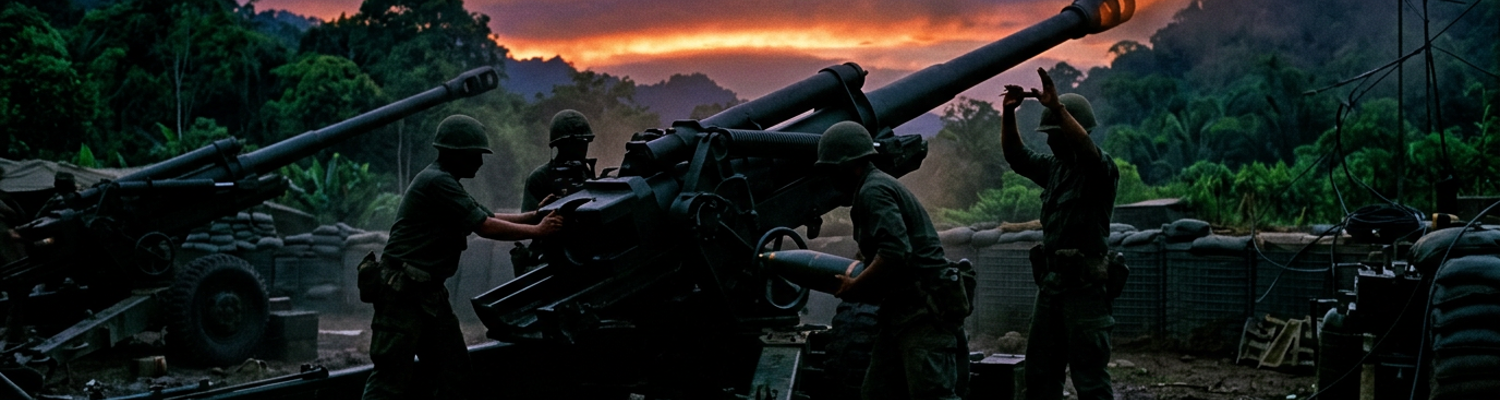

Relocation to Dau Tieng Base Camp
Drivers of the 1st Battalion, 27th Artillery Regiment wrestled their twenty-five-ton M109 self-propelled howitzers through deep ruts of saturated red clay. The tracked vehicles strained along the unpaved roadway as diesel exhaust filled the humid air. Support trucks loaded with tool chests, fire-direction gear, and heavy ammunition crates slid toward the ditch line on worn tires. The battalion relocated its headquarters and all firing batteries from Phu Loi to Dau Tieng Base Camp in November 1967 to reinforce forward tactical operations in the northern sector of III Corps. Mechanics walked alongside the crawling tracked hulls with tow cables and pry bars, pausing repeatedly to reattach thrown treads and clear choked air intake grilles from flying gravel. The exhausted road march ended as the armored howitzers clattered across the outer perimeter wire of Dau Tieng, where crews immediately cut their hot engines in waterlogged staging areas.
Artillerymen of the 1st Battalion reported directly to the 23rd Artillery Group, II Field Force Vietnam, which directed the newly arrived unit to take up both general and direct fire support missions for the 25th Infantry Division. Gun crews operated twenty-three-caliber M126 155mm cannons mounted inside enclosed armored turrets, giving infantry commanders heavy mobile firepower that could shatter enemy bunker complexes or silence hostile mortars across several surrounding tactical zones. Setting up stable firing points inside the raw perimeter proved difficult because the massive recoil forces of the 155mm howitzers drove ground spades several feet into the sodden soil with every training shot. Each sudden shift of the hull ruined the alignment of sensitive panoramic sights and leveling bubbles, forcing section chiefs to spend valuable minutes reaiming their tubes by hand while forward observers called urgently over field radios for defensive concentrations. Mechanics and gunners worked late into the night welding steel plate reinforcements onto spade hinges and bracing timber balks behind the tracks to keep the weapons from sinking past their road wheels.
Timber balks and steel plates anchored the howitzers firmly into the mud of Dau Tieng Base Camp, which occupied an exposed salient on the boundary between War Zone C and the Michelin Rubber Plantation. The isolated position extended far beyond the main American defensive lines, placing the artillerymen directly in the path of North Vietnamese Army regular regiments and local Viet Cong guerrillas who controlled the dense tree canopies. Enemy forward observers slipped into the tall rubber trees to spot the exact coordinates of the new gun revetments and command bunkers, directing mortar and rocket rounds into the compound at unpredictable intervals throughout the day and night. Hostile interdiction teams mined the narrow dirt roads leading into the salient, detonating explosive charges beneath passing supply trucks and cutting off fresh shipments of spare parts, engine grease, and clean water. Every delivery of fuel and food required heavily armored infantry escorts and aerial reconnaissance, turning routine maintenance tasks into a constant struggle to keep basic equipment running.
Cannoneers hauled ninety-five-pound high-explosive projectiles by hand through knee-deep mud to stack them inside sandbagged revetments before afternoon rain showers could ruin the cardboard propellant containers. Moisture seeped through canvas tarpaulins and fouled powder charges, causing unpredictable burning rates that threw off gun range calculations during high-angle fire missions. Gun chiefs inspected the interiors of the M109 hulls with flashlights, scrubbing rust from hydraulic traverse lines and wiping corrosion off breech blocks with diesel-soaked rags to prevent catastrophic misfires. Battery commanders shifted their defensive fire plans to target dead zones inside the surrounding rubber groves where enemy assault squads gathered mortar teams out of sight of the perimeter towers. Gun crews slept on bare steel decking beside their loaded ready racks, keeping their helmets on as perimeter flares drifted downward through the smoke of probing sniper fire.
Fire Support Dynamics in the Michelin Plantation
Field telephone bells startled the sleeping gunners awake as battery fire direction officers shouted target coordinates across the revetment pits. Forward infantry patrols from the 25th Infantry Division had run straight into subterranean bunker complexes hidden beneath the neatly spaced trees of the Michelin Rubber Plantation. Dau Tieng required full 360-degree defensive fires to shield American rifle squads pinned down by automatic weapons because hostile forces operated in every direction around the isolated salient. Gun crews energized the hydraulic traversing rings of their M109 howitzers, spinning the armored turrets through wide arcs to bring the 155mm tubes onto completely different azimuths within seconds. Rapid traverses and emergency shifts pushed the traverse pumps past their recommended operating temperatures, blowing rubber hydraulic seals and spraying hot fluid across the turret floorboards. Gunners grabbed manual hand cranks to muscle the twenty-five-ton turrets into final alignment when electrical drives jammed, straining against the heavy steel while tracking fire missions on stopwatch timers.
Revetments built from packed red clay and timber beams provided each self-propelled M109 howitzer with a hardened position designed to withstand persistent standoff mortar and 107mm or 122mm rocket attacks from the PAVN 9th Division. Shrapnel from exploding rockets pelted the vehicle hulls, slicing through rubber hydraulic hoses and tearing off exterior stowage boxes containing cleaning rods and grease buckets. Gun captains kept their crews firing through the barrage because forward infantry patrols trapped in the rubber groves depended on continuous high-explosive salvos to keep from being overrun. Loaders shoved ninety-five-pound projectiles onto the loading trays and tripped the mechanical rammers, their arms bruised and scraped from handling rough steel in the confined turrets. Exhaust fans frequently failed to clear the dense propellant smoke from the closed fighting compartments, sickening the crews and forcing men to take turns leaning out the rear hull doors to vomit into the red dirt.
Cannoneers wiped their burning eyes and hauled fresh propellant canisters from the ammunition bunkers as batteries executed continuous unobserved harassment and interdiction fire missions along cross-border infiltration routes extending toward Cambodia. Plotting charts marked with suspected trail junctions and river crossings dictated random firing schedules intended to catch enemy supply porters moving under the triple-canopy jungle. Firing blind into distant map coordinates accelerated mechanical wear on the howitzers without providing any visual confirmation that the rounds struck enemy personnel or equipment. Breech blocks accumulated heavy carbon crusts that caused extraction levers to bind, requiring section chiefs to hammer stuck primer cases free with wooden mallets. Powder charges stored in hot metal containers burned at uneven chamber pressures, widening shell dispersion patterns until rounds fell hundreds of meters away from intended road junctions. Mechanics worked in the dark by red-lens flashlights to replace worn recoil cylinders, racing to keep at least four howitzers operational before sunrise.
Supply trucks carrying replacement artillery projectiles rolled into the battery revetments before sunrise, forcing worn-out gunners to unload hundreds of ninety-five-pound shells off wooden pallets by hand. Tube wear from hundreds of high-charge firings began eroding the rifling inside the M126 cannon barrels, reducing muzzle velocity and throwing off ballistic tables prepared by the fire direction center. Forward observers radioed complaints about erratic impacts landing outside designated target boxes, but artillery officers had no fresh replacement tubes available in the III Corps supply depot to swap out the damaged metal. Section chiefs adjusted for barrel erosion by applying improvised velocity error corrections directly onto their mechanical range quadrants. Gun crews locked the breeches and swabbed out smoking chambers with bore brushes dipped in solvent, preparing their weapons for another round of fire requests from patrols probing the plantation tree lines.
Landline Severance and Radio Frequency Congestion
Copper communications wires linking the forward defensive bunkers to the battery Fire Direction Center snapped under the blast waves of incoming mortar barrages, cutting off the anticipated patrol requests before gunners could receive them. Incoming mortar barrages and sapper strikes consistently severed hardwired landlines linking forward observers to the Fire Direction Center during counter-offensives in 1968 and 1969. Sapper teams crawling through the perimeter concertina wire targeted the exposed cables with wire cutters and satchel charges, plunging frontline sectors into silence right as enemy assault infantry charged the perimeter bunkers. Linemen carrying heavy spools of wire dashed into open trenches under explosive fragments to locate the breaks with hand-cranked test sets, but secondary explosions repeatedly shredded the freshly spliced lines. Switchboard operators inside sandbagged command bunkers clicked their dead telephone handsets without receiving any voice replies, leaving the battery officers without telephone contact from the forward observer posts.
PRC-25 radio sets powered on across the plotting bunkers as operators scrambled to establish emergency voice contact, but severe tactical FM radio frequency congestion and dense jungle canopies jammed secondary radio networks between artillery observers and battery plotting boards. Hundreds of military units operating across the Dau Tieng salient transmitted over the same tactical frequency bands at the exact same moment, masking urgent fire requests beneath overlapping transmissions and harsh electronic noise. Dense jungle foliage and towering rubber trees absorbed weak radio signals, dropping the effective range of standard whip antennas to fractions of their rated distance. Forward observers shouting target coordinates into plastic microphones heard their transmissions blocked by higher-powered radios from airborne forward air controllers and supply convoys fighting along the road to Tay Ninh. Signalmen improvised directional wire antennas between wooden bunker support beams to bypass the radio interference, yet the receivers picked up only unintelligible squeals and fragments of distant division chatter.
Officers inside the Fire Direction Center calculated firing data manually without updated meteorological reports or spotter adjustments during these prolonged communications outages. Battery specialists leaned over wooden plotting boards under kerosene lanterns, using mechanical slide rules and brass range deflection fans to convert estimated coordinates into physical elevation numbers. Weather data normally received from division headquarters never arrived over the severed networks, forcing the officers to guess at upper-air temperatures, barometric pressures, and crosswinds using stale logs recorded hours earlier. Plotters marked grease-pencil targets onto clear acetate map overlays without any spotters on the radio to walk incoming shells onto hidden bunker complexes or correct for barrel wear. Section chiefs grabbed paper fire commands off the plotting tables and shouted the calculated deflection numbers into the howitzer revetments through rubber megaphones.
Cannoneers received the unadjusted firing data and cranked their panoramic sights onto the assigned azimuths, locking the heavy traverse rings into position before loading fresh high-explosive shells into the smoking tubes. Loaders tripped the hydraulic rammers to seat the ninety-five-pound projectiles against the worn rifling bands, following each shell with standard propellant bags that had absorbed moisture from the humid night air. Section chiefs pulled the firing lanyards blindly into the plantation tree line, sending heavy salvos into unobserved jungle sectors without any forward observer to confirm whether the rounds struck enemy staging trenches or exploded harmlessly among empty rubber trees. Empty brass primer cases clattered against the steel floorboards of the fighting compartments as gunners loaded consecutive rounds on fixed time intervals to maintain defensive barrages along the perimeter. Sweating crews continued loading the hot breeches in total isolation, watching muzzle flashes illuminate the dark base camp while waiting for wire teams to crawl back through the mud with restored telephone lines.
Point-Blank Direct Fire and Beehive Defense
Sappers from the North Vietnamese 9th Division exploited that communication blackout by blasting wide lanes through the outer barbed wire barriers with satchel charges and charging directly toward the gun pits. Perimeter penetrations compelled howitzer crews to execute improvised Killer Junior missions, detonating mechanical time-fuzed high-explosive rounds directly over charging enemy infantry. Gun chiefs lowered their heavy M126 cannon tubes to absolute zero elevation, peering through open driver hatches and direct-fire elbow telescopes to track massed assault squads sprinting across the cleared fields of fire. Loaders set mechanical time fuzes to ignite just two seconds after firing, creating deadly airbursts that detonated thirty feet above the ground only a few hundred yards from the battery revetments. Exploding ninety-five-pound shells rained thousands of razor-sharp steel shards across the open soil, ripping through assault waves and stalling the initial push before enemy riflemen could toss grenades into the artillery hulls.
Cannoneers scrambled to defend the compromised revetments as secondary assault waves pushed past the fallen and clawed into the remaining defensive barriers. Co-located 105mm artillery crews fired M546 antipersonnel beehive flechette rounds at point-blank range to sweep assault waves out of protective perimeter concertina wire. Each aluminum canister expelled eight thousand finned steel darts from the muzzle at supersonic speeds, creating an expanding cone of metal that swept the perimeter defenses with thousands of lethal projectiles. Dense clusters of high-velocity darts sliced through tangled coils of concertina wire, shredding uniforms, weapons, and brush while pinning enemy squads in the mud. Gun captains peered through the swirling cordite smoke to identify remaining targets, shouting for their loaders to haul fresh canisters onto the loading trays before hostile rocket teams could take aim at the exposed vehicle tracks.
Sandbag revetments channeled the explosive shockwaves straight back into the fighting compartments, where muzzle-blast concussions and violent direct-fire recoil against base berms inflicted severe physical trauma on gun crews and battered howitzer traverse mechanisms. Firing heavy 155mm howitzers horizontally instead of at high angles transferred thousands of pounds of kinetic energy directly through the vehicle tracks and into the hard-packed clay walls. Hydraulic seals ruptured under the abnormal horizontal strain, dumping boiling red oil across the floorplates while stripped gear teeth locked the turrets in place. Acoustic shockwaves bouncing off the dirt walls burst the eardrums of cannoneers, leaving blood trickling from their ears and noses as men fell to their knees inside the smoke-filled hulls. Bruised loaders struggled to stand on the slippery deck plates, coughing violently from trapped fumes while fighting through blurred vision to keep the guns firing.
Gunners grabbed heavy auxiliary hand cranks to wrestle the jammed turrets into position after the power traverse rings stripped their teeth and froze completely. Cannoneers threw their full body weight against the manual linkages, aligning the blackened cannon muzzles toward renewed rustling along the perimeter wire by flashlight beams. Section chiefs checked the remaining ready racks, rationing their last high-explosive shells and flechette canisters while coordinating defensive fields of fire with neighboring infantry squads. Drivers engaged their diesel engines to shift damaged hulls forward away from crushed berms, clearing room for crews to reload and hold the perimeter line until morning light broke over the Michelin rubber trees.
Mechanical Attrition and Tropical Powder Degradation
Detroit Diesel engines chattered and coughed as drivers maneuvered the tracked M109 howitzers onto flat ground to inspect the mechanical wreckage left by the night battle. Tracked M109 hulls suffered continuous hydraulic failures, turret drive lockups, and engine overheating from pervasive laterite mud and dust. Fine red laterite dust penetrated air intake filters and radiator cores during dry periods, while torrential monsoon downpours turned that same mineral soil into a thick abrasive sludge that chewed through rubber seals and track pins. Radiator cooling fins clogged with baked red dirt, causing engine overheating that frequently forced crews to kill the ignition while shifting firing positions under enemy observation. Hydraulic fluid lines running along the vehicle floorplates ruptured when gritty sediment worked behind the seals, dropping system pressure and causing severe turret drive lockups that left twenty-five-ton gun mounts frozen off target. Mechanics crawled beneath the hulls with scrapers, grease guns, and replacement hoses, prying impacted clay out of the drive sprockets so the battery could keep moving between reinforced berms.
Steel bore gauges inserted into the hot M126 155mm cannon tubes revealed a separate, catastrophic crisis that no track mechanic could patch with wrenches. Firing over 500,000 rounds across the battalion deployment caused extreme bore erosion in M126 155mm cannon tubes, grinding down the rifling grooves until the inner steel surfaces were nearly smooth. High explosive charges stripped away the protective lands inside the barrels, reducing the spin needed to stabilize ninety-five-pound projectiles during long-distance flight. This structural degradation caused erratic shell stabilization and lost velocity, resulting in heavy projectiles tumbling through the air and landing hundreds of yards off target. Forward observers radioed back warnings that shells were drifting across target boundaries, forcing battery officers to apply massive safety margins to fire plans to keep stray rounds from hitting American rifle platoons.
Cloth propellant powder bags stacked in nearby ready racks multiplied these dangerous ballistic errors when exposed to the punishing jungle climate. Extreme tropical humidity dampened cloth propellant powder bags, causing uneven propellant burn, erratic chamber pressures, and dangerous short rounds. Moisture soaked through the fabric into the chemical grains, causing the wet powder to ignite irregularly inside the breech and produce weak pressure waves that failed to propel shells to their calculated distances. Artillery shells intended for enemy staging lines in the rubber groves fell far short of their marks, crashing down dangerously close to base camp bunkers and friendly ambushes. Cannoneers checked every white cloth bag for discoloration, setting aside swollen lots and drying out damp containers with battery spotlights to prevent friendly fire accidents along the perimeter. Gun captains ordered loaders to shove suspect powder charges into the rear of the storage bunkers, reserving only clean, dry bags for defensive fires around the camp wire.
Airspace Clearance Gridlock and Command Friction
Fire direction officers grabbed ringing field telephone lines to clear urgent missions for those ready powder charges, but administrative rules immediately froze the guns. Operational logs from the 23rd Artillery Group record frequent fire mission delays caused by mandatory clearance protocols through adjacent ARVN district commands. American battery officers had to secure formal clearance from South Vietnamese district chiefs before sending high-explosive rounds across local administrative boundaries. Telephone calls between the Dau Tieng tactical operations center and nearby ARVN headquarters routinely encountered absent liaison officers, disconnected field switchboards, or lengthy debates over civilian safety in rubber worker hamlets. Gun crews stood idle on their vehicle hulls with lanyards in hand while forward observers pleaded over tactical radios for rounds that could not legally leave the tubes. Artillery lieutenants tracked target coordinates on grease-pencil plotting boards, verifying that the target coordinates sat outside friendly village boundaries while the required clearance approvals remained unanswered. Minutes ticked away as staff officers cross-checked paper grid overlays, leaving endangered infantry squads outside the perimeter wire to defend their foxholes without artillery support.
Huey helicopters skimming over the rubber trees compounded the crisis by creating total airspace gridlock directly above the beleaguered infantrymen. Overlapping airspace control sectors and uncoordinated friendly aviation routes repeatedly halted defensive fires while perimeter outposts were under active ground assault. Tactical air controllers, medical evacuation choppers, and armed gunships regularly traversed the Dau Tieng salient along conflicting flight paths governed by different regional headquarters. Artillery batteries received immediate check fire commands over their radio nets whenever an unannounced aircraft entered the gun-target line. Gun crews had to lower their elevated cannon tubes back to rest positions while sappers continued to press inward against American trench lines. Loaders unseated ninety-five-pound projectiles from hot breeches and returned the propellant charges to storage cans to prevent powder deterioration during the sudden halts. Radio operators shouted across the command bunker to verify aircraft altitudes and flight corridors, but conflicting radio nets kept the howitzers silenced until the skies finally cleared.
Radar operators tracking the cleared airspace suddenly detected bright counter-battery traces from hostile rocket salvos igniting along the distant horizon. Contradictory target grid boundaries between allied operational areas occasionally prevented urgent counter-battery fires against active rocket launch sites. Enemy 107mm and 122mm rocket crews positioned their makeshift firing rails directly across operational boundary lines dividing the American division from neighboring allied sectors. Artillery officers plotted the launch flashes on their coordinate boards, but the computer grids placed the hostile launch points within zones controlled by separate military headquarters that had not established synchronized boundary agreements. Plotting teams repeatedly requested emergency authorization to fire across the demarcation lines, but bureaucratic hesitations and conflicting map overlays stalled every counter-battery mission. Communications personnel contacted adjacent sector commanders to negotiate temporary firing rights, but conflicting sector charts generated hours of unresolved map checks while rockets continued to strike Dau Tieng. Hostile launch squads dismantled their rocket rails and retreated into subterranean tunnels long before allied headquarters could reconcile their paper boundaries. Battery commanders logged the denied missions in their journals and ordered their crews to traverse the heavy howitzers back toward their routine defensive sectors.
Firebase Invulnerability Myths and Reality
Cannoneers gripped the iron hand cranks and shoved their weight against the traverse gears to muscle the twenty-five-ton turrets into those assigned defensive sectors, exposing the harsh mechanical reality that contradicted popular postwar legends. Historical records of the 1st Battalion, 27th Artillery refute fictional depictions of American artillery bases as effortless, self-sustaining technological fortresses. Popular books and movies often showed distant firebases as push-button redoubts that wiped out attacking forces through unlimited ammunition, flawless radar, and effortless computerized fire direction. Actual conditions inside the Dau Tieng salient proved the exact opposite, as constant heat, corrosive red dust, and enemy mortar fire degraded the complex machinery of the M109 howitzers faster than spare parts could arrive from rear depots. Power traverse motors burned out under the strain of continuous emergency shifts, leaving gun sections with dead electrical consoles and nonfunctional hydraulic pumps. Artillerymen spent their brief respites between incoming barrages crawling across oily engine decks with flashlights, searching for cracked hydraulic lines and cleaning carbon buildup off pitted breech blocks.
Mechanics spliced radiator hoses with electrical tape and hammered bent firing pins straight on anvil blocks, proving that operational sustainability at Dau Tieng required relentless manual shell handling, improvised mechanical repairs under fire, and extreme physical endurance by isolated gun crews. Convoys carrying fresh ammunition regularly broke down along the mined plantation access roads, leaving the base camp cut off from overland resupply for days at a time. Gunners unloaded ninety-five-pound high-explosive projectiles off flatbed pallets in torrential downpours, carrying the slick steel shells on their shoulders through knee-deep red clay to stack them inside sandbagged revetments without mechanized forklifts. Loaders suffered torn muscles, swollen wrists, and bleeding palms as they lifted each heavy casing into the armored fighting compartments and seated it against the rifling bands using wooden ramming staves. Extreme tropical heat drove the temperature inside the steel turrets well past one hundred degrees, pushing dehydrated soldiers past the point of exhaustion as they breathed in sulfur smoke and hydraulic oil fumes for hours on end. Sleep deprivation broke down the physical strength of the crews, who stood guard on open sponsons with salt crusting their skin, watching the tree line for movement while their ears rang from concussive blasts.
Flares illuminated the outer rubber trees as hostile sappers cut through the concertina wire, stripping away any lingering illusion of distant, automated combat. Survival in the salient hinged on desperate field improvisation and close-range perimeter defense rather than overwhelming technological dominance. Advanced radar sets and complex plotting computers could not stop enemy infiltrators once monsoon fog rolled over the perimeter and grounded all supporting aircraft. Artillerymen dropped their ammunition logs, grabbed M16 rifles and shotguns, and scrambled onto vehicle hulls to fight as frontline infantry behind the sandbags. Cannoneers rigged claymore mines directly to battery field desks, triggered hand-cranked searchlights to sweep the outer ditches, and threw fragmentation grenades into drainage culverts where sapper squads crawled with satchel charges. Section chiefs lowered their 155mm howitzer tubes to ground level, firing time-fuzed high-explosive rounds straight into the protective wire to break up the charging squads before they could scale the earthen berms.
Gunners leaped down from the vehicle hulls into the smoking revetments with rifles at the ready, checking the perimeter wire for breaches and dragging away smoldering satchel charges left by fallen infiltrators. Artillery officers counted their remaining ready rounds and discovered that the battery had expended almost all of its canister ammunition during the midnight assault. Mechanics immediately set to work replacing stripped elevation gears and patching severed brake lines on the howitzers that had absorbed the brutal recoil of direct fire. Cannoneers refilled sandbags with wet red clay, restacked damaged powder canisters, and swabbed carbon out of the cannon breeches with bore brushes dipped in kerosene. Battery commanders reassigned tired gunners to reinforce outer guard bunkers, keeping their men on the firing line with loaded weapons until fresh infantry patrols moved out into the rubber groves at first light.