
Airmobile Doctrine and Landing Zone Friction
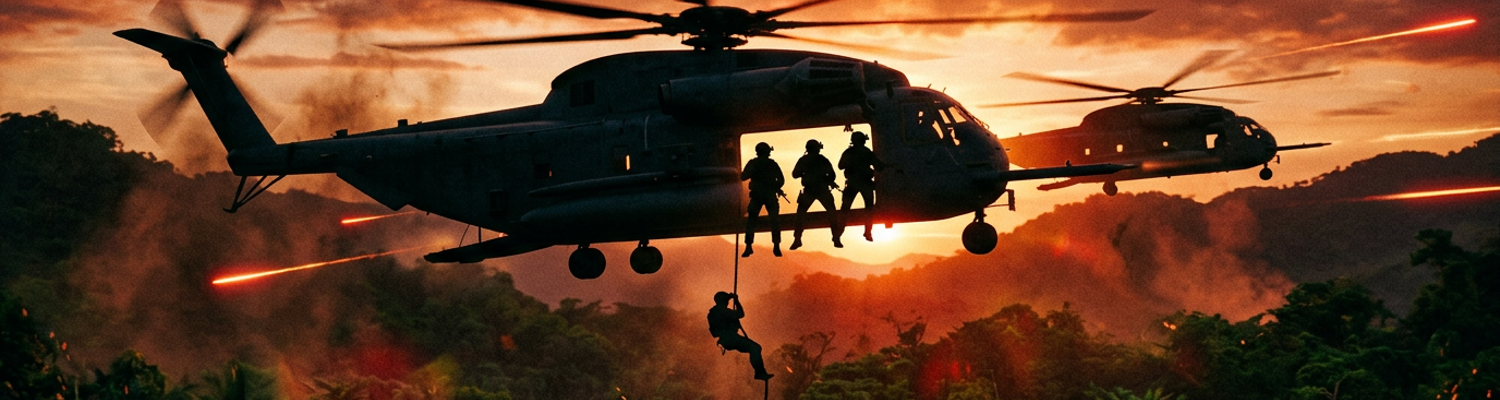
Paratroopers from the 1st Brigade, 101st Airborne Division slammed into the dirt as heavy machine gun fire erupted from the jungle perimeter around Landing Zone Gibraltar. Captain Robert Rawls and the soldiers of Company C had leaped from their transport helicopters into a dry clearing near the village of An Ninh, expecting a routine patrol against scattered guerrilla squads. Higher headquarters had launched Operation Gibraltar by committing elements of the 1st Brigade without preliminary artillery preparation into unknown enemy strength, deliberately choosing to forgo bombardment to preserve tactical surprise. This planning choice backfired within ninety seconds because the landing zone sat in the middle of a fortified base camp manned by hundreds of regular North Vietnamese and main-force Viet Cong fighters. Bullets tore through the rotor blades and engines of the departing UH-1 Hueys, disabling several aircraft and trapping the American infantrymen in an open clearing surrounded by high ground.
Helicopter wreckage burned in that clearing while the isolated infantrymen scrambled to build a circular defense against waves of attacking ground troops. These initial brigade-level operations in the Central Highlands exposed severe operational friction during unsupported company-sized combat insertions. Planners had assumed that high-speed air transport could drop isolated rifle companies into hostile territory to flush out opponents for larger follow-on units to destroy. The reality on the ground proved that dropping eighty-eight lightly equipped riflemen into dense terrain surrounded by a numerically superior enemy removed their ability to maneuver or retreat. Enemy gunners zeroed their heavy mortars directly onto the landing zone, hitting radio operators, severing platoon communications, and wounding dozens of soldiers within the first hour of combat.
Medics crawled between shallow drainage ditches to reach those bleeding paratroopers who expected immediate aerial rescue. Contemporary press coverage promoted early airmobile tactics as an invincible technological doctrine that guaranteed immediate extraction under all tactical conditions. Television broadcasts and national magazines had spent months telling the American public that the turbine-powered helicopter had transformed ground warfare into an automated system where air ambulances could evacuate injured soldiers from combat within minutes. Landing Zone Gibraltar exposed the errors behind those claims because standard medical evacuation helicopters could not penetrate the concentrated enemy automatic weapons fire raking the tree line. Pilots attempted to bring their Hueys down into the clearing, only to take multiple hits through their windscreens and fuel cells before they could touch the ground.
Pilots turned those damaged helicopters away from the valley, leaving the survivors of Company C to drag their dead and wounded into a small cluster of brush. Captain Rawls directed his men to scrape shallow fighting positions into the hard soil with short entrenching tools while enemy automatic weapons struck the dirt around them. Air Force fighter-bombers finally arrived overhead, dropping napalm and high-explosive bombs within thirty yards of the friendly perimeter to prevent the enemy from overrunning the position. Paratroopers spent the remaining daylight hours sharing ammunition magazines and packing field dressings onto open wounds while waiting for reinforcements to march overland. Colonel James Timothy and brigade leaders diverted elements of the 2nd Battalion of the 327th Infantry and the 1st Cavalry Division to relieve the pocket, but the relief columns struggled through thick underbrush and steep ravines until nightfall.
Tactical Insertion at Landing Zone An Ninh
Infantrymen marching through those dark ravines could not bridge the gap to save Company C, 2nd Battalion, 502nd Infantry, who had landed at LZ An Ninh on September 18, 1965, into an unusual valley silence before touch-down. Helicopter crews had approached the drop zone without the customary roar of preparatory artillery rounds or air strikes shaking the surrounding jungle canopy. Planners had deliberately withheld fire missions to achieve tactical surprise, betting that quiet approaches would catch local guerrilla fighters completely off guard. Paratroopers jumped out of the hovering Hueys into tall elephant grass, expecting a routine sweep against small, scattered squads as outlined in brigade intelligence briefings. Troops fanned out across the central opening while the transport helicopters lifted away, leaving eighty-eight soldiers alone in a bowl of terrain surrounded by densely wooded ridgelines. Squad leaders signaled their men forward toward the tree line, suspecting nothing because not a single enemy gunshot had disturbed their approach.
Riflemen from a reinforced battalion of the North Vietnamese Army 95th Regiment shattered that silence by initiating point-blank crossfire from prepared trench lines within minutes of insertion. Heavy machine guns and automatic rifles raked the clearing from camouflaged log bunkers that American aerial reconnaissance had completely failed to spot beneath the trees. Bullets cut down the point men instantly, forcing the surviving paratroopers to drop flat against the bare dirt as high-velocity rounds shredded vegetation around them. North Vietnamese gunners held interlocking fields of fire that crisscrossed every square yard of the open drop zone, pinning the American platoons where they lay. Captain Rawls shouted for his platoon leaders to return fire and fall back toward a central drainage depression, but enemy fire struck anyone who raised a helmet above the grass.
Mortar rounds dropped onto the paratroopers immediately after the machine guns opened up, sending heavy metal fragments slicing across the shallow depression. Initial enemy mortar fire destroyed forward AN/PRC-25 radio transceivers, severing forward tactical communications back to battalion command. Exploding shrapnel punctured the cast-aluminum radio housings, ruined internal frequency modules, and severed whip antennas right at their mounting bases. Radio operators scrambled to assemble spare components under intense fire, only to find the receiver casings cracked and the wiring harnesses completely useless. Company leaders lost the primary means to call for coordinated artillery support, request urgent troop reinforcements, or direct approaching air assets through their standard command net. Sergeants resorted to hand signals and crawling messengers to pass ammunition counts and casualty reports across the thirty-yard perimeter, keeping men organized under continuous fire.
Messengers crawled through dirt and blood to deliver remaining magazines to riflemen whose M16 rifles were overheating from constant firing. Paratroopers used their entrenching tools and bare hands to scrape small dirt mounds around their heads while enemy snipers fired from elevated tree stands along the valley rim. Helicopter gunships from an aerial escort section attempted to locate the fortified enemy positions, but the lack of ground radio contact forced the pilots to guess where the friendly lines ended. Forward air controllers finally made visual contact with smoke grenades thrown by the trapped troops, allowing jet fighters to drop ordnance within meters of the American foxholes. Paratroopers braced against the shockwaves of heavy bombs as the blast heat scorched their clothing and kept enemy assault waves from overrunning the clearing. Company C held their shrinking perimeter against successive infantry charges as daylight faded, enduring close-range combat without standard medical evacuation or battalion radio links.
Communications Collapse and Air Support
Paratroopers clinging to the shrinking defensive line discovered that continuous automatic weapons fire and mortar bursts had fractured Company C into isolated perimeter pockets, forcing squad leaders to rely on emergency runner relay networks. Men were cut off from their platoon headquarters by open ground swept by heavy machine guns, preventing verbal commands from carrying across the clearing. Squad leaders sent individual soldiers crawling through shallow irrigation ditches and tall grass to pass verbal orders, count surviving riflemen, and redistribute remaining rifle ammunition. Runners faced continuous fire from North Vietnamese marksmen positioned in elevated tree platforms, taking wounds while carrying magazines between the separated fighting holes. These improvised courier chains kept the separated groups informed of casualty counts and tactical moves, but the relays could not coordinate mutual fire support quickly enough to repel coordinated probes. Captain Rawls understood that without functional field radios to direct artillery, only immediate overhead air support could keep the separated pockets from being eliminated one by one.
Controllers flying O-1 Bird Dog observation aircraft dropped through the overcast sky to locate those isolated paratroopers beneath the heavy jungle cover. Forward air controllers struggled with low cloud ceilings and smoke obscurement while identifying friendly fighting positions. Low clouds hugged the ridgelines surrounding the valley, while thick smoke from burning underbrush, smoldering helicopter wreckage, and exploding mortar shells sat trapped beneath the cloud deck. Trapped paratroopers ignited violet and red smoke canisters to indicate their forward holes, but the gusting wind scattered the colored clouds across the entire clearing and mixed them into the gray battlefield haze. Controllers flew their small, unarmored spotter planes just above the tree canopy to draw enemy ground fire, looking directly for weapon flashes to map where the North Vietnamese assault lines met the American positions. These low-level passes gave the aerial controllers the visual references they needed to talk incoming strike flights onto the target area.
Pilots flying F-100 Super Sabre fighter-bombers descended through the cloud ceiling in steep diving runs to hit the enemy lines surrounding the American clearings. Forward air controllers directed the high-speed jets down narrow flight corridors, warning the pilots that friendly troops sat within meters of the target impact points. North Vietnamese assault units pushed directly past the outer perimeter brush, threatening to overrun the small pockets of paratroopers through sheer numbers. Controllers responded by having high-explosive ordnance and 20mm cannon runs directed inside friendly perimeter boundaries to halt massed infantry assaults. Paratroopers pressed their bodies into the bottom of their shallow trenches as 20mm cannon shells struck the dirt yards away, throwing hot soil, burning foliage, and metal fragments over their helmets. Concussive blasts from napalm canisters and heavy bombs scorched the vegetation inside the American lines and shattered the North Vietnamese assault waves, forcing the surviving attackers to break contact and pull back into the tree line.
Riflemen cleared dirt and debris from the firing mechanisms of their M16 rifles as the immediate roar of the jet passes faded into the valley. Squad leaders used the lull created by the air strikes to crawl between the surviving positions, checking the perimeter and pulling wounded men into the deeper central depression. Paratroopers collected loaded magazines and medical dressings from dead comrades, dividing the remaining ammunition evenly among the functional weapons. Radio operators continued trying to salvage working parts from shattered transceivers, hoping to establish contact with approaching relief columns from the 2nd Battalion. Soldiers kept their weapons trained on the darkened tree line, watching for fresh movement as the sun dropped behind the surrounding ridges.
Density Altitude and Helicopter Constraints
Paratroopers bleeding from shrapnel wounds inside that perimeter needed immediate medical evacuation, but the physical environment of the Central Highlands quickly crippled incoming rescue aircraft. Early UH-1B and UH-1D helicopters powered by Lycoming T53-L-11 turbine engines suffered critical shaft horsepower loss in high heat and mountain elevations. Ambient temperatures hovering near one hundred degrees Fahrenheit combined with the elevation of the valley floor to produce thin, low-density air that starved turbine compressors of necessary oxygen. Pilots watched their torque meters register sharp power drops while exhaust gas temperature gauges climbed toward redline limits during low-speed descents. These mechanical deficits eliminated the reserve power that aviators required to clear high trees or climb out of enemy fields of fire. Aircraft commanders had to dump reserve aviation fuel and strip secondary cabin equipment just to keep their skids from settling into the trees.
Helicopters stripped of extra weight still struggled against turbulent mountain air currents as they descended toward the isolated clearing. High density altitude combined with severe mountain downdrafts prevented fully loaded medical helicopters from sustaining stable hovers. Main rotor blades lost aerodynamic bite in the thin, overheated air, while sinking currents rolling down the ridges pushed descending aircraft toward the jungle floor. Flight crews attempting to pause above the canopy to locate colored smoke markers felt their collective pitch levers hit upper mechanical stops without producing enough lift. Hovering without the cushion of ground effect required significantly more shaft horsepower than the laboring engines could deliver with medical personnel and litter patients aboard. Pilots repeatedly pulled their cyclic sticks back to break off approaches and build forward airspeed before their skids struck the canopy.
Aviators returning for second attempts found that dropping their forward airspeed brought on an even more dangerous aerodynamic emergency near the ground. Aviation crews faced severe tail-rotor control loss while attempting stationary hovering over hot extraction points in restricted valley clearings. The thin mountain atmosphere degraded the thrust produced by the tail rotor blades, leaving pilots unable to counter the massive torque reaction generated by the main rotor under high power settings. Antitorque pedals pushed flat against cockpit floorboards failed to stop the helicopters from spinning uncontrollably to the right whenever pilots pulled maximum collective pitch. Spinning aircraft threatened to clip tail booms against tall bamboo stands and hardwood trees, forcing pilots to dive down narrow exit gaps between ridges to regain directional control.
Medics kneeling in the dirt realized that rapid helicopter extractions would not materialize while the enemy swept the clearing with fire and the mountain atmosphere choked the transport engines. Ground troops had entered combat expecting that early airmobile doctrine guaranteed prompt evacuation for serious casualties, but the mechanical limitations of early turbine helicopters in tropical highlands shattered that expectation. Platoon sergeants hoisted wounded men onto rubberized ponchos and dragged them into deep drainage cuts to shield them from mortar fragments and machine-gun fire. Paratroopers shared their remaining field dressings, tied tourniquets from rifle slings, and sealed sucking chest wounds with plastic ration wrappers as darkness settled over Landing Zone An Ninh. Helicopter formations withdrew to forward staging bases at Qui Nhon and An Khe to refuel and wait for cooler morning air temperatures, leaving the isolated paratroopers to defend their perimeter with rifles and air support through the night.
Extraction Challenges and Mountain Downdrafts
Paratroopers emerged from their fighting holes at dawn as unarmed medical crews from the 54th Medical Detachment flew repeated approaches into concentrated small-arms and heavy machine gun fire. North Vietnamese gunners had established interlocking fields of fire around Landing Zone An Ninh, training heavy anti-aircraft machine guns directly on the narrow approach paths between the ridgelines. Descending Hueys hit powerful mountain downdrafts that rolled down the slopes, dropping the unarmored utility helicopters toward the tree canopy at high sink rates. Aviators wrestled their cyclic controls to keep the aircraft level while automatic weapons fire punched through the sheet metal fuselage and shattered cockpit windscreens. Sinking air currents combined with intense gunfire to turn every landing attempt into an extreme aerodynamic struggle. Metal fragments and rifle bullets tore through the airframes as the rescue helicopters flared over the tall brush and settled onto the contested ground.
Flight medics dashed through the swirling dust toward the tree line to collect the wounded who had survived the long night under mortar bombardment. Medics manually loaded multiple blast casualties while pilots operated at engine redline thresholds to prevent catastrophic settling with power. Sinking downdrafts and thin mountain air created turbulent vortices that threatened to swallow the rotor system if power dropped even slightly. Aviators pulled maximum collective pitch, watching their exhaust gas temperature gauges hover at the absolute limit to keep the helicopters from plunging violently into the dirt. Litter bearers hoisted paratroopers with severed limbs and deep shrapnel lacerations through the open cargo doors under continuous sniper fire. Enemy rounds struck the engine compartments and ruptured fuel bladders during the frantic loading process, stripping the overloaded aircraft of the performance needed for a standard vertical ascent.
Helicopters sustaining heavy airframe hits were forced into running takeoffs along sloping terrain to generate forward lift. Pilots could not hover out of the clearing because the thin air and battle damage robbed the Lycoming turbine engines of necessary lifting thrust. Aviators pushed their cyclic sticks forward, dragging the metal skids across the rough, downward-sloping hillside to gain forward ground speed. Bumping over boulders, tree stumps, and flattened elephant grass forced fresh air through the rotor blades, creating aerodynamic lift that gradually lifted the laboring machines into the sky. Enemy automatic weapons sprayed the undersides of the skids and pierced the cabin floors as the helicopters skimmed only inches above the jungle floor. Turbine engines screamed at maximum limits as the aircraft bounced off the downhill slope and cleared the surrounding perimeter trees by narrow margins.
Crew chiefs worked desperately inside the vibrating cabins to keep severed arteries clamped and chest wounds sealed during the low-level dash down the valley corridor. Leaking transmission fluid and aviation kerosene sprayed along the outside of the fuselages while the pilots maintained shallow dives to keep airspeed above the stall point. Sinking air currents over the outer ridgelines continued to buffet the wounded Hueys until the aircraft finally crossed into open, lower-elevation airspace toward coastal staging areas. Forward airfields at Qui Nhon received the battered helicopters on emergency pads, where ground surgeons immediately rushed patients into surgical tents. Maintenance teams at the staging airfields immediately began patching bullet holes and replacing damaged rotor components so relief flights could return to the trapped company.
Forward Field Clearing Operations
Transports returning from those relief flights at Landing Zone An Ninh brought shattered soldiers straight to the rear, where casualties were evacuated to forward clearing stations and the 2nd Surgical Hospital operating in the vicinity of the 1st Cavalry Division base at An Khe. Litter bearers rushed from the perimeter landing pads through swirling red dust, carrying blood-soaked stretchers into canvas treatment tents supported by wooden center poles. Medical officers cut through stiffened fatigues and shredded combat boots with heavy shears to expose massive wound tracks before shock could claim the dying men. Influxes of wounded quickly filled every available cot and folding litter, forcing triage teams to lay casualties directly on rubber ground sheets across the hard-packed dirt. Doctors sorted each arriving soldier into priority categories, directing those with failing pulses and massive hemorrhages directly onto unpainted wooden operating tables under bare incandescent bulbs.
Doctors and surgical personnel managed severe polytrauma caused by Chinese Communist stick grenades, 82mm mortar fragmentation, and close-range rifle fire on those wooden tables. Cast-iron fragmentation from Chinese stick grenades and 82mm mortar rounds had torn through muscle, punctured lungs, and embedded hundreds of jagged metal splinters across exposed torsos. High-velocity slugs from enemy rifles had snapped major limb bones and shredded deep femoral vessels, producing catastrophic tissue loss that standard field dressings could not control. Surgeons probed deep inside open cavities with metal forceps, clamping bleeding arteries and removing contaminated clothing scraps that threatened rapid gangrene in the humid tropical air. Operating teams worked over multiple tables simultaneously, pausing only to change punctured latex gloves and wipe sweat from their foreheads with sterile towels.
Corpsmen and forward aid teams faced acute whole-blood logistical strain while stabilizing arterial wounds under austere field tent conditions. Insulated transport coolers containing refrigerated units of whole blood emptied rapidly because patients with severed arteries required four to six pints each to restore falling blood pressure. Medical staff suspended glass blood bottles and saline flasks from wire hooks bent over tent framing, manually pumping rubber squeeze bulbs to force life-saving volume into collapsed veins. Supply officers radioed desperate emergency requisitions across static-filled tactical channels to coastal depots at Qui Nhon, demanding immediate air shipments of Type O blood packs before reserves vanished entirely. Technicians supplemented dwindling blood stocks by collecting fresh donations directly from headquarters clerks and lightly wounded paratroopers who stood in line outside the surgical flaps.
Orderlies carried stabilized paratroopers from the operating tables into adjoining recovery tents, placing litters along wooden duckboards laid across the mud. Ward nurses tracked vital signs, secured drainage tubes, and checked arterial pressure dressings under the flickering illumination of fuel-powered lanterns. Surgical teams immediately scrubbed their hands in basins of chlorinated water, sterilized instruments in steam autoclaves, and prepared their stations for the next flight of incoming casualties. Evacuation coordinators directed the most critical postoperative survivors onto waiting Air Force C-130 transports at the An Khe airfield for urgent transfer to the 85th Evacuation Hospital at Qui Nhon. Transport planes taxied into the gathering dusk and climbed toward coastal airfields, carrying the wounded away from the Central Highlands as fresh artillery concussions rumbled along the mountain horizon.
Blast Trauma and Combat Exhaustion
Litter bearers met those transport planes on the tarmac at Qui Nhon, rushing stretchers into brightly lit evaluation tents where doctors uncovered widespread psychological collapse alongside catastrophic physical wounds. Paratroopers dragged from Landing Zone An Ninh arrived with blood encrusted across their uniforms, yet many of the most severely incapacitated soldiers had not been struck by bullets or shrapnel. Continuous perimeter fighting under danger-close friendly ordnance and hand-to-hand combat caused acute psychological shock among surviving paratroopers. North Vietnamese infantry had repeatedly charged into American foxholes with bayonets and short-fused stick grenades, forcing riflemen into desperate, point-blank struggles in the dark while Air Force jets dropped high-explosive ordnance barely thirty yards from their positions. Soldiers who lived through these nonstop explosions and close-range clashes sat mutely on canvas cots, staring vacantly into space and shivering uncontrollably while orderlies cut away their muddy boots. Triage physicians moved from man to man, peeling back eyelids to inspect dilated pupils and checking unresponsive troops for hidden concussive injuries.
Surgeons examining these disoriented soldiers discovered that blast overpressure from close-range bomb detonations had caused extensive internal trauma without leaving external shrapnel wounds. Ruptured eardrums, middle-ear bleeding, and concussive brain bruising were common among riflemen who had huddled at the bottom of dirt scrapes while heavy bombs rocked the clearing. Shock waves moving through the ground and air had compressed internal organs, producing pulmonary contusions and internal bleeding that left men spitting blood and gasping for air in their cots. This severe physical concussive damage reinforced their psychological collapse, leaving soldiers unable to process verbal commands, maintain physical balance, or recognize their own squad leaders. Medical staff placed these combined blast and shock victims into quiet corners of the receiving tents, administering intravenous saline to stabilize their erratic blood pressure.
Clerks working beside those treatment cots recorded each arriving soldier in bound administrative registers, ensuring that mental and concussive casualties were treated as legitimate battlefield losses rather than disciplinary infractions. Division medical logs classified combat stress reactions within forward surgical intake tallies rather than excluding them from operational loss reports. Declassified September 1965 casualty rosters documented medical admissions for acute combat exhaustion neurosis alongside gross blast injuries. Entries in these official division registers listed paratroopers crippled by severe combat neurosis directly next to men with compound limb fractures, traumatic amputations, and sucking chest wounds. This formal accounting dismantled the emerging promotional legend that early airmobile operations were bloodless technological triumphs where soldiers were immune to the psychological devastation of prolonged, close-quarters combat. Staff officers compiled these intake ledgers into nightly command briefings, forcing brigade leaders to confront the true human attrition suffered by Company C at Landing Zone An Ninh.
Orderlies carried these casualty tallies directly to forward ward supervisors, who had to create immediate treatment protocols for men overwhelmed by combat exhaustion. Physicians administered heavy doses of sedatives to calm agitated soldiers who shouted warnings and threw themselves from their litters whenever artillery batteries fired in the distance. Nurses established darkened recovery rows under canvas awnings away from the noise of helicopter flight lines, forcing exhausted paratroopers into deep, drug-induced sleep for thirty-six to forty-eight hours. Corpsmen monitored their breathing, replaced sweat-soaked bedsheets, and spoon-fed warm broth to recovering men as the sedative medications gradually wore off. Evacuation coordinators routed the soldiers who remained catatonic or unstable onto rearward transport planes bound for specialized psychiatric wards at naval hospitals in Subic Bay and Clark Air Base.
Aviation Adjustments and Doctrinal Reassessments
Staff officers at An Khe tracked the departure of those transport planes and immediately convened formal operational debriefs with surviving company leaders. Infantry commanders acknowledged that inserting troops into an unreconnoitered valley without preliminary fire support had backfired disastrously against an entrenched enemy regiment. Official after-action reviews of LZ An Ninh mandated dedicated armed helicopter gunship escorts and organic pre-assault fire preparation for all subsequent insertions across the Central Highlands. Planners established rigid tactical requirements that no utility troop transports could enter contested landing zones without preparatory artillery barrages or tactical airstrikes suppressing potential ambush positions in the perimeter tree line. Division directives also prohibited unescorted insertions, requiring armed UH-1B gunships to orbit directly overhead and sweep peripheral foliage with rockets and machine guns throughout every landing sequence. Artillery liaison officers were integrated directly into lead flight elements to guarantee that pre-assault barrages lifted only seconds before troop skids made physical contact with the landing surface.
Maintenance technicians at Qui Nhon inspected the bullet-riddled airframes returning from those approach corridors, documenting how extreme heat and high density altitude had nearly doomed every hovering aircraft. Flight commanders submitted detailed technical reports showing that the standard shaft horsepower produced by existing Lycoming T53-L-11 turbines left pilots without sufficient power reserves to hover out of ground effect or climb away from enemy machine gun nests. Operational power deficits demonstrated at Gibraltar accelerated the Army field integration of higher-output T53-L-13 turbine engines for Central Highlands operations. Aviation procurement officials pushed defense manufacturers to rush these upgraded engines straight from production lines to frontline airmobile units. Mechanics installed the more powerful turbines into incoming UH-1D transports and newly designated UH-1H models, giving aviators the critical power margin required to overcome mountain downdrafts. This mechanical enhancement restored essential lift margins and tail-rotor control during hot-and-high mountain extractions, allowing fully loaded medical rescue aircraft to lift clear of contested jungle clearings.
Press officers at Military Assistance Command, Vietnam, overlooked these mechanical failures and rushed triumphal combat bulletins to American newspaper correspondents. Military spokesmen in Saigon highlighted the body count of over two hundred enemy dead, presenting the engagement as a decisive validation of early airmobile doctrine in the Central Highlands. Public depictions of the engagement as an unqualified tactical victory obscured the severe airmobile and evacuation vulnerabilities uncovered during the battle. Commercial news reports praised the speed and flexibility of helicopter warfare while leaving out the collapse of tactical communications, the isolation of Company C, and the hours wounded soldiers spent bleeding without medical evacuation. Combat veterans recognized that only danger-close Air Force airstrikes had prevented the company from being overrun in their shallow foxholes. Flight leaders, ground commanders, and aviation mechanics bypassed the public relations narrative and focused instead on updating tactical field manuals, integrating heavy gunship escorts, and fitting high-output engines to survive the brutal mountain warfare ahead.