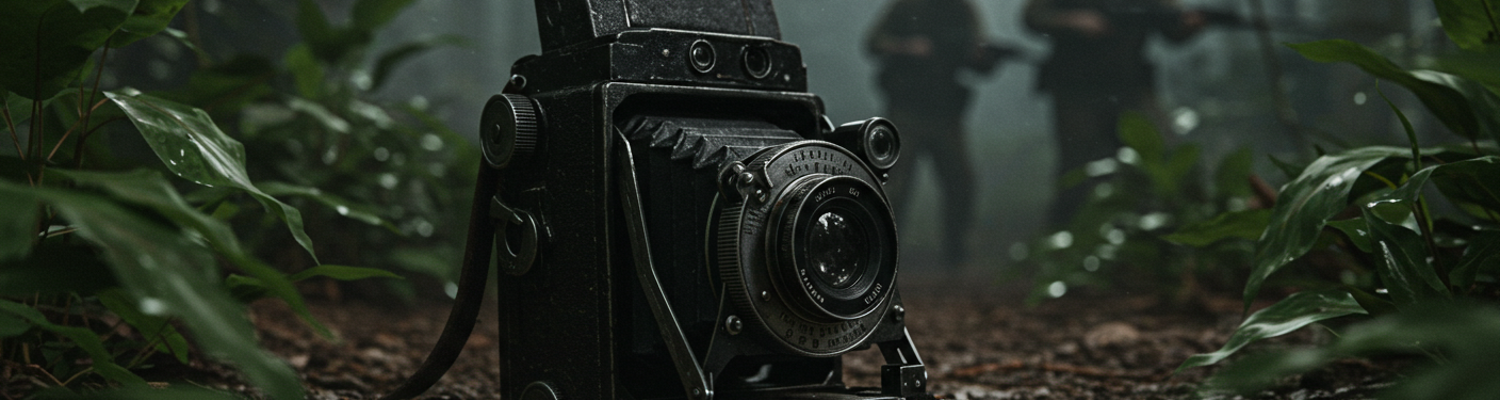

M/Sgt. Finch’s Final Exposures
Operational logs from the 51st Signal Battalion’s recovery detachment confirm the discovery in late August 1940. Amid the burned-out timbers and shattered vacuum tubes of the covert listening post designated Orinoco-Alpha, a corporal located the remains of a 4x5 Speed Graphic camera. The device was catastrophically damaged. Its bellows were shredded and the metal frame bent from the force of a high-explosive blast that had collapsed the dugout’s primary support beam. Archival evidence (NARA Record Group 111-SC) shows the attached Graflex Optar f/4.7 lens was shattered, its housing mangled beyond repair. The camera was found partially shielded inside a waterlogged leather satchel. This detail proved significant.
While the camera itself was a total loss, the Graflex film pack adapter on its rear was dented but structurally intact. It protected the twelve sheets of Kodak Super-XX Panchromatic film within from the initial blast and subsequent fire. This single piece of salvaged equipment, the personal issue of Master Sergeant Alistair Finch, represented the only surviving visual record from the forward observation position.
Station Orinoco-Alpha was not a simple signals intelligence outpost. It was a critical node for Operation Condor. Its position on a narrow, mist-shrouded ridgeline gave it a commanding view of the river valley below, a key transit corridor on the Venezuelan-Colombian frontier. M/Sgt. Finch was not part of the listening team. His deployment was a last-minute addition, tasked with providing photographic verification of what was expected to be minimal troop movement. The primary force of Operation Condor, a small battalion-sized element of specialized advisors and allied local troops, was scheduled to advance through that valley. They assumed they would face only scattered, disorganized resistance. Finch’s camera was a tool for documentation, a way to record a successful advance. Instead, the final images captured on his film sheets served as the operation’s autopsy, developed a week after the main force had already walked into a prepared kill zone.
The development process was a tense affair, conducted in a makeshift darkroom at a rear-echelon base. Of the twelve film sheets in the pack, the first eight were unexposed. The ninth was a blurry, overexposed shot of the jungle canopy, likely Finch testing the lighting. The final three sheets, however, provided a chilling, sequential narrative.
Exposure ten depicted a massive column of men emerging from the pre-dawn fog. The sheer density of the force was apparent even in the low light, a concentration of manpower far exceeding any intelligence estimate. The next photograph, number eleven, was a closer, slightly out-of-focus shot that revealed the nature of their arms. While many carried bolt-action rifles and machetes, a significant number were seen hauling heavier equipment. Analysts later identified these as German-made MG 34 machine guns and several light mortars. The final exposure on the last sheet of film was a hurried, tilted frame. It showed a group of men wrestling a 7.5 cm Feldkanone 18 cannon into a firing position on the opposing ridge. Its barrel was aimed directly down into the valley where the main American-led element was advancing.
Anatomy of an Ambush Force
A close review of the three developed film sheets provides a granular picture of the opposing force. Photo-intelligence analysts at the rear-echelon base noted the high grain and slight motion blur. This indicated a slow shutter speed was used in the extremely low light just as dawn broke. The first clear image, Frame 10, was taken with a standard lens, capturing the broad scope of the enemy column. Initial counts, cross-referenced with shadow analysis to estimate density, placed the visible manpower in excess of two thousand men. This figure dwarfed the pre-operation intelligence estimate of a few hundred hostiles.
Frame 11, likely shot after a frantic lens change, offered a chilling clarification. Analysts identified multiple German-made MG 34 machine guns, recognizable by their distinctive perforated barrel housings and side-mounted charging handles. These were not weapons of a peasant militia. They were modern, air-cooled, belt-fed general-purpose machine guns capable of firing up to 900 rounds per minute. The final shot, Frame 12, confirmed the gravest threat. Tilted and poorly composed, it nevertheless clearly showed a crew manhandling the 7.5 cm FK 18 cannon into a firing position. Its split-trail carriage was visible, a design feature allowing for a wide traverse, making it useful in an anti-personnel or anti-structure role.
The photographic evidence confirmed a tactical nightmare. A small, professional cadre equipped with modern European weaponry was embedded within a much larger, more crudely armed local force. The machine gunners and artillery crews appeared to operate with practiced efficiency. The mass of infantry surrounding them carried a motley collection of bolt-action rifles, shotguns, and machetes. This composite structure gave the attackers a dual advantage. The professional core provided the sophisticated firepower necessary to fix and suppress the American-led element. Meanwhile, the massive body of irregulars provided the numbers needed for an overwhelming assault, capable of absorbing high casualties while flanking and enveloping a smaller, pinned-down enemy. This was a deliberately constructed military instrument designed to leverage both modern firepower and raw manpower.
The Orinoco basin is notorious for its thick, pre-dawn fog. The attackers exploited this meteorological phenomenon with lethal precision. The dense, wet air muffled sound, allowing a force of several thousand men and their heavy equipment to move into assault positions along the river valley and its flanking ridges completely undetected. Visibility was likely limited to less than twenty yards in some areas. This environmental factor negated the primary advantage of M/Sgt. Finch’s observation post. Its high-ground view was useless. By the time the fog began to lift and Finch could capture his first images, the MG 34 teams were already in their final firing positions and the FK 18 cannon was being aimed down into the valley. The fog allowed the attackers to dictate the terms of the engagement, transforming the valley from a simple transit corridor into a perfectly prepared kill zone.
The Silence of Station Orinoco-Alpha
A forensic review of the recovered signal logs details a catastrophic failure in communication. The station’s primary long-range communication asset was the SCR-193 radio set, a system comprising the BC-191 transmitter and BC-312 receiver. This vehicle-designed radio was ill-suited to the extreme humidity and persistent dampness of the Orinoco river basin. Log entries from the week leading up to the attack show a frantic, escalating battle by the operators against their own equipment. The initial entries note sporadic signal fade and heavy static on the receiver, particularly during attempts to monitor high-frequency Axis propaganda broadcasts originating from German-aligned networks in Argentina and Brazil. Intelligence believed these transmissions contained coded directives for regional assets. The Orinoco-Alpha operators were tasked with intercepting and relaying these specific broadcasts for rear-echelon analysis.
By the third day before the final incident, the log notations become terse. Reception was described as an unreadable wash of static. The operators correctly diagnosed the primary issue as failing vacuum tubes within the BC-312 receiver, which used nine tubes for its superheterodyne circuit. The extreme ambient moisture caused internal arcing and component degradation, a known issue in tropical environments. Their attempts to relay even partial intercepts were reduced to faint, static-plagued transmissions that were themselves barely readable by the rear. A feedback loop of communication decay was in full effect.
The slow death of the SCR-193 was the culmination of a week of documented logistical neglect. Archival evidence shows seven consecutive days of formal resupply requests transmitted from Orinoco-Alpha, each logged with meticulous time-stamps. The initial requests were standard. Fuel for the BD-77 dynamotor that powered the transmitter. Replacement antenna wire to repair sections damaged in a tropical storm. By the fourth day, the requests grew specific and urgent. The operators pleaded for a crate of organizational spare parts, explicitly citing the need for replacement receiver vacuum tubes and a spare tuning capacitor. They even specified the required transmitter tubes, indicating they feared a cascade failure that would render their BC-191 transmitter useless. These requests were transmitted via a secondary, low-power Morse code transmitter. This was a clear sign that the main radio’s voice transmission capability was already compromised. Each request went unanswered. No acknowledgment was ever logged by the crew at Orinoco-Alpha.
In the final twelve hours, the communication link was severed completely. The primary SCR-193 set fell silent. The logbook’s final entry, scrawled in hasty pencil, reads:
SCR-193 NO RCV. SWITCH TO BACKUP.The backup was wholly inadequate, likely a man-portable set with a range of only a few miles in the dense, signal-swallowing jungle. The rear-echelon listening post, designated Condor-Base, recorded its own version of the events. At 04:30 local time, Condor-Base logged a faint, unreadable signal on Orinoco-Alpha’s frequency. It was a desperate, indecipherable burst of Morse code lasting less than twenty seconds. Another attempt was noted at 04:55, described in the log as unworkable static. After that, only silence. This final, failed attempt to warn of the impending attack occurred at the exact time M/Sgt. Finch was exposing his first images of the enemy force assembling in the fog below.
The Serpent's Spine
The entire logistical plan for sustaining Station Orinoco-Alpha rested upon a flotilla of repurposed local watercraft. A review of the operation’s logistical annex reveals the makeshift nature of this arrangement. The 7th Engineer Battalion’s riverine detachment was not issued purpose-built military patrol boats. Instead, they were ordered to procure and motorize three heavy-keeled dugout canoes, known locally as bongos. These vessels were inherently unsuitable for the task. Lacking maneuverability, they were fitted with American-made Johnson Sea-Horse K-50 outboard motors. These 5-horsepower units were notoriously unreliable and difficult to service in the field. Maintenance logs from the battalion (File Ref: 7-ENG-RIV-40.8) show a consistent struggle with the poor quality of locally sourced fuel, which was often contaminated with water and debris, leading to fouled carburetors and clogged fuel lines. The primary cargo for the final, failed resupply run was a set of replacement vacuum tubes and a tuning capacitor for the failing SCR-193 radio, packed in a wooden crate.
The mission unraveled almost immediately. Less than two hours after departing the rear-echelon base at Puerto Ayacucho, an unseasonal tropical squall descended on the river basin. The Orinoco tributary transformed into a raging torrent. After-action reports compiled from the debriefing of the single surviving boat crew describe the river level rising over six feet in under an hour. The current, now thick with dislodged trees and vegetation, increased to a speed that nearly overpowered the small Johnson outboards. One boat, designated Bongo-2, had its propeller shear pin snap after striking a submerged log, leaving it powerless. The crew was forced to cut it loose to prevent it from dragging the other boats downriver. It was last seen spinning uncontrollably in the current, the critical radio parts still lashed to its deck.
This environmental disaster was compounded by a geopolitical one. The most direct and navigable route to Orinoco-Alpha’s position lay through a deep channel that hugged the Colombian bank of the river. Diplomatic traffic from the preceding months indicates a sharp escalation in a long-simmering border dispute over a small, uninhabited river island designated by both nations as Isla Perdida. According to operational directives issued to the American advisory command, Colombian riverine patrols had orders to interdict any unauthorized foreign military vessels in this contested sector. The American convoy, already crippled and battling the flood, was therefore forced to divert. They entered a treacherous, rock-strewn channel on the Venezuelan side known to local guides as the ‘Serpent’s Spine.’ It was a channel no sane boatman would attempt during a flood. While navigating the violent rapids, the lead boat, Bongo-1, struck a rock outcropping hidden just beneath the churning surface, punching a hole in its wooden hull. With one boat lost and the other taking on water, the mission commander aborted the operation. The replacement vacuum tubes, the last hope for the radio operators at Orinoco-Alpha, were lost to the river.
The Smuggler's Cove Trap
The selection of Station Orinoco-Alpha’s physical location was a study in tactical contradiction. A review of the initial site-selection survey, attached as an annex to the Operation Condor planning documents, identifies the position by its local name: Caleta de Contrabandistas. Smuggler’s Cove. The name was literal. For decades, the small, muddy inlet had been a clandestine transfer point for illicit goods moving between Venezuela and Colombia. Its primary advantage was its extreme obscurity. The cove was situated in a low-lying geographic bowl, invisible from the main river channel and accessible only by a single, narrow tributary choked with mangroves. Sheer rock faces, rising over 300 feet, formed the rear and side walls of the basin. The forward approach was a near-impenetrable curtain of jungle. This natural concealment, so valuable for smugglers, created an inescapable logistical trap. Every single piece of equipment, every ration, every man, had to be brought in through that single, treacherous waterway. The same route would be required for any potential evacuation.
An examination of post-operational meteorological and topographical data reveals the full extent of the environmental hazards. The basin acted as a natural funnel for water runoff from the surrounding highlands. The jungle floor, a thick layer of decomposing organic matter over saturated clay, was incapable of absorbing the heavy precipitation common to the region. Flash floods were a certainty. Logbook fragments recovered from the site mention the primary camp area being inundated with more than a foot of water on three separate occasions in the week before the final attack. This constant dampness had a ruinous effect on equipment. Weapon mechanisms rusted. Ammunition suffered from moisture contamination. The field dressings in the medical kits were rendered useless by mildew. The ground itself offered no stability. Tent poles and antenna masts had to be sunk into deep, mud-filled holes and constantly readjusted as the ground shifted beneath them.
This complete isolation from any viable land-based route sealed the station’s fate. Topographical analysis confirmed that the sheer cliffs and dense, unmapped jungle surrounding the cove were impassable for a military unit, especially one carrying wounded. The operational plan contained no contingency for a land-based exfiltration. The planners assumed any withdrawal would be a controlled, orderly affair conducted via the same riverine route used for insertion. There was no Plan B. This turned the cove’s tactical concealment into a strategic vulnerability. The single entry and exit point, the narrow tributary, became a fatal chokepoint. Once the enemy force established control of the main river, a task accomplished with the positioning of the MG 34 machine guns on the flanking ridges, Station Orinoco-Alpha was completely cut off. The same terrain that hid the listening post from casual observation also imprisoned it. The operators inside were left with no path for retreat and no hope of reinforcement.
The War Against the Green
A close review of the 7th Engineer Battalion’s post-operational assessments reveals that the detachment at Orinoco-Alpha was engaged in a losing war against the environment from the moment they arrived. The jungle did not just surround the position; it actively attacked it. Engineering logs document a Sisyphean struggle. Three-man teams were assigned to 12-hour rotations for the sole purpose of re-clearing the same 50-yard perimeter. The rate of vegetative growth was so extreme that fast-growing vines and broadleaf plants could reduce a freshly cleared firing lane to an impassable wall of green in less than 48 hours. This constant labor with machetes and hand saws was physically draining in the oppressive heat and humidity.
The dampness was a chemical and biological agent of decay. A recovered maintenance report details the failure of the dugout’s primary support beams, which were not pressure-treated and became riddled with fungus and termites, threatening structural collapse. Metal components fared no better. The constant moisture, combined with acidic leaf litter, caused rapid corrosion on everything from barbed wire coils to the bolts on machine gun tripod mounts, freezing them in place. The engineers were not building a fortification; they were merely managing its decay.
The loss of the BD-77 dynamotor plunged the station into a primal darkness. The triple-canopy jungle of the Orinoco basin is so dense that it extinguishes nearly all ambient light. On moonless, overcast nights, visibility was officially logged as zero. Sentries reported being unable to see their own hands in front of their faces. This was a complete nullification of the sense of sight, forcing a total reliance on hearing. It created a severe psychological strain. The jungle was never silent. The constant cacophony of insects, nocturnal animals, and dripping water created an auditory fog that could mask the sound of an approaching man just a few feet away. After-action debriefings from the few survivors of similar outposts in the campaign speak of a creeping paranoia, where every snapped twig or unusual animal call could signal an imminent attack. The men were left isolated in small pockets of impenetrable blackness, their rifles pointed at shadows that were indistinguishable from the enemy.
This combination of rampant growth and absolute darkness rendered conventional defensive doctrine useless. The core principle of interlocking fields of fire from mutually supporting machine gun positions was impossible to implement. A gun pit cleared in the morning would have its line of sight obstructed by new growth before nightfall. The inability to use artificial illumination meant that defensive fire would be entirely blind. Barbed wire entanglements, meant to slow and channel attackers into prepared kill zones, were quickly swallowed by vegetation, their locations becoming as much a mystery to the defenders as to the enemy. The saturated clay and mud offered no purchase for sandbags or trench walls, which would slump and collapse during the frequent torrential downpours. Tactical awareness was reduced to what a single soldier could hear within a few yards of his foxhole. The station was not a cohesive defensive position but a collection of isolated, blind, and vulnerable listening posts, each one waiting to be silently enveloped by the jungle and the enemy it concealed.