
The Romanticism of the Airfield
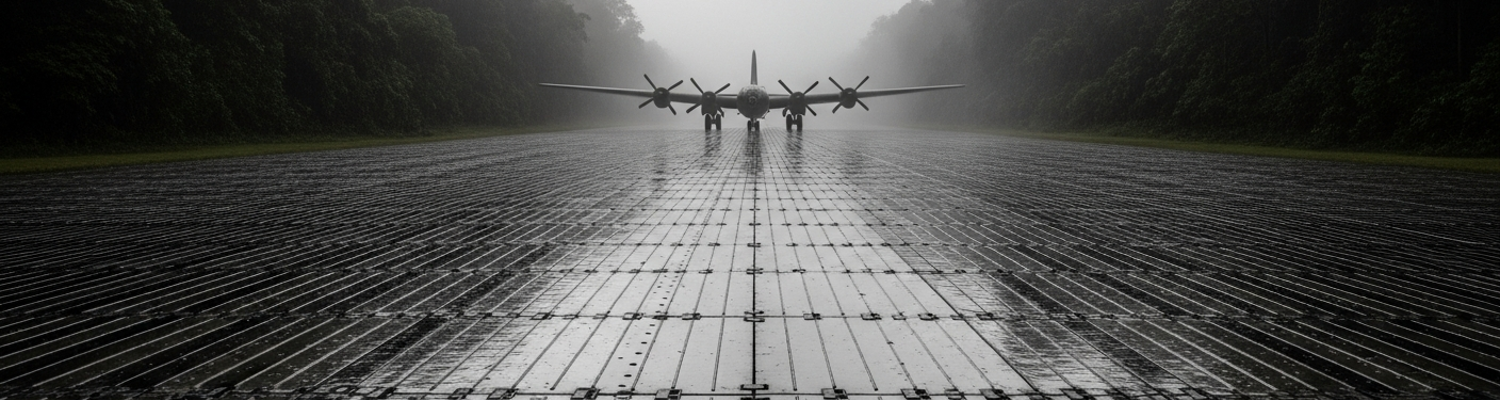
A garbled transmission cuts through the static. The pilot’s voice is tight with mechanical concern, not combat. He is not reporting enemy fighters but a failing hydraulic system, damaged over Morotai. His B-24 Liberator is crippled. The improvised runway below offers the only chance of survival.
This incident, one of thousands, stands in direct opposition to the popular memory of the Pacific War. Post-war newsreels cultivated an image of forward air bases as miniature American towns, dropped fully formed onto idyllic tropical islands. They depicted long, paved runways, orderly lines of gleaming aircraft, and permanent, well-stocked facilities. This narrative projected an image of overwhelming industrial might and engineering dominance that made victory seem inevitable. American ingenuity could instantly tame any jungle and establish a flawless operational hub.
Archival evidence from the first landings paints a different picture. When the 1st Marine Division stormed Guadalcanal on August 7, 1942, they did not capture a finished airfield. They seized a 2,600-foot-long scar of mud and gravel hacked out of a coconut grove by Japanese and Korean laborers.
Renamed Henderson Field, it became the nexus of the entire campaign. Initial conditions were appalling. The runway was unfinished, unpaved, and undrained, turning into a quagmire with every tropical downpour. More aircraft were lost in the chaotic sludge than in direct combat during the early weeks. The men of the Cactus Air Force, a mixed group of Marine, Navy, and Army pilots, lived in mud-floored tents, perpetually damp and plagued by malaria. There were no hangars, no proper repair sheds, and no bomb hoists. Ammunition was loaded by hand. Fuel was laboriously transferred from drums. Maintenance was a nightmare of cannibalization, with damaged planes systematically stripped to keep a handful of others flyable. The arrival of the 6th Naval Construction Battalion (Seabees) on September 1, 1942, marked a turning point, but their work was a constant battle against the elements and the enemy. Using captured Japanese equipment, they fought to keep the field operational under nearly daily bombing raids and nightly naval bombardments. On the night of October 13-14, the Japanese battleships Kongō and Haruna fired nearly a thousand 14-inch shells into the perimeter, destroying 48 of 90 aircraft, burning most of the aviation fuel, and cratering the runways. Within hours, Seabees were filling the holes, and patched-together aircraft were taking off again.
The experience at Henderson Field was the template. Across the Pacific, the creation of airfields was a grueling and often primitive affair conducted by Naval Construction Battalions and Army Aviation Engineer Battalions. On islands like Peleliu, the challenge was coral. The 1st Marine Division seized the Japanese airstrip on the second day of the battle in September 1944, but the Seabees moved in while Japanese defenders still held the overlooking coral ridges, subjecting construction crews to constant fire. On Iwo Jima, engineers landed just hours after the first assault waves and began repairing the main runway while under direct mortar fire. Their primary tool was often the Marston Mat, a perforated steel plank that could be interlocked to create a semi-stable surface. Each 10-foot plank weighed about 70 pounds and had to be laid by hand. A 3,000-foot runway could take 100 men nearly 100 hours to complete. These mats were a brilliant improvisation, but on soft ground, heavy bombers could cause them to ride up in waves.
Ad-Hoc Base Acquisition
Operational logs from the Pacific theater show island selection was governed by one factor: aircraft range. Planners in Washington D.C. identified coordinates on a map (NARA Record Group 218) that would serve as the next step toward Japan. An island was not chosen for its favorable terrain. It was designated a target because it occupied a critical geographic coordinate. This process created near-insolvable engineering problems on the ground. The entire strategy for the final air assault on the Japanese home islands depended on securing the Mariana Islands of Saipan, Tinian, and Guam for the B-29 Superfortress fleet. Planners knew these islands were necessary but possessed little detailed information about their suitability for supporting the massive airfields required. The directive was simple: take the island, then build the airbase. Any geological difficulties were problems for the Army Aviation Engineer Battalions and Navy Seabees to solve under fire.
There was no time for geological reconnaissance.
The first ground survey of a potential airfield site was often conducted by assault infantry. Pre-invasion intelligence, typically limited to aerial photography, could identify general topography but offered no insight into subsurface conditions. It could not reveal the load-bearing capacity of the soil or the presence of underground water tables. Archival evidence from the 6th Naval Construction Battalion shows that upon landing, engineering officers would frantically conduct soil borings with hand augers, often while still under enemy fire, to make a desperate initial assessment. The results were frequently disastrous. On one atoll, what appeared to be a flat plain on aerial photos was discovered to be a thin crust of soil over a water-logged peat bog, incapable of supporting a grader, let alone a bomber. At Peleliu, the opposite problem occurred; the ground was a solid mass of ancient coral. Standard earth-moving equipment proved useless. Bulldozer blades, designed for soil and rock, shattered against the dense formations. Construction crews resorted to extensive blasting just to create trenches for fuel lines and drainage culverts.
The operational history of the airfields on Morotai island provides a clear example of this systemic problem. Selected to support the invasion of the Philippines, its coastal plain was the only viable location for bomber and fighter strips. After its capture in September 1944, Army aviation engineers began work on the main bomber field, Wama Drome. They discovered the site was a coastal swamp with a high water table. Engineers laid down a thick base of crushed coral to create a seemingly stable surface. Under the relentless pounding of B-24 Liberators from the Thirteenth Air Force, the runway began to fail. The coral base slowly sank into the underlying muck, causing undulations in the surface that could damage landing gear. Parking hardstands, built with less robust foundations, liquefied into mud pits, trapping bombers. The 310th Bombardment Wing's maintenance records are filled with reports of aircraft bogged down to their axles, not by enemy action, but by the instability of the ground.
Engineering Imperfections
Operational logs from Army Aviation Engineer Battalions document a crisis in airfield construction rooted in material choice. On islands like Tinian, which would become home to the world’s largest air base, the only readily available construction aggregate was coral. Naval Construction Battalions were tasked with hauling, blasting, and compacting enough coral to construct six 8,500-foot runways for the B-29 Superfortress fleet. But coral, a form of calcium carbonate, was a poor substitute for proper stone aggregate. Under the weight of heavy equipment and landing bombers, it did not compact into a stable base. It pulverized.
This process created two problems.
First, the resulting surface was uneven and unstable, with sharp coral pieces shredding the tires of trucks and aircraft. Second, the pulverized coral created a constant cloud of fine, abrasive dust. This dust was ingested by the notoriously temperamental Wright R-3350 Duplex-Cyclone engines of the B-29s. Maintenance logs show accelerated wear on pistons and cylinders as the dust contaminated oil and scored critical engine components. More operational aircraft were often grounded due to engine maintenance necessitated by coral dust ingestion than by enemy action.
The engineering shortcuts extended beyond materials. A common failure across the Pacific was the implementation of adequate drainage and erosion control. The tactical urgency of getting a fighter strip operational meant that engineers often laid runways directly over unprepared ground, ignoring natural drainage paths. At Henderson Field on Guadalcanal, the initial runway was an undrained scar of dirt. The arrival of Seabees brought improvements, but they were constantly fighting the environment. On islands like Bougainville, runways built across natural swales would effectively become shallow dams during the monsoon season, flooding the up-slope side and causing erosion on the down-slope edge. The ubiquitous Marston Mat was a useful improvisation but not a complete solution. On saturated ground like that at Wama Drome on Morotai, the mats would sink into the underlying muck under the weight of a B-24, creating dangerous undulations or trapping aircraft.
These material and construction failures were symptoms of a larger issue. The island-hopping campaign was dictated by the range of aircraft, not by geological suitability. There was no time for comprehensive environmental surveys. A flat-looking plain on an aerial photograph might be selected for a runway, only for engineers to discover upon landing that it was a water-logged bog. After-action reports from engineering units detail the cascading consequences. Fuel dumps were placed in low-lying areas for ease of access and were flooded during the first major storm. Barracks and maintenance sheds were built on cleared ground without consideration for slope stability, leading to their destruction by mudslides when rains washed away the topsoil from the denuded jungle above.
Environmental Degradation
The Pacific monsoon season erased any concept of a stable battlespace. On Leyte during the 1944 Philippines campaign, engineer battalions faced 24 inches of rainfall in 30 days. The deluge turned freshly graded earth into a viscous porridge. At airfields like Tacloban, the unpaved or hastily compacted coral runways dissolved. The ground became a quagmire of slick, super-saturated clay, incapable of supporting the weight of a jeep, let alone a bomber. Aircraft attempting to take off would bog down, their wheels sinking into the muck. Landings were treacherous, with planes skidding off slick runways. The official records of Army Aviation Engineer Battalions detail aircraft losses not to enemy fire, but to the mud itself. During the battle for Okinawa in May 1945, torrential rains turned entire sectors into a swamp, nearly paralyzing the American military machine. Engineers with the 6th Naval Construction Battalion on Guadalcanal and others on Bougainville fought a constant battle, with bulldozers and graders becoming stuck themselves. They resorted to desperate improvisations, laying down corduroy roads of felled coconut trees and using flamethrowers to dry small patches of ground.
The air itself was a destructive force. The combination of extreme humidity and a constant aerosol of saltwater created a perfect electrolyte for galvanic corrosion. Aircraft were subject to an accelerated decay that horrified maintenance officers. An after-action report from one Marine Air Group noted that the lifespan of critical electronic components was reduced by over 75% compared to stateside service. Radios and navigation equipment would fail unpredictably as moisture penetrated seals and corroded wiring. The aluminum skin of aircraft was also under constant attack. Grayish-white powder would appear around rivets and seams, a sign of the metal being eaten away. Maintenance crews were forced into a punishing cycle of washing, inspecting, and lubricating. Every aircraft had to be rinsed with fresh water after every mission to remove salt deposits, a significant burden on islands where fresh water was often rationed. The problem has deep roots; Department of Defense audits decades later noted that corrosion maintenance for Navy F/A-18 Hornets between 2017 and 2020 cost over $2 billion.
Cleared land did not stay clear. The jungle began to reclaim it immediately. On islands like Espiritu Santo, where Seabees arrived to find nothing but dense jungle, the speed of growth was unnerving. A cleared perimeter could be obscured by new vegetation within a week. This was a tactical imperative. Unchecked growth along runways provided cover for enemy infiltrators and snipers, a threat on islands where Japanese holdouts remained active. It also created a direct hazard to aviation, with fast-growing trees threatening flight paths. Naval Construction Battalions and Army Engineers dedicated entire teams to jungle-clearing, using bulldozers and men with machetes. This clearing, however, created a secondary crisis. The thin tropical topsoil, no longer held in place by root systems, would be washed away by the first heavy rain. This led to mudslides that could bury equipment, undermine building foundations, and clog the very drainage ditches essential to keeping the airfields from flooding.
Resource Diversion
Command directives from the Pacific Fleet established a clear hierarchy. The fighting fleet was the priority. The logistical network of the Pacific was architected to push combat power forward and sustain it. This meant the rearming, refueling, and repairing of carrier task forces took precedence over nearly all other activity. At the forward anchorage of Ulithi Atoll, this policy was a daily fact. When the fast carriers of Task Force 38 or 58 returned from strikes, their needs were paramount. The historical record shows that specialized units like the 18th Special Naval Construction Battalion were tasked almost exclusively as stevedores for the fleet, handling an average of 20,000 tons of cargo per month. Their primary job was not to perfect the island’s airfields but to shuttle ammunition and stores to the waiting carriers and battleships. While the 51st Seabee Battalion worked to improve Falalop Airfield on the atoll, their resource allocation was secondary. Airfield upkeep became a secondary concern, addressed only after the fleet’s readiness was assured.
This command-level prioritization created a chronic scarcity of both skilled personnel and functional heavy equipment at the airfields. An Engineer Aviation Battalion was, on paper, a self-contained construction force. In practice, these units were systematically stripped of their most valuable assets. After-action reports from the Philippines campaign on Leyte in late 1944 show that engineer units responsible for airfield construction were constantly having their labor crews and equipment diverted to road repair as rains dissolved the island’s infrastructure. The 803rd Engineer Aviation Battalion's own report cited the nonavailability of necessary equipment and the poor state of repair of what little they had. Breakdowns were constant, with worn-out hydraulic lines and transmissions failing under the strain of 24-hour operations. The intense demand for bulldozers and graders meant that battalions were often under-equipped or were forced to surrender their machinery to higher-priority projects. This forced a reliance on cannibalization. To keep a single bulldozer operational, mechanics would strip two or three others of their parts.
The trans-Pacific supply chain was an exercise in prioritization, and construction materiel was rarely at the top of the list. The system was geared toward delivering combat consumables: ammunition, aviation fuel, bombs, and rations. A requisition for a new bulldozer transmission would enter a complex bureaucratic queue, competing against urgent requests for aircraft engines. Each service, the Army and Navy, largely managed its own supply channels, creating competition that further complicated efforts. The consequences are visible in the records of airfield construction. On Leyte, the inability to get airfields operational forced General MacArthur’s ground forces to rely on the few aircraft that could fly from the inadequate strips. Even an innovation like Marston Mat was subject to these bottlenecks. A single 3,000-foot runway required 1,200 tons of matting. When new shipments failed to arrive, engineer battalions were forced to manually salvage and straighten planks from bomb-damaged sections of runway, using pry bars and sledgehammers just to patch craters.
The Impact of Neglect
After-action reports from Pacific bases show a consistent neglect of physical security. The focus on runway construction and offensive operations meant that defensive measures were an afterthought. Perimeters were often little more than a line on a map. On islands like Saipan and Peleliu, where thousands of Japanese soldiers refused to surrender and instead melted into the dense terrain, this lack of security had deadly consequences. Archival records detail repeated instances of infiltration by these holdouts, who used the regenerating jungle as a concealed highway to approach American installations. The failure to establish cleared fields of fire or build proper fencing allowed enemy reconnaissance teams to creep close to the airfields, sketch layouts of aircraft dispersal areas, and pinpoint command posts.
On Saipan, surviving Japanese forces under the command of Captain Sakae Ōba, his men launched raids that targeted the sprawling B-29 bases, creating a constant drain on men and materiel. Similar events unfolded on Peleliu, where the battle for the airfield was won quickly, but the fight for the Umurbrogol mountain ridges, which overlooked the base, dragged on for more than two months. Japanese soldiers entrenched in a complex of caves and tunnels subjected the airfield and its construction crews to sporadic but lethal sniper and mortar fire. Seabee and Army engineer casualty reports from this period list men killed not in assault landings, but while operating graders or hauling coral.
The most acute vulnerability created by this systemic neglect of land use was the exposure of fuel and ordnance depots. A review of base layouts shows these critical assets were frequently consolidated in large, open-air dumps for ease of access. There was rarely time or resources to construct the heavily reinforced revetments or buried concrete bunkers that proper military doctrine required. On Tinian, aviation fuel was stored in vast farms of black rubber bladders and stacked 55-gallon drums, completely exposed. Ammunition, from .50-caliber rounds to 2,000-pound bombs, was piled in enormous pyramids under simple tarpaulins. This practice turned every airfield into a massive liability. An attack on Isley Field, Saipan, in November 1944 resulted in the destruction of 11 B-29s and damage to dozens more, with much of the loss caused by fires spreading through inadequately spaced aircraft and nearby fuel stores.