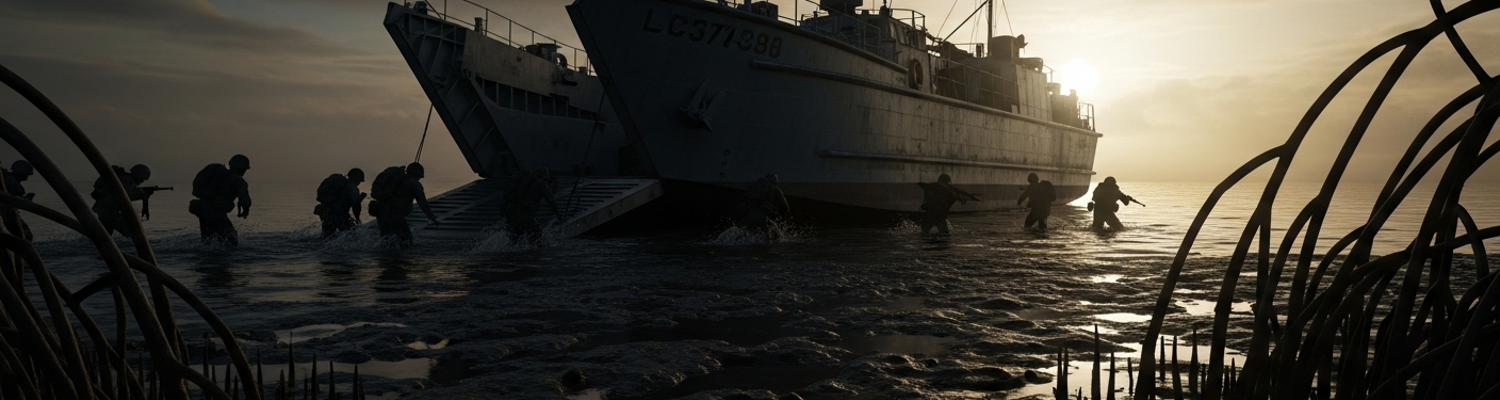

It was a brilliant success. That became the dominant, accepted narrative of the April 1944 landings at Hollandia, New Guinea.
Initial reports painted Operation Reckless as a textbook example of a skillfully executed amphibious assault. The key elements of this perception were the speed of the advance and the surprisingly low number of American casualties, especially when contrasted with the high-cost beach assaults at places like Tarawa. According to early summaries, the 24th Infantry Division's assault at Tanahmerah Bay on April 22, 1944, met only light resistance. The Japanese were caught completely by surprise. This allowed the 19th and 21st Infantry Regiments to secure their beachheads without significant fighting. Within four days, the division had pushed inland and seized the westernmost Hollandia airdrome. The story was one of an unqualified success, a tactical masterclass that achieved its objectives with minimal loss of life.
This version of events fit neatly within a framework already established by wartime cinema. The popular understanding of amphibious warfare was not shaped by dry after-action reports but by tightly edited newsreels. In these portrayals, the complexities of logistics, intelligence failures, and environmental hazards were often erased in favor of heroic action. The formula was consistent: landing craft charge a shore, ramps drop, and determined soldiers surge forward. The ensuing battle is brief and decisive. These films compress weeks of campaigning into minutes of combat, leaving the impression of a rapid, overwhelming assault rather than a protracted struggle against terrain and supply shortages.
The initial reports from Tanahmerah Bay seemed to mirror this script almost perfectly. On April 22, 1944, elements of the 24th Infantry Division landed against scattered small arms fire. Tactical surprise was total. Initial casualty reports were astonishingly low. One summary noted the seizure of the Hollandia airdromes was accomplished with only 52 battle casualties in the first four days. This narrative of an easy victory was reinforced by the fact that the primary Japanese combat strength was not concentrated at the beaches but positioned further inland. For a public accustomed to hearing of bloody struggles for every inch of sand, the news from Hollandia was that of a clean, almost surgical strike.
A close review of operational logs (NARA Record Group 338) indicates the root of the disaster at Tanah Merah Bay lay in flawed interpretations of aerial photography. Reconnaissance flights by the 5th Air Force’s 8th and 25th Photo Squadrons in February 1944 returned ambiguous images. The photographs showed two small beaches, Red 1 and Red 2, separated by the Depapre Inlet headland. From high altitude, the terrain behind the beaches appeared as a flat, dark-green expanse. To the intelligence analysts on General Walter Krueger's Sixth Army staff, this was read as solid ground suitable for the rapid deployment of troops and equipment. They identified what they believed to be an old Dutch-built road leading inland toward the Hollandia airfield complex. Later photographic evidence suggested the beaches were not ideal, but by then planning was so advanced that Krueger’s staff concluded it was too late to alter the scheme.
This was confirmation bias on an operational scale.
The planners needed a second landing zone to complement the assault at Humboldt Bay. Tanah Merah appeared, on maps and initial photo runs, to be a perfect flanking entry point. The analysis presented to assault commanders painted a picture of clear, albeit narrow, beachheads. Red Beach 2, at roughly 800 yards long, was designated the primary landing site for the bulk of the 19th and 21st Infantry Regiments. The expectation was that these units would consolidate on firm ground and push vehicles up the identified trail toward Lake Sentani. The photographs were not entirely wrong, but they were tragically incomplete. They captured the topography but failed to convey the hydrology. The dark-green, seemingly flat ground was not solid earth. It was a mangrove swamp, a morass of mud, water, and tangled roots. The supposed road was a narrow, overgrown native footpath, completely impassable for any vehicle. The high command, focused on the strategic geometry of the envelopment, had dismissed the subtle, swampy textures in the photos as inconsequential.
The collision between this flawed intelligence and the physical world was immediate. On April 22, the first waves of the 24th Infantry Division hit Red Beach 2 and encountered only sporadic Japanese fire. The enemy was not the problem. The terrain was. Instead of firm ground, the soldiers of the 19th and 21st Infantry Regiments plunged into a bog. The narrow beach was barely wide enough for the landing craft, and the area behind it was a swamp that consumed men and material. Supplies piled up on the thin strip of sand with nowhere to go. Stacks of crates and boxes quickly grew eight feet high. The advance inland devolved into a desperate, hand-powered struggle. The swamp extended for hundreds of yards, forcing troops to hand-carry every box of ammunition and every ration can forward. Vehicles bogged down immediately. The entire logistical plan for the western pincer of Operation Reckless fell apart within hours, not from enemy action, but because the ground was not ground at all.
Hydrographic data was almost totally absent. As the first waves of Landing Craft, Vehicle, Personnel (LCVPs) and the larger Landing Craft, Mechanized (LCMs) from the 542d Engineer Boat and Shore Regiment approached Red Beach 2, they hit submerged coral reefs and extensive mudflats not on their charts. The larger, deeper-draft Landing Ships, Tank (LSTs) were forced to remain far offshore. At Red Beach 1, LVT amphibious tractors scheduled to land at 07:25 were delayed by twenty minutes as they searched for a way through the coral. Only a narrow channel, allowing just two vehicles to pass abreast, could be found. The situation at Red Beach 2 was worse. Many landing craft ran hard aground hundreds of yards from the shoreline. Their ramps dropped into deep, murky water instead of onto the beach.
The grounding was a tactical disaster that left the initial assault waves dangerously exposed. Soldiers of the 19th and 21st Infantry Regiments, part of the 24th Infantry Division (Task Force PERSECUTION), were plunged into chaos. The men were weighed down with weapons and equipment. They expected to storm a beach. Instead, they disembarked into chest-deep water, a thick slurry of sea and swamp mud. The struggle to shore was a slow, exhausting ordeal that broke the cohesion of assault units. While Japanese resistance was officially recorded as light, its effect was magnified by the Americans' predicament. Pinned in the water, unable to move effectively, the soldiers were targets. The 800-yard strip of sand designated Red Beach 2, backed by an impassable swamp, quickly became a bottleneck as subsequent waves arrived.
Naval fire support was almost completely negated. The cruisers HMAS Australia and HMAS Shropshire, along with their destroyer screen, had conducted the pre-landing bombardment but were forced to stand well offshore. This distance, combined with misty weather, hampered their ability to observe and engage targets. The destroyers could not risk closing with the shore to provide direct, close-range fire needed to suppress Japanese machine gun positions. Doing so would have risked grounding themselves on the same uncharted reefs. The disorganized clusters of American troops in the water and the chaotic pile-up on the beach made it impossible for naval gunners to accurately target enemy positions without risking friendly fire. The decision was made to write off Tanahmerah Bay as a primary landing site. Follow-on convoys were diverted to Humboldt Bay, leaving the troops already ashore to contend with the logistical nightmare they had inherited.
Southwest Pacific Area intelligence summaries from early 1944 reveal a fundamental miscalculation of Japanese strength at Hollandia. The picture presented to General Krueger's Sixth Army planners, largely formulated by Major General Charles A. Willoughby’s G-2 section, was one of a hollowed-out rear area. ULTRA codebreaking had correctly identified that the main strength of General Hatazō Adachi’s 18th Army was concentrated far to the east, around Wewak. This intelligence, while accurate in its broad strokes, fostered a dangerous error in detail. Planners estimated the total number of Japanese personnel in the Hollandia region at approximately 14,000. G-2 analysts assessed that the vast majority were non-combatant service troops, air service personnel from the shattered 6th Air Division, and labor units. The actual number of ground combat troops was believed to be as low as 500 men.
This was a fatal misreading of the enemy's character.
The belief that the landings would be met by little resistance was baked into the operational orders. The strategic concept was predicated on speed and surprise against a weak opponent. American planners, confident that Adachi’s 18th Army was stranded east of the landing zones, saw no reason to anticipate a significant ground fight. This assumption was reinforced by pre-invasion aerial bombardments, which had obliterated Japanese air power, leaving over 340 wrecked aircraft on the Hollandia airfields. Planners failed to appreciate the distinction between air service ground crews and trained infantry. Thousands of personnel, categorized in Allied reports as mechanics or support staff, were in fact trained for ground defense and organized into provisional combat units. The American assumption was that the Japanese force was not only small but also lacked the will to mount a coherent defense.
The most significant intelligence breakdown was the failure to detect the westward movement of Japanese combat units into the Hollandia sector just prior to the invasion. While ULTRA intelligence correctly pinpointed the bulk of the 18th Army near Wewak, it missed subsequent movements. In March 1944, General Adachi had been ordered to begin shifting his forces west toward Hollandia. Elements had begun moving. Specifically, two regiments of the 18th Army were already marching west by the time the American convoys were at sea. These movements, conducted through the dense jungle interior, were completely invisible to Allied aerial reconnaissance. The men of the 24th Infantry Division were landing with the expectation of facing a few hundred disorganized service troops. They were walking into the path of repositioning veteran infantry. The Japanese force at Hollandia was not a static, isolated garrison; it was a reorganizing concentration of nearly 11,000 troops, many more capable of resistance than Allied intelligence had conceived.
The American troops of the 24th Infantry Division were unprepared for the fight in the jungle interior. Their training in Australia had not conditioned them for the resistance that would emerge from the swamps and hills west of the landing zones. The soldiers of the 19th and 21st Infantry Regiments, already exhausted from the logistical nightmare at Red Beach, now had to push inland against an enemy they did not expect, in terrain that was its own form of adversary. The men were equipped for a conventional infantry assault, not a protracted struggle in a maze of jungle trails and razor-sharp kunai grass.
Archival evidence shows that Japanese forces, though caught by tactical surprise on April 22, reacted with lethal efficiency. The estimated 11,000 Japanese personnel in the Hollandia area were not a disorganized rabble. They were a mix of air service ground units, naval personnel, and provisional infantry battalions. Within hours of the landings, these disparate groups began to coalesce into determined pockets of resistance. They used the dense jungle to their advantage, melting away from direct confrontation and re-emerging to ambush American patrols. By April 30, records indicate some 7,000 Japanese troops had managed to regroup in the Genjem area, west of Lake Sentani, forming a cohesive if undersupplied fighting force. They initiated a guerilla campaign, sabotaging the captured airfields and inflicting a steady stream of casualties.
The fighting that ensued bore no resemblance to the quick victory reported in initial dispatches. The push inland from Tanahmerah Bay became a grinding, close-quarters battle defined by ambushes and vicious skirmishes. The single, narrow trail leading from the swamp toward the Hollandia airdrome became a kill zone. Japanese defenders, often in small, well-concealed groups, would allow the lead American elements to pass before opening fire on the main body of the column from all sides. The thick vegetation absorbed bullets and shrapnel, making it difficult to locate the source of the attacks, while Japanese snipers tied themselves into the canopy of trees. After-action reports from the 19th and 21st Infantry Regiments detail the psychological toll of this type of warfare, where the enemy was seldom seen but always felt. The battle for the Hollandia airfields was not won in a single charge but through a series of costly, methodical advances through terrain that offered the defenders every advantage.
Hunger became a tactical reality. The decision on April 23rd to divert all follow-on supply convoys to Humboldt Bay effectively abandoned the men of the 19th and 21st Infantry Regiments. They were left with only the supplies they had managed to wrestle ashore in the first chaotic hours. The primary source of nutrition, the K-Ration, provided roughly 2,830 calories in three meals. The sheer bulk of thousands of these rations, piled on a beach with no exit, rendered them immobile. The advance inland became a desperate, hand-powered supply chain. Soldiers pushing toward the Hollandia airdromes were forced to subsist on what they could physically carry. Unit cohesion fractured as combat troops were repurposed into exhausted pack mules. The advance elements quickly outran this makeshift supply line. Within days, units were on half-rations, then quarter-rations. The intense physical exertion of jungle warfare, combined with the debilitating heat, meant soldiers were burning far more calories than they consumed. Malnutrition set in with alarming speed.
The supply crisis extended with lethal consequences to ammunition. A wooden crate of K-Rations weighed over 40 pounds; a similar crate of ammunition could weigh significantly more. A soldier’s basic load was never intended to sustain him through days of intense, unexpected combat. Combat reports from the 19th and 21st Regiments detail how the logistical breakdown directly compromised their firepower. The agonizing process of moving supplies by hand through the swamp meant that resupplies of ammunition were dangerously inadequate. As the unanticipated ferocity of Japanese resistance bled their ammunition stocks, fire discipline became ruthlessly enforced not by officers, but by the awareness that every round expended might be the last.
This scarcity crippled the tactical effectiveness of American infantry. Machine gun teams were forced to ration their belts. Mortar crews, unable to get their heavy shells forward from the beachhead dumps, were rendered all but useless. The inability to sustain a high volume of fire left American units acutely vulnerable to the ambush tactics the Japanese defenders excelled at. A close examination of combat logs shows a direct correlation between low ammunition states and stalled advances. Units would be pinned down, unable to suppress enemy positions, and forced to wait for meager quantities of ammunition to be painstakingly carried forward.
An examination of division medical records paints a grim picture of declining combat readiness. The combination of severe caloric deficits and ammunition anxiety created a devastating feedback loop. Physically weakened by hunger, soldiers became more susceptible to the jungle’s array of diseases, with rates of dysentery, skin ulcers, and malaria climbing. The psychological toll was just as severe. The initial shock of the botched landing gave way to a gnawing sense of abandonment. Soldiers of the 24th Division could see the massive logistical machine of the U.S. Army functioning perfectly for the 41st Division at Humboldt Bay, while they were left to starve and scrounge for rounds in the swamp. Morale plummeted. The neuropsychiatric casualty rate for American soldiers in the Southwest Pacific theater was the highest of the war, and the conditions at Tanahmerah were a prime contributor. The will to fight was draining away with every missed meal and every counted bullet.
The operation was ultimately a success for the Allies, but that success came at Humboldt Bay. The legacy of Tanah Merah is not one of a swift maneuver, but of a near-disaster born from confirmation bias. Planners saw what they wanted to see in the aerial reconnaissance photos. The ambiguous texture behind the beaches was interpreted as solid ground because the plan required it. The faint line was seen as a road because the plan required a road. This failure to question assumptions led directly to the grounding of landing craft, the logistical paralysis on the beach, and the subsequent starvation of the frontline troops. The initial reports of 52 battle casualties in four days masked the final tally for the Hollandia operation. That number was over 1,200 Americans killed or wounded.