
German Demolition Ordnance Deployment
Operational logs from early 1945 show German Pioniere (combat engineers) relied on a standard, if occasionally primitive, set of explosives to impede the Allied advance. The foundational tool was the Sprengkörper 28, a 1-kilogram block of TNT. By the war’s end, its casing was often little more than waxed cardboard. These blocks were designed for modularity, linked to form larger charges. For more substantial targets, engineers employed the 3-kilogram Sprengblock, a purpose-built demolition block in a zinc container with a carrying handle and multiple fuze wells. These were the workhorses for attacking infrastructure.
They were not sophisticated devices.
When facing Allied armor or reinforced concrete, specialized shaped charges, or Hohlladung, were brought forward. The 3-kilogram Hafthohlladung was a magnetically adhered anti-tank mine, designed for direct placement on a vehicle’s hull. For static fortifications, larger 30-pound bell-shaped hollow charges with folding legs ensured correct stand-off distance, capable of perforating steel cupolas. The most ubiquitous tools of denial, however, were the Teller mines. The Tellermine 43 was a simplified, mass-produced anti-tank mine containing over 5.5 kg of TNT. Its design, featuring dual fuze wells for anti-handling devices, made it quick to arm and difficult to clear.
The equipment for deploying this ordnance was rugged and entirely manual. Detonation occurred through two primary methods: electrical and non-electrical. For controlled demolitions, like dropping a bridge, the Glühzündapparat blasting machine was essential. This hand-cranked generator sent an electrical pulse through wires to attached Glühzünder (electric blasting caps). More common for hasty work was the friction-igniter and safety-fuse assembly. A standard Sprengkapsel Nr. 8 detonator, a small aluminum tube with 2 grams of a sensitive primary explosive, would be crimped onto a length of Zündschnur (safety fuse). The fuse was lit by a pull-wire friction igniter. Archival evidence (NARA Record Group 242) shows the quality of these components, particularly fuses and waterproofing, degraded significantly in 1945. This led to a high rate of misfires that required engineers to approach and manually replace dud fuzes under hazardous conditions.
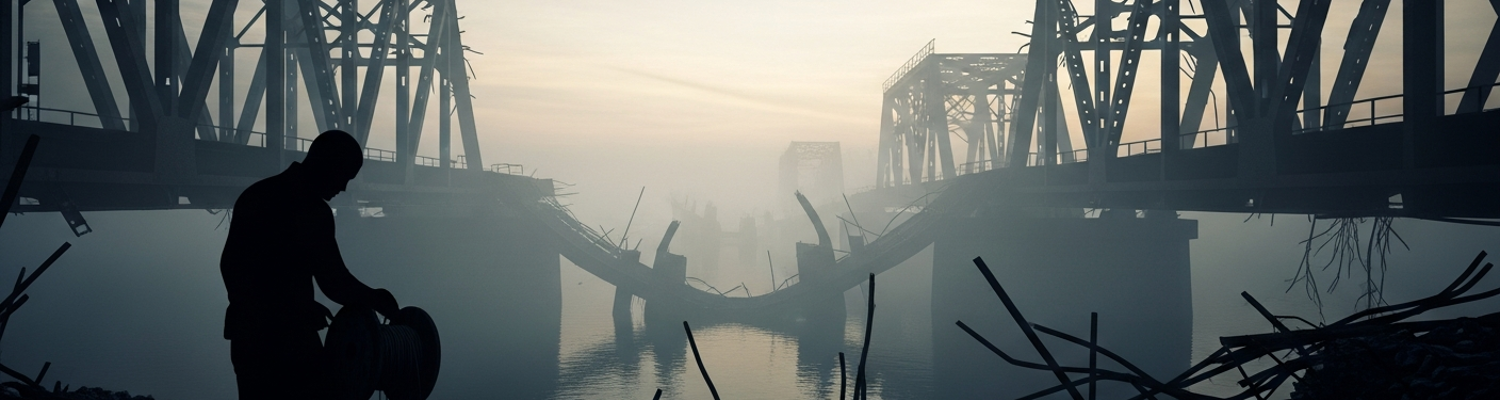
The strategic intent was formalized by the Befehl betreffend Zerstörungsmaßnahmen im Reichsgebiet, issued on March 19, 1945. Popularly known as the Nero Decree, it ordered the destruction of all military transport, communication, and industrial facilities. This was a scorched-earth policy. For the Pioniere on the Rhine, it translated into a methodical campaign to erase the infrastructure connecting western and eastern Germany. The objective was not just to halt Allied armies but to channel them. By systematically destroying every bridge, culvert, and rail line, German commanders hoped to force Allied crossings into a few predictable, heavily defended sectors. The attempted destruction of the Ludendorff Bridge at Remagen was for this exact reason. Its failure was a catastrophic exception to a demolition campaign that turned the German frontier into an engineered wasteland of craters and broken steel.
Rhine Crossing Demolition Obstacles
A logistical assessment by Supreme Headquarters Allied Expeditionary Force (SHAEF) in early 1945 operated on one grim assumption: every bridge spanning the Rhine would be destroyed. Planners for Field Marshal Bernard Montgomery’s 21st Army Group, tasked with Operation Plunder, treated the river as a coastline. The operation rivaled the Normandy invasion in scale. Preparations called for over a million soldiers, 250,000 tons of supplies, and more than 4,000 artillery pieces to support assault crossings near Rees, Xanten, and Rheinberg. Allied intelligence correctly anticipated a systematic demolition campaign, forcing any crossing to be a contested amphibious assault followed by a massive combat engineering effort under fire. The U.S. Army Corps of Engineers had already deemed the river unfordable. Its width, depth, and swift current were prohibitive. Vast quantities of bridging equipment were stockpiled, including Bailey bridge components, M2 treadway sections, and heavy pontoon units. Seven entire battalions of combat engineers were allocated just for road and bridge maintenance on the approaches to the Rhine before the operation began.
By the first week of March 1945, the German demolition campaign had achieved near-total success. Of 22 major road bridges and 25 railway bridges crossing the river, all but one were systematically destroyed by retreating Pioniere. This was the direct implementation of the Nero Decree. The destruction was methodical. The Hohenzollern Bridge in Cologne was dropped on March 6th. The bridge at Bonn was blown on March 8th. The Crown Prince Wilhelm Bridge at Urmitz followed on March 9th. Almost every span from Switzerland to the North Sea was gone.
The sole, transformative failure in this campaign was the Ludendorff Bridge at Remagen. On March 7th, elements of the U.S. 9th Armored Division found the bridge standing, wired with 2,800 kilograms of explosives that failed to detonate due to faulty fuzes. Its unexpected capture allowed five divisions to cross before the weakened structure finally collapsed on March 17th. It was the only exception in a river of ruins.
This engineered wasteland created a severe logistical chokepoint. The Allied strategy depended on the momentum of armored columns, but these spearheads were tethered to a supply chain that now terminated at the western bank of the Rhine. The Red Ball Express and other convoys faced a hard stop. The advance of entire divisions was dictated not by enemy resistance but by the speed at which engineers could throw a floating bridge across the water. The construction of a single M2 treadway bridge under ideal conditions was a nine-hour job. Under German artillery fire, the process was dangerously slow. The advance of the U.S. Ninth Army, for example, was supported by a supply route that saw 600 tanks and 32,000 other vehicles move toward the river. This entire force was dependent on the handful of pontoon and Bailey bridges that engineers could erect and maintain under constant threat. The destruction of primary bridges forced complete reliance on these temporary, fragile crossings, turning the west bank of the Rhine into a massive, vulnerable staging area.
Battlefield Engineering Improvisation
The ground itself was a weapon. Before a single pontoon could touch water, combat engineers had to carve viable approach routes from the western bank’s mud and craters. Operational logs from Operation Plunder show that units like the 17th Armored Engineer Battalion did not simply clear roads; they created them from whole cloth under fire. Standard doctrine was discarded. Engineers drove armored Caterpillar D7 bulldozers, often with extra steel plates welded to the cab, directly into the churned earth. Under observed German artillery, these machines graded paths, filling shell holes and leveling the severe slopes of the riverbanks. This allowed heavy Brockway B666 trucks carrying bridge sections to reach launch sites. Where the ground was too soft, engineers improvised causeways using logs, felled trees, sections of prefabricated Sommerfeld track, and crushed rock from destroyed buildings. This work was perilous; a single mortar round could disable a critical bulldozer, halting the entire bridging effort.
Repair was a constant state. The M2 treadway and Bailey pontoon bridges were vulnerable to artillery shrapnel. After-action reports from the crossings near Wesel and Oppenheim detail frantic, ad-hoc repairs. A common problem was the puncturing of the pneumatic floats. A single artillery airburst could send dozens of steel fragments into the rubberized pontoons. Engineer crews in assault boats would patrol the length of the bridge, even as vehicles crossed, looking for the sag of a deflating pontoon. Repair involved paddling directly to the damaged float, often under fire, and using wooden plugs, mallets, and patches of tarred canvas to seal the holes. When a treadway section itself was damaged, replacement was a large-scale operation. On March 24, 1945, a ferry broke loose upstream and drifted into a new M2 treadway bridge near Spellen, destroying nine floats. Engineers had to sever the damaged section, allow it to float downstream, and guide a new assembly into the gap, all while an armored division waited.
The approaches were lethal. German engineers had seeded the riverbanks and assembly areas with thousands of Teller mines, primarily the Tellermine 43. Clearing these fields was a slow, manual process conducted by units like the 1135th Engineer Combat Group, often at night. Mine detectors were unreliable in the shrapnel-dense soil. The primary method became prodding by hand. An engineer would lie prone, using his M1 bayonet or a thin rod to probe the ground at a shallow 30-degree angle. This was essential to strike the side of the mine rather than the top-mounted pressure plate. The greatest danger came from anti-handling devices. The Tellermine 43 featured two secondary fuze wells, one on the side and one on the bottom, allowing for pull or pressure-release igniters. A common German tactic was to link a tripwire from a secondary fuze to a stake. Any attempt to lift the mine would pull the wire and detonate it. Disarming them required an engineer to carefully excavate around the device with his hands, feeling for the thin wires in the dark before cutting them. The T.Mi.Z.43 fuze also had an integral anti-handling mechanism. The act of arming it sheared an internal pin, meaning any attempt to unscrew the pressure plate would trigger detonation.
Engineer Platoon Physical Hardships
A review of field manuals from the war's final year reveals the extreme physical toll on German Pioniere. The winter of 1944-1945 was severe. For engineers preparing demolitions along the Rhine, conditions were ruinous. Unlike infantry units, engineer platoons were often static for extended periods, working in the frozen mud of riverbanks or waist-deep in icy water to lay charges. This prolonged exposure made them vulnerable to non-battle injuries. Trench foot was rampant. Standard-issue leather boots offered inadequate protection, and the condition could progress from numbness to gangrene. Frostbite was a constant threat, particularly to the hands. The delicate work of crimping detonators and handling brittle wires required bare hands, forcing a choice between operational effectiveness and personal safety.
Work was defined by physical exertion. A standard German infantryman carried a combat load between 22 and 25 kilograms. The Pionier carried all this and more. Archival evidence shows that for demolition tasks, each engineer was expected to transport multiple explosive charges. A single 3-kilogram Sprengblock was a dense, awkward weight, and preparing a major bridge for destruction required hundreds of them. They were hauled by hand, at night, over broken terrain and down treacherous riverbanks. Specialized engineer assault packs, introduced in 1941, were designed to carry multiple 1kg charges (Sprengbüchse 24) or a single 3kg charge. In addition to explosives, engineers carried heavy spools of detonation wire, 10-kilogram blasting machines, shovels, axes, and specialized tools. This burden led to rapid exhaustion, compounding the effects of poor late-war nutrition and psychological stress. Some German divisions recorded turnover rates of 200 to 300 percent in their engineer units.
Every task was saturated with risk from their own materials. The widespread use of anti-handling devices meant that a mine, once armed, was perilous to approach even for the men who laid it. The Tellermine 43, for instance, often used the T.Mi.Z. 43 fuze, which had an integral anti-handling mechanism. The simple act of screwing the pressure plate into place sheared an internal pin, arming the device so that any attempt to unscrew it would trigger detonation. This made disarming their own mines a lethal gamble. The greatest danger, however, came from misfires. Degraded quality control in German industry by 1945 meant that fuses and blasting caps were unreliable. When a demolition failed, as at the Ludendorff Bridge, it fell to an engineer team to approach the live, multi-ton explosive arrays and find the faulty component. This involved manually checking wires and replacing dud detonators on charges that could still unpredictably detonate.
Psychological Burden of Clearance
A review of late-war German doctrine reveals a deep psychological schism within the Pioniere ranks. This condition intensified during the final defense of the Rhine. The combat engineer of 1945 was no longer clearing a path for a victorious advance. His primary function was to systematically dismantle his own country. This mission was codified by the Nero Decree of March 19, 1945, an order that sentenced Germany’s infrastructure to death. For the men on the ground, this was a physically and psychologically corrosive task. They were agents of a scorched-earth policy, working in the open on riverbanks, often under the gaze of retreating soldiers and columns of desperate civilians. The sound of approaching Allied artillery was the metronome for their work. Field reports indicate this role as architects of defeat fostered a unique and severe form of combat fatigue, distinct from the stress of direct battle.
It was a cold, procedural misery.
The mental strain was most acute during the unglamorous work of troubleshooting. Late-war German manufacturing produced unreliable components. Fuzes failed, wires snapped, and blasting caps became inert. The failure of demolition charges on a key bridge, with the ultimate nightmare being the intact capture at Remagen, placed an extraordinary load on the engineer teams. An NCO or junior officer had to consciously decide to send his men back onto a structure laden with tons of unstable explosives, knowing it was likely targeted by enemy artillery. A close examination of Pionier procedure shows it to be a methodical, nerve-shredding process. An engineer would manually trace detonation cords from the Glühzündapparat to the charge, looking for breaks. If the wire was intact, he would have to approach the primary charge to inspect the Sprengkapsel Nr. 8 detonator, an action that put him in direct contact with the explosive. This required an inhuman level of compartmentalization.
The chaotic conditions on the western bank of the Rhine in March 1945 shredded command structures. Engineer platoons were isolated, forcing junior leaders to make decisions with strategic consequences. An engineer Leutnant might have orders to blow a bridge at a specific time, only to find it swarmed with retreating Volkssturm, Hitler Youth units, and civilian refugees. The Nero Decree was absolute, but the man on the ground faced a direct moral conflict. He could execute the order and condemn hundreds of his countrymen, or hesitate and risk the bridge’s capture, ensuring a court-martial. This indecisiveness, born of situational chaos, became a tactical factor. Records from the collapse of the Rhine front are filled with accounts of bridges blown too early, stranding friendly forces, or too late, allowing Allied armor to seize a crossing. For the individual engineer, this erosion of clear authority, compounded by physical exhaustion and constant fear, resulted in a profound collapse of morale.
Frontline Discipline and Tribunals
The final collapse of the German military position on the Western Front in March 1945 saw the disintegration of the Wehrmacht’s formal system of military justice. In its place, a more arbitrary apparatus of discipline was erected. A Führer-Erlass on March 9, 1945, established Fliegende Standgerichte, or flying courts-martial. These were not courts in any conventional sense. Archival evidence shows these tribunals were mobile judicial bodies, often composed of a single senior officer acting as judge and prosecutor, unconstrained by standard rules of procedure. One such unit, attached to the 7th Army and commanded by a Major Erwin Helm, moved eastward from the Eifel, leaving a trail of summary executions. Holding cells were improvised, consisting of a guarded cellar or a cordoned-off trench near a demolition site. The legal premise was a series of decrees from February 1945 onward, which expanded jurisdiction to include not only soldiers but also civilians in any enemy-threatened territory, for offenses as vague as anything that endangered German fighting power. The right to appeal was eliminated.
This system was designed for speed, not justice.
The paranoia following the failure to destroy the Ludendorff Bridge at Remagen created an environment where any operational mishap could be interpreted as treason. Hitler personally ordered the court-martial and execution of the officers deemed responsible, setting a terrifying precedent. For the Pioniere tasked with demolition, this climate was particularly toxic. The unreliability of late-war fuzes meant misfires were frequent, but now every technical failure carried the suspicion of deliberate sabotage. A combat engineer whose charge failed to detonate could be immediately removed under armed guard, his fate in the hands of a summary court. This had a crippling effect on demolition schedules. The removal of a single experienced NCO could halt the work of an entire platoon, as terrified soldiers hesitated to touch equipment that might either explode accidentally or brand them a saboteur if it failed.
The burden of rendering these judgments fell most heavily on junior officers. A Leutnant commanding an engineer platoon was caught between the mandate of the Nero Decree and the reality on the ground. He might have explicit orders to blow a bridge, only to find it clogged with retreating Wehrmacht stragglers and civilian refugees. To hesitate was to risk being held personally responsible for the bridge’s potential capture, a crime for which other officers had just been executed. To obey was to condemn hundreds of fellow Germans. These were not decisions made with time for deliberation. They were made in minutes, under artillery fire, by young officers who were physically exhausted and psychologically frayed. The legal framework of the flying courts-martial gave these junior leaders immense power, making them the arbiters of life and death for their own men based on split-second assessments of competence versus treason.
Improvised Engineer Doctrine Legacy
The operational chaos on both sides of the Rhine in 1945 reveals the genesis of tenets that would define post-war military engineering. The rigid, top-down German command structure, exemplified by the Nero Decree, proved ineffective when confronted with the fluid conditions of a collapsing front. The failure at the Ludendorff Bridge became a powerful case study in the danger of centralized plans that lack redundancy and local flexibility. In contrast, the successful improvisations by Allied engineer units demonstrated the value of decentralized problem-solving. Post-war military thought, particularly within the nascent NATO framework and the reformed German Bundeswehr, absorbed these lessons. There was a marked shift toward doctrines that empowered junior officers and NCOs, a philosophy rooted in the German concept of Auftragstaktik, or mission-type tactics, where subordinates are given an objective but afforded the freedom to decide how to achieve it. The events of 1945 showed that on a modern battlefield, the NCO patching a pontoon or the lieutenant using a bulldozer to forge a new path were making decisive choices.
This forced a formal recognition of ingenuity as a core combat capability. The work of keeping the advance moving was a testament to the resilience of engineer units. After-action reports from units like the 17th Armored Engineer Battalion detail a continuous cycle of crisis and invention. When a ferry broke loose and tore a gap in an M2 treadway bridge near Spellen on March 24, engineers did not wait for higher command. They immediately cut the damaged sections loose and maneuvered a pre-assembled replacement span into the gap while under enemy air attack. This was not an exception. The unreliability of mine detectors in soil contaminated with metal shrapnel forced engineers to revert to prodding for Teller mines by hand with bayonets. On the Allied side, welding additional steel plates to the cabs of D7 bulldozers to protect operators became a standard field modification. This culture of ad-hoc innovation was identified as a critical battlefield attribute. Post-war training for combat engineers evolved to reflect this, moving beyond simple construction to include complex problem-solving scenarios.
The Allied operational momentum in March 1945 was governed by the work of these engineers. The advance of armored divisions was repeatedly tethered to the speed at which a handful of engineer battalions could span the river. A single M2 treadway bridge constructed by Company E of the 17th Engineer Battalion near Wesel, a record-breaking 1,152-foot span completed in just over six hours, became the artery for the U.S. Second Armored Division’s breakout across the Westphalian plain. The success of Operation Plunder, an assault involving over a million soldiers, hinged on the ability of engineers to lay down and maintain these fragile floating roads. Within 48 hours of the 5th Infantry Division’s initial assault crossing at Oppenheim, engineers had enabled four entire US divisions to establish a firm bridgehead on the east bank, creating the pressure that would lead to the encirclement of the Ruhr.